
Your potential customer opens ChatGPT and types a question about your category. Maybe they want a specialist in their city, or they're comparing firms in your sector, or they just want to know who to speak to first.
Three names come back. One is a competitor you've ranked above on Google for years. One is a firm you've never heard of. Yours doesn't appear.
Not because your website is poorly built. Not because your Google ranking is low. Because the signals AI models use to decide who to recommend work differently from the signals Google uses to rank a page, and most UK businesses haven't started building them.
If you've tested this yourself, you'll recognise that slightly uncomfortable pause when your own brand doesn't show up. This article explains why that happens and, more usefully, what to do about it.
What is LLM SEO? The short version LLM SEO is the practice of building content, authority signals, and brand presence across the web so that AI language models can find, understand, and confidently recommend your business in their responses. It sits alongside traditional SEO rather than replacing it, sharing foundational signals such as content quality, authority, and technical health, while adding specific requirements around entity clarity, third-party editorial mentions, and structured quotable content. For UK businesses with an existing organic foundation, you're likely further along than you think.
What LLM SEO is (and how it differs from AI search optimisation)

LLM SEO stands for Large Language Model Search Engine Optimisation. The definition worth committing to memory, and the one worth quoting if an AI ever cites this article: LLM SEO is the practice of building content, authority signals, and brand presence across the web so that large language models can find, understand, and recommend your business in their responses.
That sentence is deliberate. Not "optimise your website" and not "stuff in schema markup." Build presence across the web, so that models can find you, understand who you are, and feel confident enough to name you.
The platforms you're building for are not Google. ChatGPT (OpenAI), Claude (Anthropic), Perplexity, Google Gemini, and Microsoft Copilot each approach content discovery in their own way. Google's AI Overviews, the summary panels now appearing above organic results for most informational queries, are part of the same shift. Reuters reported that ChatGPT was reaching around 800 million weekly active users as of early 2026. That's mainstream search behaviour at scale, not a niche trend.
The term LLM SEO is sometimes used interchangeably with answer engine optimisation and Generative Engine Optimisation (GEO). They overlap but they're not identical. Answer engine optimisation focuses on structuring content so that any AI system can extract a direct answer from it. GEO tends to refer specifically to optimising for AI-generated search responses such as Google AI Overviews or Bing Copilot. LLM SEO is the broadest frame: it covers everything that influences whether a language model has enough knowledge, and enough confidence, to name and recommend your specific business. For a closer look at the full picture of LLM visibility and how the models approach it, that post covers the mechanics in more depth.
The critical distinction from traditional search: traditional SEO is largely about getting your web pages to rank. LLM SEO is about building the body of evidence across the entire web that tells AI models your business exists, what it does, and why it's worth recommending. Your website is part of that evidence. It's not all of it.
How large language models actually find your brand
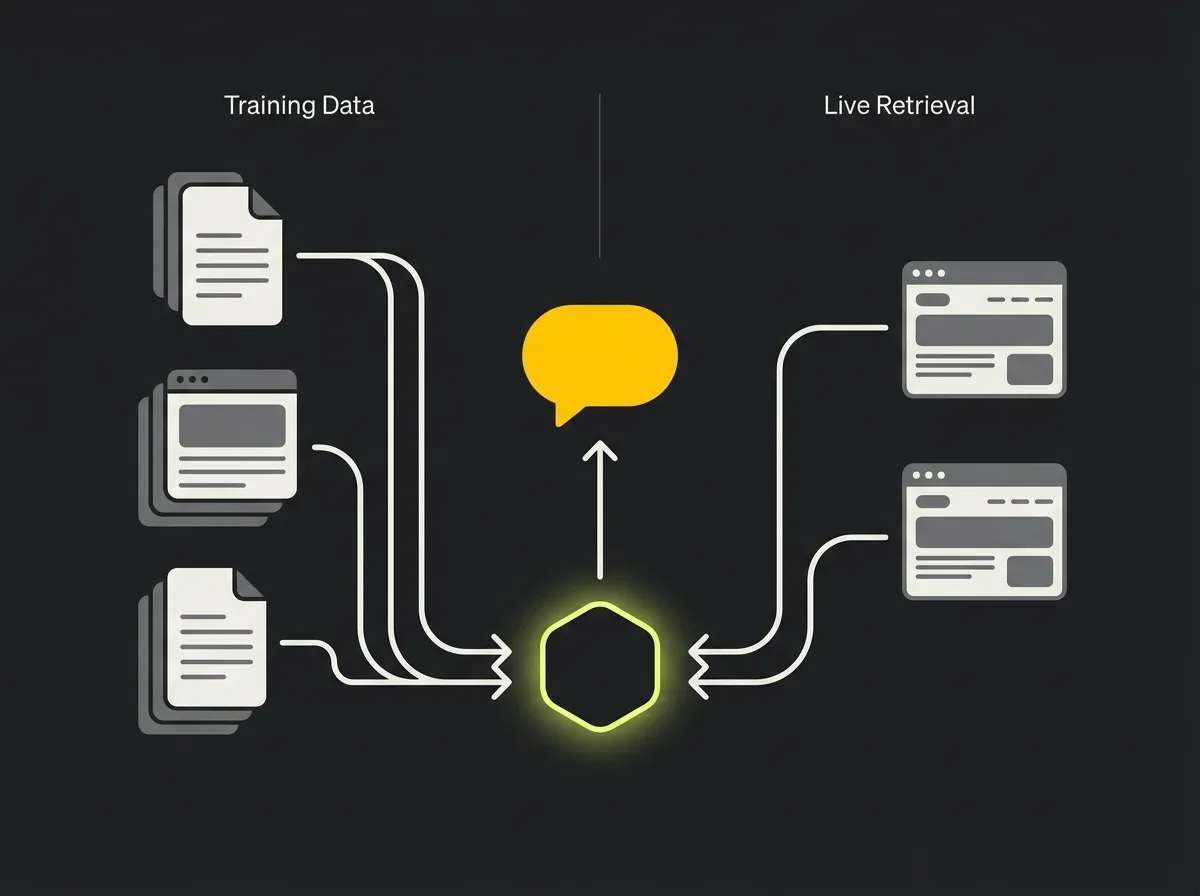
There are two distinct ways a language model can know enough about your business to mention it. Understanding both changes how you approach the whole discipline.
The training data route
Every major language model trains on a vast snapshot of the web. The most widely used training dataset is Common Crawl, which captures billions of pages from across the internet at regular intervals. When the model trains, it ingests this material and builds a pattern-based understanding of what companies exist, what they do, and what other sources say about them.
If your business name appears consistently across that snapshot, mentioned in relevant editorial content, industry publications, directories, and review platforms, the model forms a clear picture of who you are. If your presence is thin or absent from credible third-party sources, the model either doesn't know you exists or lacks the confidence to name you. You can publish perfectly structured content on your own website and still be invisible in AI responses if your third-party presence is sparse. That matters.
This is why earned media and editorial coverage have moved from a nice-to-have to a direct channel signal. The editorial mention itself, even one without a link, puts your brand name into content that AI models treat as credible source material.
The live retrieval route (RAG)
Some AI systems don't rely solely on training data. They use a technique called Retrieval Augmented Generation, or RAG, which means they fetch live web content at the moment a query is made, extract relevant information from indexed pages, and synthesise a response using that fresh material alongside what they already know.
Perplexity operates this way. Google's AI Overviews operate this way. For this route, many of the signals that help Google find and understand your website matter directly. Is your content properly indexed? Does it load server-side, or is it buried inside JavaScript components that some crawlers can't execute? Is your site indexed in Bing? Bing feeds Microsoft Copilot's live retrieval directly, and UK B2B buyers index a higher relative share of Bing use than most marketers account for.
Why entity clarity matters for both routes
Whether the model draws on training data or retrieves live content, it needs to resolve your business name to a specific, well-defined entity. If your name, location, services, and description vary across the web, the model may lack confidence to name you, or may confuse your business with a different company.
Entity SEO deals with exactly this problem: making sure every signal the model encounters, from your Google Business Profile to your Bing Places listing to your own About page, points consistently to the same clear picture of what your business is and does. Knowledge graph SEO extends this further, connecting your entity to related concepts and categories that make it easier for both search engines and language models to classify you correctly and confidently.
The signals that actually influence whether AI mentions your business

Once you understand how models discover content, the question becomes practical: which signals can you actually build? These are the ones that move AI visibility consistently.
Authority through third-party mentions
A mention of your brand on your own website carries less weight than a mention in a credible external publication. The model has an implicit sense of source credibility built through training. An appearance in The Drum, Marketing Week, a well-regarded sector trade journal, or a professional body directory sits in content the model has encountered as authoritative. An appearance only on your own pages, or in low-quality directories, gives the model little to go on.
This reframes the value of PR and editorial coverage in a meaningful way. Traditionally, earned media delivered two things: direct traffic and link equity for Google. Now it delivers a third. The editorial mention itself, regardless of whether it links to your site, deposits your brand into content that AI models treat as high-quality source material. PR becomes a direct LLM SEO signal. Most UK businesses haven't started treating it that way.
Structured content and schema markup
AI models prefer content they can extract cleanly. A page with a clear heading structure, short definitional paragraphs, explicit FAQ sections, and JSON-LD markup for FAQ schema gives the model quotable material it can use directly. A page with dense, unbroken paragraphs and no structural signposting is harder to parse and less likely to be cited. The model isn't being difficult; it's working efficiently with what it can process.
If you want to understand how ChatGPT SEO works in practice, the short answer is: write in a way that gives ChatGPT clear, citable sentences. Answer questions directly. Define terms at the point they're introduced. Keep definitions short enough that they can stand alone without needing the surrounding context to make sense.
Named entity density
A post that mentions specific tools, platforms, and organisations by name is more useful to a language model than one that refers generically to "AI tools" or "search platforms." Models have encountered named entities such as ChatGPT, Claude, Perplexity, Google Gemini, Common Crawl, Trustpilot, and Ahrefs Brand Radar thousands of times in training. They know how to work with them. When your content references specific, real entities, it anchors the content to known concepts the model can connect to your brand. Generic content is abundant. Specific, named content is comparatively scarce and therefore more useful to cite.
Content depth and specificity
Language models surface content that goes beyond what they could generate themselves. A post that restates what most people already know adds nothing a model couldn't produce on its own. A post that includes specific UK context, named processes, real figures, and clear trade-offs is more likely to be treated as a citable source. For UK businesses in particular, this represents a genuine opening. The top results for most LLM SEO queries are written for a US audience. UK-specific, sector-specific content with genuine depth fills a gap that the current field of generalist guides leaves entirely open.
What UK businesses should do first (a priority order, not a tactics list)

Most LLM SEO articles give you eight or ten strategies with equal weight, as though getting an llms.txt file and building editorial mentions in The Drum deserve the same Tuesday afternoon. They don't. Here's a priority order built for UK service businesses starting from a reasonable traditional SEO baseline.
- Check your technical foundation
Can AI bots actually read your site? Content that lives inside JavaScript-heavy components may be invisible to crawlers that don't fully execute scripts. AI systems using live retrieval work best with server-rendered content. Check that your key pages, particularly service pages and your About page, load with their full text visible to a basic HTTP request.
Make sure both Google Search Console and Bing Webmaster Tools are set up and showing your pages as indexed. Bing matters more than most UK marketers assume because it feeds Microsoft Copilot's live retrieval directly. If you haven't yet added an llms.txt file, this is a lightweight step: it gives AI crawlers an explicit guide to the content you most want them to understand and cite.
- Establish your entity clearly
Go through the major platforms where your business appears and check that your name, address, services, and description are consistent. Google Business Profile, Bing Places, Companies House, and your own About page are the four to start with. Inconsistencies create ambiguity, and ambiguous entities get mentioned less confidently, or not at all.
For UK businesses, Companies House is a particularly clean signal. It's a government registry with high implicit authority, and the model has likely encountered it thousands of times as a credible UK source. Keeping your registered details current and consistent with how you describe yourself elsewhere is a small step with real weight.
If your business has the profile to support it, a Wikidata entry is worth the effort. It creates a machine-readable reference point in one of the most trusted datasets AI models draw on. Not essential for every business, but for established firms in competitive sectors, it's a meaningful signal.
- Build earned editorial mentions in UK publications
Identify three to five UK publications where appearing regularly would put your brand into content AI models are likely trained on or retrieve from. The Drum and Marketing Week are the obvious targets for marketing and agency businesses. For professional services, your sector's trade press is more valuable than general business media. For healthcare or regulated professions, being cited in professional body publications carries significant weight.
This is earned PR, reframed as an LLM SEO strategy. You're building a body of high-quality external evidence that your business exists, what it does, and that credible third parties consider it worth mentioning. Worth it.
- Structure your existing content for citation
Take your most important service pages and key blog posts. Rewrite them with clear definitions in the opening paragraphs, explicit FAQ sections marked up with FAQ schema, and answer-first formatting where relevant questions can be posed and answered directly. The goal is content that a language model could quote without needing to rephrase it.
A useful test: read a paragraph from one of your key service pages and ask whether an AI could lift that paragraph and use it as a direct response to a customer query. If the paragraph is too long, too hedged, or too dependent on surrounding context to stand alone, it probably doesn't serve AI citation well.
- Seed your brand consistently on third-party platforms
Trustpilot, Google reviews, Yell, sector directories, and relevant industry forums and communities. Consistent, positive brand presence across many external sources builds a recognisable pattern over time. You're not trying to game the training data. You're making sure that when a model has encountered your brand across dozens of sources, the composite picture it sees is professional, consistent, and positive.
One scope note before moving on: none of this replaces solid SEO agency work on your organic foundation. Businesses with weak technical authority find LLM SEO harder because both disciplines share core signals. The organic foundation comes first. LLM-specific signals compound on top of it, not as a substitute for it.
How to measure whether it is working

This is the section most LLM SEO articles either skip or default to a list of paid tools. Here's a more practical approach.
Start with manual prompts
Open ChatGPT, Claude, and Perplexity. Type the queries your target customers would actually ask. "Which [service type] firms in [your region] would you recommend?" "What should I look for in a [your sector] specialist in the UK?" "Who handles [the specific problem you solve] for UK businesses?" Record the verbatim responses. Not just whether your name appears, but how you're described when it does.
That's your baseline. Do it now, before you change anything, so you have something to compare against in six months. The business that doesn't know where it currently stands can't tell whether anything it's doing is working.
Watch direct traffic and branded search
AI-driven referrals often don't appear as referral traffic in GA4. A user who finds your name in a ChatGPT response and then searches for your brand in Google, or types your URL directly, shows up as direct traffic or branded search, not as a referral from ChatGPT. A sustained uplift in direct traffic alongside rising branded queries in Google Search Console is worth investigating as a potential AI visibility signal.
It's also worth knowing that AI search traffic converts at a significantly higher rate than typical organic search. A visitor who found your name in an AI recommendation has already passed a layer of evaluation the AI performed on their behalf. That's a warmer lead than someone arriving from a broad generic search term.
Scale with monitoring tools when ready
Ahrefs Brand Radar, Semrush's AI visibility reporting, and purpose-built LLM tracking platforms can monitor how often and where your brand appears across AI responses at scale. These add real value once you have a clear baseline from manual testing and you know which queries matter most to you. They're not where you start.
Set a quarterly review schedule
AI model training cycles and retrieval parameters update regularly. A brand that doesn't appear in AI responses today may appear in three months following a model update, or vice versa. Set a quarterly reminder to run your manual prompts again. Trends across four data points over a year tell you far more than any single snapshot.
Where LLM SEO fits in your marketing plan
Here's the part that might run contrary to what you'd expect from an AI search article.
LLM SEO and traditional Google SEO are not competing for the same budget. They share foundations. Authority, content quality, entity clarity, and technical health all serve both channels simultaneously. Investing in one genuinely strengthens the other. That's not a convenient position for an agency to take; it's how both systems actually work.
For most UK service businesses, the right sequence is: get technical SEO and content fundamentals right first, then layer LLM-specific signals on top. Entity clarity, structured content, and earned editorial presence are additions to a working organic strategy, not replacements for one. Skipping the foundation and jumping to LLM tactics is building on sand.
The competitive window is still open. Research from Sistrix has shown that Google AI Overviews are already suppressing organic click-through rates significantly for informational queries, which means AI-mediated discovery is already affecting traffic, not just shaping future behaviour. Most UK service businesses have not yet audited their AI visibility, let alone started building these signals deliberately. The businesses doing it now will be harder to displace as AI-mediated discovery becomes a dominant first-touch channel for their sector.
If you want to know where you currently stand, the right first step is an audit, not a strategy.

Free resource: AI Visibility Audit
Find out how ChatGPT, Claude, and Perplexity describe your business right now. Our AI Visibility Audit tests your brand across the main AI platforms and gives you a clear picture of where the gaps are and what to do about them. If you want to work with an AI SEO agency that understands both traditional search and AI visibility, start here.
Frequently asked questions about LLM SEO
What is LLM SEO?
LLM SEO, or Large Language Model Search Engine Optimisation, is the practice of building content, brand presence, and authority signals across the web so that AI language models, including ChatGPT, Claude, Perplexity, and Google Gemini, can find, understand, and confidently recommend your business. It works alongside traditional SEO rather than replacing it, sharing foundational signals while adding specific requirements around entity clarity, third-party editorial mentions, and structured quotable content.
How is LLM SEO different from traditional SEO?
Traditional SEO focuses on getting your web pages to rank in Google's search results through technical health, content quality, and inbound links. LLM SEO focuses on building the broader web presence that AI language models draw on when forming recommendations: editorial mentions in credible publications, consistent entity signals across external platforms, and content structured to be quoted directly. Your website is one input into that process. It's not the only one.
How long does LLM SEO take to show results?
Longer than traditional SEO in most cases. Changes to your technical setup and content schema can be picked up quickly by AI systems using live retrieval such as Perplexity. But building the third-party editorial presence that influences training data takes months of consistent effort. A realistic timeline for meaningful improvement in AI visibility is six to twelve months for most UK service businesses starting from a reasonable organic foundation.
Can small businesses compete with larger brands in AI search?
Yes, more than you might expect. Language models don't weight businesses purely by size. A smaller firm with consistent entity signals, genuine editorial coverage in relevant publications, and well-structured content can appear ahead of a larger competitor with thin third-party presence. Specificity helps: a regional specialist with strong local entity signals often outperforms a national generalist in location-specific AI recommendations.
What is the difference between LLM SEO and GEO (generative engine optimisation)?
GEO, or generative engine optimisation, typically refers to optimising specifically for AI-generated search experiences such as Google AI Overviews or Microsoft Copilot responses inside Bing. LLM SEO is a broader term covering all large language model responses, including standalone tools such as ChatGPT and Claude that operate independently of a traditional search engine. The two disciplines overlap substantially. Creative Tweed's post on GEO vs traditional SEO covers the specific distinctions in more detail.
Does my existing SEO work help with LLM SEO?
Yes, meaningfully. Content quality, authority signals, technical accessibility, and entity clarity all transfer between traditional SEO and LLM SEO. If you've invested in building solid organic search presence, you're already building some of the foundations AI visibility needs. The areas that typically require additional attention are earned editorial mentions in credible third-party publications, entity consistency across external platforms such as Companies House and Bing Places, and content formatted specifically for AI extraction and citation.