
There are businesses on page one of Google that ChatGPT has never heard of. And there are businesses sitting on page three that Perplexity recommends every day. The difference has nothing to do with their rankings.
Your position in traditional search and your visibility in AI-generated answers are largely two separate things. The signals that earn you a ranking are not the same signals that earn you a citation. Most UK businesses have only ever worked on one side of that equation.
This guide explains what AI search optimisation is, how it differs from traditional SEO, which signals actually move the needle, and what you can do this week without bringing in a specialist first.
What is AI search optimisation?
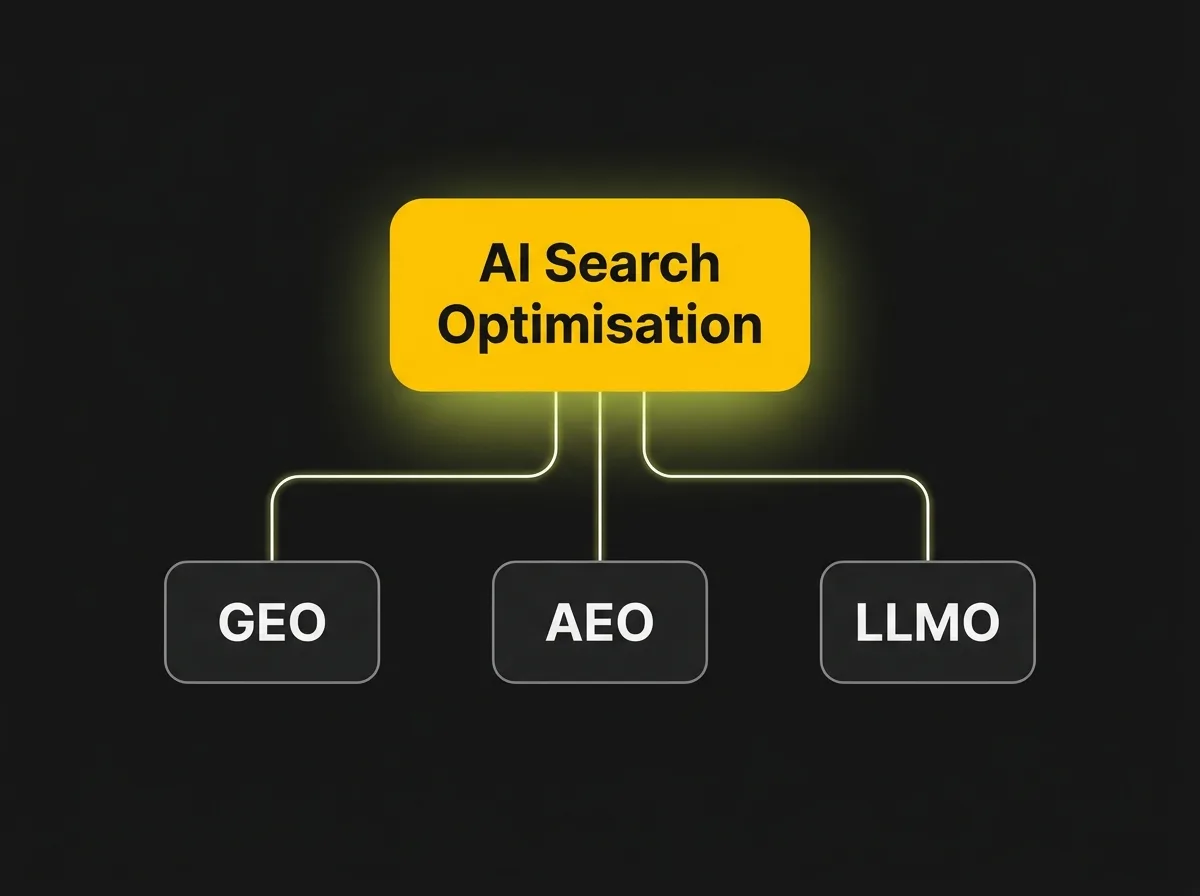
AI search optimisation is the practice of making your business more likely to be cited, summarised, or recommended when someone asks an AI tool a question related to what you do.
It goes by several names, and the terminology can be confusing. Generative engine optimisation (GEO) is the original academic term, coined in a 2023 Princeton University research paper. AEO (answer engine optimisation) emphasises direct answers and featured snippets. LLMO (large language model optimisation) refers specifically to influencing what language models know about your business. In practice, all three describe overlapping ideas. For the purposes of this guide, "AI search optimisation" is the umbrella term that covers them all. If you want a deeper look at how GEO compares to traditional SEO as a discipline, our GEO vs SEO guide covers that in detail.
The shift from traditional search is fundamental. Google returns a list of ranked pages. AI search generates a synthesised answer. Your business may or may not appear in that answer, and the factors that determine whether you do are genuinely different from the factors that determine your Google ranking.
The AI tools UK businesses encounter most are Google AI Overviews (built into standard Google Search), ChatGPT (OpenAI), Perplexity, Claude (Anthropic), and Gemini (Google's standalone AI assistant). They behave differently, draw on different sources, and reward different types of presence. More on each shortly.
What this looks like in practice. Someone searches for a solicitor in Leeds via Perplexity. They get a synthesised answer naming three firms. They click through to the one that looks most credible. They were never shown a ranked list of ten links. They never saw your carefully crafted meta title or your position-four ranking. They saw the answer Perplexity generated, and you were not in it.
That scenario is already happening at scale.
In plain English: AI search optimisation means making sure AI tools include your business in the answers they generate. It is different from SEO but builds on the same foundations. The three things it depends on most are: how clearly your business identity is defined across the web, how often authoritative sources mention you by name, and how well your content is structured for extraction. Nail those three and you are ahead of most competitors.
How AI search differs from traditional SEO
Traditional SEO is about earning the top position on a list of ranked links. Content quality, backlinks, technical health, E-E-A-T signals, relevance to the search query. The goal is position one on a results page, and the reward is roughly 30 percent of users clicking through.
AI search does not produce a ranked list. It generates a synthesised answer. The process has two distinct layers.
Layer one is training data. AI models like ChatGPT learn from enormous amounts of text scraped from the public web during a training period. What they know about your business is drawn from what existed on authoritative parts of the internet before their last training cutoff. If your business was not mentioned in those places, the base model may not know you exist.
Layer two is real-time retrieval. Tools like Perplexity, and ChatGPT in Browse mode, search the live web at the moment of the query and pull in current sources. Here, freshness matters. A page updated this month beats a page untouched since the year before last.
The critical difference in what gets rewarded: traditional SEO rewards pages that match keywords and earn backlinks. AI search rewards entities that are consistently authoritative, clearly described, and structured for extraction. You can have a technically excellent website that ranks well organically and still be absent from AI answers if your entity is ambiguous or your content is not formatted for direct extraction.
The overlap matters too. If your traditional SEO foundations are weak, your AI search presence will be weak as well. Working with an SEO agency to establish those foundations is not a parallel track to AI search work. It is the prerequisite.
AI search adds requirements beyond what traditional SEO has typically prioritised: entity clarity, cross-platform brand consistency, direct-answer content sections, and third-party brand citations on sources AI models trust.

The signals that actually matter in AI search
Most guides at this point list schema markup and helpful content. Both matter. But they miss the signal that matters most.
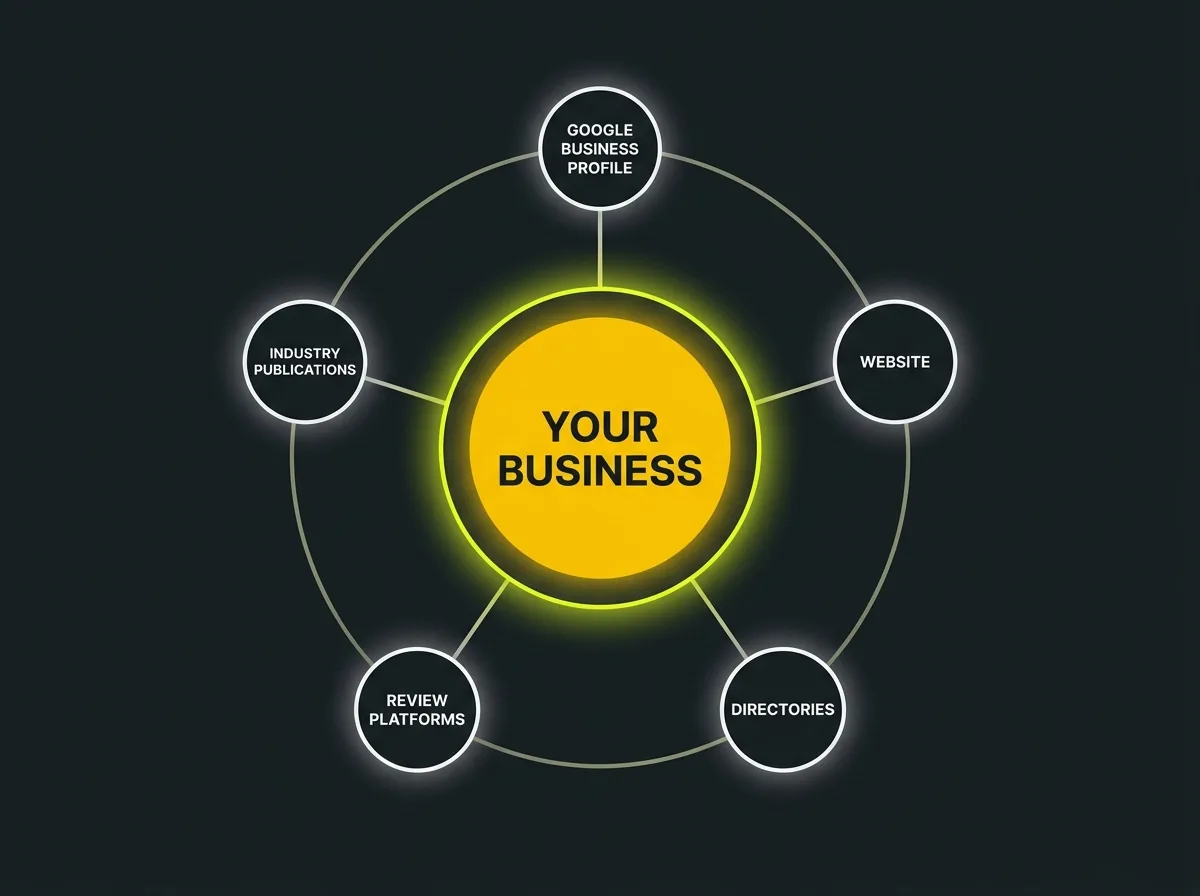
Entity clarity. AI models build their understanding of the world from entity graphs. An entity is a distinct, consistently defined thing: a business, a person, a place, a product. If your business entity is ambiguous — your name is generic, your location is listed inconsistently across directories, your services are described differently on your website versus your Google Business Profile versus your Companies House listing — AI models cannot confidently represent you.
Check this in ten minutes. Ask ChatGPT: "Who is [your business name] and what do they do?" If the answer is vague, generic, or simply wrong, your entity is not well established. If the response is "I don't have information about that business," you are effectively invisible to the model's training data. That is your baseline.
Authoritative third-party mentions. This is the highest-leverage signal for LLM visibility, and the one that takes the most work. AI models, particularly ChatGPT, weight citations from sources they trust: established industry publications, professional directories, local news, review platforms, trade bodies. A mention in a credible industry publication does far more for your AI search presence than a hundred thin directory links. Think about where your target customers' publications and associations are, and make sure your business name appears there.
Structured data. Organisation schema, LocalBusiness schema, FAQ schema, Article schema. These help AI models understand the meaning of your content, not just its words. They are implementable on any WordPress site and take hours rather than months.
Content structure. Clear H2 sections that directly answer specific questions, short paragraphs, plain-English definitions of your services and territory. AI extracts structured information far more readily than narrative prose. A section that starts with the exact question a user might ask and follows immediately with a 60 to 80 word direct answer is formatted for AI extraction. Most business websites do not have this.
Cross-platform consistency. Your business name, description, services, and location must read consistently everywhere you appear online. Inconsistency creates ambiguity. AI models typically resolve ambiguity by not citing you.
Freshness. Perplexity and ChatGPT in Browse mode weight recently maintained content. A guide last updated in 2023 with no changes reads as stale. Regular updates to your key pages signal that your content reflects current reality.
Free resource: AI Visibility Audit
Before spending time on tactics, find out where you currently stand. The AI Visibility Audit shows how your business currently appears in ChatGPT, Perplexity, and other AI tools — what they say about you, what they get wrong, and where the gaps are. Free, and takes about ten minutes to request.
How Google AI Overviews, ChatGPT, and Perplexity each work differently
Treating all three as interchangeable is the most common mistake in AI search thinking right now. They are not. The same tactic does not work equally across all of them.
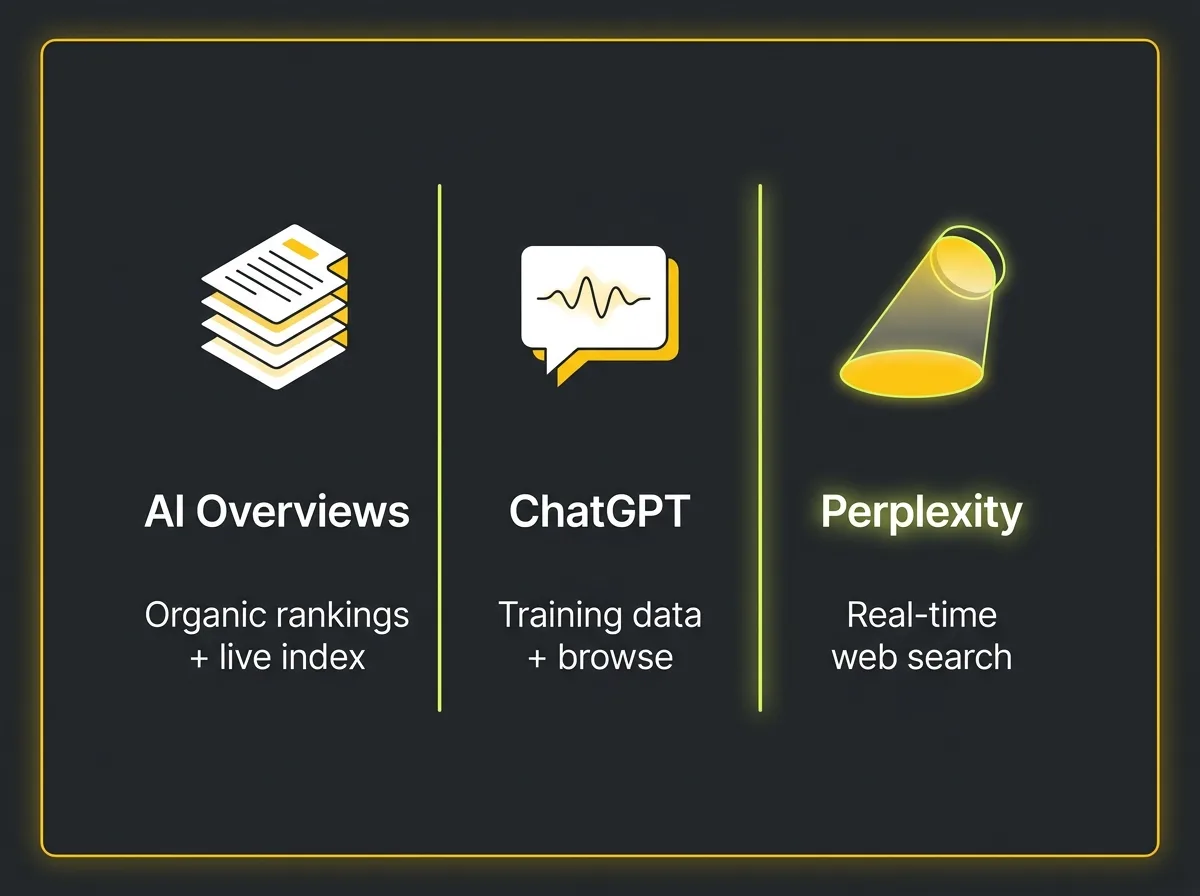
Google AI Overviews are the most closely tied to traditional organic rankings. Pages ranking in the top five for a keyword are meaningfully more likely to be cited in the AI Overview for related queries. If your SEO is already working, you have a head start here. Schema markup matters particularly in this context: structured definitions, FAQ schema, and clear article structure are frequently pulled directly into AI Overviews. The work you have done building organic visibility transfers.
ChatGPT (without Browse enabled) works primarily from training data, not the live web. This is the most misunderstood aspect of AI search. Updating your website does not change what ChatGPT knows about your business at the base model level. It reflects the web as it was when last trained. To appear in base-model ChatGPT answers, your business needs to exist as a named entity on trusted parts of the public internet: established industry directories, media coverage, trade body listings, and review platforms. With Browse enabled, ChatGPT now also searches the live web, and Perplexity-style freshness applies. For a deeper look at this platform specifically, our ChatGPT SEO guide covers what actually works.
Perplexity is real-time web search with source citations shown inline. It actively crawls the current web at the moment of query. Fresh, clearly structured content that directly answers the question has a genuine chance of being cited within days of publication. This is the most immediately responsive platform for AI search work. It is also where AI search traffic converts at significantly higher rates than traditional organic, because users who arrive via a Perplexity citation are typically verifying a decision rather than starting one.
Three platforms. Three distinct mechanisms. One common set of underlying signals, weighted differently across each. The businesses that appear consistently across all three are the ones that have addressed entity clarity, third-party presence, and content structure together.
What to do first: a practical starting point for UK businesses
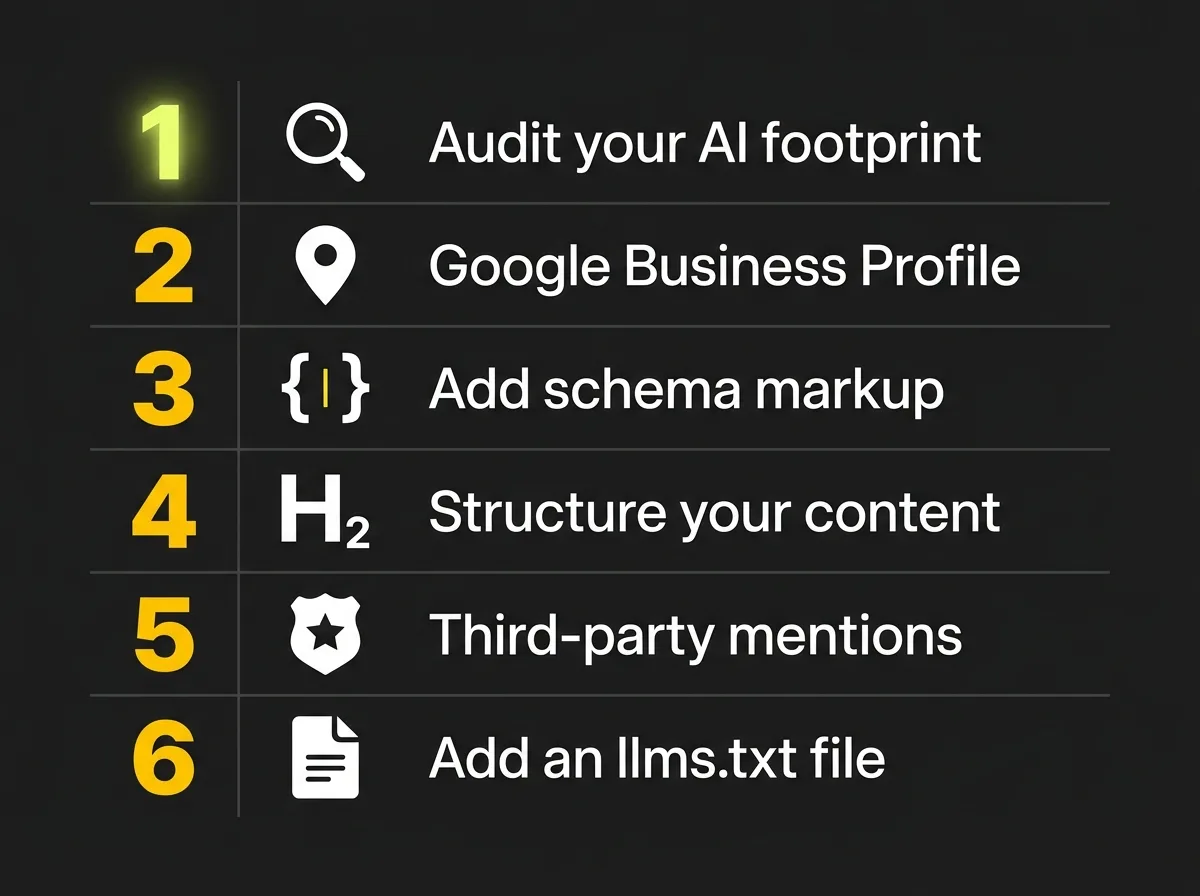
Not fifteen tactics. Six, in the order that matters.
-
Audit your AI footprint. Before anything else, establish your baseline. Google your business name. Ask ChatGPT and Perplexity "who is [your business name] and what do they do?" and "what [your service] providers would you recommend in [your city]?" Note whether the answers are accurate, complete, or missing you entirely. This takes ten minutes and costs nothing.
-
Complete your Google Business Profile. GBP is the most heavily crawled and widely cited local data source across all AI platforms. Every field matters: category, services, description, photos, regular posts, review responses. A thin or outdated GBP signals to AI models that your entity is not well maintained. Fix this before anything else.
-
Add schema markup to your key pages. At minimum, Organisation schema on your homepage and LocalBusiness schema if you serve a specific geography. Add FAQ schema to pages that answer specific questions. Use Google's Rich Results Test to see what you currently have, and what you're missing.
-
Structure your content for direct-answer extraction. Add an H2 to key service pages framing the question your potential customers are asking ("What does [your business] do?" or "What is [your service] and who is it for?"), followed by a 60 to 80 word direct answer. AI extracts this format readily. Most business websites have none of this.
-
Get mentioned on trusted third-party sites. Industry directories, local business associations, sector-specific media, professional bodies, Trustpilot. This is slower than the steps above but it is the highest-leverage signal for ChatGPT base-model visibility. One mention in a credible industry publication does more for your LLM presence than a hundred thin listings.
-
Add an llms.txt file. A plain-text file in your site's root directory that tells AI crawlers what you want them to know about your business. Simple to create, increasingly standard practice among businesses taking AI search seriously. Our llms.txt guide explains how.
One honest note on timelines: expect three to six months before AI citation becomes consistent, and only if your traditional SEO foundations are already reasonably solid. If they are not, fix those first. Building strong AI search visibility on top of weak organic foundations is like decorating a house with no roof. The order matters.
How to measure whether it is working
GA4 referral sources are your first check. Open the Acquisition report and look for referral traffic from chatgpt.com, perplexity.ai, claude.ai, and gemini.google.com. This traffic is small for most businesses right now, but it is growing month on month for any site that has started building AI visibility. Create a segment to track it separately from other referrals and compare quarter on quarter.
Direct testing costs nothing and tells you things no analytics tool can. Ask the platforms the questions your prospects are genuinely asking. "Which firms offer [your service] in [your city]?" Note what appears. Note what the AI says about you when your name does come up. Note whether it is accurate and whether the description matches how you actually want to be known. Do this monthly. Things change.
AI search visibility tools are also emerging from mainstream SEO platforms. Semrush and Ahrefs are building AI brand monitoring into their products. Useful at scale, not essential for most small UK businesses yet. The direct testing approach above is free and gives you the clearest signal.
Set realistic expectations. AI search visibility is a quarterly metric, not a weekly one. It is influenced by factors outside your direct control, including AI platform training schedules and crawl policy changes. What you can control is the quality and consistency of your entity signals across the web. That is where effort belongs.
Research from SparkToro suggests that more than half of all Google searches now end without a click to any website. Gartner research projects that AI assistants will handle around a quarter of all searches by 2026, rising significantly beyond that in the years that follow. Both figures point the same way.
The businesses that weather this shift are the ones building AI citation alongside their organic search presence now. Not waiting to see how it settles. The SERP for AI search queries is not locked in. The entity graphs AI tools draw on are still being populated. That window does not stay open indefinitely.
Free resource: AI Visibility Audit
Before building a strategy, find out where you actually stand. The AI Visibility Audit shows how your business currently appears in ChatGPT, Perplexity, and other AI tools: what they say about you, what they get wrong, and where the gaps are. It is a free diagnostic, not a sales pitch. If you want a clear picture of your AI search footprint, this is the practical starting point.
Frequently asked questions about AI search optimisation
What is AI search optimisation?
AI search optimisation is the practice of making your business more likely to be cited or recommended when someone asks an AI tool a question related to your products or services. Unlike traditional SEO, the goal is not a position on a ranked list but inclusion in a synthesised AI-generated answer. The key signals are entity clarity, authoritative third-party mentions, structured content, and schema markup. It is sometimes called generative engine optimisation (GEO), answer engine optimisation (AEO), or LLMO, depending on the context.
How is AI search optimisation different from SEO?
Traditional SEO aims to rank pages in a list of results using signals like content quality, backlinks, and technical health. AI search optimisation aims to be cited in a generated answer using signals like entity clarity, cross-platform consistency, and direct-answer content structure. The two disciplines share the same foundations: strong traditional SEO helps AI search visibility. But a business can rank well in Google and still be entirely absent from AI answers if its entity signals are weak.
What is generative engine optimisation (GEO)?
Generative engine optimisation is the original academic term for the discipline now broadly called AI search optimisation. It was coined in a 2023 research paper by Aggarwal et al. at Princeton University. It describes the practice of improving a business's presence in the outputs of generative AI models, particularly large language models. GEO, AEO, and LLMO all refer to overlapping ideas; most practitioners use the terms interchangeably.
Does Google AI Overview reduce my organic traffic?
It can, for queries where an AI Overview generates a direct answer. When AI Overview appears at the top of results, a meaningful proportion of users do not scroll to individual links. Practitioner data suggests organic click-through rates for queries with active AI Overviews can be 30 to 50 percent lower than comparable queries without one. This makes appearing inside the AI Overview itself more important than simply ranking beneath it. The traffic that does reach your site via an AI Overview citation tends to be further along in their decision.
How do I know if my business appears in AI search results?
Start with direct testing: ask ChatGPT, Perplexity, and Google AI Overviews the questions your prospects are likely to ask, using the platforms themselves. Note whether your business appears, what is said, and whether the information is accurate. For ongoing tracking, GA4 now records referral traffic from AI platforms including chatgpt.com and perplexity.ai. Dedicated AI search visibility tools are being built into platforms like Semrush and Ahrefs for businesses that want to automate this monitoring.