
The Checkatrade renewal notice landed in the inbox last week. Price went up again. The Google Ads account manager is asking for more budget to "stay competitive," and the referrals from last spring's installs are coming through, but slowly. Not enough to fill the diary the way they used to.
Nothing is broken. But something is not adding up.
If you run a home improvement company in the UK – kitchens, bathrooms, windows, conservatories, multi-trade, anything in between – you have probably tried at least two of the channels everyone recommends. And you have probably noticed the economics getting tighter. Checkatrade leads cost more and convert less reliably than they did three years ago. Google Ads CPCs on bathroom and kitchen terms have climbed year on year. Direct referrals are unpredictable at the best of times. Social media takes time you simply do not have.
This guide walks through every realistic marketing channel for a UK home improvement business. What each one is, when it earns its keep, what it costs to do properly, and how you know whether it is working. We cover the UK-specific platforms, the UK accreditations that affect discoverability, and how AI tools like ChatGPT, Claude, and Perplexity are already changing how homeowners pick installers. For the broader context, our guide to digital marketing for construction companies covers adjacent territory.
What makes marketing for home improvement companies different
Most marketing advice is written for businesses where the purchase is fast, the ticket is small, and the buyer can easily switch if something goes wrong. Home improvement is the opposite on all three counts.
A kitchen installation is a £12,000 to £30,000 decision for most UK households. A conservatory or orangery can be twice that. Bathroom refits, window replacements, loft conversions: every one is a high-consideration purchase with a long research phase, multiple competing quotes, and real disruption to the home during installation. The buyer is not in a hurry. They are looking for someone they trust with their home.
That trust dynamic changes everything about how marketing works. Reviews matter more than in almost any other consumer vertical. Accreditations matter. Photos of real completed work matter. Geographic service areas matter, because you cannot serve the whole country from one location. Seasonality matters: enquiries for kitchens and bathrooms spike in January and September; conservatories and outdoor living projects in spring. Your marketing has to account for all of it.
The UK home improvement market is substantial. Spending runs into tens of billions of pounds annually, split across a fragmented industry of owner-operated firms, regional chains, and a small number of national players. The vast majority flows through companies with under fifty employees. That means the buyer is doing their own research, comparing competitors online, and making a decision based largely on trust signals they find before they ever speak to anyone.
There is no shortcut to that trust. But there are channels that build it faster, and channels that burn budget without building anything at all.
The UK shift: how homeowners now research home improvement firms
A homeowner researching a new kitchen in the UK goes through roughly three stages before they call a showroom or submit an enquiry form.
The first is Google. They search "kitchen fitters near me" or "bathroom installers in Manchester" or "how much does a loft conversion cost." They look at Google Business Profiles, scan reviews, and check websites. This stage can take weeks.
The second is AI tools. ChatGPT, Claude, Perplexity, and Gemini are now part of how people research high-consideration purchases. Homeowners ask things like "what should I look for in a kitchen installer" or "are Checkatrade companies reliable." If your content surfaces in those answers, you are ahead of most of your competitors before the buyer has even heard of you.
The third is community. Mumsnet, Reddit, local Facebook groups. "Can anyone recommend a good window company in Leeds?" The answers in those threads are read by dozens of people who never post. Being the recommended name in local community spaces is worth more than most installers realise.
The shift that matters most commercially: AI search traffic converts at five times the rate of typical web traffic. Someone arriving via an AI recommendation is already further through their research than someone from a generic Google click. And where Google AI Overviews appear on informational queries, they absorb a meaningful share of clicks before the reader reaches any website. Being present in those answers matters now, not at some future point.
Local SEO and Google Business Profile

What it is: the combination of your Google Business Profile (the map panel that appears when someone searches "kitchen fitters near me") and the work you do to make sure your company appears near the top of that panel ahead of local competitors.
When it works: almost always, for almost every home improvement installer. Local discovery is typically the dominant first step in the buyer's research journey. According to BrightLocal's Local Consumer Review Survey, the overwhelming majority of consumers use Google to evaluate local businesses before making contact. For a business serving a defined geographic area, this is the most efficient channel available.
What it costs: your time, initially. A properly configured Google Business Profile, managed consistently with regular photo uploads and review responses, can be handled in-house. Once you move into local SEO properly – building location-specific service pages, earning local citations, building links from local press and trade directories – you are looking at either significant time or agency fees from around £500 to £1,500 per month depending on how competitive your area is. Our local SEO that actually picks up local search work is built specifically for home services businesses.
How to know it is working: your GBP insights panel shows calls, direction requests, website clicks, and the search queries people used to find you. Set a baseline in month one and track it month on month.
On the GBP specifics: choose your primary category to match your main service (Kitchen Remodeller, Bathroom Remodeller, Double Glazing Installer, Conservatory Supplier). Add secondary categories where you genuinely deliver. Upload project photos consistently rather than in one large batch. And make your accreditations visible. TrustMark is a government-endorsed quality scheme covering most home improvement trades. FENSA covers window and door installations. Gas Safe covers gas work. MCS covers renewable energy installations. CHAS covers health and safety compliance. Displaying these on your GBP and your website resolves a subconscious buyer question in the first three seconds.
Reviews are the single biggest variable on a competitive local SERP. A Google Business Profile with 50 or more reviews and a strong rating consistently outperforms a competitor with 8 reviews, regardless of how good the website behind it is. Build your review system now.
For what this approach looks like in practice for building and trade businesses, we have covered what actually works for local builders in the UK in detail.
Organic SEO and content
What it is: ranking in Google's main search results, not just the local map pack, for the queries homeowners type before they are ready to call: "kitchen installation cost Bristol," "bathroom refurb ideas UK," "FENSA registered window fitters Edinburgh."
When it works: when you have a consistent content programme behind it. Organic SEO for home improvement companies is a medium-term investment. Expect six to twelve months before you see meaningful growth in organic traffic, and twelve to twenty-four before it becomes a reliable primary lead source. It is not the channel if you need leads next month. It is the right channel if you want to reduce your dependence on paid leads and aggregator platforms over the next two to three years.
The approach that works: building "service area plus service" pages. Not one homepage that covers everything, but a dedicated page for "kitchen fitters in Edinburgh," another for "bathroom installers in Edinburgh," another for "loft conversions in Edinburgh." These pages outrank generic city homepages because they satisfy a specific search query. Pair them with project case studies, cost guides, and after-care content and you build topical authority across the category. Schema markup matters too, and most home improvement websites ignore it. Service schema, LocalBusiness schema, and AggregateRating schema tell Google what your pages are about in structured form, and they make your site easier for AI tools to parse and cite.
What it costs: an ongoing commitment. Whether you handle content in-house or work with an agency offering organic search that compounds over time, the commitment is monthly, not one-off. The payoff is traffic that keeps producing without a cost per click.
We have covered the specific approach in our posts on SEO for builders and SEO for tradesmen. The principles transfer directly to kitchen, bathroom, window, and multi-trade companies.
Free resource: Traffic Projection Report
Want to see what organic search could realistically deliver for your specific company and service area? The Traffic Projection Report models your current visibility against local competitors and projects what is achievable over twelve months. It is the most efficient way to make a go/no-go decision on SEO investment.
AI search visibility
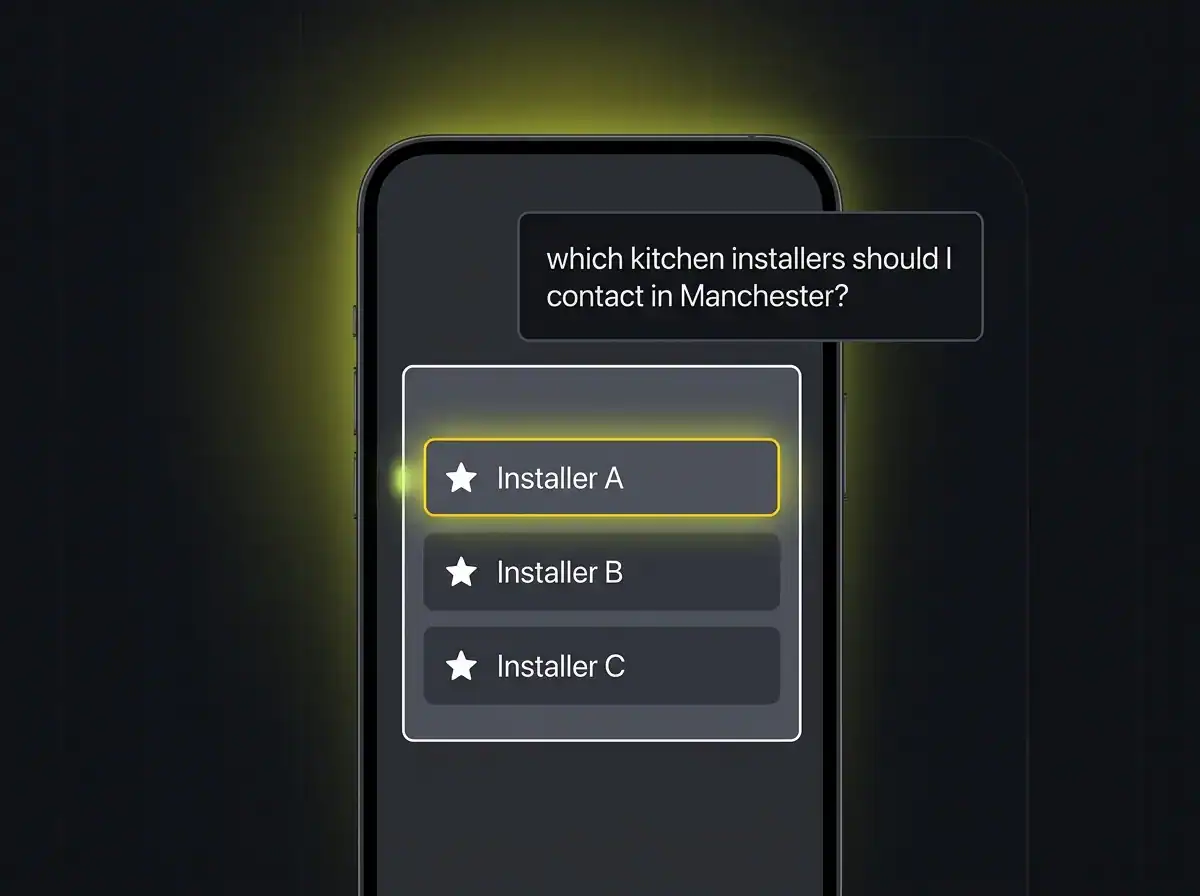
What it is: the ability to appear as a recommendation when homeowners ask AI tools about home improvement companies, services, or installers in their area.
When it works: now. This is not a future channel to monitor. Homeowners are already asking ChatGPT "what should I look for in a kitchen installer" and Perplexity "which bathroom fitters in Leeds have good reviews." AI tools pull answers from websites, review platforms, and trade publications. If your content surfaces in the sources AI tools reference, and if your website answers the questions those tools are trying to answer, you have a genuine chance of appearing in the recommendation.
What gets a UK installer named in AI answers: UK-specific content that explicitly names your service areas. Named accreditations with registration details: Gas Safe number, FENSA registration, TrustMark membership. Structured, specific information about what you do, who you do it for, and what a typical project looks like. Reviews on platforms AI can read. Coverage in local trade press or consumer media. The more specifically your website matches what an AI tool needs to give a confident recommendation, the more likely you are to appear.
What it costs: mostly content and structure work that overlaps with organic SEO. You are not running a separate AI search campaign. You are making your website and online presence easier for AI tools to understand and cite. Businesses already investing in getting recommended in ChatGPT, Claude, and Perplexity are building a position most of their local competitors have not yet noticed.
Most of your local competitors are not doing this. That gap closes fast once awareness catches up.
Google Ads and Meta Ads
What it is: paid advertising on Google Search (showing your ads when someone actively searches a relevant term) and Meta (showing ads to audiences on Facebook and Instagram based on interests, behaviour, and retargeting lists).
When Google Ads earns its keep: when your average project value is high enough to sustain the cost per lead. For kitchen and bathroom installers with finance options and average orders above £8,000, paid search is a viable primary channel. It generates enquiries immediately, which matters when you have diary gaps to fill. It is also the right channel if you have just launched and cannot wait twelve months for SEO results.
Where it stops working: on lower-margin trades in hyperlocal commodity markets where the cost per enquiry is too high relative to job margin. If your typical project is under £2,000, the economics in a competitive UK city are very difficult to make work.
On budget: what you need to spend to see consistent enquiries depends entirely on your location and how competitive your category is. Kitchen and bathroom terms in London and the South East carry higher CPCs than the same terms in smaller UK cities. Track your cost per booked appointment, not cost per click or cost per enquiry, and work backwards from there. The number that drives results in one market may produce nothing in another.
When Meta Ads earns its keep: home improvement is a visual product. A bathroom renovation or bespoke kitchen photographs well. Meta Ads work well for showing completed project photos to homeowners in your service area. Retargeting people who have already visited your website is particularly effective: they are already familiar with your company and conversion rates are higher. Seasonal promotions, showroom open days, and finance offers all work in Meta creative.
On tracking: most home improvement installers significantly under-attribute both channels. A phone call that came two weeks after someone clicked an ad, then did a direct search, then called: that is attributable to paid advertising, but standard tracking will not capture it. Enhanced conversions, call tracking, and offline conversion import from your CRM give a clearer picture of what each channel is actually delivering.
Lead aggregator platforms

The core trade-off: aggregator platforms are easy to start and generate enquiries quickly. But you are renting access to an audience the platform owns. When you stop paying, the leads stop. And you are competing directly against other members of the same platform, often on price.
Use them as a supplement to organic visibility, not a substitute for it. The installers most exposed to platform risk are the ones who depend entirely on aggregators and have built no owned audience. For more on building lead generation that does not depend on a third party, see our post on lead generation for builders.
-
Checkatrade is the most established name in UK home improvement. It suits companies offering a range of trade services who want a recognised brand behind their profile. The membership model gives buyers confidence because companies are vetted. The common complaint is that lead quality has become more variable as the platform has grown, and membership fees have risen consistently. Optimise your profile with project photos, a high review count, and fast response times: those are the signals buyers use to compare companies on the platform.
-
MyBuilder operates on a pay-per-lead model. You pay for the enquiries you choose to respond to rather than a flat membership fee, which makes it flexible for companies testing paid lead generation without a large upfront commitment. The competition per lead is real, and conversion rates depend heavily on response speed and profile completeness.
-
Rated People works similarly to MyBuilder. Good for smaller installers getting started with paid leads. Track your lead-to-appointment conversion rate specifically: if it is consistently below 15 to 20 per cent, either your response speed or your profile needs attention.
-
TrustATrader is subscription-based and smaller in scale than Checkatrade, but it attracts homeowners who are specifically seeking verified tradespeople. Worth testing in trades and regions where Checkatrade is heavily saturated.
-
Houzz Pro UK targets the higher end of the market: premium kitchen designers, bathroom specialists, and large-scope installers. The audience is actively planning significant home projects, which means enquiry intent is typically higher than on the generalist platforms. Understand the cost structure clearly before committing.
Reviews, referrals and reputation systems
Reviews are not a channel on their own. They are a multiplier on every other channel in this guide. A stronger Google review profile makes your local SEO more effective, your Google Ads more compelling, your aggregator profile more competitive, and your AI search citations more credible. Build it deliberately.
The practical system: at the end of every completed job, send a review request by SMS. Keep it short, link directly to your Google Business Profile review page, and make it one tap. Follow up with an email two days later if there has been no response. A well-timed SMS from a satisfied customer converts at a rate no other review collection method comes close to.
Where to build reviews: Google is the priority. Every other platform benefits from Google's authority in local search. Once your Google review count is solid, extend to Trustpilot and the native review systems on whichever aggregator platforms you use. Consistency across platforms signals credibility to buyers and to the AI tools that pull from review data.
One well-handled negative review outperforms ten bland positive ones. When a complaint appears publicly, reply within 24 hours, acknowledge the issue directly, and describe what you did to resolve it. Buyers read the response as carefully as the original complaint. A business that handles problems transparently is one buyers feel confident choosing.
Referrals are a separate programme worth formalising. A recommendation from a friend or neighbour is still the highest-converting lead source for most home improvement companies. A simple referral scheme – a gift voucher, a discount on a future service, a charitable donation in the client's name – turns passive word of mouth into something you can rely on.
Direct response
Door drops, vehicle livery, and showroom events are channels that digital-first thinking tends to undervalue. For the right installer, they still pay.
Door drops in defined postcode clusters around recent installs work because proximity is a trust signal. If your van has been outside number 14 for three weeks, the neighbours noticed. A well-designed leaflet posted to the five nearest streets at the end of the project, showing the completed work with a clear next step, arrives in a context of social proof. Response rates on proximity door drops are higher than cold distribution because you are borrowing credibility from the neighbour's decision.
Vehicle livery is the cheapest persistent local presence signal you have. A clean, professional wrap does not need to say much: your name, your trade, your accreditations, your phone number. It is visible at every install, in every street you park on. For the cost of one set of graphics, you get years of brand presence across your service area.
Showroom events work at the higher end of the market, particularly for kitchens, garden rooms, and orangeries. A supplier evening, a design consultation day, or a partnership with a local developer brings qualified prospects into a setting where the sale is easier than it is over the phone. It requires sales team capacity to run and delivers better in urban areas with the footfall to support it.
When to skip direct response: if your average order value is low and margins are tight, the economics of door drops and events may not stack up. Prioritise digital channels where cost-per-enquiry is measurable and you can scale what works.
The website is the engine

Every channel above sends traffic somewhere. That somewhere is usually your website, your Google Business Profile, or a landing page from your paid ads. If the destination does not convert, the spend driving traffic to it is wasted. Entirely.
Six things that make a meaningful difference on a home improvement website:
-
Clear pricing or finance signals. You do not have to publish a price list. But acknowledging how you charge, what a typical project costs, and whether you offer finance options removes the primary barrier to enquiry. Buyers who cannot get a rough sense of cost before calling often do not call at all.
-
A specific, real portfolio. Your actual completed projects, in real UK homes, with project details where you can share them. The closer your portfolio matches the buyer's own situation, the harder it is for them to look anywhere else.
-
Accreditation badges above the fold. TrustMark, FENSA, Gas Safe, MCS, and CHAS marks should be visible without scrolling. They answer a subconscious question in the first three seconds: is this a legitimate, accountable business?
-
A simple enquiry form. A form asking for name, phone, and project type converts far better than a twelve-field form asking for dimensions, budget, and planning permission status. Get the detail on the call.
-
Mobile-first design. Most home improvement searches happen on a phone. A slow or awkward mobile experience loses the lead before it starts.
-
Named people. A photo of the owner, the lead designer, or the installation team makes the website feel like a real business. That matters disproportionately when the buyer is trusting someone with access to their home.
Our post on the six elements of a good landing page covers conversion mechanics in more detail. If the website is the bottleneck, the answer is a website that actually converts the traffic every other channel is sending to it.
Where to start: matching channels to the business
Under £1m turnover: start with your Google Business Profile, configure it properly, and build a review collection system from day one. Aim for 25 or more Google reviews as fast as you can. These two things improve your local discoverability at very low cost. Add local SEO that actually picks up local search once your GBP is working. Use Google Ads only if your average order value is above £4,000 and you have enough budget for a proper test. Aggregator platforms are a reasonable lead supplement but not a foundation.
£1m to £5m turnover: run paid search and organic SEO alongside each other. Paid search fills the diary now; organic SEO builds the asset that reduces your dependence on paid channels over two to three years. Automate your review collection. If your product is strongly visual (kitchens, garden rooms, orangeries, premium bathrooms), add Meta Ads with a project portfolio creative strategy and test seasonal promotions. Consider Houzz Pro UK if you are targeting the higher end of the market.
£5m+ turnover: a full visibility programme is justified. Organic SEO, AI search visibility, paid search, and regional content scaling across your full service geography. CRM-driven email nurture keeps past customers engaged for repeat work and referrals. You need proper attribution tracking to understand what each channel actually contributes. Start with the full search visibility picture before adding more channels.
FAQ
How much should a home improvement company spend on marketing?
Most established UK home improvement companies spend somewhere between 5 and 10 per cent of revenue on marketing. Earlier-stage companies investing in growth often spend at the higher end or above it. The more important question is what you are spending it on. Five per cent of revenue going entirely to Checkatrade leads with no organic visibility leaves you highly exposed to platform risk. The same budget split across organic search, a paid campaign, and reputation management builds something more durable.
Is Checkatrade worth it?
It depends on your trade, your geography, and your price point. For multi-trade companies doing a range of smaller jobs, Checkatrade can generate useful lead volume, particularly in areas where the brand has strong consumer recognition. For premium kitchen, bathroom, or extension companies, the cost per acquired customer has risen considerably over the last few years and lead quality can be inconsistent. Test it with proper tracking (cost per booked appointment from Checkatrade specifically) and compare it honestly against your other channels. It should be a supplement, not a strategy.
How long does SEO take for a home improvement company?
Six to twelve months before you see meaningful growth in organic traffic. Twelve to twenty-four months before it becomes a reliable primary lead source. That timeline feels long, until you consider that the organic traffic you build in year one is still working in year three without an additional cost per click. No paid channel compounds in the same way.
Do I need to worry about AI search yet?
Yes. Not because AI has replaced Google (it has not), but because the companies building AI search visibility now will be very difficult to displace in twelve months' time. Homeowners are already using ChatGPT and Perplexity to research home improvement companies. If you are not in those answers, a competitor who started earlier will be.
Should I hire an agency or do this in-house?
Direct response channels (door drops, vehicle livery, showroom events) and review collection can usually be managed in-house with the right system in place. Organic SEO, paid search, and AI search visibility are technically complex and time-consuming to do well. Most home improvement companies above £1m in revenue are better served by an agency with real home services experience. The key question is not in-house versus agency, but whether whoever is doing the work genuinely understands the trust dynamics, seasonality, and platform landscape that define this market.
A useful next step
If you have worked through this guide and you want to see what the opportunity looks like for your specific company, the Traffic Projection Report is the most efficient starting point.
We model your current search visibility against your local competitors, project what organic and AI search could realistically deliver over the next twelve months, and give you an honest read on where the biggest opportunity in your specific market sits. No obligation. Just a clear picture of what is achievable for a business of your size, in your location, in your trade.