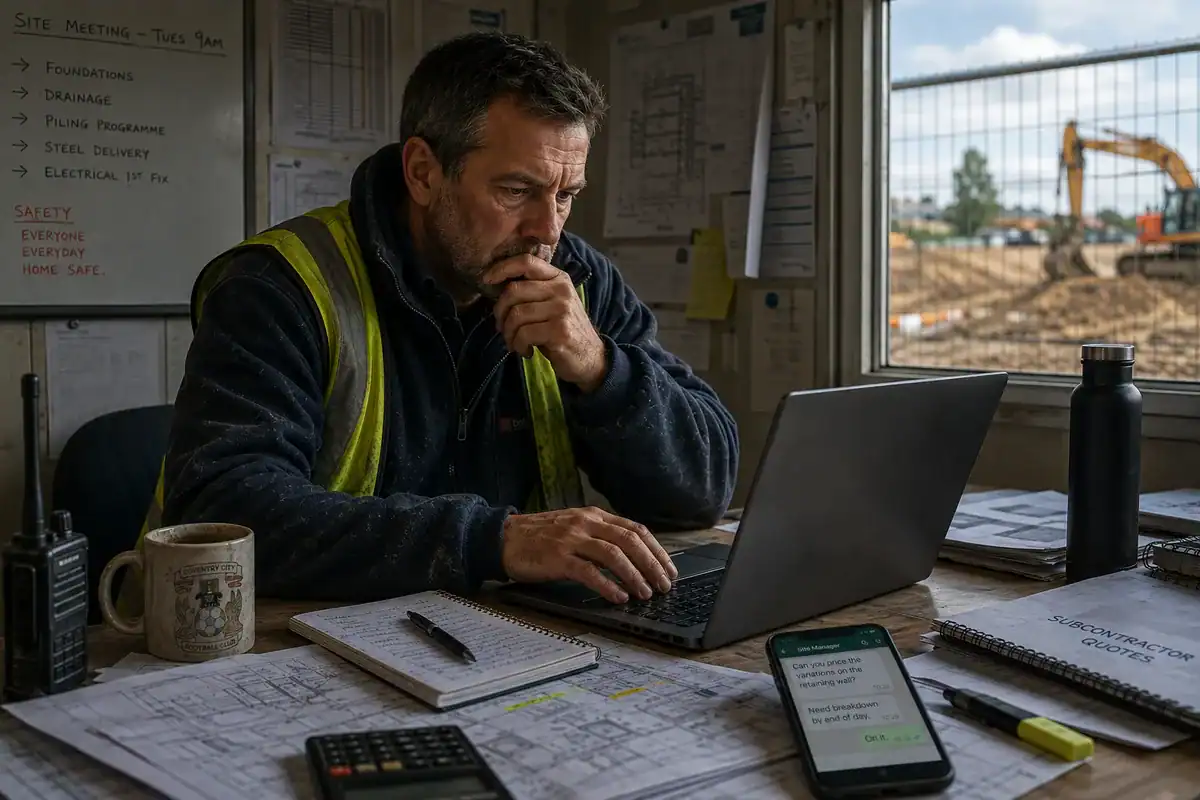
The last big contract you won. Think about where it actually came from. A name passed along, a repeat client, a main contractor you delivered for last year. Almost certainly not your website.
That is the thing most digital marketing advice for construction firms quietly ignores. In construction the contract is usually decided long before anyone opens your site. Project values are large, sales cycles run from three months to well over a year, and the decision involves an MD, a quantity surveyor, sometimes a procurement team or an architect who is not even your direct client. UK construction output is worth well over £100 billion a year according to ONS construction output data, and almost none of it is won by a contact form.
So before the digital channels, it is worth being honest about the whole picture. Digital is one part of how construction firms win work, and for most it is not the biggest.
How construction firms actually win work
Five things bring work through the door, and only some are digital.
Relationships and referrals. The dominant source for most established firms. Repeat clients, main contractors, subcontractor networks, cost consultants, architects. The work that comes from a name passed along at a CITB or RICS event will, for most firms, outweigh every other channel combined. Nothing below replaces this. The job of everything else is to support it.
Framework agreements, tenders and PQQs. For public-sector and larger commercial work, getting onto the right framework and answering pre-qualification questions well is the real pipeline. It is procurement more than marketing, but it is where a large share of contracts originate.
Reputation and proof. References, completed-project case studies, and accreditations like CHAS, Constructionline and the relevant ISO standards. This is what a quantity surveyor checks before you make the shortlist.
Trade directories and local listings. More relevant for domestic and smaller commercial work. Checkatrade, MyBuilder and the like generate real enquiries for extension and refurbishment firms, far less for a groundworks contractor chasing commercial frameworks.
On-site visibility. Site boards, hoardings and vehicle livery still do quiet work in a local area. Cheap, and easy to forget.
Then there is digital: search, your website, AI search, LinkedIn and paid. For most construction firms digital rarely originates the large contract. What it does is decide whether you survive the shortlist when the buyer checks you out, and it originates a real share of domestic and smaller commercial enquiries. Worth investing in properly. Just worth knowing what job it is doing.
One more thing shapes all of this: which part of construction you are in. Residential builders and developers are closest to consumer marketing, where the buyer often searches Google, checks reviews and scrolls Instagram. Commercial main contractors and tier-two firms work in a procurement and relationship-led world where decisions pass through several layers, often via a framework agreement or tender. LinkedIn and targeted SEO matter here; Instagram does not. Specialist subcontractors (M&E, groundworks, fit-out, piling) mostly work with main contractors who already know the options, so reputation and references dominate and digital is a credibility check rather than a lead source.
Getting this wrong is expensive. An M&E subcontractor spending £2,000 a month on Meta ads is funding an agency’s retainer, not growing their business. The rest of this guide is the honest, channel-by-channel verdict on the digital side: what earns its place for a construction firm in 2026, and where the budget goes to die.
What works in digital marketing for construction companies in 2026
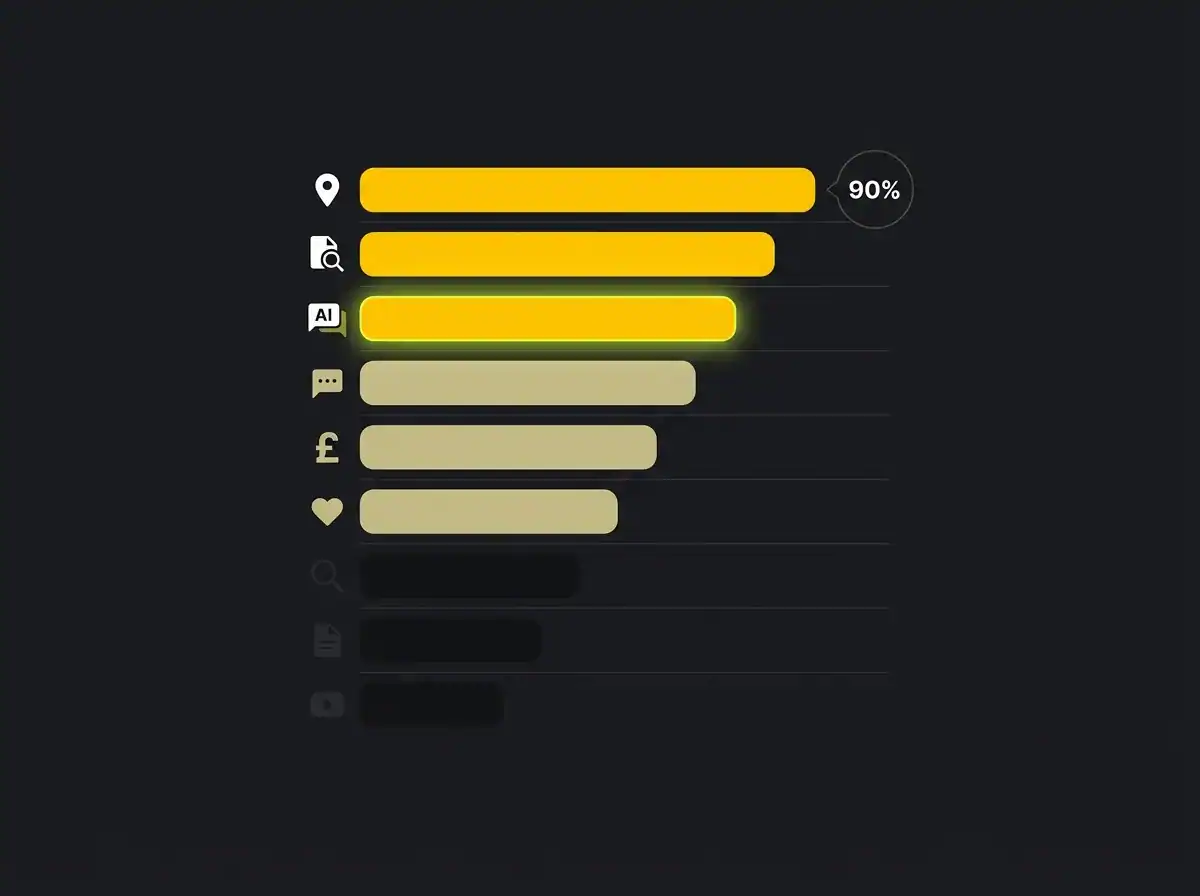
For UK construction firms in 2026, three channels reliably drive pipeline: local SEO and Google Business Profile for regional firms, technical and content SEO targeting commercial-intent keywords, and AI search visibility for commercial and main contractor audiences. LinkedIn organic works for commercial and tier-two work. Paid social via Meta works for residential and developer-facing firms only. Paid search works on narrow, intent-led terms. Generic PPC, brand video, Instagram management for commercial contractors, and broad-match paid search waste budget for most construction businesses.
SEO is still the highest-return channel for most construction firms
Search engine optimisation is not glamorous. It is also, for the majority of UK construction firms turning over less than £10m, the strongest-performing marketing channel available.
The reason is commercial intent. When a developer types "design and build contractor Manchester" or a facilities manager searches "office fit-out company London", they are not in research mode. They are building a shortlist. The keyword already signals a buying moment. Compare that with a display ad or a social post, where you are interrupting someone who was doing something else entirely.
Target the right keywords and this becomes very specific. "Groundworks contractor Birmingham", "structural engineer Bristol", "piling contractor Kent". These are relatively low-volume searches with very high commercial intent. The competition for them is often thin. A properly structured site with relevant content and a handful of authoritative backlinks can rank for these terms and stay ranked for years with modest ongoing effort.
A SEO agency that understands construction will focus here, not on generic head terms. "Construction company UK" is a vanity keyword. It attracts students, recruiters, journalists, and competitors. It does not attract buyers.
Local SEO sits inside this and deserves its own attention. For regional firms, service-area keyword targeting combined with a well-maintained Google Business Profile is often the cheapest source of qualified enquiries in the whole marketing mix. Local SEO services focused on the local pack, review management, and citation consistency can move results faster than almost any other investment at this scale.
What to skip: monthly SEO retainers under £800 that are 90 per cent generic blog content about "construction trends in 2026". They rank for nothing commercially useful, attract traffic from people who will never become clients, and give the appearance of activity without any movement on the terms that matter.
Google Business Profile is the most under-priced channel in construction marketing
If there is one channel that UK construction firms consistently under-invest in relative to the return it delivers, it is Google Business Profile.
The local pack (the three business listings that appear under the map in Google results) outranks organic listings for most location-based searches. For someone searching "builders near me" or "drainage contractor Nottingham", the map results appear first. That position is determined not by domain authority or backlinks but by proximity, reviews, and profile completeness. A firm with 40 genuine five-star reviews and a fully maintained GBP profile will consistently outrank a competitor with a stronger website.
For residential firms, the compounding effect of reviews is significant. Each completed project is an opportunity. A systematic process tied to project handover (a short follow-up message, a direct link, a project manager who asks personally) generates reviews consistently. A passive approach generates almost none. Forty reviews does not sound like a lot until you realise most local competitors have three.
Weekly GBP posts with real project photos are higher-return activity than almost any social media strategy. Finished groundworks, rendered extensions, fitted kitchens with project context and named towns in the caption. Real work, real places.
What to skip: paying an agency £400 a month to manage your GBP profile when an in-house person could do the same meaningful work in two focused hours a week. The GBP activity that matters is review generation and photo uploads. Neither requires a retainer.
AI search visibility is the channel construction is most behind on
Construction is one of the most under-represented verticals in AI search results. That is both a problem and an opportunity.
Commercial directors and procurement leads are increasingly using ChatGPT, Claude, and Perplexity to build shortlists before they brief anyone. Not as a replacement for their own judgement, but as a starting point. A senior project manager asking "which groundworks contractors have the best reputation in the East Midlands" gets something a Google search could not easily deliver five years ago. AI search handles it by pulling from indexed content, published case studies, and authoritative sources. If none of your published content is specific, opinionated, or credible enough to be cited, you simply will not appear.
The firms getting cited in AI results right now have well-structured, factual, specific content: detailed project pages, clear service-area descriptions, case studies with named outcomes, and FAQ sections that answer the questions buyers actually ask. Not generic blog posts about "the five benefits of choosing a professional builder."
AI search traffic converts at five times the rate of traditional search because the people arriving have already completed a verification step. They asked an AI, got a recommendation, and came to your site to confirm it. That is a buyer in the late consideration stage, not a browser. An AI search agency that understands how to structure content for citation can create a genuine competitive advantage in construction, because almost no construction firm is doing this yet.
What to do: structured FAQ sections answering the specific questions your buyers ask, project-specific case study pages with real numbers and named locations, and content that is updated regularly enough to signal freshness.
LinkedIn works for commercial and main contractor work, not for residential
LinkedIn is genuinely useful for commercial construction and tier-two subcontractor work. Senior decision-makers (commercial directors, cost consultants, project managers, public sector procurement leads) are on the platform and reachable.
The organic content that works on LinkedIn for construction firms is project-specific and people-led. A site manager sharing a short post about a complex problem they solved on site, with a real photo and a named outcome, will consistently outperform anything the marketing team writes from a desk. Named people, real projects, honest commentary on what the work actually involved. That is the content that earns followers and drives inbound conversations from commercial clients.
LinkedIn Sales Navigator is worth considering for firms actively targeting specific organisations. The ability to filter by job title, company size, and sector, and to track people moving into relevant roles, gives commercial construction firms a targeting capability that would cost far more via conventional advertising.
Where LinkedIn does not earn its keep: small residential extension and renovation work. The homeowner having a kitchen extended is not on LinkedIn looking for a builder. Spending time here for that audience is simply the wrong channel.
Paid LinkedIn can work for very specific commercial audiences, but the cost per click is high. Test narrowly before committing meaningful budget.
Paid search and paid social, separated honestly
These two channels get conflated in most agency conversations. They behave completely differently in construction.
Paid search works for construction firms on narrow, intent-led keywords. "Piling contractor Birmingham", "design and build warehouse Kent", "commercial fit-out company". These searches signal an active buying moment. The CPC is often high (£8 to £30 is typical for commercial terms), but the quality of the traffic justifies it when project values run into the tens or hundreds of thousands.
What paid search does not work for: broad-match terms like "construction company" or "builder UK". These attract jobseekers, students, and competitors checking your ads. The click volume looks impressive in a monthly report. The enquiries do not appear.
Paid social via Meta is a different story depending on your firm type. For residential developers, housebuilders, and firms doing consumer-facing work (extensions, renovations, custom build), Meta is genuinely effective. The targeting options for homeowners, households with specific income profiles, and people in particular postcodes make residential campaigns viable. For commercial work and specialist subcontractors, Meta is almost always the wrong channel. The buyer is not on Facebook deciding which M&E firm to shortlist.
One rule worth keeping: if you cannot trace a measurable return to a specific channel within 90 days, stop spending on it. Budget going into a channel that produces no trackable enquiries is not brand building. It is waste.
Content, case studies, and the AI feeder loop
Content marketing is a long-game channel. It is not going to fill your pipeline next quarter. What it does, done well, is build the foundation everything else sits on.
Case studies are the most effective content type for construction firms, and most firms do not invest in them properly. A detailed project case study (client brief, challenges on site, what was done, the outcome with specific numbers) does several things at once. It gives prospects the evidence they need to make a shortlist decision. It gives search engines content targeting project-type and location keywords. And it gives AI models the specific, factual content they need to include you in a recommendation.
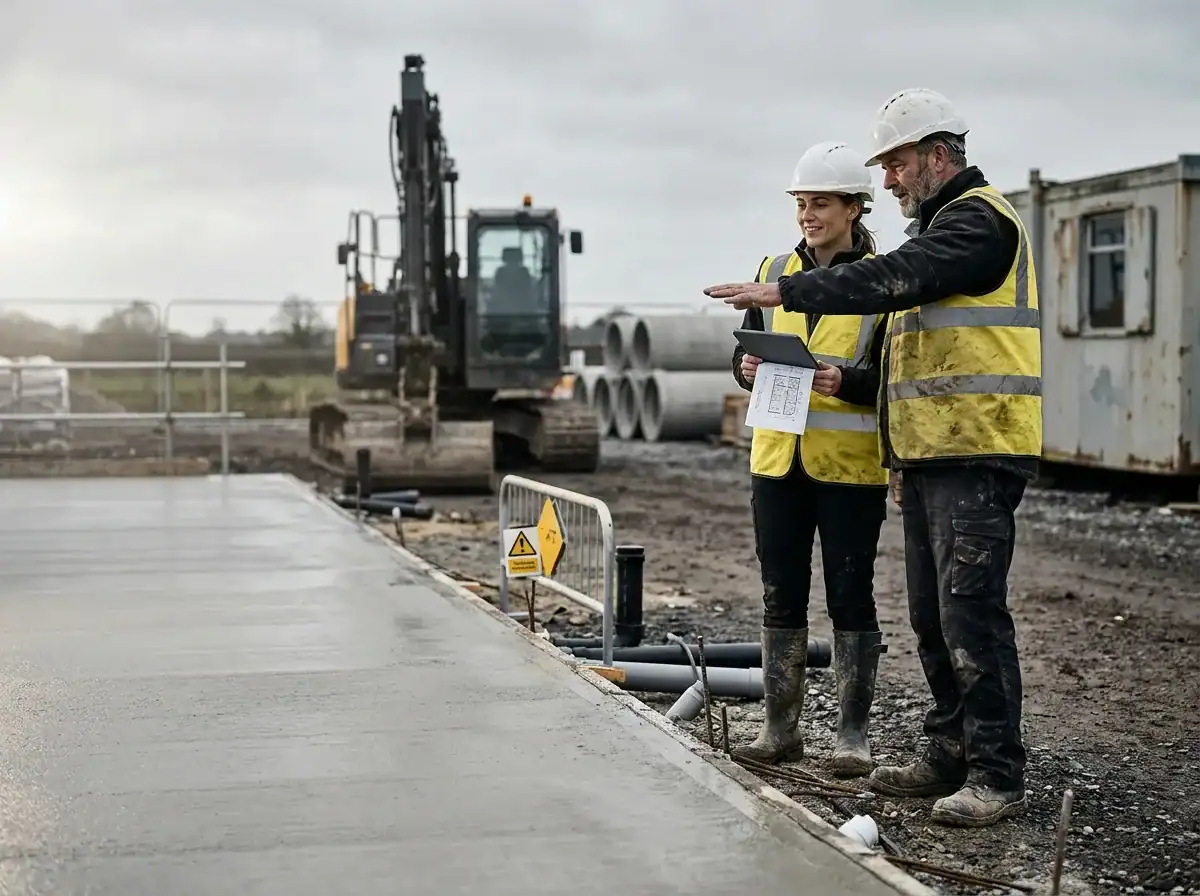
The AI feeder loop is real. Published case studies indexed by Google are also read and weighted by the models powering ChatGPT, Claude, and Perplexity. A firm with twenty detailed, well-structured case studies on their site has a real advantage over a firm with a services page and a photo gallery. The investment in writing them pays back across SEO, AI search, and conversion simultaneously.
Where these case studies live also matters. A site built for web design that prioritises clear project presentation, proper page structure, and a conversion path for enquiries turns the content investment into actual leads. Writing the case study is wasted effort if the page template is just a thumbnail gallery with no text beneath it.
The channel most construction firms forget: your past-customer list
Every firm that has been trading a few years is sitting on its most underused marketing asset: the list of everyone it has done work for. Not a CRM, not a database. Just the names and email addresses of people who hired you, paid you, and were happy. They are a warm referral network most builders never tap.
One email a quarter is enough. A job you have just finished, with a photo. A practical seasonal note of the kind a builder actually notices, like checking pointing before the winter frosts. Then a soft ask: if they know anyone weighing up a similar project, you would value the introduction. Existing customers and warm referrals convert at a far higher rate than cold enquiries, and reaching them costs nothing.
The tools are not the hard part. Mailchimp’s free tier covers up to 500 contacts, Brevo is a sound alternative, and for a list under fifty a simple BCC from Outlook does the job. The only thing to get right is consent: a short line at handover, asking whether you can keep their email to share occasional project news and local tips, keeps the list GDPR-compliant, and most clients agree when the work has gone well.
Where construction firms most often waste digital marketing budget
Generic monthly SEO retainers without local focus. The kind where the agency produces four blog posts a month on broad construction topics and calls it content marketing. These posts rank for nothing commercially useful, produce traffic from people who will never become clients, and give the illusion of activity. Cut them.
Broad-match PPC on "construction company" or "builder UK". The traffic looks healthy in the dashboard. The enquiry rate is close to zero. The CPC drains budget before you have had time to question what you are actually buying.
Brand films before basic site conversion is fixed. A £10,000 brand video is satisfying to commission. It is also the wrong spend when the enquiry form on your contact page does not work on mobile. Fix the basics first.
Social media agencies posting three times a week to a commercial main contractor's Instagram, because it was included in the package. Commercial buyers do not research subcontractors on Instagram. The agency knows this too, but the content is easy to produce and the reporting looks busy.
Pretty website rebuilds that do not improve conversion. A new site that loads faster, looks better, and still has no clear path from "we do groundworks" to "here is how to talk to us" has replaced one problem with a more expensive version of the same problem.
The most expensive marketing spend is the one that produces no learning.
Common questions about digital marketing for construction companies
How do I promote my construction company?
Start with the channels your buyers actually use. For residential work, Google Business Profile and local SEO produce the highest return per pound spent. For commercial work, LinkedIn and content-driven SEO are the priority. Paid advertising works only on narrow, intent-led terms. Build the basics before adding anything more elaborate: a well-maintained GBP profile, a site that converts, and case studies that give buyers the evidence they need.
Is SEO worth it for a construction company?
Yes, for most firms, and particularly for regional contractors and specialists. The right keywords for a construction firm are low-competition and high-intent: service, location, and project-type combinations. Ranking for these terms produces durable, qualified traffic that paid advertising cannot replicate once the budget stops. A properly built SEO foundation typically takes six to twelve months to show meaningful results, and it compounds over time in a way that PPC never does.
What is the best social media for construction firms?
It depends on your firm type. LinkedIn is the right channel for commercial and tier-two subcontractor work. Facebook and Instagram work for residential and consumer-facing firms. Most construction businesses spread effort across all three and get meaningful results from none. Pick the platform that matches your buyer and do that one well, rather than maintaining a presence everywhere for its own sake.
What should a construction firm spend on digital marketing?
Gartner's research on B2B buyer behaviour consistently shows that B2B buyers complete most of their research before any supplier contact. For a construction firm under £5m revenue, a monthly budget of £800 to £2,000 focused on local SEO, GBP management, and a small paid search campaign on intent-led keywords typically outperforms a larger budget spread across every available channel. Scale what produces actual enquiries, not what the agency recommends scaling.
Where to start
The most common mistake is trying to run every channel at once. It produces activity across everything and results from nothing.
Get the basics right first. A site that loads quickly, explains what you do and where you do it, and makes it easy for the right person to get in touch. A fully maintained Google Business Profile with a systematic process for generating reviews after every project. Local SEO targeting the service-area and project-type keywords your buyers actually search. A structured approach to case studies that gives future clients the evidence they need to put you on a shortlist.
Once those foundations are in place, layering in AI search visibility, LinkedIn for commercial audiences, or carefully targeted paid search will produce compounding returns. Without them, the more elaborate channels are expensive ways to send traffic to a site that will not convert it.
If you want to see what your firm could realistically rank for and what that would mean in qualified traffic, a Traffic Projection Report gives you a concrete picture of the opportunity before you spend anything on it.
A joined-up search visibility and traffic strategy brings local SEO, traditional search, and AI visibility into a single plan rather than treating them as separate tactics. That is usually where the real returns start to emerge for construction firms who are serious about growing beyond word of mouth.
Free Traffic Projection Report
See what your firm could realistically rank for and how much qualified traffic that would mean. Free, no pitch, delivered to your inbox within 48 hours.