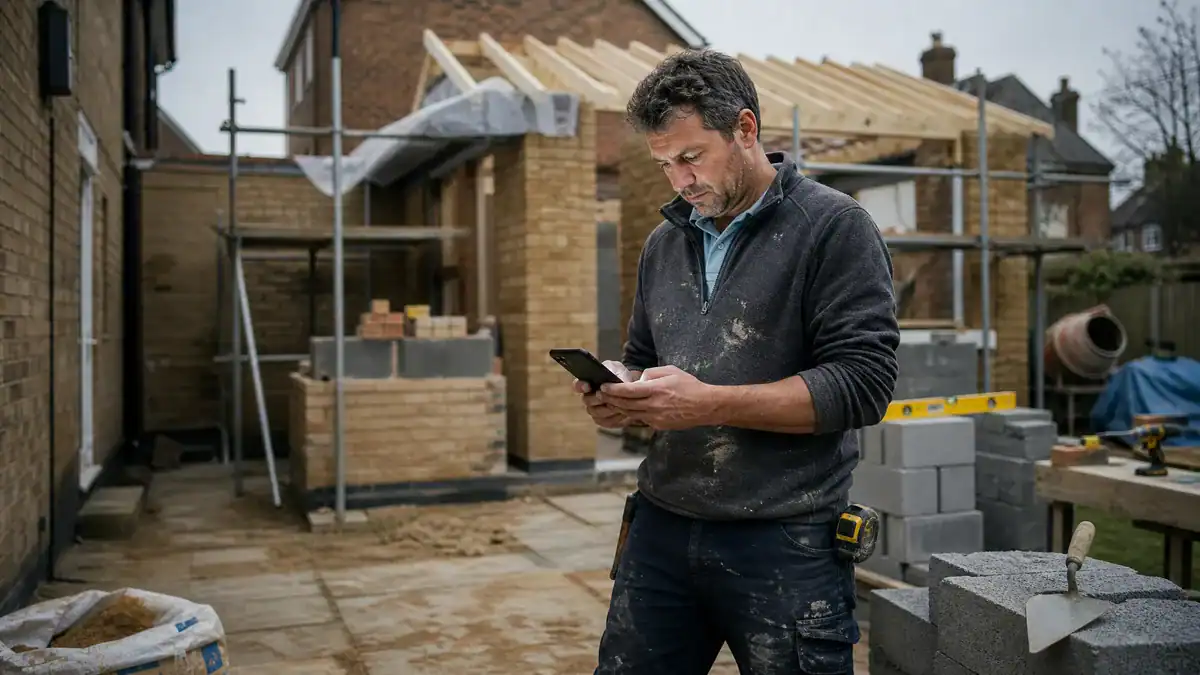
Picture this. You finish a job on a Friday afternoon, you're sitting in the van, and you type "extension builder [your town]" into your phone to see where you come up. Your competitor is in the map pack at the top. You're nowhere. Three agencies have told you this year that SEO is the answer. They all sounded exactly the same.
That moment is the reason this post exists. Not another generic "why SEO matters for small businesses" guide. The actual answer to what moves the needle for a UK building firm, what is mostly a waste of money, what you can do yourself, and where spending with an agency actually makes sense. We'll also cover something none of the other results on this topic mention at all: AI search, and why it's starting to matter for builders specifically.
What local SEO actually means for a UK builder
Local SEO for builders means getting your firm to appear in Google search results and Google Maps when homeowners in your area search for the work you do, whether that's extensions, loft conversions, kitchen refits, new builds, or general building work.
Simple in theory. Harder in practice, because Google uses three factors to decide who appears in local results. According to Google's three local ranking factors (confirmed in their Business Profile Help documentation): relevance, distance, and prominence. Relevance is how well your business matches what the person searched for. Distance is how far you are from the searcher. Prominence is how well known and trusted your business appears to be, based on reviews, links, and mentions across the web.
You cannot change distance. But relevance and prominence are entirely within your control, and most building firms have barely touched either.
There are two places you want to appear. First, the map pack, the three listings that appear at the top of a local search with the map beside them. This is prime real estate. Most clicks go here. Second, the organic results below the map pack, the regular blue links. Both matter. The firms that appear in both positions dominate their local market. Those that ignore either are leaving work on the table.
Our local SEO services are built around exactly this two-layer approach.
Why builders are different from other trades
A plumber fixes a leaking pipe. A homeowner calls whoever comes up first, checks the reviews briefly, and books. Decision made in ten minutes. A builder doing a rear extension is a different conversation entirely.
That extension might cost £60,000 to £120,000 and take four months. The homeowner is going to look at your website, read your reviews, scroll through your photos, maybe ask a neighbour, and then call three firms before they even think about committing. The sales cycle is weeks or months, not minutes. The trust bar is much higher.
This changes what SEO needs to do for a builder. Photos matter more than for electricians or plumbers, because homeowners buying a loft conversion or a kitchen extension are buying a transformation. They want to see what you have actually done. A Google Business Profile with two blurry photos from 2021 loses to a competitor with twenty recent, properly composed shots of finished work. Every time.
It also means project case studies are the most valuable content a builder can put on their website. Not a blog post about "planning permission tips" (fine, but further down the priority list). A properly written up project page for the Harpenden extension, the Listed Building renovation in Bath, the new build in Harrogate, with photos, a location, a rough cost range, and a completion date. That content does real work.
The advice that follows is built around these specific dynamics. This is not generic "tradesperson SEO."
Google Business Profile: the single biggest lever

If you only do one thing, do this. Your Google Business Profile is the single highest-leverage asset for local search. It is free, it is managed by Google, and most building firms have set it up once and never touched it again.
Here is what actually matters on the profile.
Category. This is the most commonly botched setting. Google offers "Builder", "Construction company", "Home builder", "General contractor", "Remodeling contractor", and others. The right primary category depends on what you actually do most. If the majority of your work is domestic extensions and lofts, "Builder" is usually the right primary. If you mostly do new builds, "Home builder" is more accurate. Get this wrong and you become less relevant for your best searches.
Service areas. You can set a radius or name specific towns and postcodes. Named towns tend to work better because they are more specific, and Google can match you to searches that include those place names. List every town and area you regularly work in, but do not go so wide that you are claiming to cover half of England.
Services list. Fill this in completely. Extensions, loft conversions, kitchen renovations, garden rooms, new builds, listed building work, whatever you actually do. These terms feed into Google's relevance calculation.
Photos. Upload at least fifteen to twenty photos before you consider the profile "done". Finished project photos, work in progress shots, your team on site, the front of your vehicles if they're branded. Then make it a weekly habit: one new photo, minimum. Google rewards active profiles.
Posts. The posts feature (similar to a social media update, visible on your profile) is used by almost no building firms. One short post per week, whether that's a project update, a recent completion, or a note about a service, signals to Google that you are active.
Reviews. Reply to every single one. Good or bad. A profile owner who engages with reviews signals trust. We will cover the review strategy properly in a moment.
For deeper support with your profile setup and ongoing management, our specialist local SEO support covers all of this.
Your website needs to do four specific things
Most builder websites are slow, hard to navigate on a phone, and give the homeowner no real reason to trust the firm over anyone else. That is a problem you can fix, and fixing it has a direct impact on both your Google rankings and how many of your visitors turn into enquiries.
Location pages that actually say something. If you work across a wide area, you need individual pages for each town or area you target. Not pages that say "We cover Watford" and nothing else. A real location page talks about the kind of work you do in that area, references local landmarks or project types, and has a photo or two from actual jobs in that location. Google can tell the difference between a real location page and a doorway page stuffed with town names. So can the homeowner.
Project case studies as your primary content. This is the section most builder websites skip, and it is the most valuable thing you can publish. A project page for a rear extension in Guildford, with before-and-after photos, a brief description of what was involved, an approximate cost range, and a completion date, does three things at once. It proves the quality of your work. It gives Google keyword-rich, location-specific content. And it gives the homeowner the social proof they need to make contact.
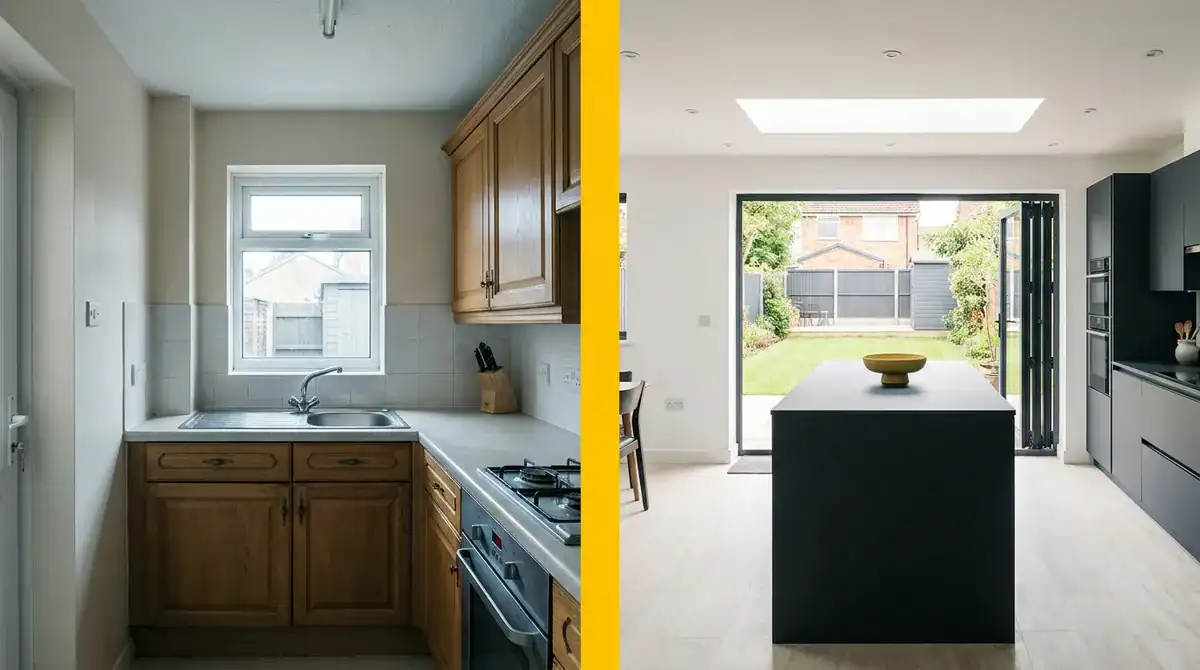
A fast, mobile-first site. Most homeowners research builders on their phones. If your site takes more than three seconds to load, a significant portion of visitors will leave before they see anything. This is one of the more fixable technical issues, and it makes a measurable difference to both rankings and enquiry rates. SEO that goes beyond Google Business Profile includes the technical groundwork that most builders' websites are currently missing.
Contact options that are obvious. Phone number, WhatsApp link, and a simple contact form, all visible without scrolling, on every page. Not buried in the footer. If a homeowner has to work to find out how to reach you, they will go back to Google and call the next firm down.
Reviews, citations and the trust signal stack
Google reviews are the most important review type for your search rankings. Full stop. Checkatrade, MyBuilder, TrustATrader, Houzz reviews all matter for trust when a homeowner is deciding between you and a competitor, but they do not carry the same direct weight for Google's local ranking algorithm that your Google reviews do.
The simplest review system that works: text every satisfied client within a week of final payment, with a direct link to your Google review page. Not an email. A text. Keep the message short. "We really enjoyed working on your extension. If you have two minutes, a Google review would mean a lot to us. Here's the link: [direct review link]." Most happy clients will do it if you make it that easy.
BrightLocal's Local Consumer Review Survey consistently shows that reviews are one of the primary trust signals homeowners use when choosing a local trade. The volume of reviews matters, but so does recency. A profile with eighty reviews, the last one from two years ago, looks less active than a profile with thirty reviews and three in the last month.
For citations, what matters is accuracy and consistency. Your business name, address, and phone number (called NAP) should be identical across Companies House, the Federation of Master Builders directory, Yell, Bing Places, and any other directory where you appear. Inconsistencies confuse Google and dilute your local authority.
Citation package services that promise to list you in "1,000 directories" are largely a waste of money in 2026. The directories that matter for a UK building firm number in the dozens, not the thousands. Getting listed accurately in the right ones is a one-time task, not a recurring spend.
AI search and how builders are starting to be recommended (or not)

ChatGPT, Claude, Perplexity, and Google's AI features are increasingly answering "best extension builder in [town]" style queries directly. Not just sending users to Google. Giving an actual answer, sometimes with firm names, sometimes with a summary of what to look for.
Most UK building firms are invisible in these answers. Not because the AI tools are ignoring builders, but because the editorial layer for this niche is thin. There are not many well-structured, genuinely informative articles about building firms in specific UK locations. The firms that do appear tend to be FMB members with complete profiles, have an About page that names the directors, have project case studies that include location and project type, and appear in credible UK directories.
What makes a firm citable by AI tools is similar to what makes a firm trustworthy to Google, but it goes further. Named individuals matter. A team page with photos and names signals that this is a real business with real people, not a shell site. Case studies with enough structured detail that an AI model can quote from them matter. Editorial mentions in local or trade press matter.
This is not another agency upsell. It is the direction search is heading. Builders who are well-structured online now will be the ones showing up in AI answers over the next two years. Understanding how AI search is reshaping local discovery is increasingly part of the picture for any firm that wants to stay visible. Our AI search visibility service is built around getting businesses cited in these answers, not just ranked in traditional results.
What to do yourself, what to pay for, and a realistic cost range
Here is an honest split of what a building firm owner can sensibly do without paying an agency, and where outside help is genuinely worth it.
Things you can do yourself:
-
Claim and set up your Google Business Profile correctly
-
Upload photos regularly (one per week as a habit)
-
Ask every satisfied client for a Google review using a direct link
-
Make sure your business name, address, and phone number are consistent across directories
-
Write a brief description of each completed project and post it on your website
Worth outsourcing:
-
Building proper location pages (not thin doorway pages)
-
Technical site work: speed, mobile performance, structured data
-
Project case study pages written with SEO in mind
-
AI search readiness: structured data, About page, editorial mentions
-
Link building: getting your firm mentioned in local press and industry sites
In terms of cost, a real local SEO programme for a small to mid-sized UK builder, covering ongoing profile management, content, and technical work, typically runs in the range of £600 to £1,800 per month depending on how competitive your area is and how much ground you are starting from. Larger cities with more competition sit towards the top of that range. Market towns with less competitive searches can see results at the lower end.
Timeline expectations: three months is a reasonable window to see meaningful movement in your Google Business Profile rankings. Organic results, the regular blue links below the map pack, typically take six to nine months of consistent work. Anyone promising page one in thirty days is not being straight with you.
The mistakes that quietly cost builders work
These come up repeatedly, and most of them are fixable once you know to look for them.
Thin location pages. A page that says "We are builders in Cheltenham, Gloucester, Stroud, Cirencester, Tewkesbury, and Swindon" with no other content is not a location page. It is a list. Google ignores it, and so do homeowners.
Buying or manufacturing reviews. Asking your brother-in-law for a five-star review, or paying a service to generate them, violates Google's terms and can get your profile suspended. It is not worth it, and Google has become considerably better at detecting it.
Ignoring photos. A profile with no photos, or only photos of your logo, will consistently underperform against a profile with real project photography. Phones take good enough photos. There is no equipment barrier here.
Letting the agency own your Google Business Profile login. Some agencies manage your profile under their own account. When you leave, they take your profile with them. Always own your own Google Business Profile login. Always.
Paying for "1,000 citations" packages. As covered above, the directories that matter number in the dozens, and getting listed accurately in the right ones is not an ongoing monthly expense. If an agency is billing you each month to maintain citations, ask exactly what they are doing.
No tracking. If you have no way of knowing whether enquiries are coming from Google, Checkatrade, word of mouth, or the new location pages you just built, you cannot make sensible decisions about where to spend. Google Business Profile Insights and Google Search Console are free and tell you a lot.
A 90-day plan if you are starting from scratch
This is not a magic formula. But if a building firm started here today, these are the moves in the right order.
Weeks one and two. Claim your Google Business Profile if you have not already, or recover access to it if an old agency set it up. Complete every section: category, service areas, services list, description, photos (at least fifteen to start), opening hours, website link. Check your NAP is consistent across Companies House, FMB, Yell, and Bing Places. Run a basic audit of your website: can it be found on mobile? Does it load in under three seconds? Is there a phone number and contact form visible without scrolling?
Month one. Set up your photo and review system. Commit to one new Google Business Profile photo per week. Text every completed project client for a Google review the week after handover. Fix the top three technical issues on your website (speed and mobile are usually the worst offenders).
Month two. Build or rewrite your location pages with genuine content. Write up three to five project case studies with photos, location, cost range, and completion date. These are the pages that do the most work long term.
Month three. Address AI search readiness. Make sure your About page names your directors, your team, and your firm's background. Add structured data to your site. Look at local or trade press for any mention opportunities. Set up Google Search Console and check what searches are bringing people to your site. Review the wider search visibility picture to understand how all the pieces connect.
Want to see what local SEO could be worth for your firm?
The question most building firms are sitting with is not really "should I do SEO?" It is: "Is there actually enough search demand in my area to make this worth the time and money?"
That is a question we can answer with real numbers. The Traffic Projection Report models what local search is realistically worth for your firm, based on your location, your services, and what the search landscape actually looks like in your area. It gives you a number, not a sales pitch.
The building firms that dominate local search over the next two years will not be the ones with the biggest marketing budgets. They will be the ones that treat search visibility as a real channel with a real system behind it, rather than something they handed to an agency once and forgot about. If you want to know what that channel is worth for your firm specifically, start there.