
It’s June. You’re fully booked. A kitchen extension wrapping up in a fortnight, a loft conversion starting next month, and a new build pencilled in from August. Everything looks fine.
Except it doesn’t quite feel fine. Because August is on the horizon and there’s nothing behind it. Same feeling as last year. You’ve tried Checkatrade and the leads were poor quality, the same enquiry going to four other builders, the job won in the end only by cutting your price. MyBuilder was similar. Word of mouth has carried the business for years, but it’s thinning out, and you can’t manufacture a customer recommendation when the phone goes quiet.
This is the feast-and-famine cycle that most small and mid-sized building firms accept as just how it works. It doesn’t have to be. What follows is a UK-focused walkthrough of what actually generates a reliable pipeline for builders in 2026, what looks like it works but mostly doesn’t, and how to put the right channels together so your search visibility and traffic becomes something you own rather than something you rent by the month.
TL;DR: The most effective lead generation for UK builders in 2026 combines owned channels (Google Business Profile, local SEO, a website that does its job) with a systematic referral process. Pay-per-lead platforms like Checkatrade, MyBuilder, Rated People, and Bark can be useful short-term top-ups, but making them your whole pipeline means paying forever for leads that often go to four competitors simultaneously. Build what you own first. The platforms are a tactic, not a strategy.
Why your leads have got worse, not your business
The residential building market has got more competitive online. Not because there are more builders, but because more builders are chasing the same digital enquiries that used to come through recommendation alone.
Ten years ago, a homeowner planning a side extension asked a neighbour, found one or two results on Google, and called the first plausible name. Now they research for weeks. They read reviews, look at project photos, check who’s on Checkatrade, browse your website (or notice you don’t have one), and in some cases ask ChatGPT what questions to ask a builder before hiring one. The FMB’s State of Trade survey consistently reports on the pressures facing small and medium building firms across the UK, and the recurring themes are tighter margins, stronger competition for residential work, and homeowners taking longer to commit.
At the same time, the lead marketplaces have evolved in ways that serve their own growth rather than yours. Checkatrade, MyBuilder, Rated People, and Bark all built their businesses on volume. More enquiries through the platform means more subscription revenue and more per-lead income. The side effect is that a single homeowner enquiry about a loft conversion now typically reaches four or five builders at once. The homeowner gets choice. You get a race to the bottom on price.
Google has also shifted. More search results pages now lead with map pack listings, AI summaries, and aggregator results before any organic website results appear. A builder who ranked well three years ago on the strength of a basic website might find that enquiries have slowed without any obvious change on their end.
None of this means your business is struggling. It means the environment has changed and what used to work passively now requires a bit of active management.
Rented leads vs owned leads, and why most builders pick wrong
Here is the mental model that makes everything else clearer.
Rented lead sources are ones you pay for and the tap runs. When you stop paying, the tap stops. Checkatrade, MyBuilder, Rated People, Bark, Buildscout, Barbour ABI, Glenigans. All rented. Each one can generate genuine work, but none of them builds anything you keep. You own no rankings, no reviews on your own profile, no content that compounds. The moment the subscription lapses, it is as if you were never there.
Owned lead sources are ones that compound over time. Your Google Business Profile, your website, your local search rankings, your review portfolio, your customer list. These take longer to build, but once they exist they work without ongoing fees. A project case study you publish this month can generate enquiries two years from now. A genuine five-star review left by a customer last year is still influencing homeowners today.
Most builders end up rented-heavy because platforms are immediate and owned channels feel like a long-term project with uncertain returns. The result is a pipeline that costs more every year to maintain as competition on the platforms increases, while the owned channels that would reduce that cost never get built.
Both types of channel have a place. A new firm with no track record and no online presence should absolutely use Checkatrade or MyBuilder to generate early work and first reviews. An established firm might use Bark to fill one specific gap when the diary has a hole. The mistake is letting rented channels become the whole pipeline rather than a short-term top-up while the owned channels are growing.
Start with Google Business Profile
If there is one action worth taking this week, it is this one. Free, fully owned, and the highest-return lead channel available to any service-area business in the UK.
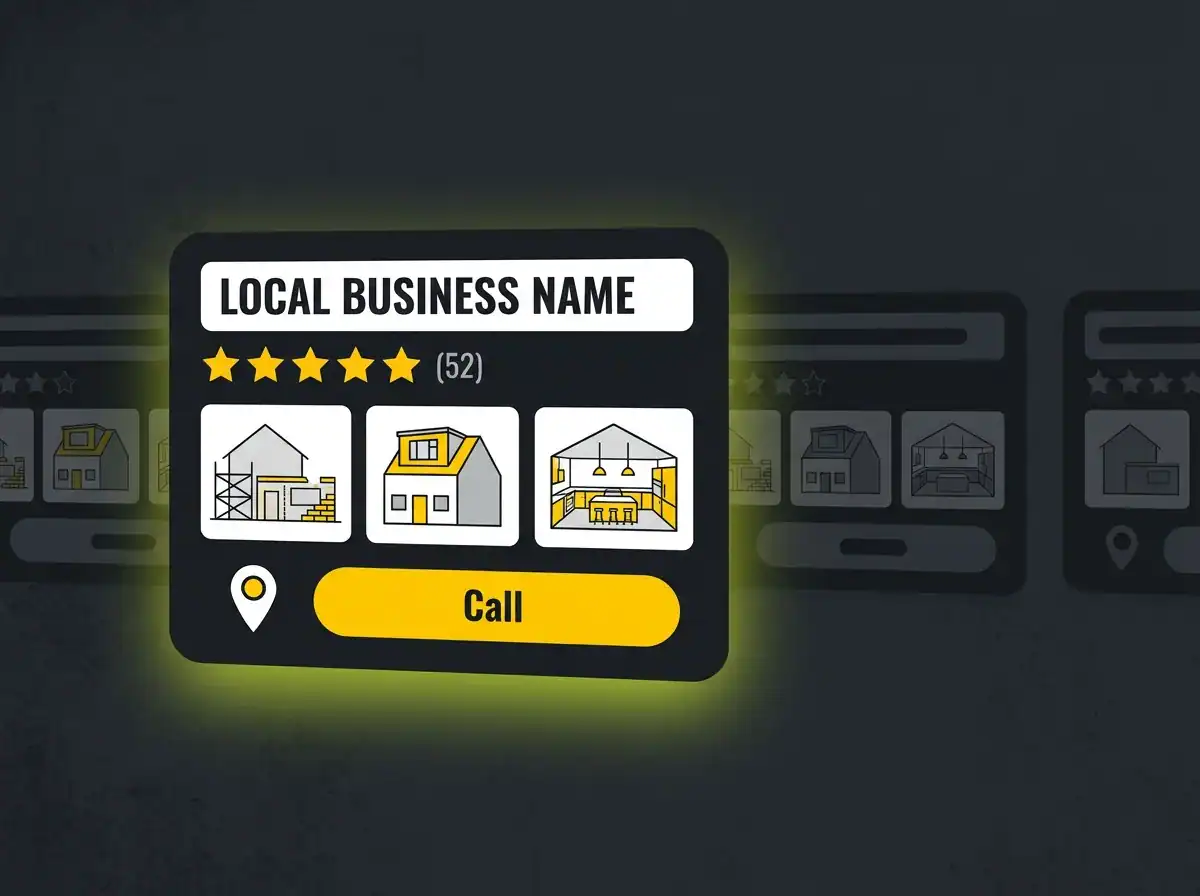
Most builders have a Google Business Profile. Most builders have a half-finished one. The things that are consistently missing are the things that move the needle most.
Service categories. Most profiles are set to just “Builder” and left there. You can add multiple categories: general contractor, extension builder, loft conversion specialist, kitchen fitter. Each one adds relevance for different search terms.
Service areas. This is how Google understands that you cover more than your office postcode. Set it to the specific towns and postcodes where you want to work. Keep the profile address matched to your registered trading address so Google can verify it, then use the service area settings to map your actual coverage.
Project photos. Not the ones your phone took by accident on site. Proper on-site photos with a brief caption explaining what the job was, where it was, and what the finished result looks like. Upload twenty to start. Builders with a consistent drip of new photo activity significantly outperform those with a static gallery.
Reviews. Ask every happy customer at handover, in person, not by text a week later when the goodwill has cooled. A QR code on a business card that links directly to your Google review page takes ten minutes to set up and removes the friction that stops most customers actually leaving one.
Google posts. A brief weekly update, a photo from a current job, a note about upcoming availability. It takes ten minutes and it signals to Google that the profile is actively managed, which matters for the local ranking algorithm.
For the full picture of what good local SEO for trades looks like beyond the profile, there is more detail on the Local SEO service page.
A website that earns enquiries instead of decorating the van
When a homeowner finds a builder on Google, the next thing they do is visit the website. If the site looks like it was last touched in 2019, with a stock photo of a hard hat, a phone number in the footer, and an About Us page that could belong to any business anywhere, they close the tab.
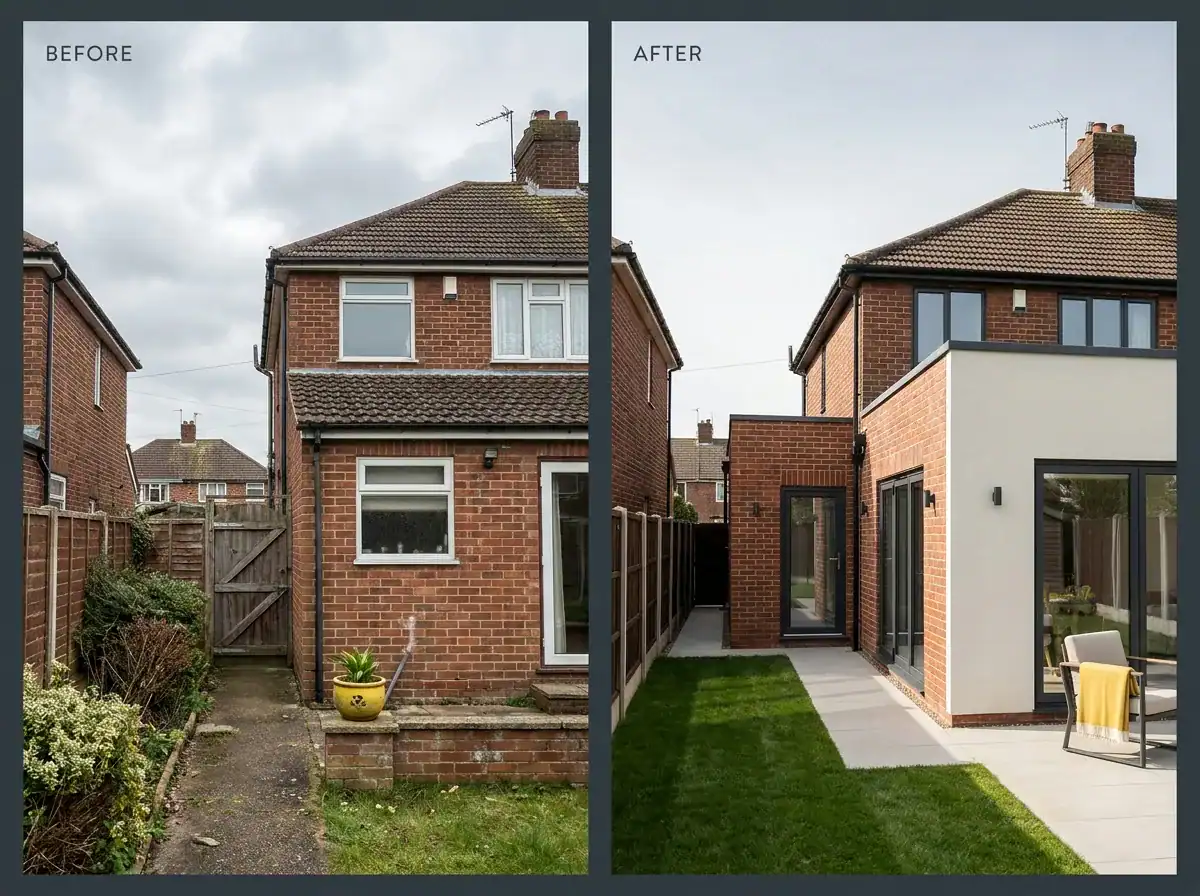
What a builder’s website actually needs, in plain terms:
A page for each main service. Not a single Services page with a bulleted list, but a proper page for extensions, one for loft conversions, one for refurbishments, one for new builds. Each should explain what the work involves, the kind of budget range it typically sits in, the postcodes you cover, and at least one real project photo.
Real project case studies. The problem the customer came with, the approach taken, a handful of photos showing the work in progress and finished, and an honest cost band. Homeowners planning an extension do not want to see fifteen generic before-and-after photos. They want to see a job that looks like theirs, done well, with a realistic sense of what it cost.
Per-area pages for your highest-value locations. If you regularly work in three or four towns, a dedicated page for each one (“Extensions in Harrogate”, “Loft conversions in Knaresborough”) gives you something specific to rank locally that a generic page cannot.
A mobile-first design with a tap-to-call button at the top. More than half of builder-related searches happen on a phone. If the first step a visitor has to take is scrolling to find a contact number, you are losing jobs you have already paid to attract.
A website that actually converts does not have to be expensive or elaborate. It needs to answer three questions in the first ten seconds: what do you do, where do you do it, and why should I trust you. Most builder websites fail at least two of those three. The same principles that make landing pages that convert apply directly to any service or area page on a builder’s site.
Local SEO and the map pack
When someone searches “builder near me” or “loft conversion Leeds”, Google shows a map pack: three business listings, a map, and then organic website results below. The three firms in that pack get the overwhelming majority of clicks from that search.
Google decides who gets those three spots based on three signals. Relevance: does your profile and website match what the person searched? Distance: do you physically cover their area? Prominence: do you have reviews, links to your site, and consistent mentions of your business name elsewhere on the web?
Relevance you influence through your Google Business Profile categories and your website’s per-service and per-area pages. Prominence you build through reviews and citations.
Citations are mentions of your business name, address, and phone number across other websites. Consistency matters more than volume. If your address is listed slightly differently across Checkatrade, FMB, TrustATrader, and a local council trader directory, Google’s confidence in your business details weakens. Claim your listings on all of them, make the details match, and update them whenever anything changes.
Which? Trusted Traders is worth a mention here. Homeowners do check it when deciding between builders, and it carries genuine trust signals. Being listed there is useful as a citation source and as a conversion factor, regardless of whether it generates direct enquiries.
Reviews are doing two jobs at once. They are a local SEO ranking factor and they are the first thing a homeowner reads when deciding whether to call. A profile with forty reviews averaging 4.8 stars wins the click over a profile with eight reviews most of the time, regardless of what else is on the page.
For a more technical breakdown of how this all works specifically for building trades, the post on SEO specifically for builders covers the mechanics in detail.
AI search is now part of the buying journey

Nobody else writing about builder lead generation seems to have noticed this yet.
Homeowners are increasingly using ChatGPT, Claude, Perplexity, and Gemini to answer preparatory questions before they open Google. “What questions should I ask a builder before hiring them?” “How much does a side extension cost in 2026?” “What planning permission do I need for a loft conversion?” AI tools answer these questions, sometimes at length, and they draw from websites with structured, clearly-written content.
Businesses with genuine FAQ pages, real project content, and schema markup are the ones AI models pull from most reliably. That matters because AI search traffic converts at 5x the rate of typical organic traffic. Someone who arrives at your website after asking an AI tool about building extensions is not casually browsing. They are verifying. They have already done the research and they are checking whether you match what the AI described.
Getting visible in AI search is not a separate project from the local SEO and website work described above. A site with clear service pages, real project photos, genuine reviews, and an FAQ section covering the questions homeowners actually ask is already well-positioned. The additional step is technical: Article and FAQPage schema markup makes it easier for AI models to parse and cite your content correctly. An SEO agency handles the technical implementation; the content is yours to build through the project case studies and FAQ pages already described.
For the broader picture of AI search visibility and why it is worth paying attention to for a trades business, the principle is simple: write what your customers are asking, not only what you want to tell them.
Referrals as a system, not an accident
Word of mouth still works. The point is not to replace it but to stop treating it as something that happens to you.
A referral system is simple. Ask every customer at handover, in person, not by text a week later when the moment has passed. Give them something to pass on: a business card with your website and Google review link, a brief one-page summary of the job they can forward if a friend asks. Follow up every six months with a short email: “We are taking bookings from September. If you know anyone planning building work, we would appreciate a mention.”
That follow-up email takes ten minutes to send to a list of twenty past customers. It generates a consistent trickle of introductions every time. Most builders do not do it. The ones who do find it produces a noticeable share of their annual pipeline.
A small spend on a proper print job at handover, good quality business cards with a real project photo on the back, outperforms most digital tactics for repeat referrals from the same customer. People keep useful business cards. They throw away the cheap ones. The difference in material quality communicates the difference in the quality of the work.
Good lead nurturing for a small building firm does not need to be a complex automated system. The six-monthly email to a list of past customers is about as sophisticated as it needs to get, and it is more effective than most things that cost money.
When paid lead platforms still make sense
Honestly, there are two situations where they make sense and one where they do not.
A new firm with no track record, no online reviews, and no website has almost nothing to offer a prospective customer on trust alone. A Checkatrade or MyBuilder profile with early reviews and project photos is a reasonable starting point while the owned channels are being built. Treat it as a twelve-month bridge, not a permanent foundation.
A fully booked firm that wants to fill one specific gap, say, only kitchen extensions for the next six weeks, can use Bark as a tactical top-up without much guilt. The key is time-boxing it. Use it for the gap, then stop. Do not let the habit replace the work of building owned channels.
The situation where platforms do not make sense is using them as your entire pipeline indefinitely. The cost per acquired job is higher than most builders realise, partly because of the subscription or per-lead fee, and partly because of the time spent quoting shared leads that go to competitors. Verify current pricing directly with each platform before committing, as rates shift frequently and vary significantly by job type and region.
Qualifying leads so quoting doesn’t eat your week
The problem with lead generation done well is that it can produce more enquiries than you have time to quote properly. A site survey and a proper quotation takes several hours. If three out of every five enquiries turn out to be exploratory conversations from people with no budget and no plan to start for eighteen months, you have just lost most of a day.
Before committing to a site visit, ask three questions. What is the project? What is the rough budget for the work? When are they looking to start? Anyone who answers all three clearly is a genuine prospect. Anyone who cannot engage with the budget question, or says “not sure yet” to all three, is not ready to hire a builder and probably should not be taking up a slot in your diary.
This is not about being difficult. It is about protecting the time you need to do the actual work. Understanding the shape of a proper marketing funnel makes this easier, because it separates the people who are still looking from the people who are genuinely deciding. A short qualifying call before the site visit will tell you most of what you need to know in five minutes.
Putting it together: a 90-day plan
Three months. Three sets of priorities.
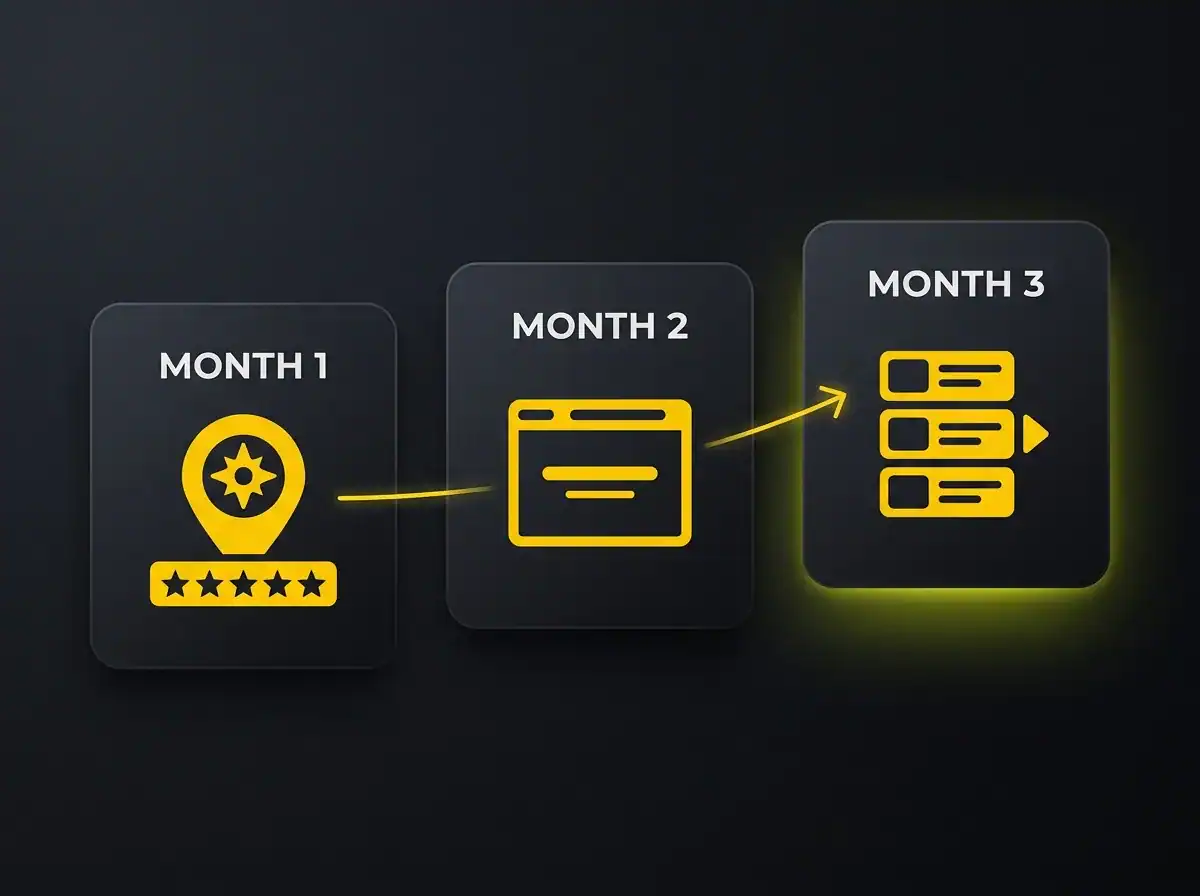
Month one. Claim, complete, and fully optimise your Google Business Profile. Set your service categories and service areas correctly. Upload twenty real project photos with captions. Set up a system for requesting reviews at handover, whether that is a QR code on a business card, a text message template, or a direct verbal ask. Audit your existing website: does it have a page per service, a working mobile call button, and at least one real project photo per service type? If not, note what is missing.
Month two. Rebuild or refresh the website around real project case studies and per-service pages. Add two or three per-area pages for your highest-value postcodes. Claim your listing on Checkatrade, FMB, Which? Trusted Traders, and TrustATrader if you have not already, primarily for NAP citation consistency rather than for direct leads. Focus on driving traffic to your site through the owned channels you have now built, rather than relying on the platforms.
Month three. Start publishing one project case study a month. Brief summary of the job, five project photos, cost band, short customer testimonial. Set up a FAQ page or FAQ sections on your service pages covering the questions homeowners actually ask. Document your referral process so you are asking consistently at every handover, not just when you remember.
Three months is not long enough to see the full compounding effect of local SEO. But it is long enough to have a Google Business Profile working properly, a website you are not embarrassed by, and a referral system you are actually using. That puts you ahead of most of your competitors before month four.
Frequently asked questions
Is Checkatrade worth it for builders?
It depends on where you are. For a firm with no online footprint and no reviews, Checkatrade provides a useful starting point and can generate early work while owned channels are being built. For an established firm with a working Google Business Profile and a decent website, the return tends to be lower, because the same enquiry goes to several builders simultaneously and the cost per job won can be high. It works best as a short-term top-up rather than a long-term foundation.
How much do builder leads cost in the UK?
It varies significantly by platform and job type. Pay-per-lead platforms charge per enquiry, and per-lead costs have risen as builder competition on the platforms has grown. Subscription models offer access to a volume of enquiries for a monthly fee, which can lower the cost per lead but comes with no exclusivity guarantee. Check current pricing directly with each platform before committing, as rates change frequently and are sometimes negotiable.
Do I need a website if I’m fully booked on referrals?
Yes, and this is the question that ages badly. Referral networks thin out over time. Customers move, their networks change, and the projects available through those networks do not always match the work you want to take on. Beyond that, almost every referral will check your website before calling, even if a friend recommended you. A neglected website quietly loses jobs you were already in line for. A basic but genuine site is a hygiene factor, not a luxury.
How do I get extension or loft conversion leads specifically?
Dedicated service pages for each type of work, optimised with the correct local search terms and real project photos from completed jobs. A Google Business Profile correctly categorised for that specific work. Reviews that mention the job type by name. The local SEO for these searches typically takes three to six months to gain traction. Google Ads can bridge the gap while organic rankings are building, particularly for high-value job types where the cost per click is justified by the job margin.
How long does it take for SEO to start working for a builder?
For Google Business Profile improvements, weeks. Consistent reviews, updated photos, and correct categories can move a profile up the map pack within four to eight weeks. For organic website rankings on competitive searches like “builder in [city]”, expect three to six months before meaningful movement, longer if the site is starting from scratch. The return compounds over time. A site ranking well in month twelve costs very little to maintain compared to the equivalent paid lead spend.
The honest answer to “where do we start?”
The rented versus owned distinction is the whole argument. Most builders end up spending more on platforms every year because they never build the thing that would make the platforms optional.
If you are currently paying Checkatrade, MyBuilder, Bark, or Rated People, that spend is not necessarily wasted. But it is not building anything. The same investment directed over twelve months toward a properly built website, an active Google Business Profile, and a few hours of local SEO work each month would likely produce more enquiries, and would keep producing them after the investment stops.
The best next step if you want to see what that could look like for your specific business is a Traffic Projection Report. It is not a generic estimate. It looks at your actual trade, your postcode coverage, and the real search demand for the type of work you do, then shows you a realistic picture of what a properly built owned pipeline could deliver over twelve months. No guesswork. Just the numbers for your market.