
"We had the site rebuilt about three years ago. Looks the part. Honestly, I couldn't tell you whether it's brought in a single new client."
That conversation happens more than it should. The firm has the ICAEW badge. The team page has proper photos. The contact form works. Enquiries still come through word of mouth, the occasional referral, or a Google search for the firm's own name. Not from a stranger landing on the website and deciding to call.
Sound familiar?
The problem is rarely the design. It is the architecture underneath it. Most accountancy websites are built to look credible to the partners reviewing them, not to feel reassuring to a prospect who has never heard of the firm.
They are making up their mind in the next five minutes. Whether to pick up the phone or keep scrolling.
This guide covers six things that separate accountancy firm websites that generate enquiries from those that don't: where trust signals belong, why your service page structure is probably costing you both clients and search rankings, what real lead capture looks like, what compliance copy your site legally needs, and how your content determines whether AI tools recommend you.
All of them are structural, not cosmetic.
These are the questions we work through on web design for professional services firms. If your sector is law rather than accountancy, we cover the same ground in our guide to professional services web design for solicitors — the differences are regulatory, not structural.
Why accountancy websites lose the prospect before the phone call
The person typing "accountant [city]" into Google is not researching the accounting profession. They already know they need an accountant. What they are doing is screening — quickly, with several firms open in parallel tabs — to work out which one is worth a call.
That decision happens fast.
A typical verification journey runs five to ten minutes. They land on the homepage, scan for service names they recognise, click to the team page, check qualifications, look for Google reviews, glance at the contact page for a phone number. If any of those steps returns a dead end, a vague answer, or a feeling that the firm is generic, they close the tab.
Then they try the next one.
This is where the gap between "looks professional" and "passes the screen" opens up. A site with a named R&D tax specialist, a visible ICAEW practice certificate, recent five-star Google reviews, and a list of specific sectors the firm has worked in for twenty years says something. A site with nice photography and a "We help businesses of all sizes" headline says nothing.
One of those passes the screen. The other does not.
The underlying principle is the same one behind every what B2B websites need to generate enquiries conversation: a prospect arrives already intending to buy. The website's job is not to convince them. It is to not talk them out of it.
Trust signals that move prospects from browsing to calling

Professional body credentials are the most under-used trust signal in accountancy websites. Most practices put the ICAEW or ACCA logo in the footer, where it sits next to the copyright notice and the cookie policy link. That is the wrong place.
These logos should be in the header or prominently above the fold on the homepage, where a prospect sees them before they read a single line of copy.
ICAEW has specific guidance on how member firms must display the "ICAEW Chartered Accountants" designation, covering the approved form of words, sizing, and placement requirements. Worth reading before any redesign.
A firm using the designation incorrectly creates a compliance risk. A firm displaying it prominently and correctly creates an immediate credibility signal to every business owner who knows what the letters mean.
Software partnership badges. For a small business owner choosing an accountant, knowing the firm is a Xero Gold Partner or a QuickBooks ProAdvisor matters. It means the firm can work with the systems the business already runs on. These badges belong on the homepage and on relevant service pages, not buried in an "About us" paragraph two scrolls down.
Placement matters more than people think.
Named partner bios. A team grid with headshots and job titles converts poorly. A bio page with qualifications, sector focus, years of experience, and a sentence about what the person enjoys working on converts significantly better. The prospect is choosing a person as much as a firm. Give them enough to make that decision.
A bio that says "Jane Holt FCA, with 18 years specialising in owner-managed businesses and R&D tax credits" is more useful than "Jane, Senior Partner."
Google reviews and their recency. Total count matters less than people think. A firm with eighty reviews, the most recent from two years ago, looks like it stopped caring. A firm with fifteen reviews, the most recent from last month, looks active. The review snippet should be visible on the homepage with a direct link to the Google Business Profile so prospects can read the full set without hunting for it.
Recency is what builds confidence. Total count is just vanity.
Client outcomes rather than testimonials. "Very professional and always responsive" tells a prospect nothing they could not have written themselves. "Helped us restructure the shareholding ahead of a company sale, saving around £85,000 in capital gains exposure through timing the transaction correctly" creates belief. Generic praise creates nothing. If you have one or two specific outcomes you can share with client permission, those belong on the homepage and on relevant service pages.
Why one "What we do" page is costing you clients (and search rankings)
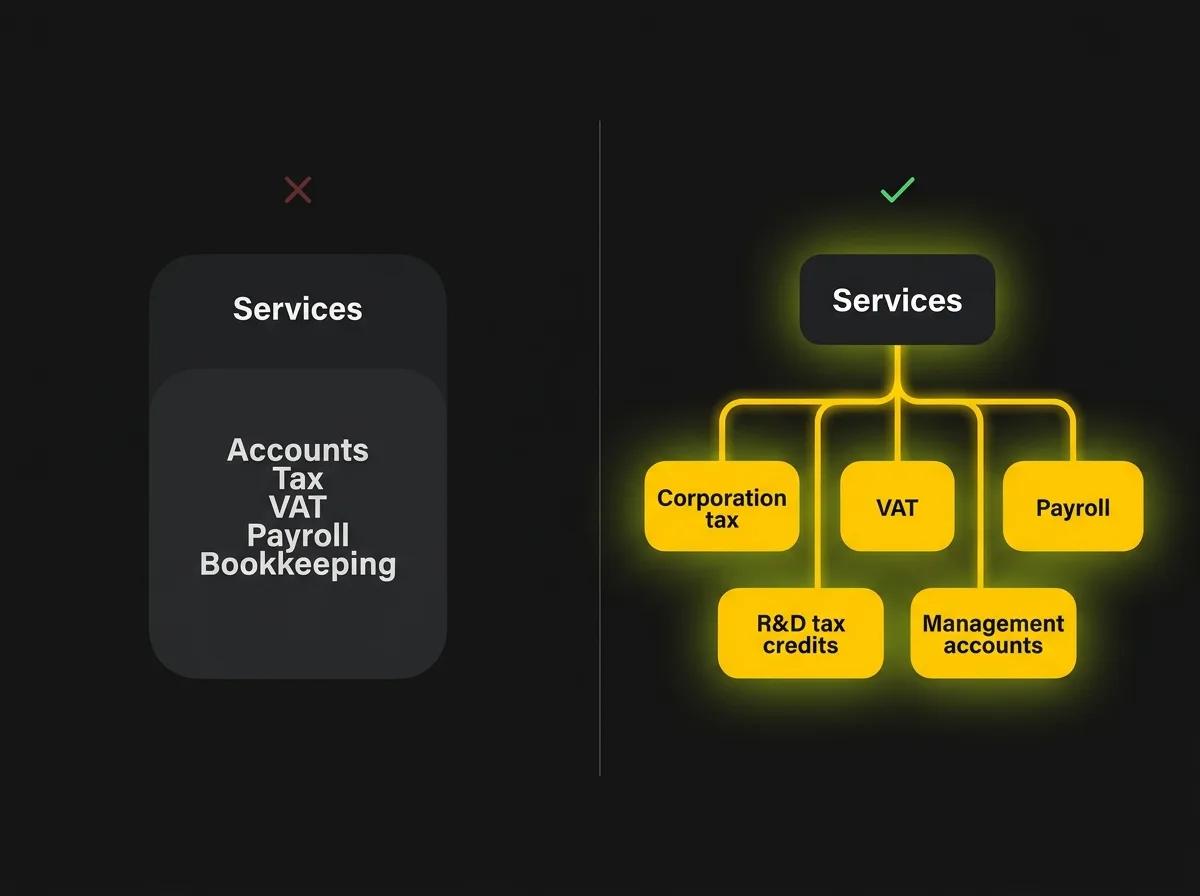
The single services page is the most common structural mistake in accountancy websites. It looks tidy. Partners like that everything is in one place.
It costs the firm in two ways that do not show up until you go looking.
The first cost is conversion. A prospect who needs an R&D tax credit specialist cannot tell from a bullet-pointed list whether the firm has genuine expertise in that area or just mentions it as a side service.
An individual service page with 500 words explaining what R&D tax relief covers, which types of business qualify, what the claim process involves, and what the firm has done for comparable clients — that demonstrates depth.
A line in a list does not.
The second cost is search visibility. A single page cannot rank for multiple distinct queries. "Accountants for construction contractors" and "R&D tax relief for SMEs" and "VAT returns for e-commerce businesses" are three different searches with three different intents. They need three different pages to rank for them, each one answering the specific question a searcher in that situation is actually asking.
That matters.
The service pages worth building out properly include, at a minimum: accounts preparation, corporation tax, VAT, payroll, bookkeeping, management accounts, R&D tax credits, Making Tax Digital advisory, and personal tax if the firm works with individual clients.
Each page should answer four questions: what the service includes, who it is for, what a client needs to bring to get started, and how to take the next step.
Somewhere between 400 and 800 words per page is typically right.
This connects directly to local search visibility. Individual service pages with location signals help Google understand the depth of a practice's offering, which affects both organic rankings and map pack prominence for specific service queries. We cover that side of it in detail in local SEO for accountancy firms.
Lead capture for accountancy firms: beyond the "Get in touch" form
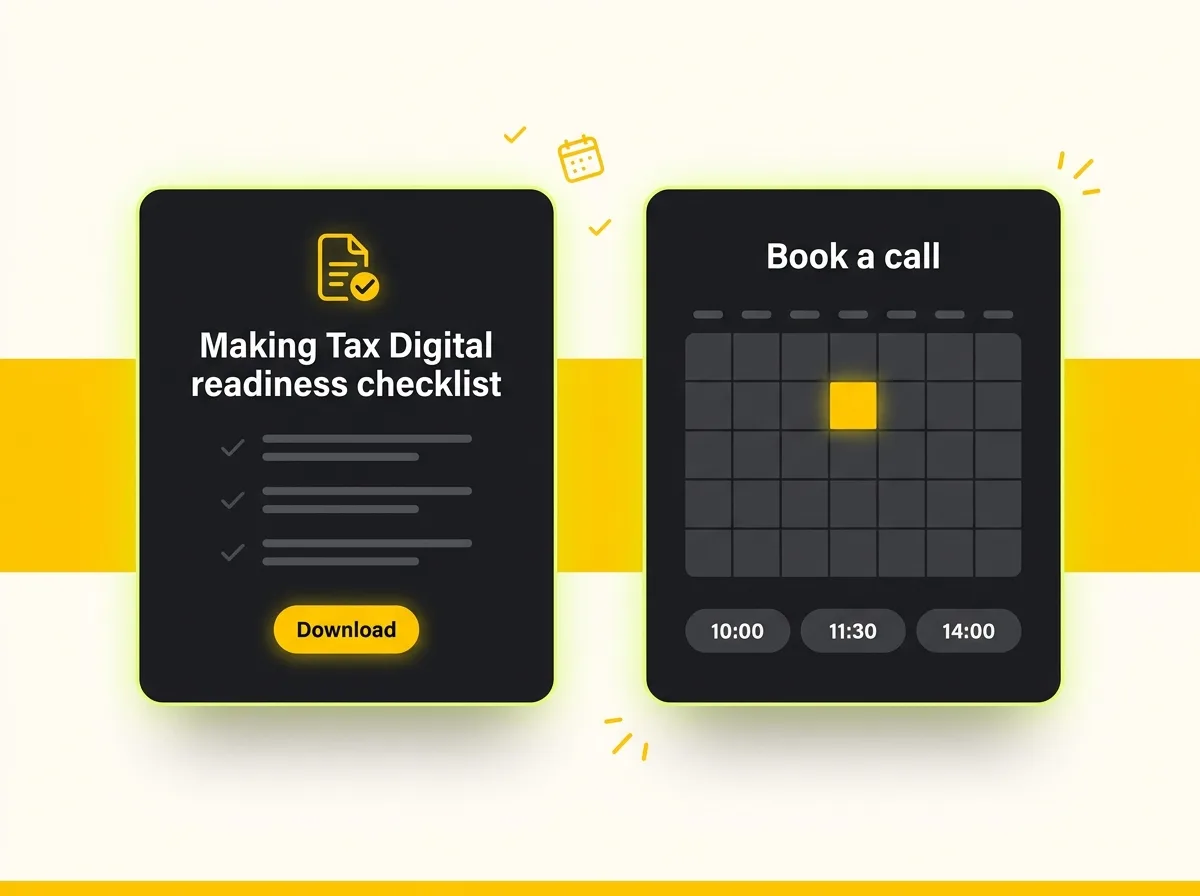
The contact form is a high-commitment action. A prospect has to be fairly convinced before they fill one in. That means most of the people who reach your contact form were already nearly decided before they arrived.
Everyone else leaves without leaving a trace.
Most accountancy websites have no way to capture interest at that earlier stage. Here are three that work.
A specific downloadable resource. The ones that work best are tightly matched to the prospect's current problem. A Making Tax Digital readiness checklist is useful to a small business owner still figuring out what MTD means for them.
A corporation tax planning guide aimed at companies with turnover between £500k and £5m is useful to the exact type of director a practice wants to attract. A "preparing for your year-end" checklist is evergreen and captures email addresses from prospects who are interested but not yet ready to call.
The exchange is simple: you get the email address and permission to follow up; they get something genuinely useful now.
Online initial consultation booking. A calendar link to book a free 20-minute call is a lower-commitment step than a full enquiry form, and it converts people who would otherwise leave. The prospect decides on their own time without having to compose a message. This option belongs in the contact page and in the service page calls to action, not as a separate buried page.
Low friction matters.
A tax deadline calendar. Either an interactive page or a downloadable PDF, updated each year. It positions the firm as a practical reference point, drives return visits from existing clients, and attracts bookmarks from prospects who are not yet ready to engage. It is also an easy candidate for an external link from a local business association or accountancy trade publication.
A firm that becomes the reliable source for deadline dates builds familiarity before a prospect ever considers switching accountants.
The principle across all three is the same: give someone a lower-commitment reason to identify themselves. The contact form catches the people who were already decided. These catch the people still making up their minds.
Compliance copy: what your accountancy website legally needs to say
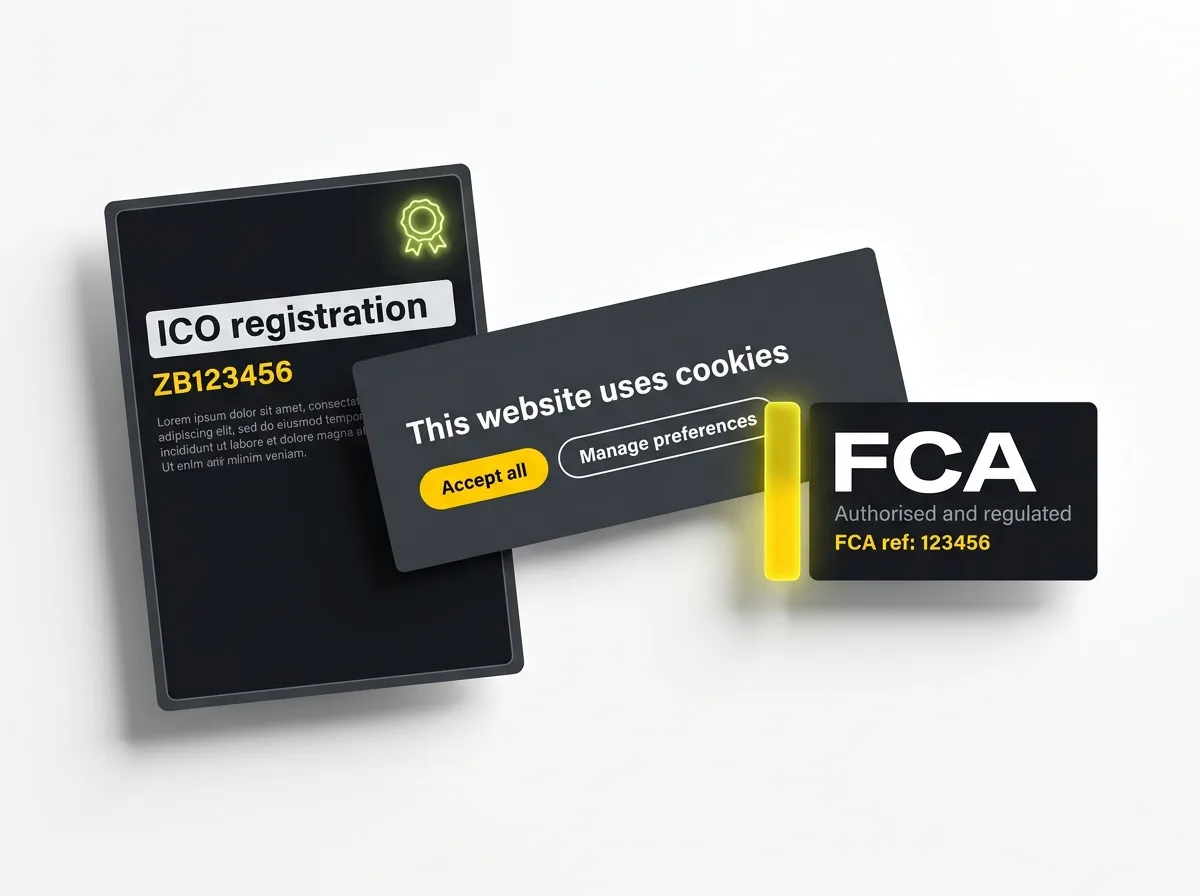
Most web design guides for accountants mention "add a privacy policy" and stop there. The compliance picture for a UK accountancy firm is more specific than that. The gaps are often visible to the sophisticated business clients a practice most wants to attract.
ICO registration. Any organisation holding personal data is legally required to register with the ICO. That includes client financial data, which every accountancy practice holds. Registration fees currently range from £35 to £3,600 per year depending on firm size and turnover.
The ICO registration number should appear in the footer alongside the privacy policy link.
Not displaying it when you hold one is an oversight that looks, to a cautious business buyer, like the firm might not have one at all. That is an easy thing to fix and a surprisingly easy trust gap to create.
GDPR-compliant contact forms. Consent must be freely given, specific, and unambiguous. Pre-ticked boxes for newsletter sign-ups do not comply. Forms must state clearly how submitted data will be used. Worth checking if the site was built before 2018 and has not been reviewed since.
Cookie consent. A compliant banner must appear on a visitor's first arrival. Declining non-essential cookies must be as easy as accepting them. A banner with only an "Accept all" button does not meet the current standard, regardless of what the developer said at the time.
Worth revisiting this one too.
FCA considerations. Firms that offer financial advice or investment guidance may require FCA authorisation. If authorised, the firm's reference number and a statement that it is "authorised and regulated by the Financial Conduct Authority" must appear on the website. You can verify firm and adviser status on the FCA Financial Services Register. The specific requirements depend on the nature of the advice offered; confirm current obligations with your professional body or legal adviser rather than relying on this article alone.
Seek advice before assuming you are exempt.
Anti-money laundering. Accountancy firms are supervised for AML compliance by their professional bodies. A brief reference to AML procedures builds credibility with business clients in higher-risk sectors — property, financial services, international trade — who have their own AML obligations and want to know their accountants take it seriously.
Nothing above is legal advice, and requirements change. The point is that a privacy policy page and a cookie banner are the floor, not the ceiling.
AI search readiness: what happens when a prospect asks an AI to recommend an accountant
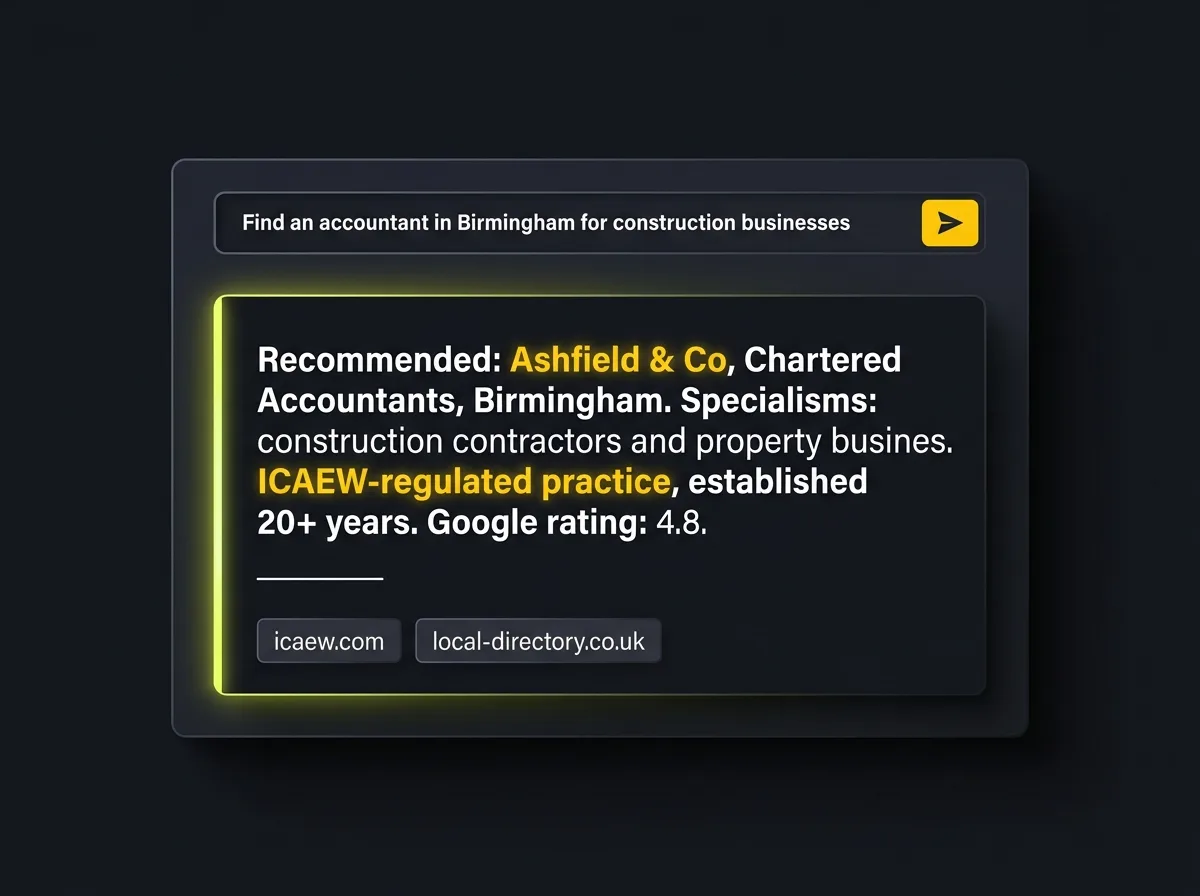
An increasing number of professional services searches now begin with a query to ChatGPT, Perplexity, or a similar AI tool. "Find me an accountant in [city] who specialises in small businesses" or "which accountants in [region] work with construction contractors" are queries that AI tools handle directly, drawing on what they know about which firms have made their expertise visible in indexed web content.
This is a real channel now. Not a future one.
What influences whether your firm appears in those recommendations?
Named specialisms in body copy. "We help businesses across a range of sectors" is invisible to an AI recommendation engine. "We specialise in accounts and tax for construction contractors, professional services firms, and e-commerce businesses" gives the AI something to match against the query. Specific, textual claims are what get extracted and cited. Vague positioning does not.
It is a text problem, not a technical one.
Credentials in text, not images. AI tools can extract named partners and their qualifications from page text. "Jane Holt FCA, 18 years specialising in owner-managed businesses in the West Midlands" is something an AI can read, understand, and cite. The same information embedded in a JPEG headshot is invisible. If your partner credentials are primarily in graphic form, they are essentially not there as far as AI is concerned.
Format is function here.
Location signals beyond the footer address. A footer with a postcode is not enough. "Serving Birmingham city centre, Solihull, and Worcestershire" in body copy, a local dialling code on every page, and a dedicated page for each office location (for multi-office practices) give AI tools a much clearer picture of where the firm actually operates.
This overlaps with the local SEO recommendations but applies specifically to how AI-generated responses pull textual signals, which is different from map pack ranking.
Third-party citations. ICAEW practice member directories, the Xero adviser directory, Google Business Profile, and local business association listings all contribute to an AI tool's view of a firm's credibility. A firm with presence only on its own website is harder to validate and recommend. A firm listed consistently across three or four trusted directories is far easier to cite with confidence.
There is more on what this means for conversion in why AI search traffic converts differently.
What to do with what you have found
Run through the elements above against your current website and note which are missing. The gaps tend to be the same ones: service pages that are too thin to rank or convert, credentials buried in the footer, no mechanism to capture interest below the contact form, and compliance details that have not been reviewed since the site launched.
Most practices find two or three gaps, not eight.
The gap between a website that looks professional and one that actively generates new client enquiries is almost always those specific things. Not the colour scheme. Not the font. Not whether the photography is photographic or illustrated.
Before you commission a rebuild or a significant redesign, it helps to understand what realistic search visibility your current site is generating and what a properly structured version could be expected to produce.
A free projection showing the search queries relevant to your practice that your current site ranks for, what volume is available, and what a well-structured site in your market could realistically generate in terms of qualified inbound enquiries. It makes the investment case easier to evaluate before you brief anyone.
If you are ready to talk through conversion-focused web design for your practice specifically, that is where the conversation starts.
Frequently asked questions about web design for accountants
How much does web design for accountants cost in the UK?
A professionally designed accountancy website typically costs between £3,000 and £15,000 depending on scope, number of service pages, and whether the brief includes copywriting. At the higher end you are buying a well-structured information architecture, properly written service pages, and a site built to convert rather than just to look right.
At the lower end you are likely getting a template rebuild.
The honest answer is that a website that does not generate enquiries costs more than one that does, regardless of what you paid for it. For a full breakdown by project type, what a professional website costs in the UK is worth reading before you get quotes.
Does my accountancy firm website need to be GDPR compliant?
Yes. Any website that collects personal data through a contact form, enquiry form, or newsletter sign-up is subject to UK GDPR. This means a valid privacy policy, a compliant cookie consent mechanism, and forms that explain clearly how submitted data will be used.
Firms holding client financial data are additionally required to register with the ICO and display their registration number in the footer.
This is not optional, and it is not something your web designer can opt you out of by leaving the tick box pre-checked.
How long does it take to rank a new accountancy website?
For an established practice with an existing domain, a properly structured rebuild typically starts showing meaningful rank improvements within three to four months for service-specific and local queries. Competitive terms like "accountants [major city]" take longer, often six to twelve months with consistent content work and link building.
For a brand-new domain, the timeline extends further.
Search visibility is a function of site structure, content quality, and consistent effort over time.
Can an AI tool recommend my accountancy firm to prospective clients?
It depends on what your website says and how it says it. AI tools like ChatGPT and Perplexity draw on indexed web content when making local professional services recommendations.
A firm with clearly stated specialisms in body text, named credentialled partners, and consistent listings across reputable directories (ICAEW member directory, Xero adviser directory, Google Business Profile) is far more likely to appear in AI-generated recommendations than one with generic copy and no external presence.
Most of this is fixable through content changes rather than a technical rebuild.