
"We've got two offices, we've claimed both Business Profiles, we've got reviews on each. So why does the firm three streets away keep showing up in the map pack when we don't?"
Sound familiar? The frustrating thing about that situation is that the basics are done. The practice isn't invisible because no one set anything up. It's invisible despite having done the obvious things, which means the problem is somewhere in the gap between the basics and what actually drives map pack rankings.
Local SEO for accounting practices gets genuinely complicated the moment there is more than one office: more than one Business Profile to maintain, more than one location page that needs to be something other than a city-name swap, and review profiles that need to be built separately for each listing. This article covers the mechanics of how Google evaluates accounting practices for local search, where most multi-office firms go wrong, and why the same signals that drive map pack placement are increasingly the ones that determine whether your firm surfaces when a business owner asks an AI tool to recommend an accountant in your area.
How the map pack actually works for accounting searches

Google's local algorithm runs on three factors: proximity, relevance, and prominence. They are not equal, and one of them is entirely outside your control.
Proximity is where your office is. Full stop. If a searcher is in Manchester city centre and your nearest office is in Salford, Manchester-based practices will always have a structural advantage on proximity. You cannot move your office to close that gap. Spending budget trying to compensate for a genuine proximity disadvantage is usually unrewarding.
Relevance is how clearly Google understands what your practice does and where it does it. This comes from how completely your Google Business Profile describes your services, how consistently your business information appears across directories, and how well your website corroborates your profile. Any uncertainty in those areas means Google defaults to firms it understands better.
Prominence is where the competition actually happens. Reviews, citation consistency, website authority, GBP activity, and the quality of your location pages all feed into prominence. This is the factor you can materially influence, and it is where most of the work sits.
One thing most guides skip: not every accounting search triggers the map pack. "Accountant in Bristol" and "accountant near me" are local pack queries. "Self-assessment help for landlords" or "PAYE payroll software advice" may return only organic results, with no map pack at all. Knowing which queries your prospective clients actually type is the first strategic decision, because the work looks different depending on whether you are targeting map pack placement or organic rankings.
The stakes are higher here than for standard organic positions. The map pack shows three results above the fold. Position four is functionally invisible for local intent searches. Missing the three-pack earns almost nothing.
Your Google Business Profile is doing more work than your website

Most accounting practices underestimate how much weight their Google Business Profile carries. For local search, it often has more direct influence on map pack placement than the website does.
Primary category selection. "Accountant" is the correct primary category for the vast majority of UK practices. This single choice carries more ranking weight than any other element on your profile. If you are currently set to "Accounting firm", "Financial consultant", or anything else as primary, change it. "Chartered accountant" and "Tax consultant" work as secondary categories to add alongside.
The services tab. Every distinct service you offer should be listed as an individual entry: self-assessment tax returns, VAT returns, payroll, bookkeeping, management accounts, business advisory, company formations. Each entry is a relevance signal. A profile listing four services when the practice offers twelve is leaving relevance on the table.
Business description. You have 750 characters. Use them to say what you do and where you do it, including the service types you are known for. This is not keyword stuffing. It is basic completeness, and completeness is itself a ranking signal. Google surfaces the profiles it has the most data on.
Photos and posts. Add exterior shots (this confirms to Google that your business is a real physical location), interior images, and team photos. Name each file descriptively before upload. A GBP post every two to four weeks signals an active, managed profile. Simple content is fine: a January self-assessment deadline reminder, an update about a new service. Consistent beats elaborate.
Q&A. Seed your own questions before a stranger does. "Do you take on sole traders?" and "Do you offer a free initial consultation?" are natural starting points for an accountancy practice. Answering them yourself takes ten minutes and removes any ambiguity for a prospect deciding whether to call.
The key insight: an incomplete GBP is telling Google you are not worth surfacing with confidence.
Reviews: the ranking signal you can actually control
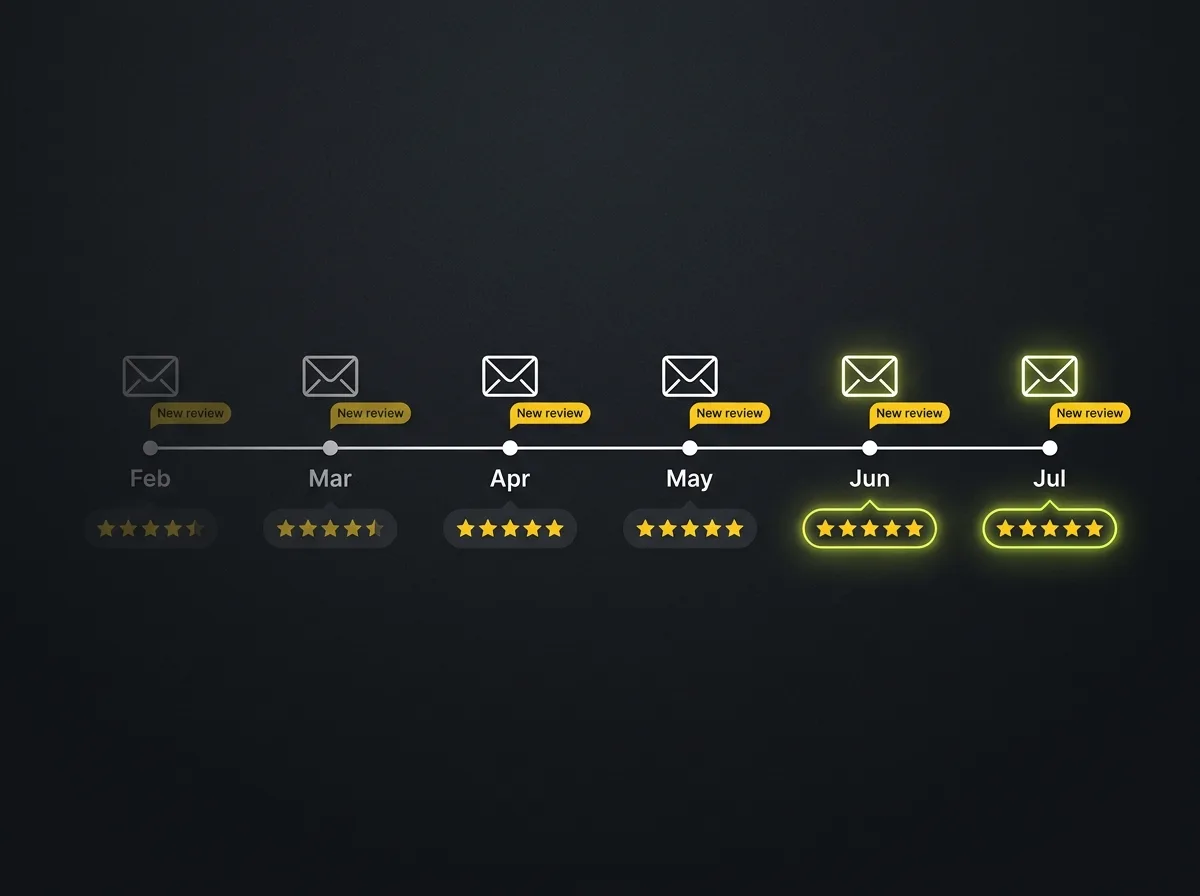
Reviews are the most accessible prominence signal you can build, and the way most practices approach them is wrong in a specific, fixable way.
Total count matters less than most people assume. Recency matters significantly more. According to BrightLocal's Local Consumer Review Survey, 73% of consumers consider reviews older than three months irrelevant when evaluating a service business. A practice with 120 reviews, most of them from three years ago, is less persuasive to the algorithm and to a prospective client than one with 40 reviews, 15 of which arrived in the last 90 days.
This means the goal is not a one-time push to collect reviews. It is a system that generates them consistently. The natural touchpoints in an accounting practice are better than most partners realise. The year-end letter, the filing confirmation email, the onboarding check-in after a new client is set up on payroll: these are moments when a client has just seen something completed on their behalf, the outcome is visible, and they are in a positive frame of mind. Asking at exactly that moment, with a direct link to your GBP review page and a single clear request, converts reliably. Make it frictionless and the timing does most of the work.
Respond to every review, including negative ones. Google weights active profiles higher. A calm, professional response to a one-star review says more about your practice than the review itself.
A practical target for competitive UK markets: four to eight new reviews per month per office. That last part matters more in a multi-office practice than most partners register. Each GBP listing is a separate local entity in Google's view. Encouraging clients to "leave us a review" without specifying which office sends the signal to the wrong place, or splits it inefficiently across listings. Your Leeds office needs reviews for Leeds. Your Bradford office needs reviews for Bradford.
Free resource: Traffic Projection Report
The Traffic Projection Report is a free diagnostic that shows what improved local search visibility could realistically deliver for your practice in monthly traffic and enquiries. If you want to see the numbers before committing to the work, this is the right starting point.
Why location pages fail (and what makes them work)
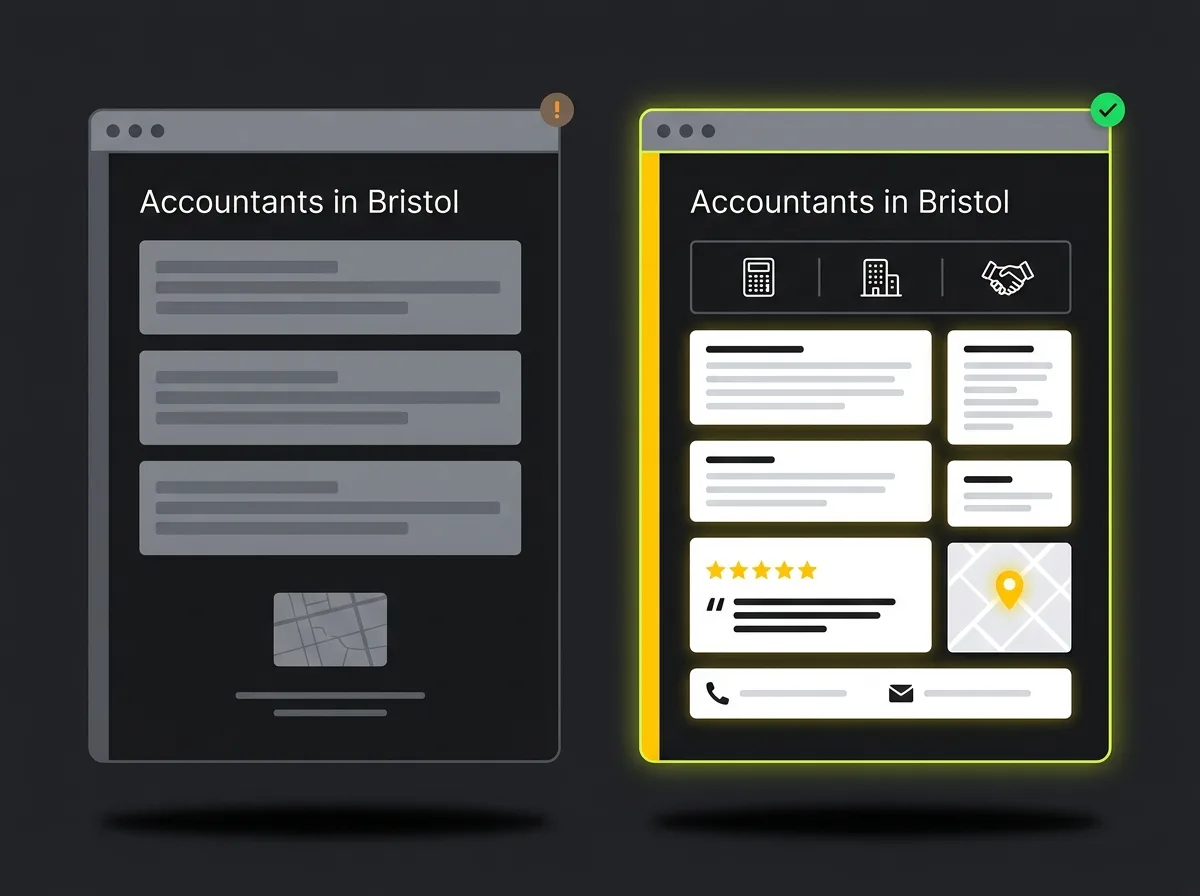
Multi-office practices make the same location page mistake with striking consistency. They build one template and swap the city name.
Google is better at identifying this than most people expect. Five pages that share 90% of their content, differentiated only by a headline and a postcode, are treated as near-duplicate content and deprioritised accordingly. The one that performs is usually the office with the strongest authority signals, and the others become invisible. This is why practices with five offices can have weaker local visibility than a single-office rival. They have built a duplicate content problem without realising it.
A location page that Google takes seriously looks genuinely different from every other location page on the site. It covers the types of clients served in that specific area (local industries, typical business size, the economic character of the town or city), the office address and contact details embedded in body copy rather than buried at the bottom, client testimonials or review quotes from clients in that area, an embedded Google Map, and structured data specifying the office address, opening hours, and service area.
Aim for 800 to 1,200 words of original content per page. In practice, that means a few paragraphs about the local client base, a genuine team section, some area-relevant content about the types of businesses you serve, and your contact information clearly presented. It takes longer to write than a template. It also actually works.
One important line to draw: a location page for a virtual address or a serviced office the team never visits is unlikely to qualify for a GBP listing and will be treated sceptically by Google. The page should reflect a real, staffed location. GBP verification has become more rigorous, and a suspended listing mid-campaign is a significant operational disruption for a practice that depends on map pack visibility.
On schema: add LocalBusiness structured data to each location page, specifying address, opening hours, geographic coordinates, and service area. This is a specific brief you hand to your web developer. It is also read by AI tools when deciding which firms to surface in location-based queries, and it connects directly to the knowledge graph and entity signals that underpin how Google understands your firm as a distinct business entity.
Managing multiple GBPs without offices competing against each other

If one section in this article applies directly to the problem most multi-office practices are quietly experiencing, it is this one.
Each physical office needs its own separately verified GBP listing. There is no shortcut.
Business name consistency. Use exactly the same name format across every listing. If the practice is registered as "Harrison & Co Accountants Ltd", every GBP should say exactly that. "Harrison & Co Accountants", "Harrison and Co Accountants Ltd", and "Harrison & Co Ltd" are different strings to Google's entity recognition system. Inconsistency weakens the signals that connect all your listings to one firm. A small formatting difference that looks cosmetic can have a measurable effect on how confidently Google surfaces any of your offices.
Phone numbers. Each GBP listing should use a location-specific number, not the central switchboard. A single number appearing on four GBPs in four cities sends a weak location signal because it does not reinforce the geographic specificity of each listing. If your practice uses one central number for everything, this is worth revisiting.
Service areas. If an office serves clients beyond its immediate postcode, set service areas in GBP to reflect realistic reach. Setting the service area to all of England for an office in Coventry actively dilutes the local relevance signal for Coventry searches. Keep service areas proportional and accurate.
The cannibalisation problem. Two offices in the same metropolitan area can compete directly against each other in local results. Google tends to surface whichever profile is more complete, more recently active, and has more recent reviews. The instinct is often to focus everything on the stronger listing and let the other coast. Wrong. Both offices represent real client relationships and real local business. Keep both actively maintained, build both review profiles separately, and ensure the location pages are genuinely distinct. The competition between your own offices is only a problem if one or both listings are under-maintained.
A specialist local SEO agency working with multi-office accounting practices typically starts by auditing the full listing picture before touching anything else. Finding out that two of your offices are effectively invisible because the same phone number appears on both, or because the business name was entered inconsistently on each verification, is a five-minute discovery that changes the entire approach.
What local SEO signals mean for AI search recommendations
When a business owner asks ChatGPT or Perplexity "recommend a good accountant in Sheffield", that response is not drawn from a live Google search. It is drawn from a combination of trained knowledge and, increasingly, real-time retrieval from sources that look credible, complete, and consistently structured.
The firms that surface in those responses share a common characteristic. Their online presence is built consistently: accurate NAP (name, address, phone) across directories, an active GBP, recent reviews signalling an ongoing client base, and AI search visibility supported by structured data that names their location, services, and business type explicitly. Named professional body listings, like the ICAEW find-a-chartered-accountant directory, carry particular weight as citation sources precisely because AI tools recognise ICAEW as a credible institution. Accountants listed there have an authority signal that most online directories cannot match.
This is the compounding return that most practices do not see until someone spells it out. The work you do to get into the Google Maps three-pack is the same work that builds your entity signals for AI search. They share the same foundation.
Accounting practices that invest seriously in local SEO now are not just building map pack visibility. They are building the breadcrumb trail of consistent, structured signals that AI tools follow when deciding which firms in a city are worth recommending. It compounds. And that value holds over time in a way that most marketing spend does not.
If you are thinking about where local SEO sits within a broader search presence, including organic content and link authority, a well-grounded B2B SEO strategy is the right starting point before narrowing down to the local layer specifically.
Frequently asked questions about local SEO for accountants
How long does it take to rank in the map pack for accounting searches?
Three to six months is a realistic timeframe for a practice starting from scratch to reach a competitive position in the three-pack for their primary location. The timeline depends on market competitiveness (London, Manchester, and Birmingham are significantly harder than most mid-size UK cities), how complete the GBP currently is, and how consistent the existing citation footprint is. Practices with a second office that needs untangling before it can be properly managed sometimes see that listing move faster than the primary once the legacy issues are resolved.
How many reviews do I need to appear in the local three-pack?
There is no fixed number. A practice with 30 reviews that are recent and well-responded to will consistently outperform one with 150 reviews from three years ago in most UK markets outside central London. Focus on velocity and recency rather than chasing a total count. In most mid-size UK cities, 10 to 20 visible and recent reviews, added consistently over time, will be competitive.
Can I rank in a city where I don't have an office?
For map pack placement, no. The map pack is tied to verified physical locations, and a practice without a verified office in a city will not appear in that city's local three-pack regardless of what the website says. Organic rankings below the map pack are different and can be influenced by content and authority signals. But if map pack visibility in a specific city is the goal, the starting point is a genuine, verified physical presence in that city.
Does my website ranking help my GBP ranking?
Yes, indirectly. Website authority contributes to the prominence factor in Google's local algorithm. A well-structured site that corroborates the GBP information, includes distinct and substantive location pages, and has earned some inbound links will support GBP rankings. Think of the GBP as the primary instrument and the website as the supporting evidence. For the organic side of search, including content strategy and authority building, that falls under broader SEO agency work rather than local search specifically.
The map pack is genuinely valuable territory for UK accounting practices. Referrals and professional networks remain important, and most practices will not dispute that. But a growing proportion of business owners now begin their search for an accountant the same way they find everything else: by typing into Google, scanning the local pack, and calling the first practice that looks credible and nearby. If that is not you, it is someone else.
Free resource: Traffic Projection Report
The Traffic Projection Report is a free diagnostic that shows what improved local search visibility could realistically deliver for your practice in monthly traffic and enquiries. If you have been wondering whether the investment makes sense for a firm of your size and location, it gives you a concrete answer in real numbers.
For practices ready to move beyond the report and into actual implementation, our local SEO services cover everything from GBP management and citation building through to location page development and multi-office strategy.