
"I found you on LinkedIn," she said, "so I went to your website. Checked the case studies first. Then the About page. Then your services. Went back to the homepage, had another look, and then sent the enquiry."
Four pages. Under five minutes.
A buying decision that had taken weeks to reach, resolved by a single website visit.
This is how B2B buyers actually behave. They do not arrive at your homepage and scroll dutifully through every section. They arrive with a specific question already forming: are you credible enough to contact? And they check the same four or five things, in roughly the same order, before deciding yes or no.
Most B2B websites are not designed around this. They are designed to look professional.
The sections are in the right places, the photography is acceptable, and there is a contact form in the navigation. But the buyer visits the case studies page and finds vague paragraphs about "our approach to client relationships". They read the services page and find copy that could have been written by any agency in any sector. They check the About page and encounter stock photography of people in a boardroom who bear no resemblance to the actual team.
Then they close the tab.
This piece maps the buyer's actual research session and builds the design recommendations from it. Not design principles for their own sake. The buyer's questions, and whether your site answers them.
What B2B buyers do on your website before they reach out
CEB research, now part of Gartner consistently shows that B2B buyers are typically more than halfway through their purchase evaluation before making first contact with a supplier. They have identified their problem. They have a rough view of what a solution should look like. They have probably reviewed two or three alternative businesses already.
What they are doing on your website is not learning about you from scratch. They are running a verification check.
Think with Google's research on B2B mobile shows that a substantial and growing share of this research happens on mobile, often between meetings or during commutes. The first visit a new prospect makes to your site may well happen on a phone, in five minutes, while they are standing in a corridor with one eye on a meeting about to start.
If your site does not perform on mobile, you are losing buyers before they have even properly arrived.
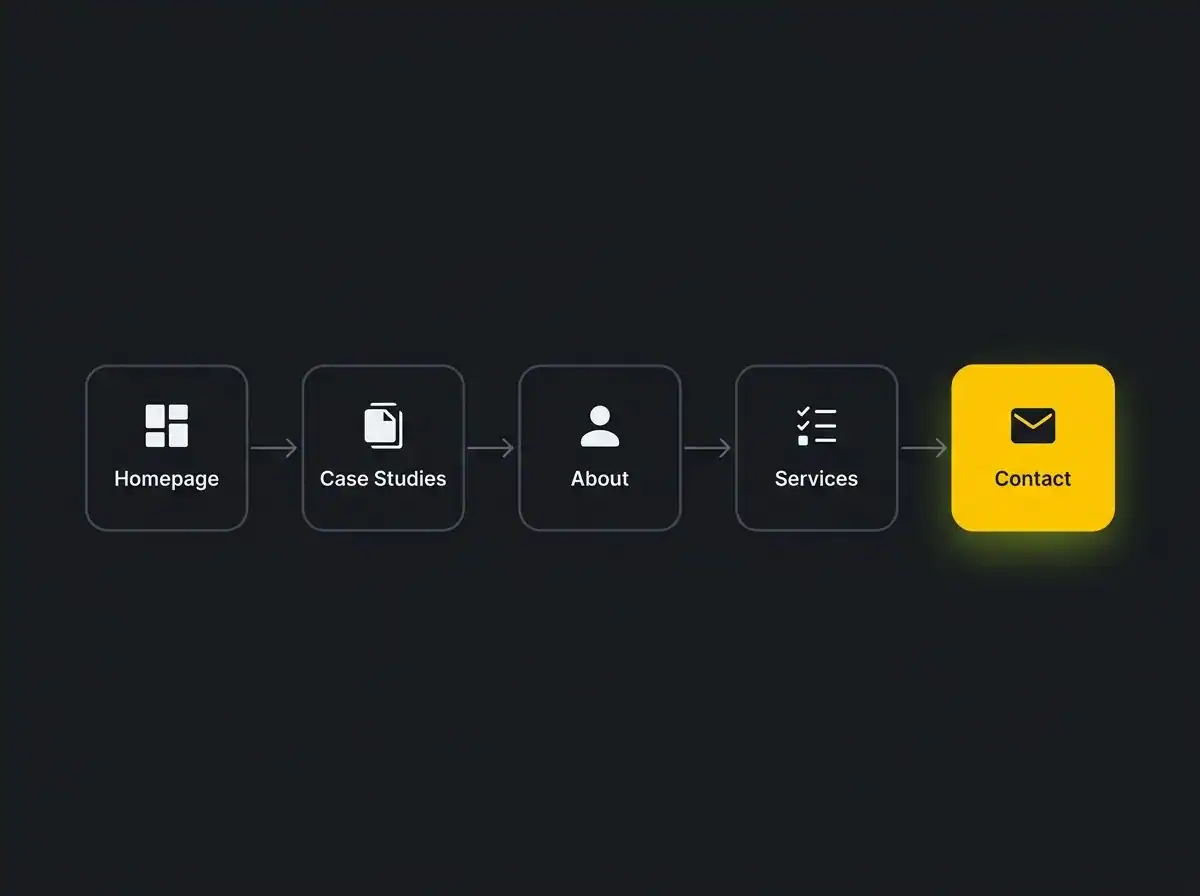
The typical session for a buyer who has found you through outreach, referral, or search follows a recognisable pattern. Homepage first, to understand broadly what you do and whether you look credible. Case studies or work page next, because that is where the proof lives. Then the About page, to understand who is behind the business. Then services or how-we-work, to check whether your offer maps to their specific situation. Often a return to the homepage. Then, if the site has passed all the checks, contact.
The whole session usually runs three to eight minutes. The buyer is scanning rather than reading.
They are looking for evidence that makes reaching out feel like the obvious next step, and for reasons to disqualify you before investing any more time. Understanding this changes the design question fundamentally. It is not "how do we present our business attractively?" It is "does this site answer the questions a buyer is forming, in the right order, with enough specificity to earn a conversation?"
The website is rarely the first touchpoint in a B2B sale. It is usually the checkpoint where a promising lead either becomes an actual enquiry or quietly disappears. Understanding where it fits within a broader B2B marketing funnel helps to see which part of the job the site needs to do, and which parts other channels handle.
What your homepage needs to do in under ten seconds
The ten-second test is a fairly brutal one. A stranger lands on your homepage. In ten seconds, can they repeat back what you do, who you do it for, and why it matters?
Most B2B homepages fail it.
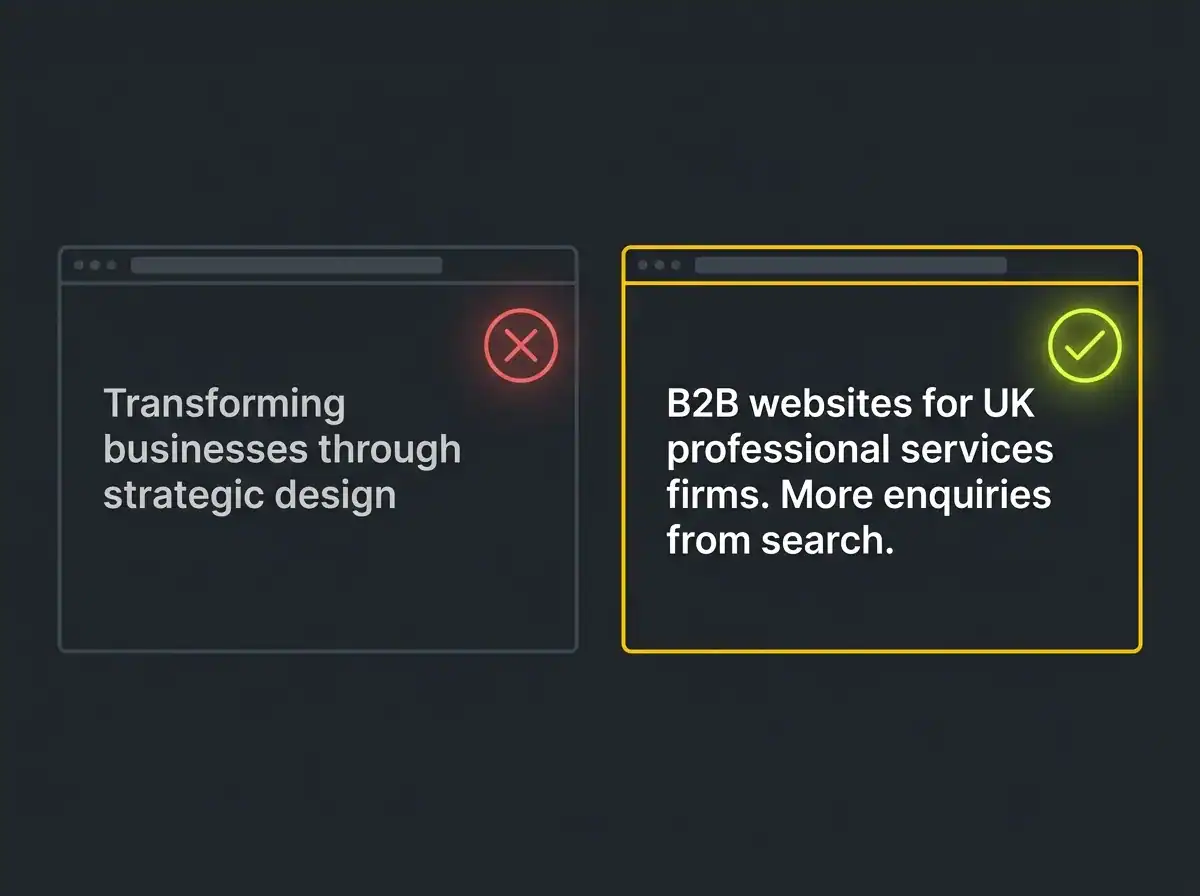
The failure mode is almost always the same. Abstract taglines that sound ambitious and communicate nothing. "Transforming businesses through strategic design." "Delivering outcomes that matter." "Your success is our mission." These phrases say nothing about the sector, the service, or the result. They are the homepage equivalent of a firm handshake and a business card with no job title.
Specificity is what passes the test.
"We design and build B2B websites for UK professional services firms that want more qualified enquiries from search" tells a buyer in one sentence whether they are in the right place. It does not need to win a copywriting award. It needs to be true, and specific enough that someone can act on it immediately.
The structure of the page matters as much as the headline copy. The route to your case studies, your About section, and your services pages should be visible and obvious from the first scroll. Many B2B sites use navigation labels that make perfect internal sense ("Insights", "Solutions", "Our Approach") but leave a buyer scanning for the proof they are looking for.
If they have to hunt for it, most of them will not bother.
Mobile is where the homepage fails most often and most quietly. A hero section that looks clean on a desktop becomes a wall of text on a phone. Navigation that works with a mouse becomes a friction point on a touchscreen. The buyer standing in a corridor with four minutes to make a decision needs the same clarity as the desktop visitor. Often they are getting a much worse version of it, and the session ends there.
For the underlying design fundamentals that make a homepage work, the thinking in what makes a good website is worth working through alongside this piece.
The pages B2B buyers check most, and what they need to find
After the homepage, buyers move with purpose. They are not browsing. They are verifying.
The case studies or work page. For most buyers arriving through outreach or recommendation, this is the first destination after the homepage and the most important page on the site. It is where they are looking for evidence that you have solved a problem like theirs before.
A work page full of vague project descriptions is not a case study. It is a placeholder.
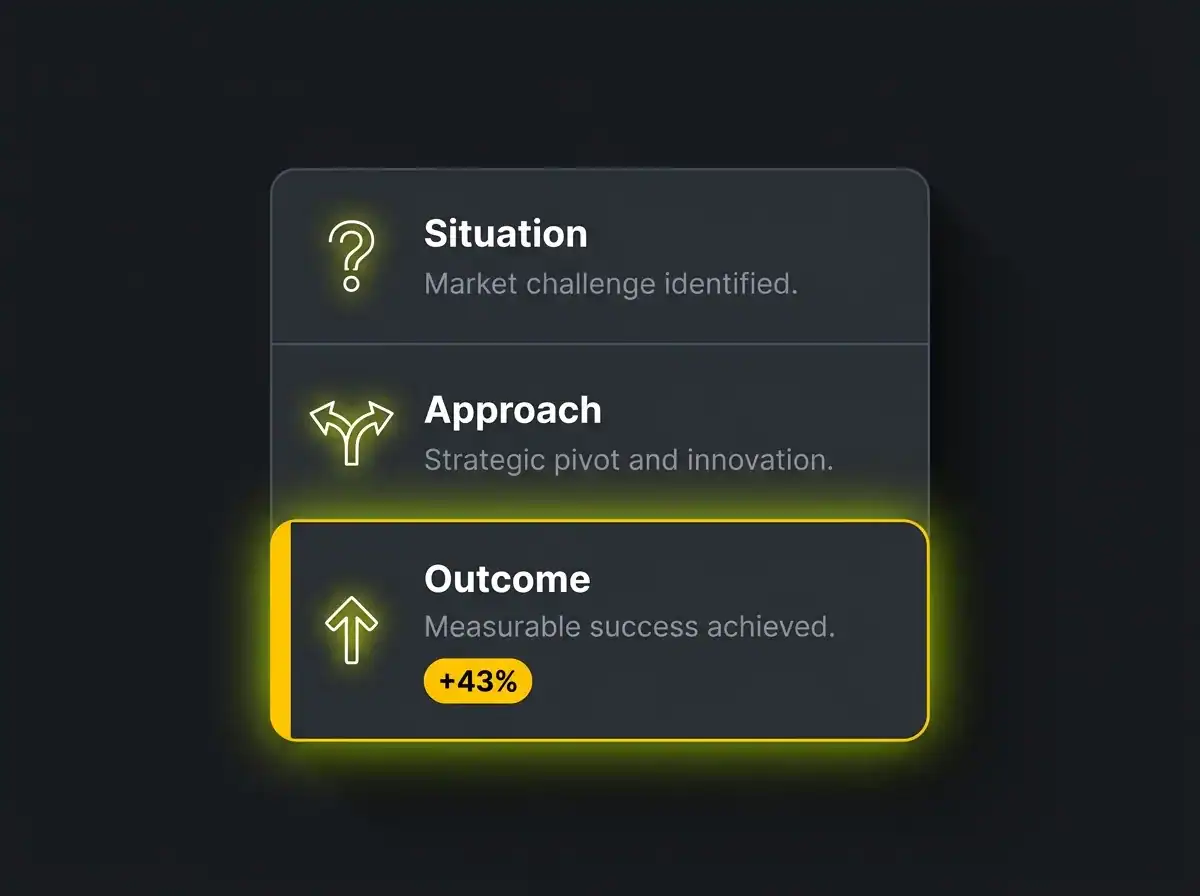
What makes a case study earn its place is structure. Situation: what was the problem before you arrived? Approach: what specifically did you do, and why that approach rather than another? Outcome: what changed, measured in real terms wherever possible? Named client, named sector, and concrete results. "The client reported strong improvement following the engagement" tells the next buyer nothing. "Organic enquiries from search increased by 43% in the eight months following the redesign" tells them exactly what they needed to know.
The difference between a case study that converts and one that decorates is measurability. Vague praise is inert. Specific proof is persuasive.
The About page. Most businesses write the About page as a company showcase. Buyers read it as a risk filter. They are not looking for a values statement or a founding story. They are checking for real people with named roles, a comprehensible company history, and evidence that the team has dealt with a problem like theirs before.
Stock photography of generic office workers fails this check immediately.
A genuine headshot of the person who would actually be leading their project, with two sentences that say something specific about their background, passes it. The About page is where the human trust signals live. Get it wrong and the buyer quietly files you alongside every other agency they have looked at this week.
Service pages. This is where most B2B sites fail to differentiate, and where enquiries are lost most often. Generic copy that could apply to any agency in any sector is common. "We deliver bespoke solutions tailored to your specific requirements" is copy the buyer has read on four other sites in the last hour.
Specificity about process, typical timescales, and what a client can realistically expect at each stage is what separates a site that generates enquiries from one that generates visitors.
The buyer on the services page is asking a very specific question: "have you done something like what I need?" A page that answers it with concrete language converts. A page that answers it with generic reassurance does not.
Trust signals that close the gap between browsing and calling
There is a hierarchy to social proof. Most B2B websites sit at the wrong end of it.
Logos alone are the weakest form of trust signal. They communicate that you have clients, not what you did for them, whether it worked, or whether the experience was worth repeating. A full-width logo strip is a placeholder, not a proof point. Useful, but only as a starting point.
Testimonials with specific outcomes outperform testimonials with warm words. The gap is not tone, it is precision. "Working with the team has been a genuinely positive experience and we would recommend them to anyone" is pleasant and forgotten in thirty seconds. "We've seen inbound enquiries increase by over 50% in the year since the redesign. We've largely stopped relying on referrals to hit our new business targets" is persuasive because it names a real before-and-after.
The reader can picture what it would mean for their own business.
Sector relevance amplifies this considerably. A professional services firm reading a testimonial from a similar professional services firm finds it credible. The same firm reading three testimonials from hospitality and retail businesses does not. Where possible, show the proof that is most relevant to the buyer reading it.
B2B branding plays a larger role in perceived trust than most website briefs acknowledge. A buyer who visits your site and then checks your LinkedIn profile, downloads a brochure, or opens a PDF proposal is forming an impression about your operational consistency from everything they see. Mismatched logos across channels, a different colour palette on your print collateral, and generic stock photography that bears no resemblance to the actual team all send a quiet signal. Not always a conscious one.
Inconsistency reads as operational immaturity. That matters.
A good B2B branding agency will tell you that brand consistency is not a cosmetic concern. To a risk-averse buyer about to commit significant budget to an external partner, the website is the most visible expression of how a business presents itself. But it only works as a trust signal when the rest of the picture matches it.
How your website captures leads, not just visitors
Most B2B websites have one conversion path. A contact form, accessible through a button in the navigation or a link in the footer, occasionally both.
That is a problem.
The limitation of this approach is that it demands maximum commitment from someone who may have arrived on your site for the first time three minutes ago. They are not ready to speak to your sales team. They want something useful they can take away first, something that helps them decide whether the conversation is worth having at all.
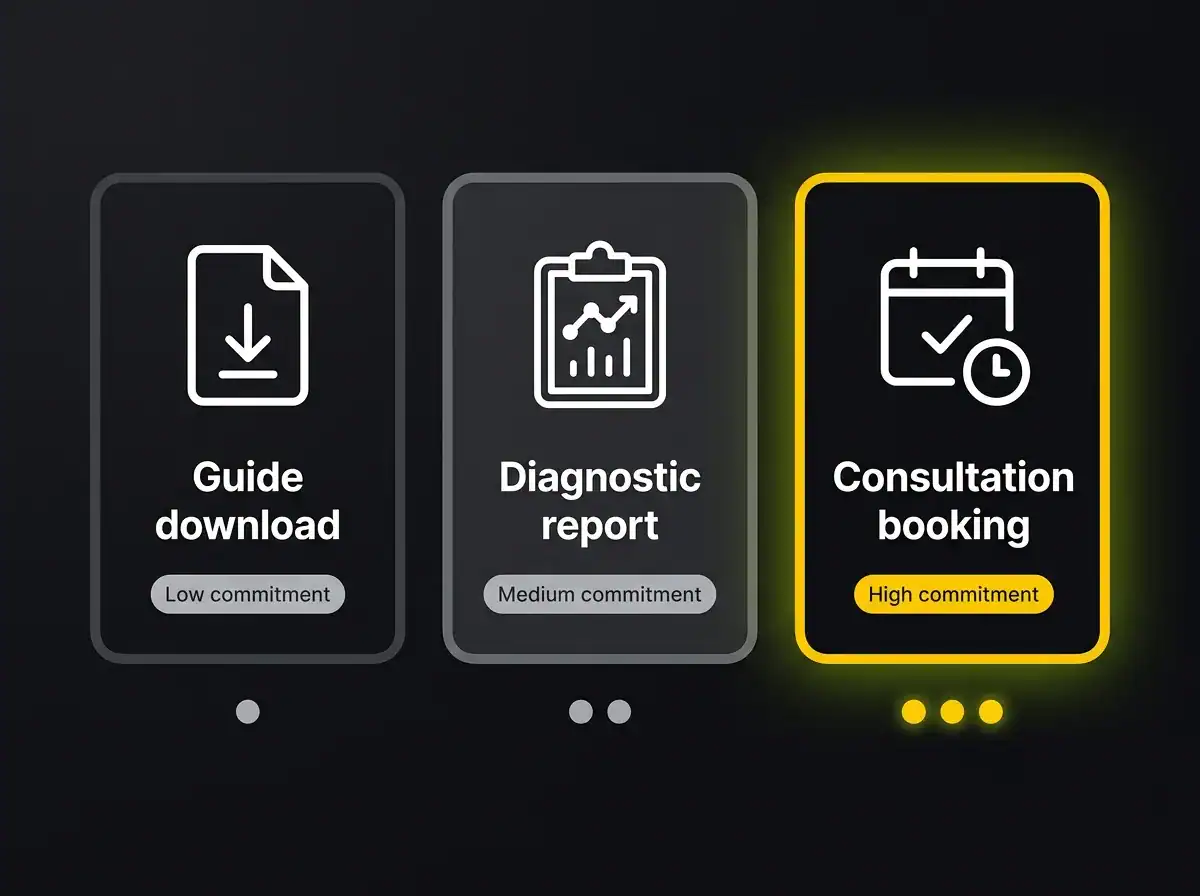
Better conversion architecture creates multiple entry points at different levels of commitment.
For high-intent visitors who are ready to talk, the direct contact or consultation request works well. For earlier-stage visitors still forming their view of what they need, a lead magnet: a diagnostic report, a practical guide, a checklist that gives them something useful before committing to a call. For buyers on longer evaluation cycles, a content subscription keeps you visible across the months their decision takes to mature.
CTA placement is where B2B sites underperform most predictably. A well-structured site places conversion touchpoints through the page: after the hero, after the case studies section, after the services section, and at the close. Each placement catches a visitor at a different point in their session.
A single CTA in the footer catches only those who scrolled every word to the bottom. That is a small minority.
For a closer look at how this applies at the individual page level, the guide to the elements of a high-converting landing page covers the same principles in more structural detail.
Free resource: Traffic Projection Report
Before committing to a full redesign, it is worth understanding what better search visibility could mean for your enquiry pipeline in concrete terms. The Traffic Projection Report models the difference, so you go into any brief with realistic expectations rather than guesswork.
What AI search means for your B2B website content
A growing share of B2B research now starts in AI tools rather than a search engine. A business owner asking ChatGPT "what should I look for in a B2B web design agency in the UK," or querying Perplexity for "what does a good B2B website include," is performing the same research intent as a Google search. But often the interface returns a synthesised answer without the buyer visiting any website at all.
This changes what your website content needs to do.
AI tools construct a description of your business from what your copy literally says. Not what it implies. Not what a thoughtful reader might infer from your visual identity or your tone of voice. What the words on the page actually state.
A homepage that says "we create digital experiences that drive results" cannot be described accurately by an AI tool. There is no sector, no geography, no service, no proof. A homepage that says "we design and build B2B websites for UK professional services and manufacturing firms, with a focus on lead generation and search visibility" can be described precisely.
That is a meaningful difference in whether you appear in AI-generated answers to relevant queries.
The structural changes that help AI tools understand and cite your content are almost entirely the same changes that help human buyers convert. Named services. Named sectors. Named outcomes. Clear heading structure that organises information in a way a non-human reader can follow. Concise, direct copy that does not ask the reader, human or otherwise, to infer the point.
A useful audit: if an AI read your entire website, could it summarise your business accurately in two sentences? If the answer is probably not, the same copy that confuses an AI is also confusing the buyers who arrive through search.
A more detailed approach to this at the content level is covered in the CT guide to B2B SEO strategy, which connects content structure to both traditional and AI search visibility.
It is not an aesthetics question
A B2B website that generates enquiries is a structure problem.
Build the site around the buyer's actual research session: prove you can do the work on the case studies page, establish trust on the About page, be specific on the services page, and offer multiple ways to start a conversation at the buyer's own pace.
The aesthetics matter. A site that looks dated or visually inconsistent undermines every other signal. But aesthetics are not what closes the gap between a visitor and an enquiry. The specificity of your proof, the clarity of your value proposition, and the architecture of your conversion paths are what does that work.
If you want to understand what better search visibility could mean for your pipeline before committing to a redesign, the Traffic Projection Report models it in concrete terms.
Or if you are ready to have the wider conversation about your site, our B2B web design service starts with exactly the buyer-behaviour questions this piece covers.