
Three positions in the map pack. All three firms set up within the last four years. You have been running your practice for a decade.
That is a jarring thing to find when you search for your own specialism in your town. Not because newer practices should not rank. Because the signals that put them there have nothing to do with their client outcomes, their qualifications, or the quality of their advice. They are local search signals. And the gap is entirely fixable.
This guide is for FCA-regulated financial advisors who want to understand what those signals actually are, why the standard local SEO guide does not quite apply to a regulated sector, and what the FCA compliance picture really means for your Google Business Profile and your website content. Spoiler: the compliance question is simpler than most advisors fear. The trust signals that matter for local search are largely the same ones you have spent years building in your professional life.
Why the local pack is different when clients are evaluating you, not just finding you
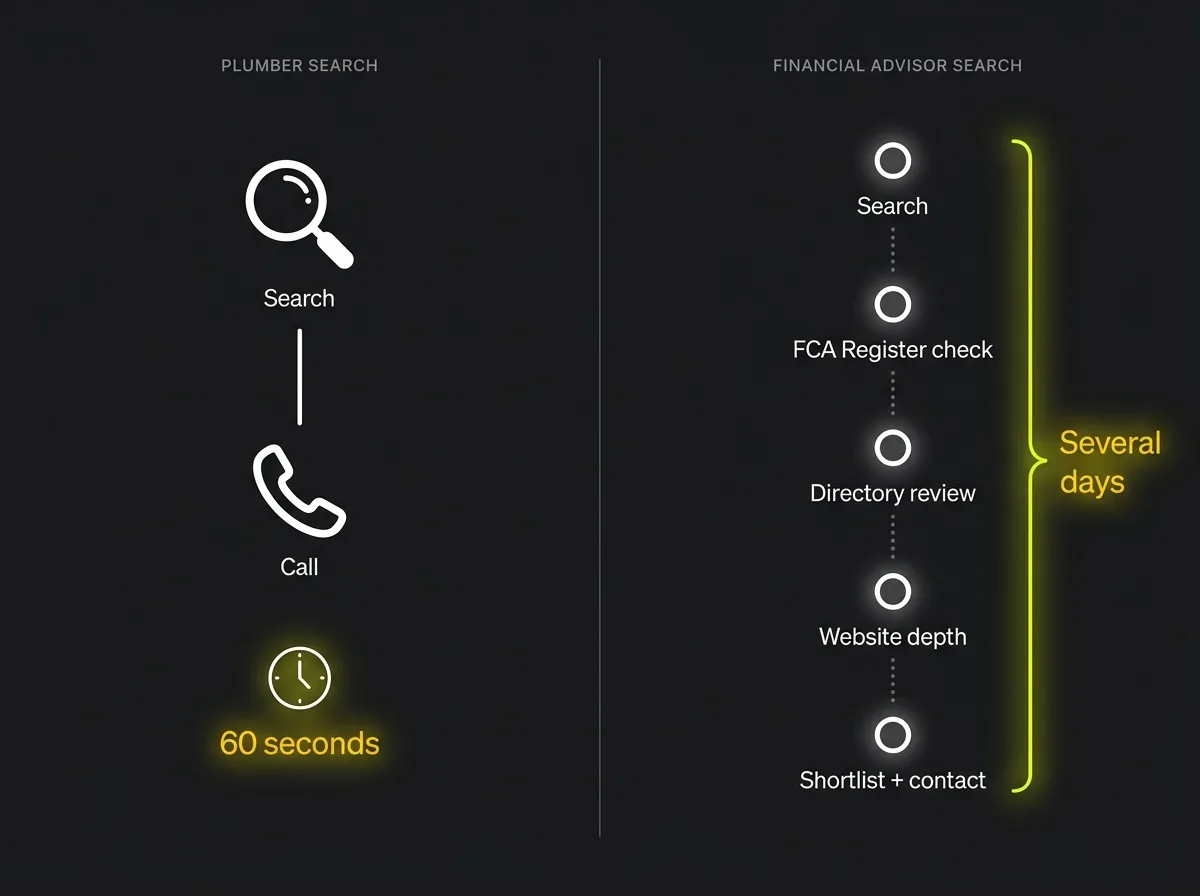
A plumber search takes about sixty seconds. Someone finds a name with decent reviews and calls. The trust bar is relatively low: a bad plumber means a frustrating morning and a dispute about an invoice.
A financial advisor search is a different category of decision entirely.
Prospective clients are considering handing another person the management of their pension, their investments, or their family's financial security. The evaluation process reflects that weight. They read reviews in full, not just count the stars. They check the FCA Register to confirm the firm and its principals are properly authorised. They look at individual advisor profiles to verify qualifications. They compare several firms before making contact, sometimes over several days.
This extended due diligence changes what local SEO actually requires for a financial advice practice. Signals that barely move the needle for a commodity service, structured schema, website content depth, credentials visibility, thoughtful responses to client reviews, matter significantly here. Clients are doing research. The question is whether your digital presence supports that scrutiny.
Google's E-E-A-T framework and YMYL.
Financial queries sit in the YMYL category: "Your Money or Your Life." These are searches where Google applies elevated scrutiny before surfacing a result prominently, looking for Experience, Expertise, Authoritativeness, and Trustworthiness. A firm with weak E-E-A-T signals, anonymous website content, no named practitioners, missing or inconsistent credentials, is penalised more heavily in this category than it would be in almost any other sector. How this plays out in healthcare SEO follows an identical pattern: the standards are stricter precisely because the stakes for the consumer are higher.
One new client acquired through local search is not a one-off transaction. It is potentially a multi-year relationship. The case for investing in local search infrastructure is more compelling for a financial advice practice than for most service businesses, and the logic is straightforward: the cost of building the infrastructure is fixed while the return compounds.
Google Business Profile: what you can do and what to avoid under FCA rules

Your Google Business Profile is the primary surface of your local search presence. It controls what appears in the map pack. It is often the first thing a prospective client encounters before visiting your website. For FCA-regulated firms, it requires a little more care than it does for a florist or a gym.
Category selection.
"Financial Planner" and "Financial Advisor" are both available as primary GBP categories, and the one you choose has a real effect on which queries trigger your listing. If the firm holds mortgage permissions, "Mortgage Broker" is a separate primary category for that service. Select the category that represents the majority of your work. Add secondary categories to capture the rest.
Services section.
Listing your specific services, retirement planning, inheritance tax planning, pension transfers, investment advice, protection advice, improves how Google matches your listing to relevant searches. Keep descriptions factual and specific. "Pension drawdown advice and retirement income planning" is appropriate. "Helping clients achieve their financial dreams" adds no search relevance and no trust signal. List what you do. Not how it might make someone feel.
GBP posts.
Regular posts improve engagement signals on your listing. The safe pattern for a regulated firm is educational content: five questions to ask before transferring a pension, what the 2026 ISA allowance changes mean in practice, how to think about care-fee planning. A post that explains a concept or shares a practical framework does not meet the FCA threshold for a financial promotion under the Financial Services and Markets Act 2000. A post containing performance claims, implied outcomes, or a call to engage with a specific regulated product is a different matter.
Write as a teacher explaining concepts. Not a salesperson promoting outcomes. That framing is both FCA-compliant and E-E-A-T credible.
Review strategy.
Asking a satisfied client to leave a Google review is entirely legitimate. The review is their own expression of their experience, not a financial promotion by the firm. Do respond to reviews: professionally, briefly, without restating specific financial advice in the response text. In a high-trust sector, serious prospects read reviews rather than just counting stars. A dozen substantive, detailed reviews outperform fifty one-line ratings.
FCA reference number.
Include your FCA reference number in your website footer and link directly to your firm's entry on the FCA Register at register.fca.org.uk. This is a regulatory expectation regardless of SEO. It is also a concrete trust signal: the prospective clients most likely to become your clients are exactly the ones who verify FCA authorisation before picking up the phone.
One firm boundary: do not claim independence in your GBP posts or description if the firm is restricted. That distinction is an FCA disclosure requirement wherever it appears. If the firm is independent, communicating that clearly is a genuine differentiator for clients who understand the whole-of-market distinction.
The UK directories that matter for a financial advice firm's local SEO
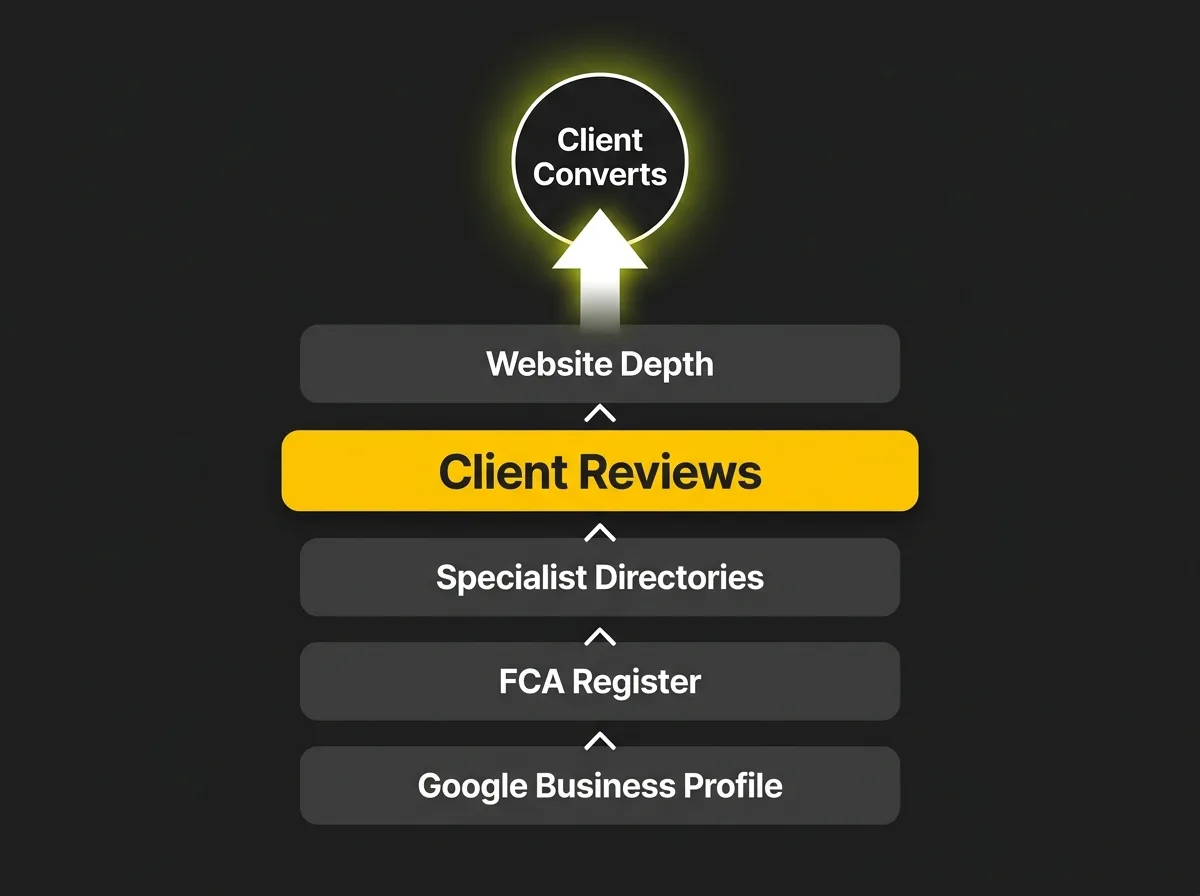
Local SEO for financial advisors is not just about Google. Prospective clients cross-reference multiple sources before making contact, and the citation infrastructure you build across authoritative directories does two things simultaneously: it improves your NAP consistency signals (the Name, Address, Phone consistency that influences local ranking) and it creates direct discovery channels that serious prospects actively use.
FCA Register.
Your firm's entry on the FCA Register is effectively a primary citation. Your firm name, address, and contact details appear there by regulatory necessity. Ensuring those details match your GBP and website contact page exactly is a regulatory baseline, and from a local SEO perspective it matters enormously: inconsistency here is visible to the clients who are most likely to convert, because they are the ones who check.
VouchedFor and Unbiased.co.uk.
These are the two authoritative specialist directories for UK financial advisors. Unlike generic business directories, they are destination platforms that prospective clients actively use as part of their evaluation. A well-maintained VouchedFor or Unbiased profile functions as both a citation signal and a direct lead source. If you are investing time in one specialist directory, start here.
Professional body directories.
CISI, PIMFA, and Personal Finance Society member directories carry genuine domain authority. A link from the Personal Finance Society member directory to your firm's website is a different order of trust signal than a listing on a generic aggregator, because the domain authority of a recognised professional body is hard to manufacture and immediately credible. If your advisors hold relevant memberships, confirm those directories link to the correct URL.
Companies House.
The registered office address on Companies House should match your GBP trading address and website contact page. Many small practice websites have the address wrong because it was added at launch and never updated when the firm moved. Quick fix. Worth doing now.
Generic directories.
Yell, Bing Places, and Apple Maps are worth maintaining for NAP consistency even if they drive negligible direct traffic. The principle is simple: in a high-trust sector, clients are cross-referencing multiple sources before they call. Consistent information removes friction at every checkpoint. Inconsistency creates doubt. And doubt kills conversions when the decision involves someone's financial security.
A structured citation audit as part of a local SEO programme covers this systematically, including identifying directories where your firm appears incorrectly, is missing entirely, or where outdated information has been cached.
FCA compliance and SEO content: where the boundary actually sits
Most financial advisors approaching local SEO worry more about compliance than they need to, in the wrong places.
The FCA financial promotions regime under Section 21 of the Financial Services and Markets Act 2000 applies to communications that invite or induce a person to engage in investment activity. The consequences of getting this wrong are serious. But a blog post explaining how pension drawdown works is not a financial promotion. A guide to questions someone should ask before reviewing their pension is not a financial promotion. Educational content that explains concepts, demystifies financial planning, and helps readers understand their options is almost universally fine, and it is the single best content strategy available for building long-term local search visibility in this sector.
The actual risk areas are specific. Performance claims or projections ("our clients typically achieve X%"). Approval-and-results language that implies outcomes rather than processes. Directing readers toward specific regulated products without the appropriate qualification structure. Comparative claims that are not presented clearly, fairly, and with a balanced methodology. Those are the lines. An explainer on how a Lifetime ISA works sits nowhere near any of them.
Consumer Duty 2023.
The FCA's Consumer Duty principle, which came into full effect in 2023, requires firms to act to deliver good outcomes for retail customers. It has direct implications for how financial services websites are structured: information must be clear, balanced, and must not nudge users toward unsuitable decisions through presentation or omission. This is directly aligned with what Google E-E-A-T rewards. A well-structured, clearly attributed website that presents information fairly performs better in search and meets Consumer Duty expectations at the same time. Two birds, one well-built website.
Independence versus restricted.
Where a firm is independent, this should be clearly communicated on the website and can be reflected in GBP content. For clients who understand the whole-of-market distinction, independence is a genuine differentiator worth signalling. If the firm is restricted, that must be disclosed with equal clarity. It is an FCA requirement regardless of SEO, and being honest about it is a trust signal in its own right.
A practical rule: write to explain concepts, not to promote outcomes. Check the FCA financial promotions guidance before publishing anything you are genuinely uncertain about, and consult your compliance officer or appointed representative if a piece of content could be characterised as a financial promotion. That is practical, honest advice to you as a practitioner. The FCA Consumer Duty guidance is also worth reviewing for its implications on how your website structures information for prospective clients.
Location pages and local content for IFA practices
Single-location practices.
One well-optimised location page is usually sufficient, either the homepage or a dedicated "financial advisor in [city]" page. Avoid creating thin location pages purely to add them. Thin content dilutes site authority without improving relevance, and Google has become considerably better at identifying it over the last few years.
Multi-branch practices.
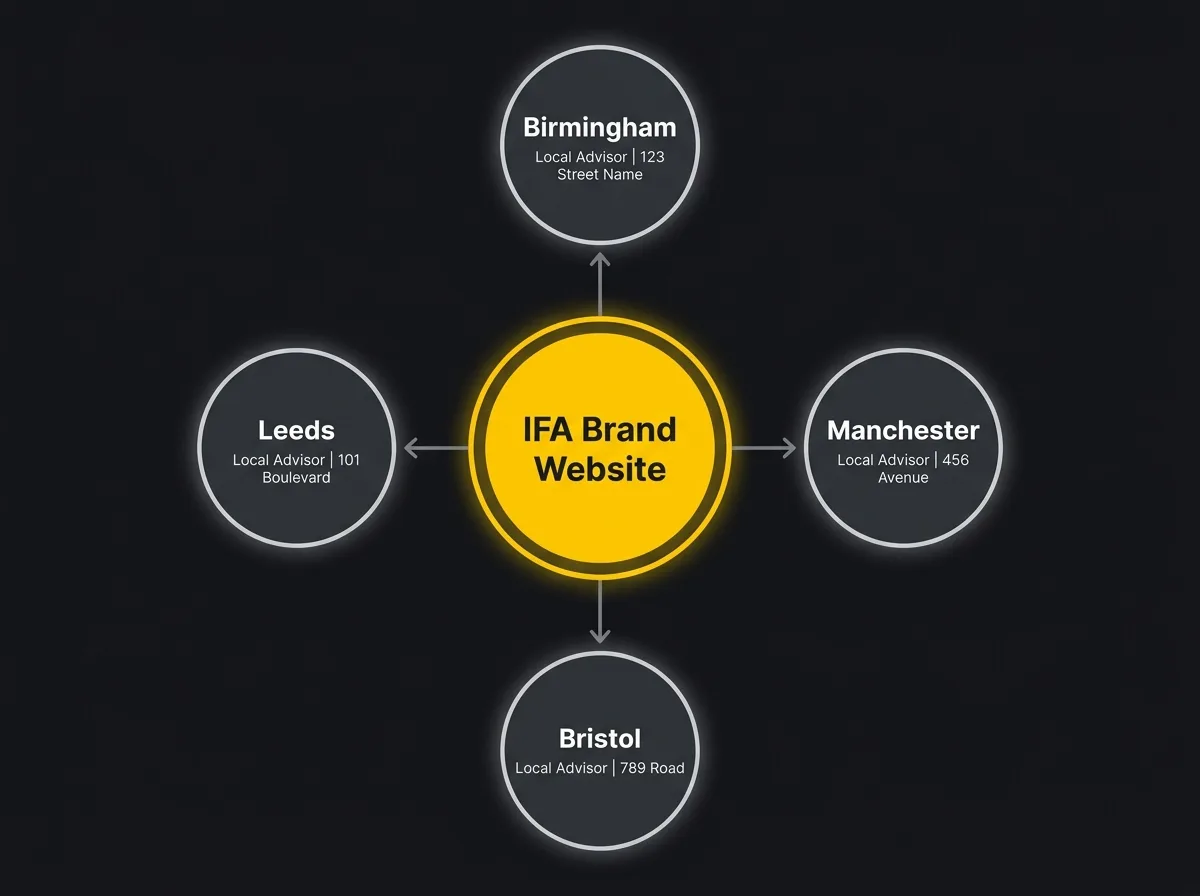
For firms operating from more than one location, a hub-and-spoke structure works well. The main brand site is the hub. Each branch location page is a spoke, and it must have genuinely distinct content: the named advisors based at that office, any local community involvement, specific service availability, and contact details that match the FCA Register entry for that address. Duplicating the same content across location pages and changing only the town name is the most common location page mistake in financial services and professional services generally. It harms the whole site, not just the individual pages. What accounting firms get wrong about local SEO covers a near-identical set of errors, worth reading if you have multiple offices.
Local content within FCA constraints.
Plain-English guides to pension regulations, explainers on how inheritance tax planning works in practice, frameworks for financial planning at specific life stages, these are all educational, non-promotional, and genuinely useful to prospective clients in your area. They are also the content that builds the topical authority Google uses when deciding which local practices to surface for informed-buyer searches. Write for the 55-year-old business owner who has just received a pension transfer value and does not know what to do with it. That reader is the prospect you want.
Local backlink opportunities sit in the same places as they do for local SEO for solicitors: sponsorship of local professional events, editorial contributions to local business press, and the formal acknowledgement of cross-referral relationships with local accountants and solicitors. Cross-referral is standard practice in financial planning. Formalising it with a short partnership page or a mutual mention builds local link authority in a way that feels natural because it is.
How AI search is changing financial advisor discovery

"Can you recommend a good financial advisor in Birmingham who specialises in pension drawdown?"
People are asking that question to ChatGPT and Perplexity now. Not instead of Google, necessarily, but in addition to it, and often before it. This is not a future trend. It is already the behaviour of a meaningful segment of the audience a financial advice practice most wants to attract: younger, more financially aware clients who research carefully before making contact.
What AI returns for these queries matters. The tools draw on VouchedFor, Unbiased, the FCA Register, and the websites of firms that are well-structured, clearly attributed to named practitioners, and referenced from authoritative professional body directories. Generic firm websites with anonymous "our team" pages and boilerplate service descriptions are largely invisible to this discovery layer.
The structural overlap with local SEO is not a coincidence.
The signals that make a firm visible in the local pack are broadly the same signals that make it citable by AI: consistent citations, entity clarity, authoritative content, named practitioners with verifiable credentials. There is no separate AI optimisation programme to run alongside your local SEO work. Do the foundational work thoroughly. AI visibility follows.
One specific action with the highest direct impact on AI citability: ensure your About page names every principal advisor with their full qualifications, years in practice, and professional body memberships. CISI, PIMFA, and Personal Finance Society affiliations function as verifiable markers of legitimacy that AI models weight when building a recommendation response. Named experts with real credentials are what AI cites. Anonymous firms with impressive-sounding copy are not.
AI traffic and what it means for professional services covers why AI-referred visitors convert at a significantly higher rate than traditional organic search traffic. For a practice thinking about where visibility investment has the most commercial impact, that conversion differential is the number that matters. AI search visibility for professional services covers how CT structures this work in practice.
What a local SEO programme delivers for a financial advice firm
Setting realistic expectations is part of doing this properly.
For competitive terms like "financial advisor [major city]," meaningful map pack movement takes four to six months of consistent foundational work. Less competitive terms, smaller towns, niche specialisms such as "pension transfer specialist [city]," or specific life event searches, can move faster. These timelines assume the foundational work has been done properly rather than quickly.
What to measure.
GBP insights show search impressions, map views, website clicks, and calls from the listing directly. Track local keyword rankings for the three to five most commercially important searches in your area. And ask every new client the same question: "how did you find us?" That single question, applied consistently, is often more useful than a dashboard for understanding whether local search is genuinely driving enquiries.
The compound effect.
Unlike paid advertising, local SEO does not switch off when spend stops. A financial advice firm that builds this infrastructure is creating a searchable asset that continues to generate visibility without ongoing ad budget. For practices that prefer a predictable cost model for their marketing, which is most of them, that matters. The effort in the first year builds the asset. The asset works in years two, three, and four.
This is not a speculative investment. It is catching up with how prospective clients are already searching for you. For practices ready to understand what a structured approach looks like, our local SEO services page covers the full programme.
Get your Traffic Projection Report
Want to see what local search visibility could mean for your specific practice? The Traffic Projection Report gives you a concrete picture of the search opportunity available to your firm, before you commit to anything.
Frequently asked questions about local SEO for financial advisors
Can I include my FCA registration details on my Google Business Profile?
Yes, and you should. Your FCA reference number belongs in your website footer with a direct link to your firm's entry on the FCA Register. While you cannot add the reference number to a dedicated GBP field in the way you would a phone number, your GBP website link should point to a site that makes this information immediately visible on arrival. It is a regulatory expectation and a concrete trust signal: the clients most likely to become your clients are exactly the ones who verify FCA authorisation before they make contact.
Is asking clients for Google reviews allowed under FCA rules?
Yes. Asking a satisfied client to share their experience as a Google review is not a financial promotion. The review is their own expression of their experience with the firm. Do not coach clients on what to write or offer any incentive for leaving a review: that territory concerns both the FCA and Google's review policies. Responding to reviews professionally and briefly is entirely appropriate. Restating specific financial advice or outcomes in those responses is not.
What is the difference between a financial promotion and educational SEO content?
Under the Financial Services and Markets Act 2000, a financial promotion is a communication that invites or induces a person to engage in investment activity. Educational content explaining concepts, what pension drawdown involves, how inheritance tax planning works, what to ask when choosing an IFA, does not meet that threshold. The risk areas are performance claims, outcome language, and directing readers toward specific regulated products without appropriate qualification structure. Write to explain, not to sell, and the vast majority of educational blog content sits comfortably within the regulatory boundary.
Does a single-location practice need multiple local landing pages?
Not unless each page has genuinely distinct content. One well-optimised location page, either the homepage or a dedicated city page, is sufficient for a single-location practice. Creating thin location pages that duplicate your main content and change only the town name is more likely to harm your rankings than improve them, because thin duplicate content dilutes the authority of the whole site.
How long does local SEO take to show results for a financial advice firm?
For competitive city-level searches, expect four to six months of consistent foundational work before meaningful map pack movement. Smaller towns and niche specialisms typically move faster. The investment compounds over time: the authority built in months three and four accelerates progress in months eight through twelve in a way that paid advertising does not replicate. Plan for the medium term and measure consistently from the start.