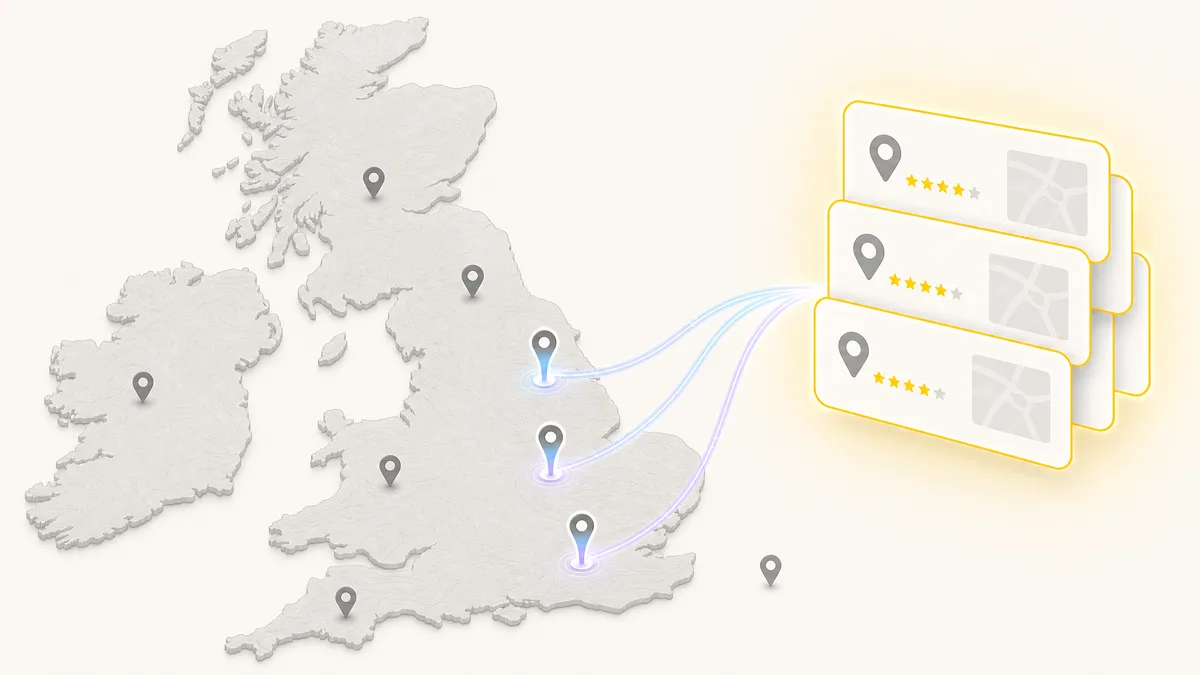
Your Manchester office appears in the map pack. Your Leeds office doesn't. You set them up the same way. Both have a Google Business Profile, both have client reviews, both carry the firm name, the same services, the same opening hours. And you genuinely cannot work out what is different.
This is not a beginners' problem. The guides telling you to claim your Google Business Profile and ask for reviews have not helped, because you have already done both. The gap is elsewhere.
What local SEO for solicitors actually means
Local SEO for solicitors is the process of improving a firm's visibility in Google's local search results, specifically the map pack, for searches tied to a geographic area. It matters more than organic rankings for most UK practices because local legal queries, "conveyancing solicitor in Sheffield" or "employment law firm near me", typically surface a map pack result before any organic blue links. The ranking factors that determine map pack position differ from those that drive organic placement. They include the proximity of the office address to the searcher, the relevance of the Google Business Profile category and content, and the firm's local authority: review volume, citation consistency across directories, and the strength of location-specific pages on the website. For multi-branch firms, each office needs its own local presence built around its own physical address. One firm, four offices means four separate local programmes running in parallel.
This guide covers how to structure that properly, what breaks when offices share resources they shouldn't, and why the branch that underperforms is usually fixable once you understand the architecture behind it.
Why the map pack matters more than organic search for most UK solicitor firms
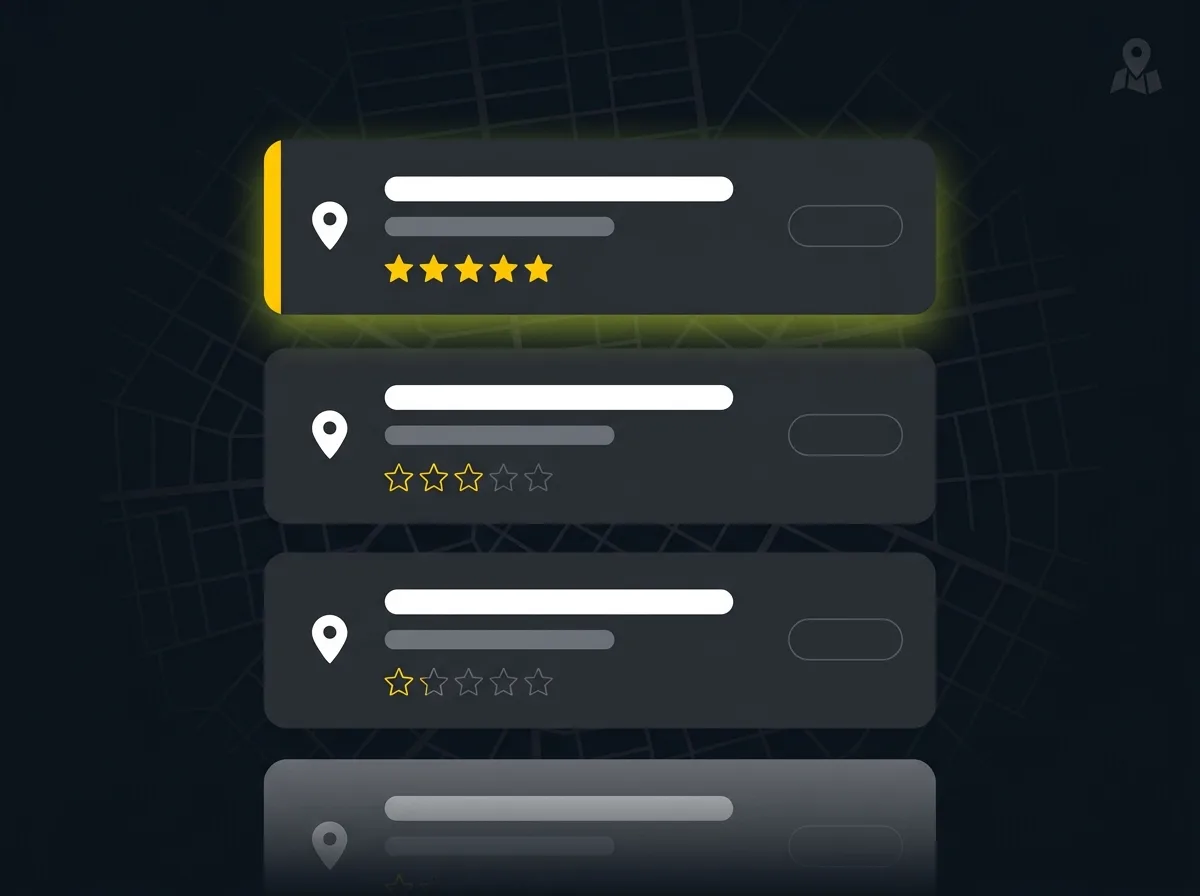
When someone searches for a solicitor in a specific town or city, Google shows three local results above the organic links.
Three. Not ten, not a page of results. Three firms get the name, the address, the phone number, the star rating, and a directions link prominently on screen. Everyone below that is largely invisible to anyone who does not scroll past the map.
According to BrightLocal's Local Consumer Review Survey, the local pack captures a significant share of clicks for searches with local intent. Position four in the map pack, which has no public equivalent, receives close to nothing. Being the fourth-best-known conveyancing firm in Birmingham is effectively the same as being invisible to most people searching from their phone.
For solicitors, the commercial stakes are concrete. Conveyancing, family law, and personal injury instructions almost always start with a local search. The client is not looking for a national firm. They want someone nearby, someone familiar with the local courts, someone they can reach in person if needed. Map pack presence is the front door.
Local Services Ads for law firms sit above the map pack in paid search results. Google Screened verification is available to certain UK legal practices and adds a verified badge to paid placements. Paid local and organic local are complementary, not competing. A firm investing in local SEO for solicitors alongside Local Services Ads can appear in two visible positions for the same search.
For most regional practices, the map pack is where the competition for new instructions begins. Getting it right for one office is achievable. Getting it right across three or four offices, without them cannibalising each other, is where most firms come unstuck.
The GBP structure multi-branch firms get wrong
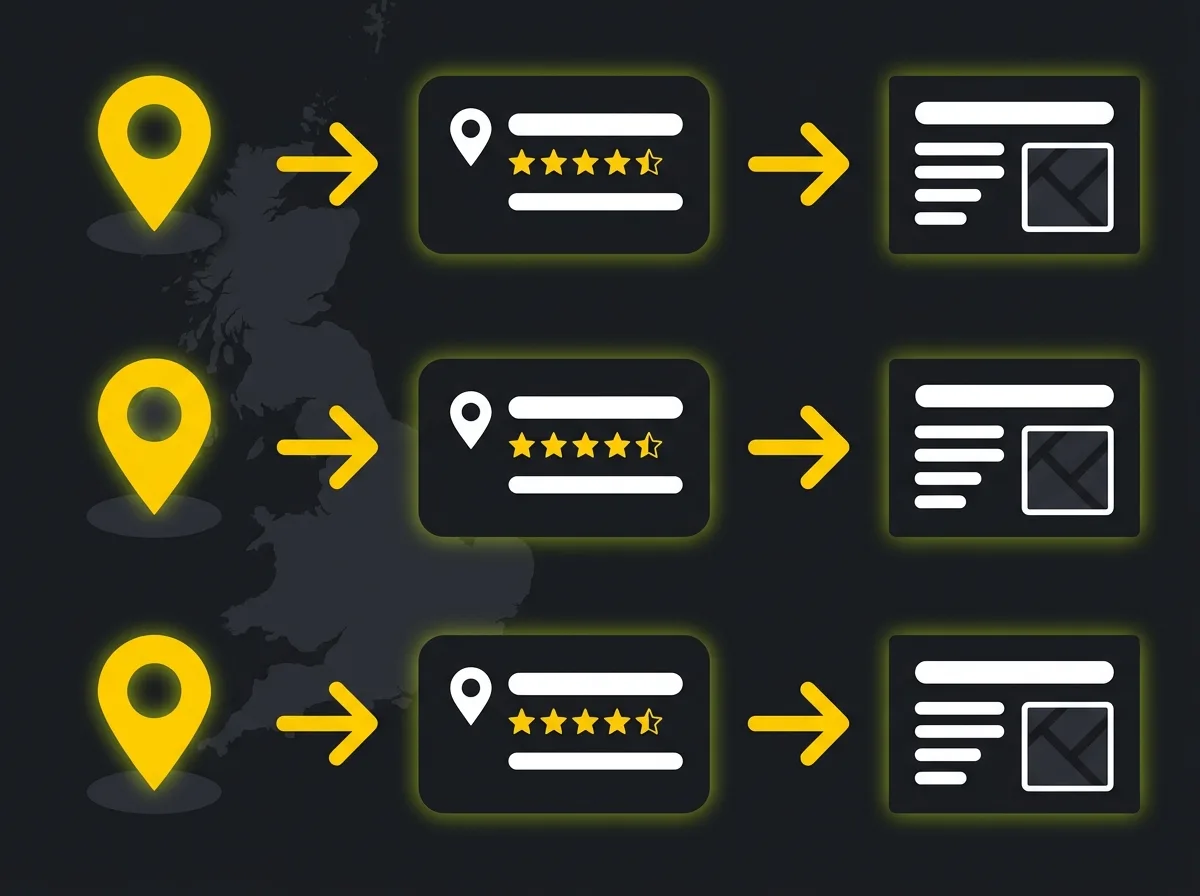
One Google Business Profile per physical office. Always.
This sounds obvious until you see how many regional firms have consolidated two offices onto a single listing, used a virtual office address to claim a city centre presence, or created a practitioner profile where a branch profile should be. All of these fail for the same reason: Google's proximity algorithm ranks local results partly based on how close the registered business address is to the person searching. One address gives Google one data point. If your Leeds and Bradford clients are spread across West Yorkshire, a single-address approach means the listing is always geographically wrong for someone.
The second most influential factor in local pack rankings, after your Google Business Profile primary category, is proximity to the searcher. No amount of profile work overrides a missing or inaccurate address.
Category selection matters more than most firms realise.
"Solicitor" is the correct primary category for a UK practice. "Lawyer" is US-weighted and should not be used as a primary. Secondary categories can include practice-area-specific options where they exist in Google's category taxonomy, such as Conveyancing Solicitor, Family Law Attorney, and Employment Law Attorney. These should reflect the services actually delivered at that specific branch. A Manchester office focused on employment law and a Salford office focused on family matters should have different secondary category configurations, not identical profiles. Two offices doing different things but appearing identical to Google is a missed opportunity at the most foundational level.
Completing the profile fully is a genuine ranking signal, not optional housekeeping.
Hours accuracy matters in ways most firms underestimate. Google can deprioritise a listing in the final hour before the stated closing time. A branch that closes at 5.30pm but has 6pm listed on its GBP may be losing visibility to a competitor with accurate hours during the after-work search spike. Team photos, exterior photos, and service descriptions all help Google understand what each branch is, where it is, and who it serves.
Each branch GBP should link directly to that branch's location page on the website, not to the firm homepage. A homepage link sends a generic signal. A location page link tells Google: this address corresponds to this page about these practice areas in this location. That connection is what ties the local search signal to the website authority the firm has built.
The proximity problem when offices are close to each other

This is the issue almost no local SEO guide for solicitors addresses properly.
When two offices sit in the same city or in adjacent towns, they compete for the same map pack positions. A Birmingham city centre office and a Solihull office might both target Birmingham-area conveyancing searches. Google shows three results. The firm effectively has two of its own entries bidding for those three slots, and neither will consistently appear while they are fighting over the same ground.
How Google resolves this comes down to relative maturity. The more established GBP, the one with a longer history, more reviews, and a more consistent posting record, tends to dominate. A new branch GBP will typically underperform a three-year-old listing even with identical profile content and identical category settings. The newer office is not doing anything wrong. It simply has less of what Google uses to determine confidence in a local result.
There are practical ways to manage this.
Differentiate each office by practice area. If you can give each close-by office a distinct primary practice area identity, they start competing for different searches. A Manchester city centre office concentrated on employment law and a Salford office concentrated on conveyancing are likely appearing in different map packs for different queries. This requires the website location pages and the GBP secondary categories to reflect that distinction, not just an internal policy decision that never reaches the public profile.
Concentrate review effort on the weaker branch. Head offices accumulate reviews naturally. Secondary branches need active work. Distributing client satisfaction outreach proportionally across offices, rather than letting it all flow to the most prominent location, is how you build the review foundation each GBP requires to compete in its local market.
Allow for an extended ramp-up period. Opening a new office and expecting it to rank alongside a mature branch within six months is unrealistic. A new GBP serving an area where you already have an established presence typically takes twelve to eighteen months to reach full competitive performance. Factor this into commercial projections before opening, rather than treating it as a failure of the new branch's marketing.
Firms that recognise the proximity problem can manage around it. Firms that don't spend years puzzled by why the newer office doesn't perform, despite "doing the same things."
Location pages that actually earn their place in the SERP
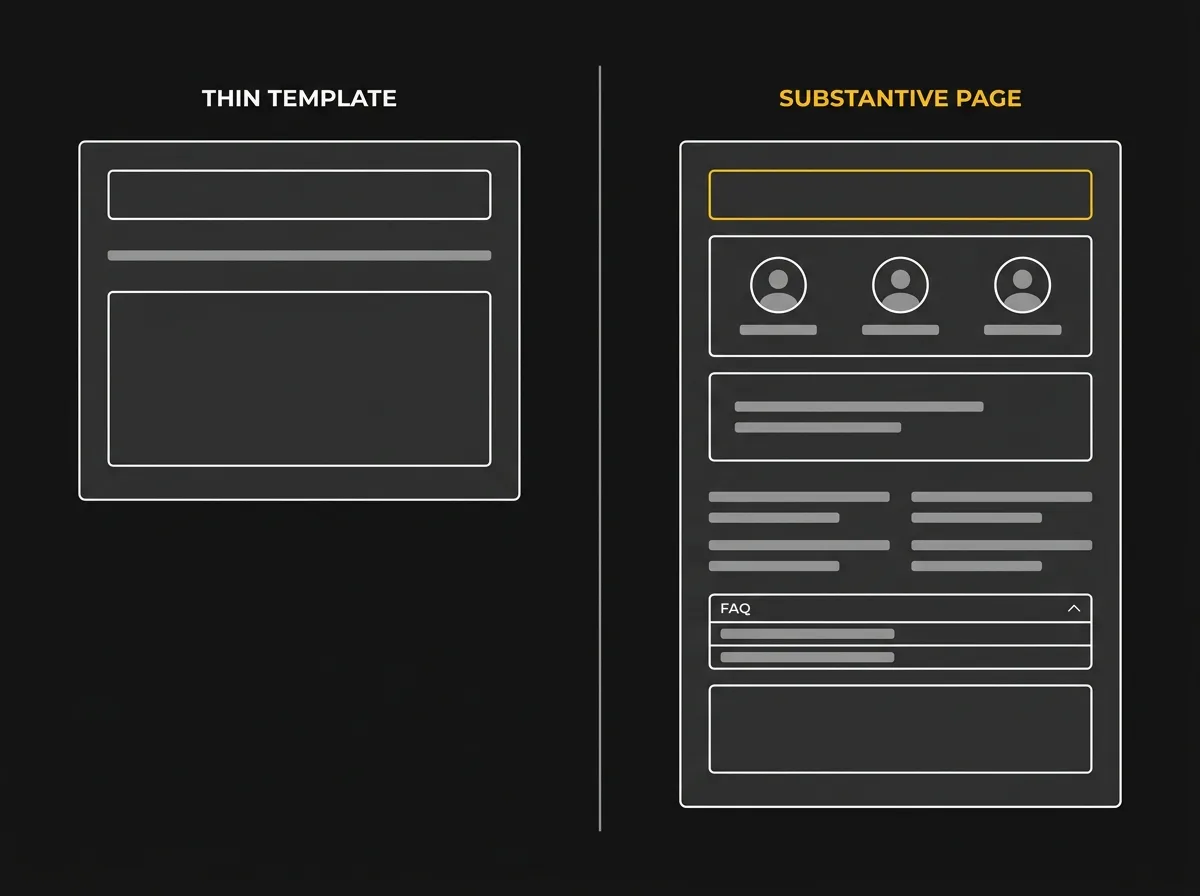
Most solicitor firm websites build location pages the same way: copy the template, change the town name, update the postcode, swap in a local map embed. These pages do not rank. They have no unique content and provide no genuine geographic signal to Google beyond the address. They are thin duplicates with a postcode on top.
A location page that earns its place in the SERP needs to be about the office, not just about the firm with a town name appended.
Team profiles for staff based at that office. If your Leeds branch has four solicitors, their names, qualifications, and areas of practice should be on the Leeds page. Not buried in a company-wide team section that visitors have to navigate separately. Google and prospective clients both want to know who is actually at that location.
Local area references. A Manchester office page can reference Manchester Civil Justice Centre, Manchester Family Court, and Salford County Court. Not as filler, but because a client about to instruct a family law solicitor wants to know the firm is familiar with the courts they might end up using. This content is genuinely useful to the reader and is simultaneously the kind of localised signal that separates a real location page from a template. Both things can be true.
Practice-area-specific copy written for that location and market. A location page is not a branch finder. It is a landing page for searches like "conveyancing solicitor Leeds" and "employment law firm Leeds." These are separate searches and, if the practice is serious about ranking for both, they need separate pages.
This raises the prioritisation question most firms skip. Each office has multiple practice areas. Each practice area in each location is a potential keyword target. Identify the two or three highest-priority practice-area and location combinations for each branch, build substantive pages for those first, and expand from there. "Conveyancing solicitors Birmingham" and "employment law solicitors Birmingham" are different pages, different search intents, and different conversion paths. Treat them as such.
A note on SRA compliance. Client testimonials and case result references on location pages require care. The SRA Code of Conduct includes guidance on financial promotions and the use of client quotes. Named testimonials require explicit written consent. Statements framed as financial outcomes, such as "we recovered £X for our client," are treated as financial promotions under SRA guidance and need careful handling or a compliant disclaimer. The rules are updated periodically; check current SRA guidance directly rather than relying on any third-party interpretation, including this article.
For the broader context of what a firm's website needs to do, our law firm marketing guide covers the full channel picture beyond location pages.
Citations, reviews and the directories that matter for UK solicitors

Citations are mentions of your firm's name, address, and phone number (NAP) across the web. They do not directly cause map pack rankings, but inconsistent ones suppress them.
Google cross-references the address in your GBP against how your firm appears elsewhere online. If your Yell listing says "Mitchell and Co Solicitors," the Law Society register says "Mitchell & Co. Solicitors," and your website footer says "Mitchell & Co Solicitors Limited," Google reads three slightly different entities. Multiply that across four branches, each with years of independent directory history, and you have a consistency problem that undermines every GBP you are trying to build.
Tier 1 for UK solicitors. Law Society Find a Solicitor, the SRA register, Google Business Profile, and Trustpilot are the mandatory starting points. Every office needs a listing on all four, with identical NAP formatting across all of them.
Tier 2. The Legal 500 and Chambers & Partners carry authority in legal professional services that general business directories cannot match. An entry in either publication, even a basic recommended listing, provides a named-entity signal that search engines and AI tools can use to verify a firm's identity and credentials with confidence. Local chambers of commerce, Yell, and Bing Places for Business round out this tier. They will not move rankings on their own, but they contribute to the citation pattern Google expects a legitimate local professional services business to have.
Per-branch review velocity is the issue most multi-branch firms ignore.
A common pattern in regional practices: the head office accumulates 120 or more reviews while satellite branches sit at ten to fifteen each. Each GBP competes on its own review count in its own local market. A Leeds GBP with fourteen reviews is competing against Leeds-based firms with eighty. The fact that the whole firm has 140 total reviews is irrelevant to that comparison. Client satisfaction outreach should be distributed proportionally across offices, not left to flow naturally to the largest or most prominent location.
Review solicitation is compliant under SRA rules. Sending a follow-up to a satisfied client asking them to share their experience is normal good practice. Filtering reviews, paying for them, or presenting a curated selection while suppressing others is not. All reviews should receive a professional response. Audit your citation record across all branches, using a tool such as BrightLocal or Local Falcon, before running any new citation campaign. Correcting inconsistencies is slower than adding new listings, but considerably more important.
AI search and local solicitor visibility
When a prospective client asks ChatGPT for the best conveyancing solicitor in Nottingham, or asks Perplexity for a family law firm in the West Midlands, the AI is not running a local search. It draws on the entities it can identify with confidence, from its training data and from live search access, and recommends the ones it can verify.
The signals AI tools rely on for UK solicitors differ from pure local SEO signals. A firm with a Chambers & Partners entry, even a Recognised Practitioner credit, exists as a verifiable named entity in AI training data in a way that a firm known only from its GBP and a handful of directory listings may not. Entry-level listings in The Legal 500 and Chambers & Partners are accessible to regional firms of genuine quality. They provide the kind of entity recognition that sits behind an AI recommendation rather than generating a generic answer.
FAQ schema on location pages and practice area pages is the most practical structured data step available to a solicitor firm. It allows AI tools to quote the firm's own answers to questions prospective clients ask most frequently: "Are you regulated by the SRA?", "What areas of law do you handle at the Manchester office?", "How quickly can you progress a conveyancing matter?" The firm provides the answer in structured form. The AI attributes it rather than synthesising a response from elsewhere.
AI search is additive to local SEO, not a replacement for it. The effort compounds.
Firms that rank well in the map pack and maintain presence in the legal directories tend to appear in both channels. If you want to understand how AI-generated referral traffic behaves differently from organic traffic once it arrives on your website, the AI Search Optimisation post covers that in detail.
Measuring local SEO and deciding when to bring in help
Local SEO for solicitors is not difficult to understand. Consistently executing it across multiple offices without letting parts of it slip is where most firms find the real challenge.
What to measure. Google Business Profile Insights show calls, direction requests, and website clicks per branch. Track these by branch separately, not as a firm-wide aggregate. A head office trend line that improves while a branch declines will average out into a flat line that hides the problem entirely. Local rank-tracking tools such as Local Falcon and BrightLocal can show where each office appears in the map pack by postcode, which is more useful than a desktop search from your own office. A dedicated inbound number per branch enables accurate attribution of calls by location.
When to manage it in-house. A single-office firm with consistent monthly effort can handle local SEO without agency support. The tasks are manageable, the review stream is a single channel, and the citation audit is a one-time project that periodic maintenance keeps tidy.
When the coordination cost becomes the problem. Three or more offices managing separate GBPs, separate review profiles, separate citation records, and separate location pages is a coordination challenge more than a technical one. The individual tasks are straightforward. Maintaining consistency across all of them, every month, alongside running a legal practice, is where things reliably come apart. The branch manager forgets to update the GBP hours when Friday closing time changes. The fee earner who managed review requests at the Leeds office leaves. The Birmingham location page still carries a profile of a solicitor who moved on eighteen months ago.
These are not failures of knowledge. They are capacity failures. A specialist SEO agency manages the monthly execution while the firm focuses on the practice itself.
Before committing to a monthly programme, the Traffic Projection Report gives you a grounded view of what consistent local SEO investment should realistically produce in terms of search visibility and enquiry volume from local search.
Free resource: Traffic Projection Report
Find out what consistent local SEO could realistically mean for your firm's enquiry flow. The report models expected search visibility and local leads based on your location, practice areas, competition, and current online presence.
Frequently asked questions about local SEO for solicitors
How long does local SEO take for a solicitor firm?
Early improvements to map pack visibility for an established office can appear within four to eight weeks if the Google Business Profile is incomplete or the NAP record across directories is inconsistent. Reliable lead flow from local search typically takes three to six months of consistent work. A new GBP at a branch location, particularly one in an area where the same firm already has a more established presence, takes longer. Allow twelve to eighteen months before expecting the newer listing to perform comparably to a mature one.
Do I need a separate Google Business Profile for each office?
Yes, always. One GBP per physical address. Each office competes for map pack visibility based on its own registered address, its own reviews, and its own listing content. A single consolidated GBP gives Google one address to weight against searchers across multiple locations, which means every location other than the registered one is being treated as approximate. There is no legitimate shortcut that achieves genuine multi-branch local presence from a single listing.
What are the SRA rules on solicitor reviews?
Solicitors can ask satisfied clients to leave a Google review. This is normal good practice and consistent with SRA Transparency Rules. What is not compliant: filtering which reviews are displayed, paying for reviews, or suppressing negative feedback. All reviews should receive a professional response. The distinction the SRA draws is between soliciting genuine feedback from real clients and presenting a misleading picture of client satisfaction. Check current SRA guidance at sra.org.uk directly, as the rules are updated periodically and third-party summaries, including this one, may not reflect the most recent position.
How do I rank in the map pack for multiple practice areas?
Through secondary GBP categories and dedicated practice-area location pages. Each office GBP should carry secondary categories reflecting the practice areas delivered at that branch. On the website, each practice area in each location needs its own page targeting the relevant search combination. "Family law solicitors Birmingham" and "employment law solicitors Birmingham" are separate searches requiring separate pages, each with substantive content about that practice area in that specific location. The map pack reflects the primary GBP category, but dedicated location pages carry the practice-area-specific organic rankings that work alongside it.
How do I know if local SEO is actually working?
Track Google Business Profile Insights per branch, not as a firm-wide aggregate. The numbers to watch month-on-month are calls, direction requests, and website clicks from each GBP. Use a rank-tracking tool such as Local Falcon or BrightLocal to check map pack positions by postcode for your target searches. If those figures are improving, the local SEO is working. If GBP clicks are flat while overall website traffic rises, the location page is probably not converting well, and the problem has shifted from search visibility to the website itself.