
The call came in on a Tuesday morning. A specialist running a private clinic in London, enquiries down by a third over six months, Google rankings still solid. Three years of SEO investment and he could not work out what had changed. Then a colleague tried something: typed his specialty and city into ChatGPT and asked for a recommendation. Three names came back. Not him.
That gap, between the patients who click on Google results and the patients who ask AI, is where a growing share of private healthcare enquiries now lives. Most clinic owners do not know the gap exists. Many are still running SEO programmes built for a search landscape that has shifted considerably since 2023.
This guide covers what SEO for healthcare actually involves in 2026, where UK practices should be spending their budget, and where the money is routinely wasted. If your enquiry numbers are not matching your rankings, this will be a useful read.
What SEO for healthcare actually means in 2026
In plain English: SEO for healthcare is the practice of making your clinical and service content findable across Google search, AI tools, and local search, while meeting the trust standards that Google applies to medical content. In the UK in 2026, a well-constructed search visibility strategy covers all three of those channels, not just blue links in Google results. A GP practice, a private physiotherapy clinic, and an aesthetic medicine provider have different priorities, but the underlying logic is the same: the right patient, finding your specific service, at the moment they are ready to decide.
SEO for the healthcare industry differs from generic SEO in two specific ways. First, the bar for trust signals is higher. Google's quality guidelines classify health content as YMYL, Your Money or Your Life, which means credibility, authorship, and accuracy requirements are significantly more demanding than for a software company's blog. A poorly credentialled health page does not just rank badly. In competitive searches, it often disappears.
Second, the intent behind healthcare searches is unusually varied. A patient searching "knee replacement surgery" may be three months from a decision or three years away. The content that serves them at each stage is entirely different. Generic SEO treats all searches as roughly equivalent. Healthcare SEO has to map content to the specific moment in the patient journey.
The practical consequence: healthcare SEO is not a discipline you can hand to a generalist agency and expect results. The compliance constraints, the YMYL requirements, the local search dependencies, and the emerging AI search layer all require someone who has done this in medical contexts before.
How patients actually search for healthcare
The patient journey from symptom to booked appointment is longer than most practice owners expect. It rarely starts with a direct search for a specific clinic.
A patient researching persistent joint pain might begin with "what causes pain in the shoulder when lifting", progress to "shoulder impingement treatment UK", and eventually arrive at "private shoulder consultant Birmingham". According to the ONS Internet Users survey, searching for health information is consistently among the most common online activities for UK adults.
The queries that move a patient towards an appointment fall into roughly four stages:
-
Symptom and condition queries: "pain in lower back when sitting", "signs of early menopause", "what causes recurring migraines"
-
Treatment and procedure queries: "knee replacement surgery UK", "laser eye surgery recovery", "dental implants cost UK"
-
Comparison and vetting queries: "private GP vs NHS waiting times", "how to choose a physiotherapist", "questions to ask a consultant before surgery"
-
Location and availability queries: "private orthopaedic surgeon Manchester", "aesthetic clinic near me", "private GP appointments this week London"
A website with only service pages and a homepage catches patients at that fourth stage only, when they are already looking for a specific type of clinic in a specific location. That is a small fraction of the available audience. Practices that build content covering symptoms, conditions, treatments, costs, and aftercare capture patients earlier, build trust across a longer decision cycle, and typically convert at a higher rate because the patient arrives having already understood what they are getting into.
Local SEO is the biggest single lever for most clinics

For the vast majority of private healthcare practices in the UK, the most immediate and measurable SEO gains come not from blog content or backlink campaigns but from local search. Specifically, from appearing in the Google map pack when a patient searches for a practitioner in their area.
The map pack sits above organic results for most location-based healthcare searches. Three listings. A map. Star ratings visible before anyone clicks. If your practice is not in those three listings, you are effectively invisible for a substantial portion of the searches that matter most to your business.
Getting into the map pack requires a properly configured Google Business Profile. Every field completed accurately, the correct primary category for your specialty, and a consistent name, address, and phone number across every directory your practice appears in: NHS Choices, Yell, your own website, PHIN, and anywhere else. Consistency matters. Discrepancies confuse Google and suppress ranking.
Reviews deserve more attention than most practices give them. Not just volume, but velocity. A practice with 200 reviews built over five years will typically underperform a practice with 80 reviews built over the last 18 months. Recent reviews signal active practice to both Google and prospective patients. In healthcare, a new patient who sees the last review is from 2022 is less likely to book than one who sees reviews from last month.
For practices with multiple sites, each location needs its own Google Business Profile, its own set of reviews, and its own citation consistency maintained separately. Lumping multiple locations under a single profile is a common mistake. It suppresses ranking for all of them.
Our healthcare SEO playbook for UK medical practices goes deeper on the operational side: GBP setup, review strategy, and citation building for multi-site practices. If you are starting from scratch, read that first. This post covers the wider picture.
For practices that have not addressed local search yet, a specialist local SEO for healthcare practices programme is usually the fastest route to measurable patient enquiry growth.
Content that ranks for medical queries
Treatment pages and condition pages consistently outperform generic blog posts for healthcare-related searches. Clinician biography pages with real credentials, professional registrations, and named clinical experience rank for a practitioner's specialty. FAQ pages structured around real patient questions appear prominently in both standard results and Google AI Overviews.
What does not rank: thin informational content that covers territory the NHS already owns far more authoritatively. A 600-word explainer on "what is type 2 diabetes" will not outrank the NHS page in any realistic timeframe. It should not exist on your site at all. Your content should address the questions your specific patients ask in the context of your specific service: how long recovery takes at a private clinic for a given procedure, what is included in a private consultation in your specialty, what to bring to a first appointment.
E-E-A-T, Google's framework for Expertise, Experience, Authoritativeness, and Trustworthiness, matters more in healthcare than almost anywhere else. In practice this means:
-
Named authorship on clinical content, with credentials stated clearly
-
A visible clinical review process or sign-off statement on medical pages
-
Content dated and reviewed regularly, not left static for years
-
Citations to authoritative bodies: the Care Quality Commission, NICE guidelines, the relevant royal colleges, the GMC
-
A registration overview page including CQC registration numbers, GMC-registered clinicians, and professional body memberships
These signals are not administrative box-ticking. They tell Google, and increasingly AI tools, that the content is produced by a real, accountable clinical operation rather than a content farm. The difference in ranking behaviour is significant.
The ASA and GMC also impose constraints on UK healthcare marketing that a generalist agency will typically miss. Before-and-after claims, testimonials with outcome language, and certain superlative descriptions are restricted. Healthcare content has to be built within those constraints from the start, not edited for compliance at the end.
Technical SEO for healthcare sites (the boring bits that actually matter)
Healthcare websites are, on average, slower than they should be. Not dramatically, but enough to matter. A clinic site that loads in four to five seconds on mobile loses a measurable proportion of visitors before the page finishes rendering. Most practices do not know this is happening because nobody has examined the Core Web Vitals data in Google Search Console.
Other technical issues that appear consistently in healthcare site audits:
-
Mobile experience built as an afterthought, with desktop-first layouts that break on smaller screens
-
Missing or incorrectly implemented schema markup: MedicalBusiness, Physician, and FAQPage schema are all relevant for most UK practices and are almost universally underused
-
Outdated booking forms that create friction at the moment of conversion
-
HTTPS not properly enforced on booking and contact forms where patient data is submitted
-
Accessibility gaps that affect patients with visual impairments and also signal poor technical quality to search engines
Schema markup deserves a specific mention. Properly implemented FAQPage schema can earn FAQ content a featured snippet in Google results and significantly improves the chances of that content being cited in AI Overviews. MedicalBusiness schema tells Google exactly what type of practice you operate. Physician schema associates named clinicians with your site in a way that feeds directly into E-E-A-T signals. None of this is complex to implement. Almost no healthcare competitors have done it consistently. That gap is the opportunity.
AI search is now part of patient discovery
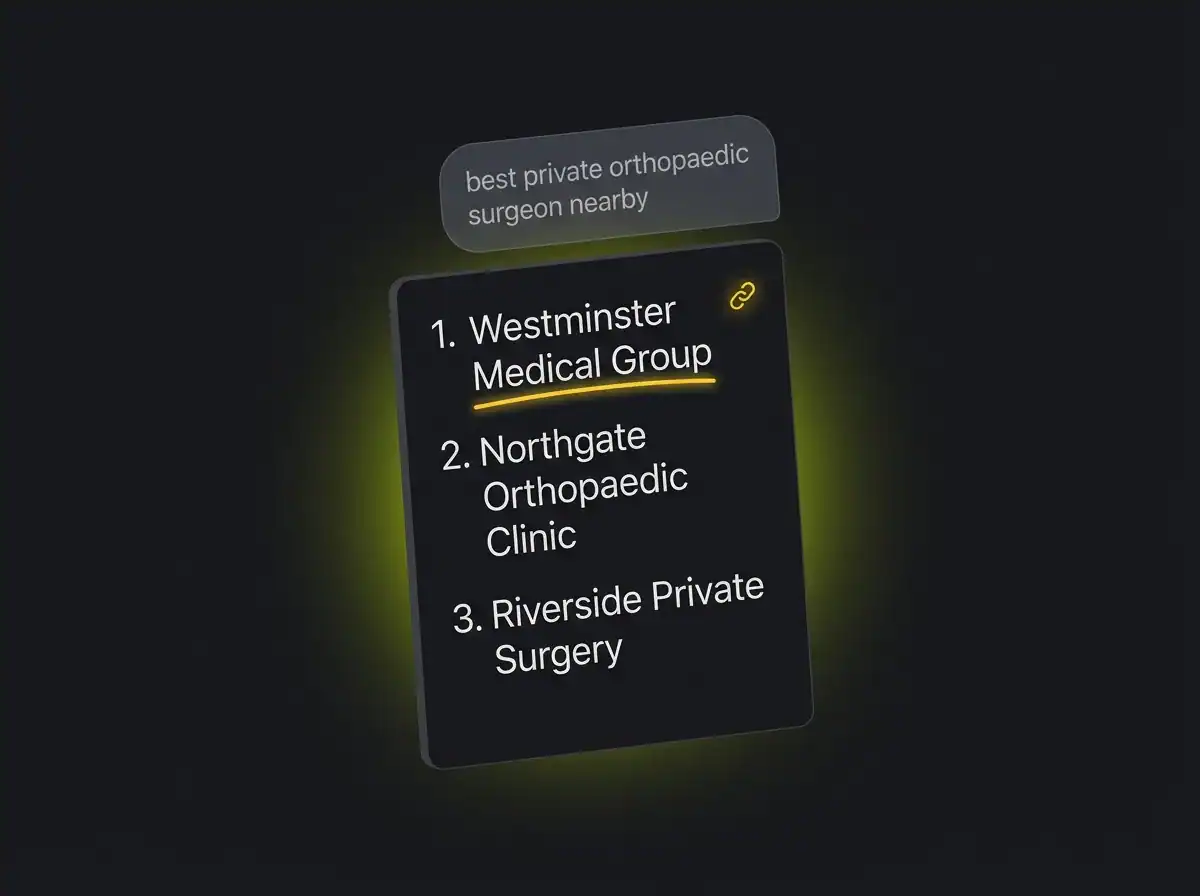
The clinic owner from the opening of this post had solid Google rankings. His enquiries were falling because a growing number of patients no longer start their search in Google. They open ChatGPT, Perplexity, or Claude and ask a question directly.
A Google AI Overview now appears on roughly six in ten healthcare informational queries in GB results. That means a meaningful share of organic clicks is absorbed before any blue link is reached. For recommend-me queries, the picture is starker still. A patient asking Perplexity "best private orthopaedic surgeon in Leeds" receives a named list of practitioners and clinics, with citations linking to the sources used to generate that list. Those citations are the equivalent of a first-page Google ranking, except the selection logic works differently.
What AI tools draw on when generating recommendations: content on your site that answers a specific question clearly, FAQ schema that can be extracted as a direct answer, named entities including your clinic name, registered practitioners' names, your specialty, and your location, and citations to authoritative bodies that signal credibility rather than promotion. A listing on the Private Healthcare Information Network is one such signal. Visible CQC registration is another.
Practically, this means the content signals that improve your Google E-E-A-T also improve your AI citability. They are not competing priorities. A site with credentialled content, FAQ schema, named clinicians, and visible regulatory registrations is well-positioned for both.
The conversion case for AI search is worth understanding. Our post on why AI search traffic converts at 5x the rate covers the detail. The short version: a patient who arrives via an AI recommendation has already been told your clinic is relevant to their specific problem. They are verifying, not comparison shopping. That is a fundamentally different conversation at the point of enquiry.
If you want to understand how your practice currently appears across AI tools, a structured AI search visibility assessment is the most direct starting point.
What healthcare SEO costs in the UK (and where the money goes)
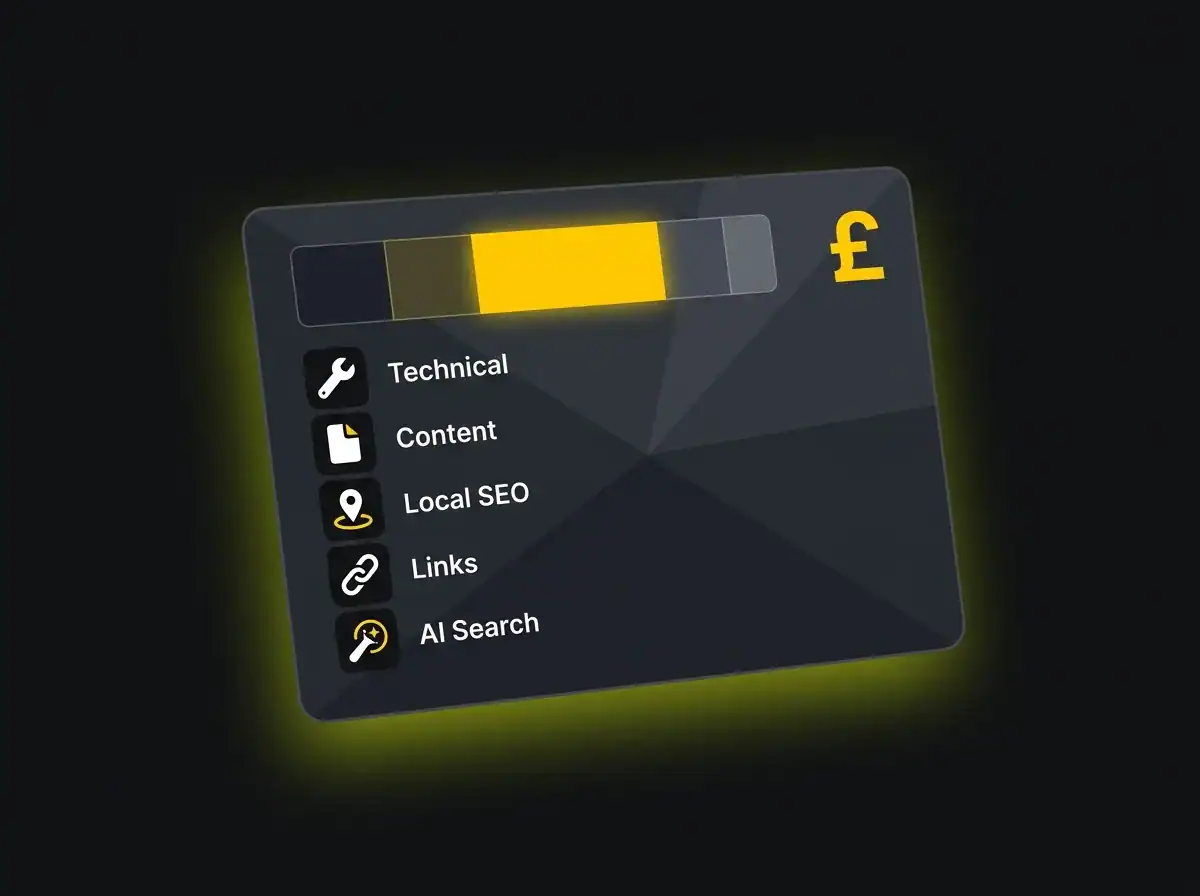
UK healthcare SEO costs vary based on practice size, the competitive landscape, and how much foundational work needs doing before anything strategic can happen. As a working range:
A single-site private clinic with limited prior SEO investment should expect to spend somewhere between £1,500 and £3,000 per month for a programme covering technical foundations, content development, local SEO, and basic link building. That assumes a practice with two to four key treatment areas and one primary location.
A multi-site healthcare group, or a single-site practice in a competitive urban market such as London or Manchester, would typically sit between £3,000 and £6,000 per month for a programme addressing multiple locations, multiple specialties, AI search readiness, and a realistic link acquisition approach.
These are working ranges with caveats. The right figure depends entirely on your starting position.
Where budget typically goes in a structured programme:
-
Technical audit and fixes: usually front-loaded in the first two to three months
-
Content development: ongoing, typically three to six pieces per month covering treatment pages, condition pages, and FAQ content
-
Local SEO: Google Business Profile management, citation building, review strategy
-
Link building: modest in the first six months, more active once the content foundation is in place
-
AI search readiness: schema implementation, structured FAQ content, named entity clarity across the site
What to spend less on in the first six months: link building from general directories, generic health blog content with no connection to your clinical services, and paid search as a substitute for organic visibility. PPC delivers immediate traffic but creates no lasting asset. The most common error in healthcare marketing budgets is spending heavily on Google Ads while neglecting the organic and AI channels that compound over time.
The five things that waste healthcare SEO budget
Chasing keywords the NHS owns is the most common. If the NHS has a comprehensive page on a condition, you will not outrank it for the generic informational query. Direct that resource towards the service-specific queries where you can actually compete.
Generic blog calendars with no clinical purpose come second. Twelve posts a year on "tips for healthy eating" or "the importance of sleep" will not move patient enquiry numbers. Every piece of content should connect directly to a treatment you offer or a question a patient would ask before booking with you.
Off-topic backlinks from lifestyle blogs, general business directories, and link-scheme networks may briefly move raw domain metrics, but they contribute nothing to the YMYL trust signals that healthcare SEO actually needs. Quality matters far more than volume here.
Ignoring AI search entirely is an increasingly expensive error. Every week without structured content, FAQ schema, and entity clarity in your site is a week competitors may be building AI citations you are not. This is the fastest-moving shift in patient discovery behaviour since mobile search.
Hiring a generalist agency that has not worked in YMYL territory is the fifth and often the most costly waste. The compliance constraints, E-E-A-T requirements, CQC and GMC context, and ASA restrictions are not things a general agency can absorb from a briefing document. The mistakes tend to be slow to fix and expensive to reverse.
Working with a healthcare SEO agency
If you are considering bringing in a specialist, a handful of questions are worth asking before you sign anything. How many active healthcare clients do they currently work with? Can they name the specific regulations and bodies that govern marketing for your specialty? What does their reporting actually cover, and can they connect SEO activity to patient enquiry data? Do they have someone who understands clinical content, or is everything written by a general copywriter?
Track record in healthcare matters because the work is specific. A site audit that does not check CQC compliance signals, GMC practitioner profiles, and PHIN data will miss the foundational trust layer entirely. An agency that has run this across multiple UK healthcare clients has encountered the common failure points and knows how to move past them.
The questions to ask at the outset are not particularly complicated. What they are is specific to healthcare. A good agency will have clear answers to all of them.
If you want to work with a healthcare SEO agency that covers both the traditional Google side and the AI search layer, the conversation starts with a structured review of where your practice currently stands across both.
Frequently asked questions
How long does SEO for healthcare take to show results in the UK?
Technical and local SEO improvements can produce visible changes in map pack rankings within six to twelve weeks. Content-driven results, where treatment pages and FAQ content begin to rank and drive traffic, typically take four to six months from publication. AI search citability, once the structural content is in place, can build faster: AI tools update their knowledge continuously rather than on a crawl cycle.
How much should a UK clinic spend on SEO each month?
For a single-site private clinic starting from a limited SEO base, a working range is £1,500 to £3,000 per month for a programme covering the core channels. Multi-site groups or practices in highly competitive urban markets should budget higher. The right figure depends on your starting position, competitive landscape, and how quickly you need results.
Does SEO still matter when patients are asking AI for recommendations?
Yes, and the two are more closely linked than most practitioners expect. The content signals that earn AI citations, structured FAQ content, named clinicians, clear E-E-A-T credentials, and authoritative regulatory references, are the same signals Google uses to evaluate healthcare content. Building for one tends to improve your standing in both.
What is the single most important thing a private clinic should do first?
Fix your Google Business Profile and build a genuine review strategy. For most single-site and small multi-site practices, local search visibility is the fastest route to measurable enquiry growth. A properly configured GBP with a consistent stream of genuine patient reviews will outperform months of content investment in the short term. Do both, but start there.
SEO for healthcare in 2026: where to go from here
SEO for healthcare in 2026 is not one discipline. It is three overlapping ones: traditional Google search, local map pack visibility, and the AI recommendation layer that now sits across all of them. Most clinics are addressing one of the three, inadequately. Very few are managing all three in a coordinated way.
If you want a clear picture of where your practice currently stands across all three channels, an AI Visibility Audit is the most direct way to find out. It covers how you appear in Google, how you appear in AI search responses, and where the specific gaps are. No jargon, no sales presentation. A clear read of your current position and what would actually move patient enquiry numbers.
The patients who ask ChatGPT which specialist to see are often the ones with the most pressing need and the clearest intent. Being the clinic that comes back when they ask is a specific, measurable advantage. It is available to you. The question is whether your current setup lets you claim it.