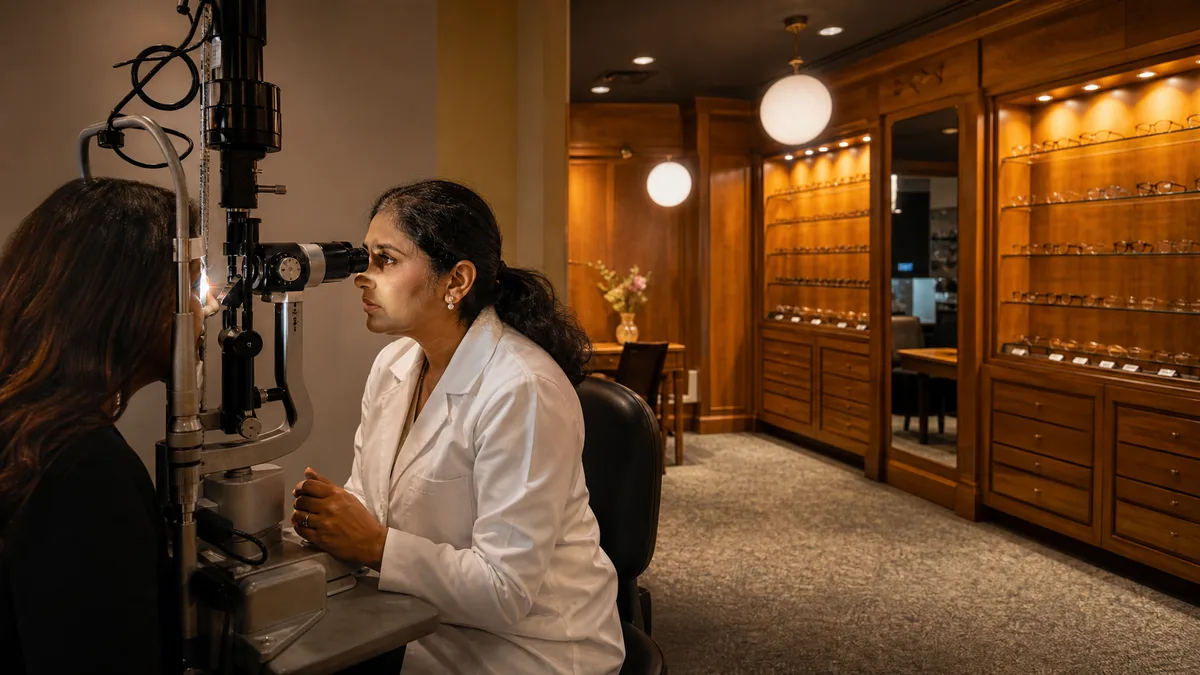
Three companies control 62% of the UK optical market. But across the country, thousands of independent practices are still open, and in many towns they are outranking Specsavers in Google's local results. Not because of bigger budgets. Because they are doing a few specific things better.
This is not a channel checklist. It is a competitive strategy guide for independent practices specifically. The argument is straightforward: national chains are dominant at the brand level but structurally vulnerable in local search, and the independent's advantages, proximity, authentic reviews, personalised recall, and genuine clinical depth, are exactly what Google's local algorithm rewards.
The chains cannot replicate what you have at the postcode level. The question is whether you are making use of it.
Why local search is the independent optician's biggest competitive advantage
The patient who books with you almost never typed "Specsavers" into Google. They typed "optician near me" or "eye test [town]" or "[postcode] opticians." That distinction matters enormously, because those are local queries, and Google's local algorithm does not care about national brand size.
It ranks on three factors: proximity, relevance, and prominence. Specsavers' marketing budget does not appear anywhere in that list.
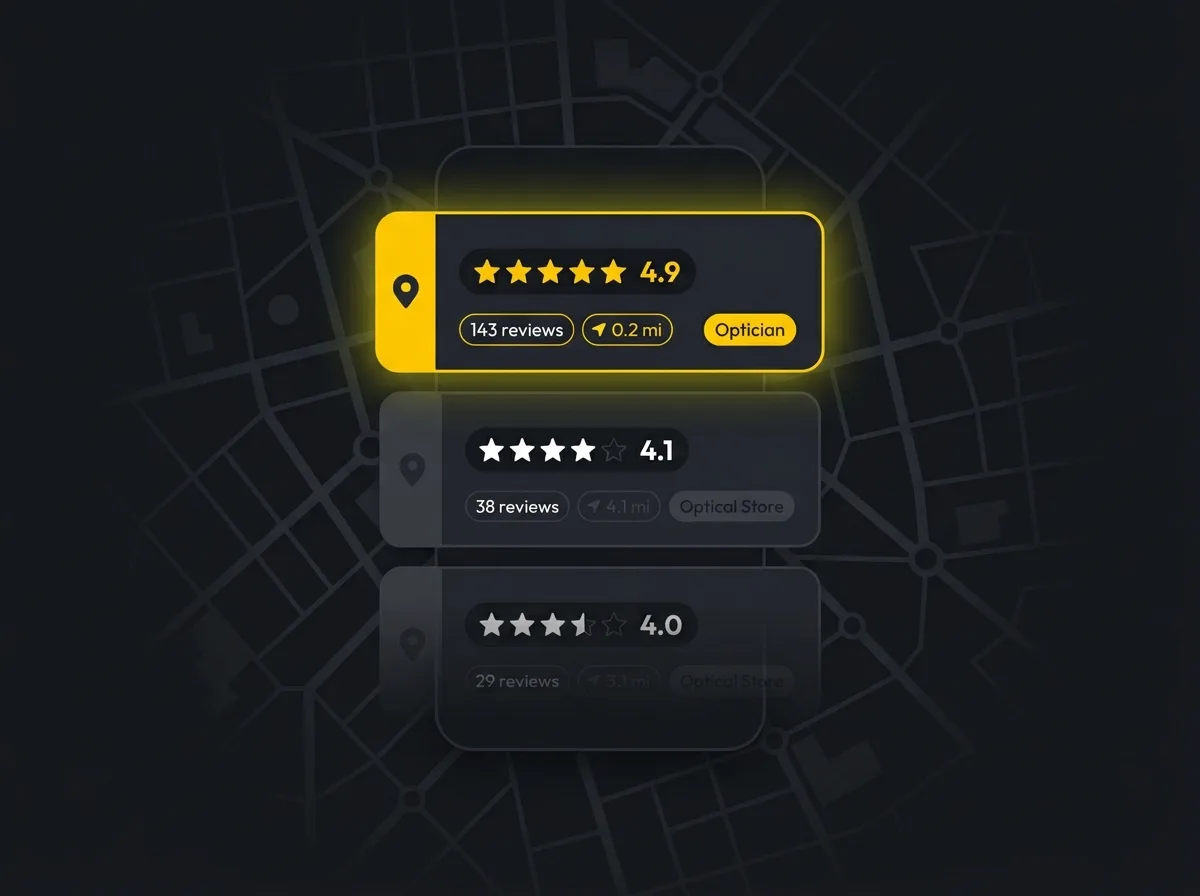
Proximity is fixed by geography. Relevance is built through a complete, well-structured listing and website. Prominence is earned through reviews, citations, and consistent activity signals. A single-location independent with 150 reviews and a properly maintained Google Business Profile will regularly beat a chain branch with 40 reviews and a generic listing. That happens regularly.
Specsavers has over 900 UK locations. Their reviews are distributed across all 900. An independent with one location that actively prompts patients to leave reviews can build a denser local reputation signal faster, per location, than any chain can. Research from optician marketing specialists suggests the typical practice in a competitive local map pack holds around 130 reviews. That is a concrete, achievable target.
The other thing working in your favour is intent. Eye test bookings are not impulse decisions. Patients who type "optician near me" want an appointment. Conversion rates from those searches are high relative to most paid channels, which means ranking in the map pack produces patients at a genuinely low cost per acquisition. It matters more than almost anything else on this list.
Understanding what your current search visibility for healthcare practices looks like against local competitors is always the sensible starting point before committing to any spend.
Google Business Profile: your practice's real front door
Most new patients evaluate a local optician through their Google Business Profile before they visit the website. For many, it is the only page they look at. They check the star rating, read two or three reviews, confirm the opening hours, and either call or move on. The listing is doing more work than the website.
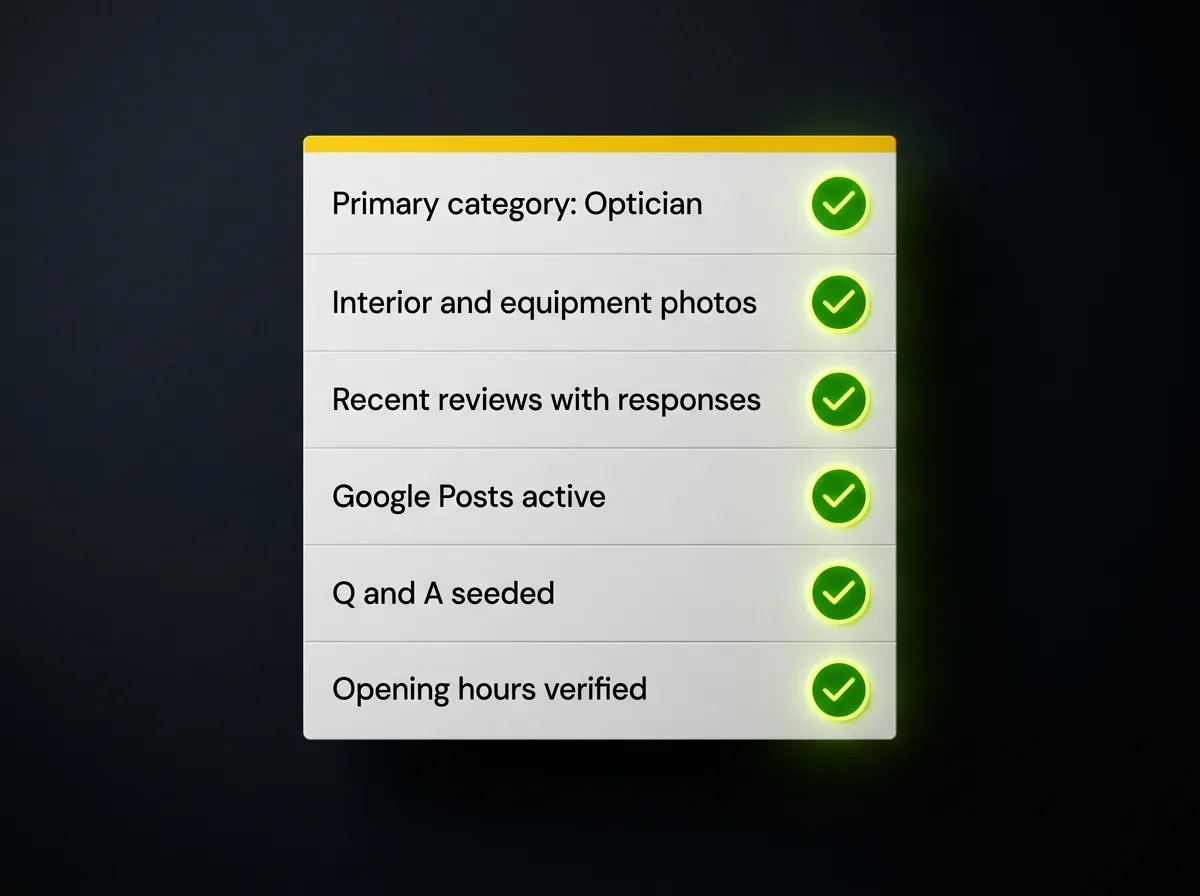
The basics are often wrong. Wrong primary category is the most common failure. The correct one is "Optician." If you also sell contact lenses or sunglasses directly, secondary categories such as "Contact Lenses Supplier" or "Sunglasses Store" can be added. Wrong categories push your listing into the wrong relevance signals for the searches that matter.
Photos. Most practice listings are under-photographed, or rely on images taken years ago on a phone. Upload interior shots of the consulting room and waiting area, frame displays, clinical equipment (a slit lamp or OCT machine signals genuine clinical depth), and real staff photographs, not posed portraits. Patients want to know what they are walking into before they commit to a booking.
Reviews. The most impactful thing most practices can do in the next 30 days costs nothing. Send every patient, within 24 to 48 hours of their appointment, an SMS or email with a direct link to your Google review page. Not a general reminder. A direct link with zero steps between the patient and the review form. Most satisfied patients do not think to leave a review unless they are asked directly and given a frictionless route to do it.
Google Posts. Wildly underused. Seven-day posts on seasonal themes, back-to-school eye tests in August, NHS eligibility reminders before the end of the tax year, January eye health messaging, new frame arrivals, show up in the listing and signal an active, managed practice. They take 10 minutes each.
The Q&A section. Seed it yourself with the real questions prospective patients ask: "Do you accept NHS referrals?", "Can I book a contact lens fitting online?", "Do you offer OCT scanning?" If you leave it empty, anyone can add questions and anyone can add answers. Control the first impression.
Review responses. Reply to every review, including the difficult ones. Chains manage this badly at scale because it requires genuine attention and local knowledge. A thoughtful response to a negative review builds more trust with a prospective patient reading the listing than a stack of additional five-star scores would. They can see the difference between a real reply and a templated one.
What this adds up to is a listing that reads as a real, active, well-run practice rather than a branch location on a directory. That contrast is visible and it converts.
Recall marketing: the highest-ROI activity most independent opticians overlook
Recall marketing is prompting existing patients to rebook their next appointment at the right time. The standard adult interval is two years. Annual for children, contact lens wearers, and patients managing conditions such as diabetes or raised intraocular pressure.
The lifetime value calculation rarely gets written down, but it should.
One patient who returns every two years for 15 years generates seven or eight appointments plus dispensing revenue. At a typical independent practice dispensing value of £200 to £300 per visit, one loyal patient represents meaningful long-term income from a single relationship. Chains understand this arithmetic. Many independent practices do not structure their communications to reflect it.
Why chains do recall poorly is worth understanding, because the weakness is structural. A national operation sending automated messages to 900 locations' worth of patients cannot personalise by practitioner name, by the patient's last test category, by their frame preferences, or by their specific clinical follow-up needs. You can. That is not a small operational difference. It changes whether a patient feels remembered or processed.
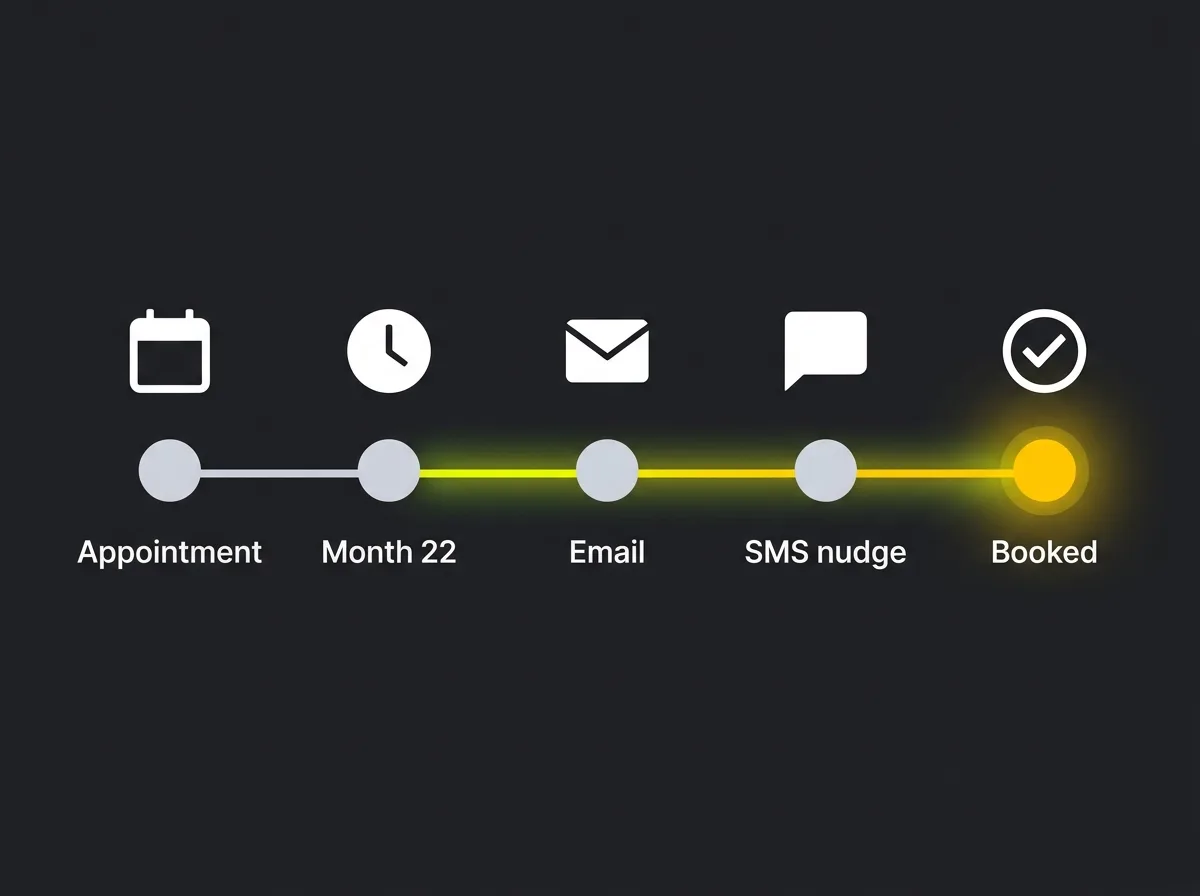
The recall email structure is simple. Send it at around 22 months after the last appointment for standard adult patients, 10 months for children. The subject line should feel like a message from a practice that knows who the patient is, not an automated system firing on a schedule. Keep the body short, two paragraphs at most. The booking link should be one tap, not a search through the website.
SMS recall serves as the follow-up for patients who did not engage with the email. Open rates are significantly higher, the message is shorter, and the same direct booking link applies. It is not a replacement for email. It is the second prompt for patients who missed the first.
Contact lens renewal is a separate and more frequent touchpoint, often monthly or quarterly. Wearers who are not actively managed drift toward online retailers, not necessarily because the price is better, but because the online retailer makes reordering easier. A simple renewal prompt timed to the end of their current supply is usually enough to keep most of them. Chains automate this well. Independents who do not are quietly losing lens patients.
For independent practices with a patient list of any size, recall and renewal communications deliver a higher return per pound spent than almost any acquisition channel. No advertising budget required. Returns compound year on year.
Free resource: Traffic Projection Report
If you want to see how your practice currently shows up in local search for eye test and optician queries in your area, a Traffic Projection Report gives you a clear baseline picture before committing any budget to new patient acquisition channels.
Turning your website from a brochure into a booking engine
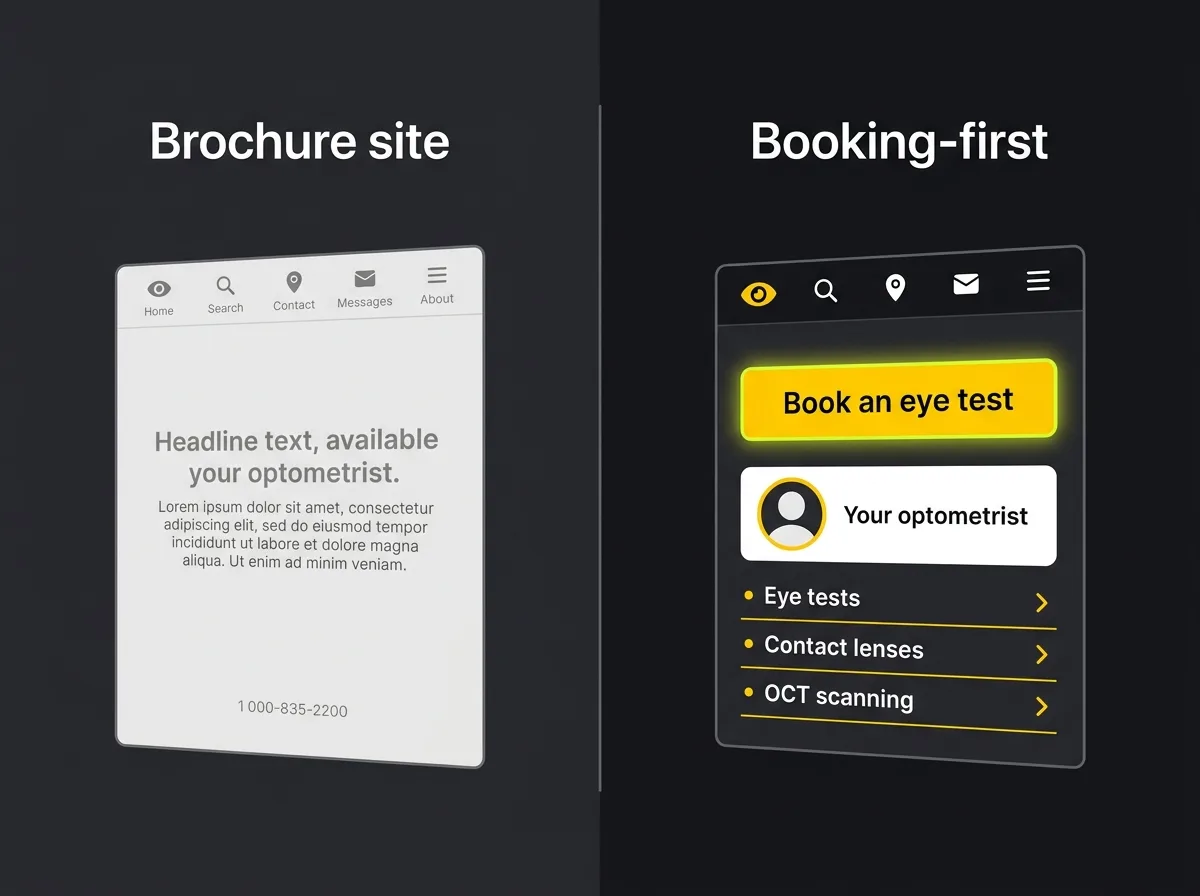
Most independent optician websites convert badly. Not because they look poor. Because they were designed to explain the practice rather than move a patient from interest to booked appointment. The distinction matters more than most design decisions.
The funnel is short: patient finds the practice on Google or their Google Business Profile, visits the website, and attempts to book. The biggest leak is the last step. If the only way to book is to call during opening hours, a meaningful proportion of working-age adults and contact lens patients will not bother. They expect to self-serve online. If that is not an option, it is the first thing to fix, before any other conversion work.
Mobile experience is non-negotiable. Eye test searches skew heavily mobile. The path from finding a practice in a search result to completing a booking must work without friction on a phone. If the site takes four seconds to load on mobile or forces a user to pinch-and-zoom to tap a button, those patients are gone before they reach the booking form.
Trust signals matter in ways that are specific to opticians. Your General Optical Council registration number should be visible and briefly explained. The GOC registers individual optometrists, not brand names, which is worth making clear: it means a specific qualified professional is accountable for the eye care provided, not just a brand umbrella. Named optometrists with genuine photographs rather than stock images, clinical accreditations, and professional body memberships all reinforce the same message. This practice is run by real, credentialed people who are responsible for what they do.
Service pages earn their place. A dedicated page for OCT scanning, dry eye clinic, myopia management in children, and specialist contact lens fitting each targets specific search queries ("OCT scan [town]", "myopia control [city]", "children's eye test near me") and signals clinical depth that a five-page brochure site cannot. Each page needs its own clear booking call to action. The patients searching those terms are often the highest-value patients on any practice's list.
For a detailed look at what patients need from a healthcare website before they are willing to book, including the trust signals and structural elements that shift conversion, that guide covers the specifics. And if you want to understand what a high-converting page actually looks like at the structural level, the principles apply directly to an optician booking page.
The full channel picture: every option, in priority order
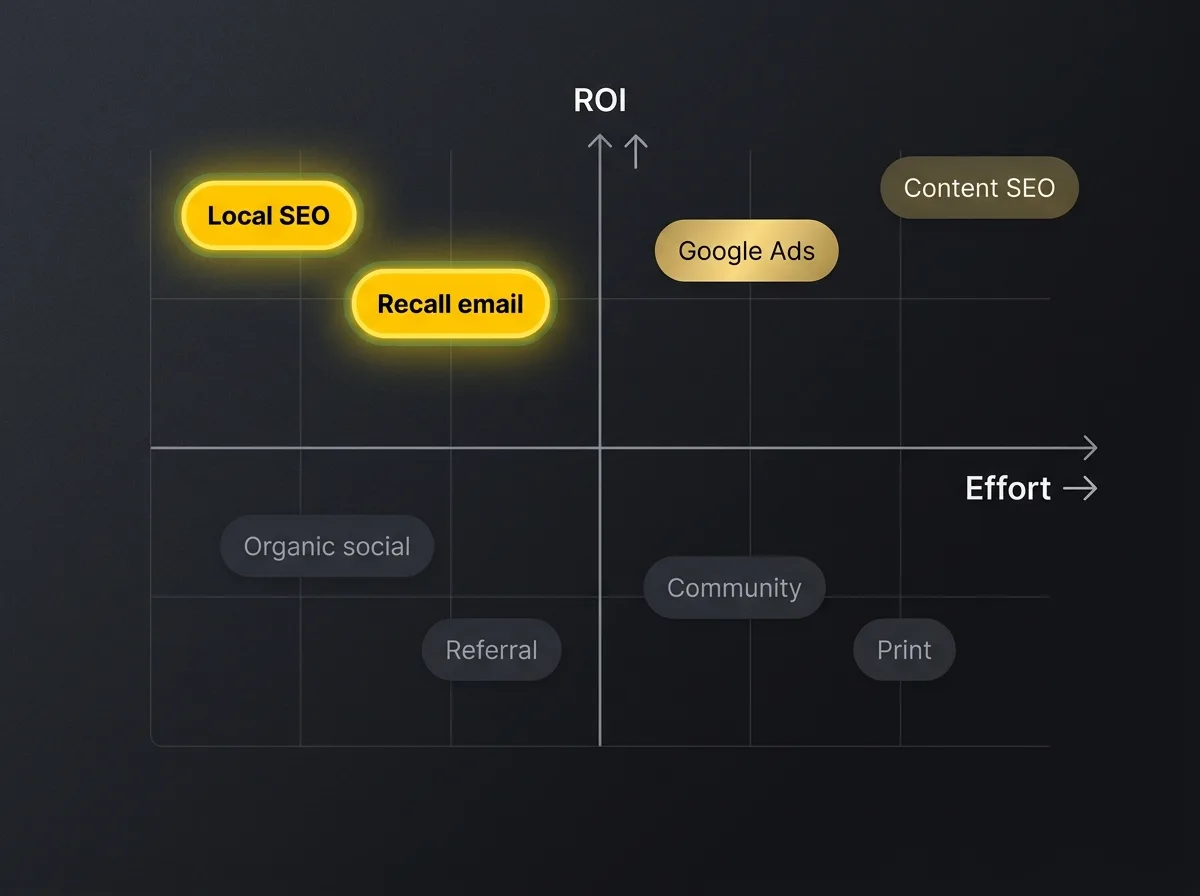
Independent opticians cannot do everything at once. Budget is finite. So is time, especially when one or two practitioners are managing a patient caseload and the business simultaneously. Channel prioritisation is not a luxury. It is the whole game.
This is the honest landscape for independent optician marketing, including channels that fall outside healthcare marketing or a local SEO agency scope entirely.
-
Local SEO and Google Business Profile. Highest ROI, most sustainable, and the foundation every other channel builds on. Do this before spending on any paid channel. The mechanics are covered in the sections above.
-
Recall email and SMS. Highest return per pound for any practice with an existing patient list. No advertising budget required. Returns compound year on year. Run this in parallel with local SEO because it draws on entirely different resources.
-
Google Ads. Specifically for eye test appointment intent keywords and contact lens searches. Works immediately. Most effective in competitive towns where the map pack is difficult to enter organically, or as a seasonal push around back-to-school and January. Not a long-term replacement for organic ranking, but it fills gaps while that ranking builds.
-
Content SEO. Blog content on eye health topics, children's vision, specific clinical services, and contact lens guidance builds topical authority over six to twelve months and captures long-tail search queries that service pages alone will not cover. It also feeds into AI search visibility. Practices publishing specific clinical content are beginning to appear in AI-generated responses when patients ask "who is the best optician in [city]" through ChatGPT or Perplexity. It is early, but the direction is clear.
-
Organic social. Instagram works well for frames and lifestyle content, Facebook for local community updates and engagement. Better for patient retention and brand warmth than new patient acquisition. Worth running consistently, but not a reliable primary acquisition channel for most single-location practices.
-
Referral and word of mouth. Still the dominant acquisition channel for many independent practices. Can be stimulated with a referral scheme, but largely organic and difficult to manage directly. A consistently excellent patient experience is the referral programme.
-
Local community presence. School vision screening partnerships, health fairs, chamber of commerce. Excellent for local authority and referral relationships; difficult to measure in digital terms.
-
Local print. Targeted leaflet drops in catchment postcodes, local newspaper advertising. Can work well for awareness and seasonal campaigns.
The pattern here mirrors what works in healthcare marketing for UK practices across other appointment-based sectors. Local search, recall, and web conversion come first. Paid channels amplify what is working. Content builds the long-term position. The same logic applies whether you run an optician practice, a dental surgery, or a private GP clinic. If that parallel is useful, the approach is explored in more detail in the guide on digital marketing for dentists.
What to measure and when to expect results
The metrics worth watching are the ones connected directly to patient flow.
Primary KPIs: new patient enquiries from Google (GBP direct calls and direction requests, website contact form submissions, online bookings with source attribution), recall email rebooking rate, and appointment conversion rate from website visits. These numbers connect marketing activity to revenue. Everything else is context.
Useful secondary tracking: the search queries patients used to find your listing (visible in GBP Insights and Google Search Console), impressions and click trends over time, and review count tracked month over month. Worth reviewing quarterly rather than obsessively.
Realistic timelines: GBP completeness improvements and increased review velocity produce visible changes to listing performance within four to eight weeks. Map pack ranking movement in a competitive town typically takes three to six months of sustained effort. Content SEO is a six to twelve month investment. Google Ads can deliver bookings from the day a campaign goes live.
One note on AI search. Practices publishing regular, specific content on clinical services, particularly OCT, dry eye, myopia management, and children's vision, are starting to appear in AI-generated responses when patients ask ChatGPT or Perplexity which optician to see in their area. It is early. But it compounds. Practices building editorial content now will have an advantage that takes years for competitors to close.
For a broader framework covering search visibility and traffic across channels, including how to structure measurement properly, that hub covers the full picture.
Frequently asked questions about marketing for opticians
How long does local SEO take to produce results for an optician?
Visible changes to Google Business Profile performance, including impressions and the queries driving them, typically appear within four to eight weeks of making completeness improvements and increasing review activity. Map pack ranking movement in a genuinely competitive town takes longer, usually three to six months of consistent work across the GBP listing, on-page signals, and local citation building. If you need bookings before that timeline, Google Ads can deliver from day one of a live campaign alongside the organic work.
Is Google Ads worth running if I already rank well organically?
Often, yes. Paid ads occupy different positions on the results page and capture intent that organic rankings do not reach. Eye test queries in particular carry high booking intent, and running ads for specific high-value services, OCT scanning, dry eye clinic, specialist contact lens fitting, alongside strong organic presence generates incremental bookings at an acceptable cost per patient. The two channels do not compete for the same clicks in the same way; they capture different moments in the same search session.
What should I post on Google Business Profile to stay active?
The most effective posts for opticians focus on time-sensitive or educational content: NHS eligibility reminders, back-to-school eye test campaigns in late summer, winter eye health awareness, new frame arrivals, and clinical service updates such as a new OCT machine or a dry eye clinic launch. Keep each post brief, include a direct booking link, and aim for one or two per week. Posts expire after seven days, so consistency matters more than individual post quality.
How do I get more Google reviews without it feeling awkward?
Timing and framing matter more than frequency. Sending a direct link to your Google review page within 24 to 48 hours of an appointment, via SMS or email, captures patients while the experience is still fresh. The message should feel personal and brief, not a template from a call centre. Most patients who had a genuinely good experience are happy to leave a review when asked directly and given a frictionless path to do it. Responding to existing reviews, including critical ones, also signals to prospective patients that the practice is attentive, which is often more persuasive than a higher star rating alone.
How does AI search affect independent optician marketing?
AI tools such as ChatGPT and Perplexity are increasingly answering local healthcare queries directly rather than returning links alone. When a patient asks "which is the best optician in [city]", the AI synthesises from editorial content it can reach. Practices that publish specific, named clinical content, on OCT scanning, dry eye management, myopia control, and children's vision, structured with clear answers to real patient questions, are better positioned to appear in those responses. Local SEO still matters because AI tools draw from Google-indexed content; a strong GBP and organic ranking feeds AI visibility rather than competing with it.
Where to focus first
Independent opticians have structural advantages in local search that national chains cannot replicate at scale. Proximity, authentic review velocity, personalised recall, and genuine clinical relationships all work in your favour. The chains know it, which is why they continue to invest in local community programmes and NHS partnerships. They are trying to borrow what you have naturally.
The sequence matters when time and budget are limited. Get the Google Business Profile right first. Activate recall marketing for the patients already in your system. Fix the website-to-booking conversion before spending on new patient acquisition. Then use Google Ads to accelerate map pack gaps or seasonal volumes. Content builds the long-term moat.
The Association of Optometrists publishes regular data on the UK optical market if you want to sense-check the competitive landscape from a primary source before making investment decisions.
Free resource: Traffic Projection Report
If you want to see how your practice is currently showing up in local search for eye test and optician queries in your area, and what the gap looks like compared to what you could be capturing, a Traffic Projection Report will show you that. It takes around ten minutes and gives you a clear baseline before committing to any spend.