
"Eight months of Google Ads and I still don't know if it's working."
That is a sentence I hear fairly often from dental practice owners. The enquiries come in, then they slow down, and the monthly agency report is full of impressions and click-through rates that do not clearly connect to new patients sitting in the chair.
Sound familiar?
Meanwhile, the practice manager has suggested TikTok, a local competitor seems to be appearing everywhere on Google Maps, and a patient mentioned last week almost as an aside that she found the practice by searching online rather than clicking any ad.
The problem is rarely the channels themselves. It is not having a clear map of what each channel does, how they relate to each other, and in what sequence it makes sense to invest.
Digital marketing for a dental practice works as a layered system. The practices that grow most consistently build the channels that compound, the ones that keep working without continuous spend, and use faster, costlier channels selectively on top. Most practices do the opposite.
This guide covers the full picture: how patients actually find a dental practice, which channels build lasting value and which stop the moment you stop paying, and what a sensible build sequence looks like for a UK practice today.
What this guide covers
UK dental practices often spread marketing spend across multiple channels without a clear picture of which is actually driving new patients. This guide maps the full channel landscape, from local SEO and Google Business Profile (the highest compound return for most practices) to organic search, Google Ads, social media, and AI search visibility. It explains which channels build value over time and which stop when spend does, and gives a practical sequence for what to get right first.
How patients find a dental practice in 2026
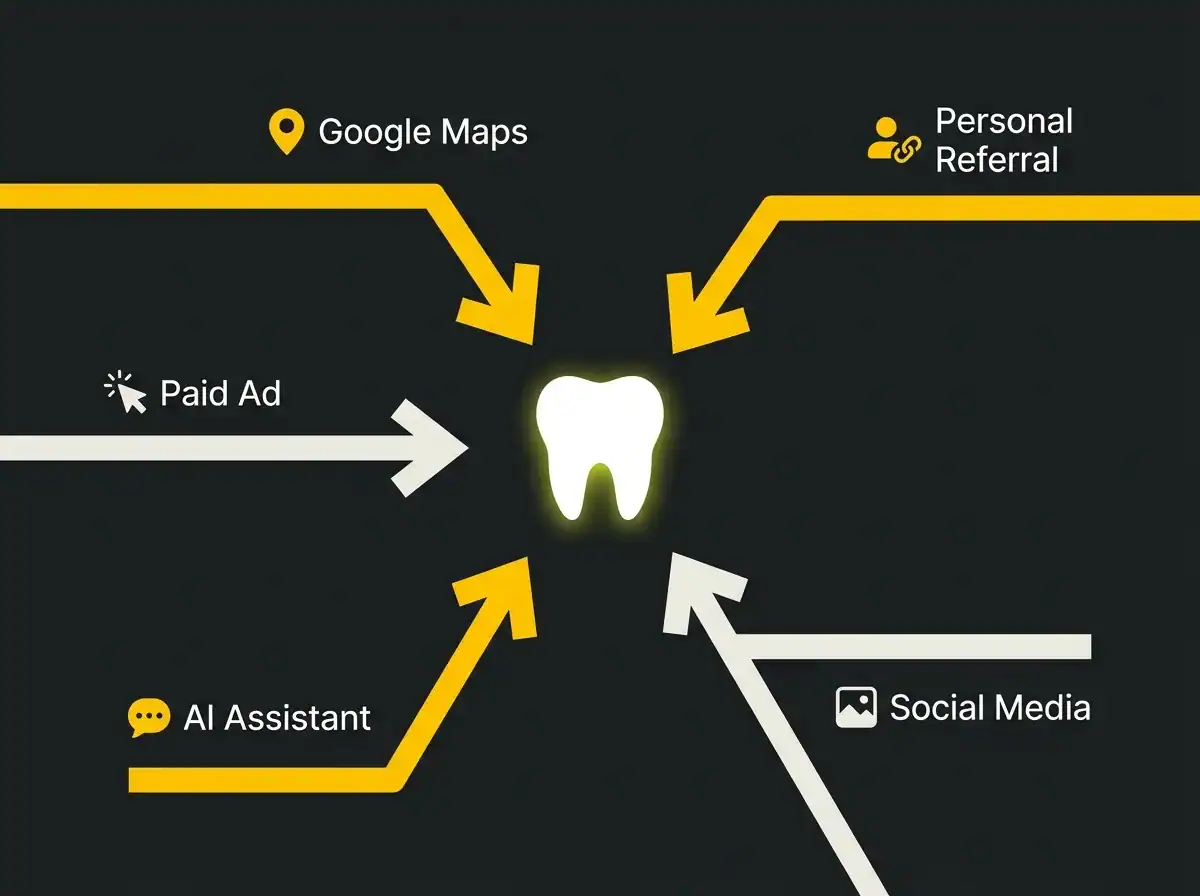
Before deciding where to invest, it helps to understand the full picture of how a patient actually arrives at a new practice.
The routes are more varied than most dental marketing agencies acknowledge, partly because agencies tend to present the channels they happen to sell.
Word of mouth and personal referrals. Still the most common path, particularly for cosmetic treatments. Invisalign results, composite bonding transformations, and implant work get shared between friends and colleagues because the results are visible and personal. No marketing budget fully replicates a trusted recommendation. Referrals come from patient experience, not campaigns.
Google local pack. When someone searches "dentist near me," "emergency dentist open now," or "Invisalign [their town]," the results they see first are a map with three local listings. Each shows reviews, distance, opening hours, and sometimes a direct booking link. A large proportion of local dental searches end here. This is also where local SEO for dental practices has its most direct impact.
Organic search. Below the map pack, standard website listings. Treatment-specific searches like "dental implants cost UK," "composite bonding near me," or "how long does Invisalign take" land here. Practices with dedicated, properly structured treatment pages capture this traffic.
Paid search. Ads sit above the organic results. Visible immediately, stops immediately when the budget pauses.
NHS Find a Dentist, Whatclinic, and Whatdentist. A significant number of UK patients use these directories when choosing or registering with a practice, particularly for first-time registrations or when researching a specific treatment provider. Whatclinic and Whatdentist both send patient enquiries directly and feed into the directory ecosystem that supports local search authority.
Social media. Instagram in particular for cosmetic dental practices. Before-and-after imagery for composite bonding and Invisalign travels well because the results are visually compelling. Generally stronger for awareness and warm-up than direct booking.
AI tools. A growing number of patients begin dental research by asking ChatGPT, Perplexity, or Gemini: "who are the best cosmetic dentists in [city]," "what should I look for when choosing an Invisalign provider." Most UK dental practices are not appearing in those answers.
Worth knowing.
A brief note on context. UK dental marketing operates across three distinct types of practice: NHS-contracted, mixed (the most common type and the most common prospect for CT, offering both NHS and private treatments), and fully private or cosmetic clinics. NHS-only practices face a different set of marketing considerations. The channel landscape in this guide is most directly applicable to mixed and private practices, where active digital marketing can meaningfully drive patient acquisition.
The Oral Health Foundation publishes annual data on UK patient search behaviour. The consistent finding over the past several years is that most patients research a dental provider online before booking, even when the initial prompt to look came from a personal recommendation.
Digital visibility is not optional for mixed or private dental practices.
The channels that build over time, and the ones that stop when you stop paying
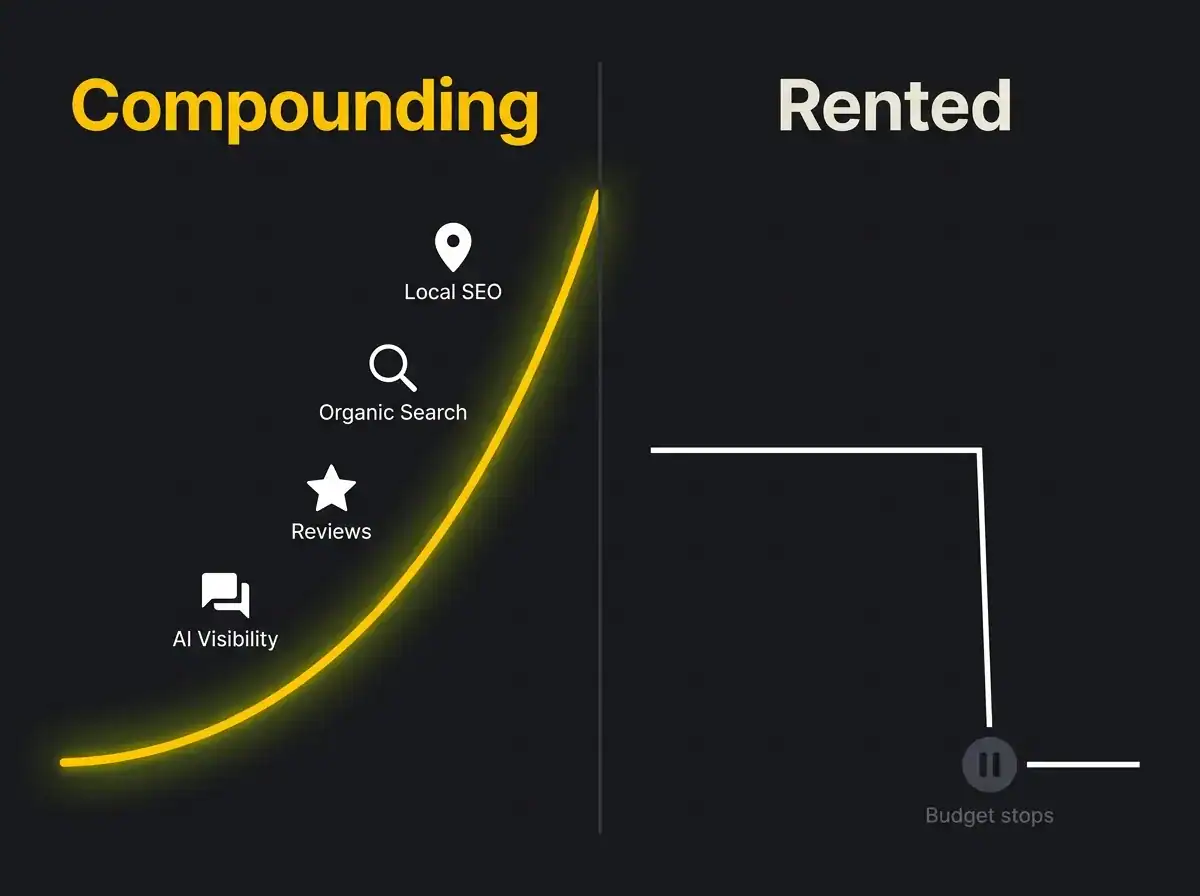
The single most useful frame for dental marketing is the distinction between two types of channel: compounding and rented.
Compounding channels build value over time. Local SEO authority, organic search rankings, review volume, content that answers patient questions, and AI search citations all fall into this category. They take three to twelve months to show meaningful results. But once they are working, they generate patient enquiries at effectively zero marginal cost per month. A practice with a strong local SEO presence and a top-three map pack position for "Invisalign [city]" receives those enquiries for the cost of the original optimisation work, not for each individual click.
It compounds.
Rented channels deliver immediately and stop when the budget does. Google Ads are the clearest example. The moment a campaign is paused, enquiries from that channel stop the same day. These are not bad channels. They are the wrong channels to rely on exclusively.
Most UK dental practices over-index on rented channels early, because they feel measurable and give the agency something concrete to report. The clicks are counted. The impressions are tracked. Compounding channels are harder to attribute month to month, which is precisely why most practices underinvest in them.
That is the trap.
The practices that grow most consistently do the opposite. They build the compounding foundation first, use paid search to fill the gap while organic builds, and use it selectively to launch a specific high-value treatment or to compete in a tight geography. They do not run ads as an indefinite substitute for a patient pipeline.
This is the strategic core of search visibility and traffic for any dental practice: get the compounding channels right, then layer rented channels on top with a clear purpose and a clear exit condition.
Local SEO and your Google Business Profile
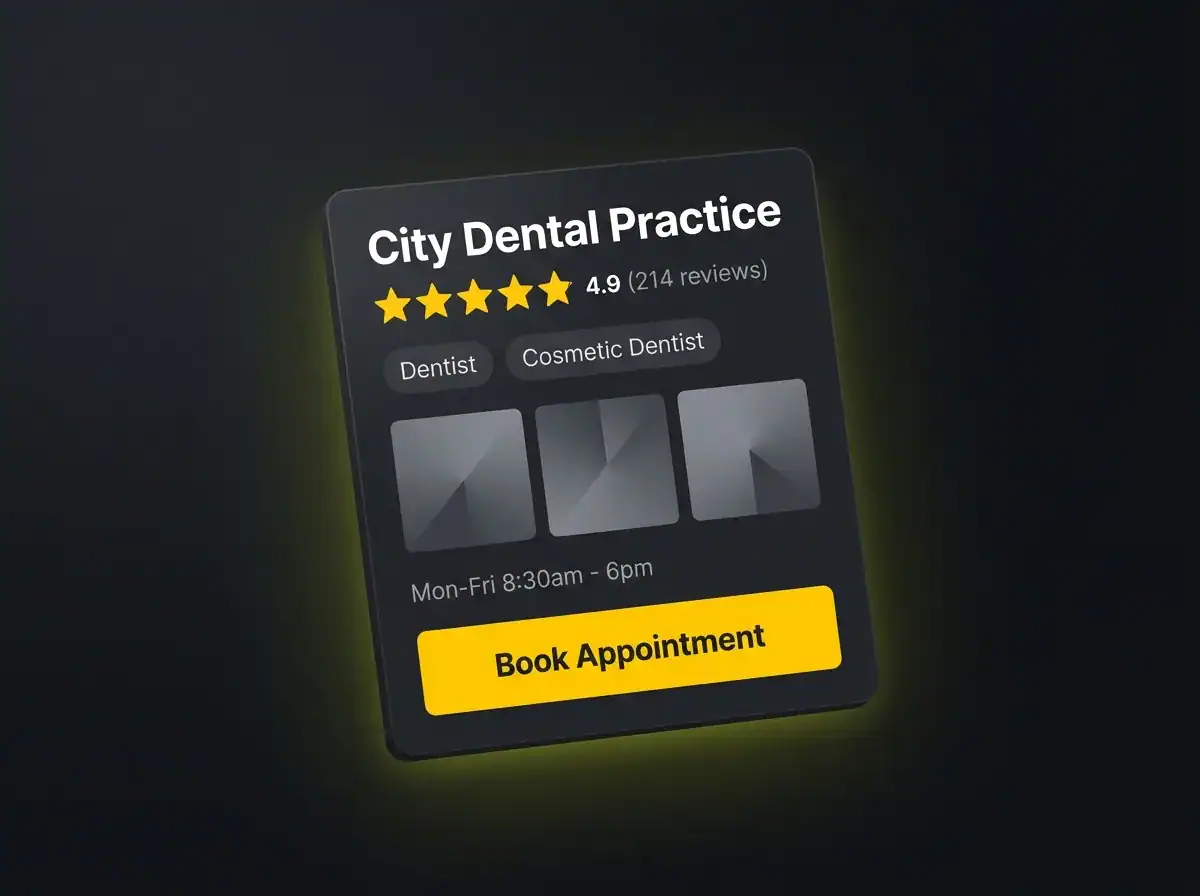
For most UK dental practices, local SEO delivers the highest compound return of any early investment. The reason is straightforward: local intent in dental search is enormous.
"Dentist near me," "dental implants Bristol," "emergency dentist open now," "Invisalign [town]" are searches made every day by patients who are ready to act, not just browsing. Map pack results capture a substantial share of these clicks and tend to convert well, because the listing itself does much of the trust and information work before the patient even visits the website.
Start here.
Your Google Business Profile. This is the foundation of everything in local search. If it is incomplete or inaccurate, nothing else will perform as well as it should. Every field matters: professional practice photos, team photos, every service listed by name rather than a vague "dentistry" category, correct and current opening hours, and a direct appointment link where one exists.
Your primary category should be "Dentist." Add accurate secondary categories where applicable: "Cosmetic Dentist," "Dental Implants Provider," "Orthodontist." If the profile was set up in 2019 and nobody has touched it since, it is costing the practice visibility every week.
Reviews. The primary trust signal for prospective dental patients. Review volume and recency both signal to Google and, more importantly, to the patient deciding whether to call. A practice with 60 reviews averaging 4.8 stars will consistently outperform one with 10 reviews at 4.5, even when the care quality is equal.
The key is a consistent flow of genuine reviews rather than a single burst followed by months of nothing. Ask after positive patient interactions, make the process simple with a direct link, and respond to every review, including negative ones, professionally.
One compliance note: the General Dental Council sets clear rules on how practices can seek and present patient testimonials. You cannot incentivise reviews, and NHS practices face additional restrictions on certain types of patient feedback. Work within those rules. The long-term credibility of a review profile depends on every review in it being genuine.
Local citations. Your practice name, address, and phone number must be identical across every directory that lists you: NHS provider directory if applicable, Whatclinic, Whatdentist, Yell, Thomson Local. Not "The Dental Studio" in one place and "Dental Studio Ltd" in another.
Inconsistency across citations directly weakens local ranking signals. It is one of the more tedious tasks in local SEO and one of the most commonly neglected.
For cosmetic practices, the Google Business Profile is also a visual portfolio. Before-and-after content in GBP posts is permitted within GDC advertising guidelines where patient consent has been obtained and outcome claims are not misleading. A cosmetic practice with strong case imagery in its profile attracts exactly the patients it wants before they have ever read a word of the website copy.
Organic search and treatment-specific pages
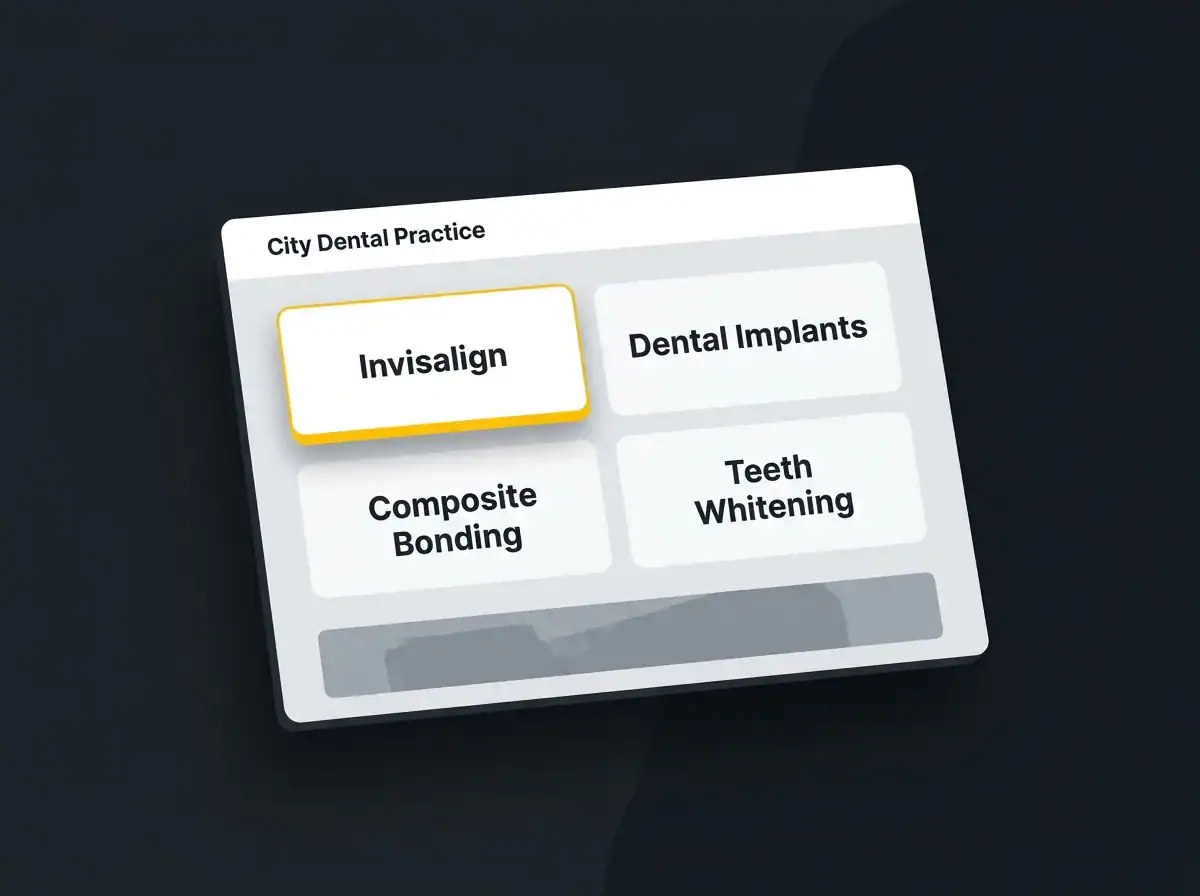
Most dental practice websites follow the same structure: a homepage, an about page, and a single services page listing everything from a routine check-up to dental implants.
That is not how dental search works.
Every treatment is a separate query. "Composite bonding near me." "Dental implants cost UK." "How long does Invisalign take." "Teeth whitening Birmingham." Each has its own monthly search volume, its own patient intent, and its own opportunity for a dedicated page to rank. A services page that mentions all of these in passing will not rank for any of them.
Each treatment needs a proper dedicated page. Not a paragraph within a longer list, but a full page with the treatment name in the main heading, a local modifier in the title tag and page copy, an honest indication of cost range, patient FAQs, relevant imagery within GDC guidelines, and a clear next step.
These pages are what capture the patient who is actively researching a specific procedure and moving toward booking a consultation.
Informational content also earns its place. "What to expect from dental implant surgery." "How many Invisalign aligners will I need." "Is composite bonding permanent." These questions are being asked every week by patients who are not yet ready to book but are building toward it. A practice whose website answers them builds trust early in the decision and keeps that patient from finding those answers at a competitor's practice instead.
YMYL applies here. Dental content falls under Google's Your Money or Your Life category, which means E-E-A-T requirements, Experience, Expertise, Authoritativeness, and Trustworthiness, apply firmly. GDC registration credentials should be visible on treatment pages. Authors of clinical content should be identifiable. Thin or duplicated content will not rank regardless of keyword density.
Our healthcare SEO guide covers the technical and content requirements for healthcare websites in more detail. Once a CT dental SEO post is published, the organic search section of this guide will link to it as the tactical implementation companion.
Treatment-specific pages are among the highest-compound organic investments a dental practice can make. A page that ranks for "composite bonding Manchester" or "Invisalign cost Birmingham" generates enquiries for months or years at no ongoing cost per click. That is where SEO for dental practices starts.
AI search visibility: the channel most dental practices have not touched yet
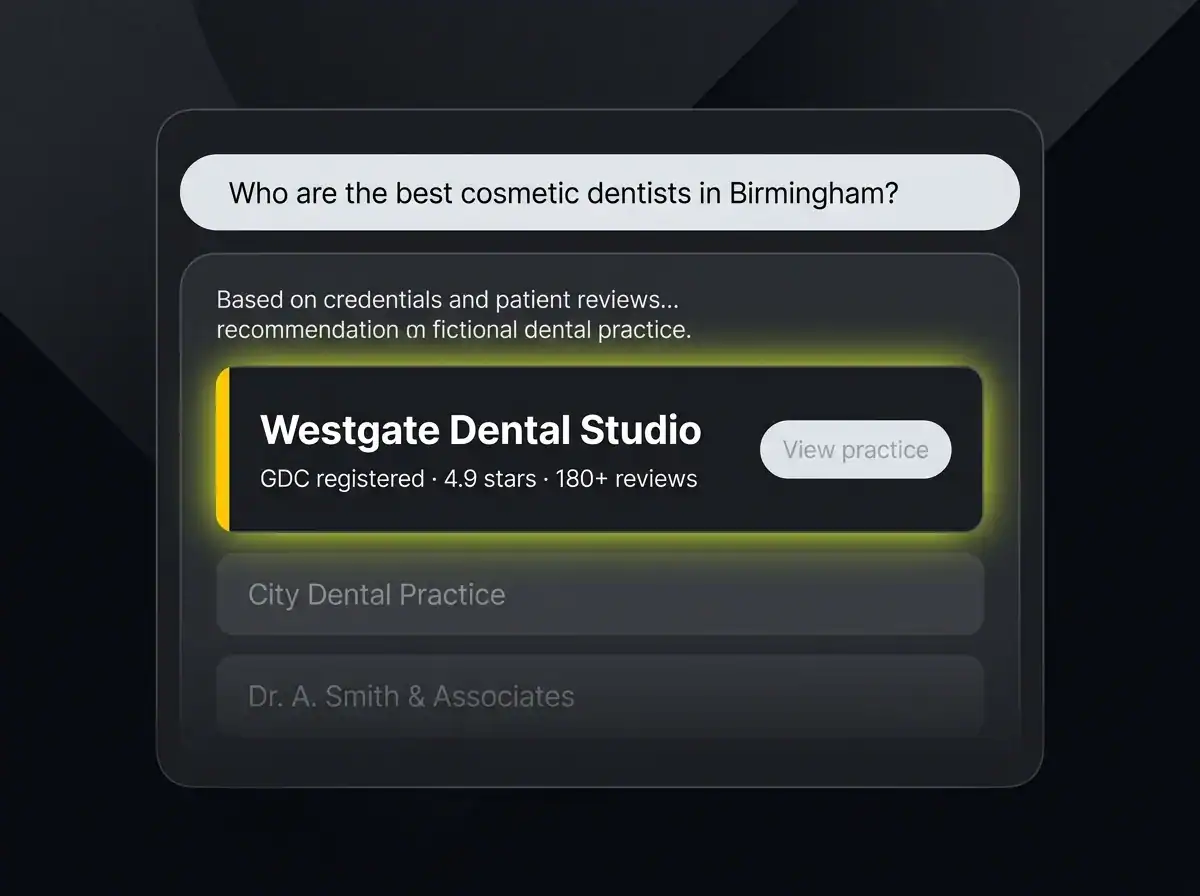
A growing number of patients begin their dental research by asking an AI tool. "Who are the best cosmetic dentists in [city]." "What should I look for when choosing a dental implant provider." "How do I know if a dentist is good at Invisalign." ChatGPT, Perplexity, and Gemini all field these questions every day.
The AI gives an answer. Most UK dental practices are not in it.
What determines whether a practice appears in AI citations is different from, but closely connected to, what drives traditional search rankings. The key factors are a strong organic presence on Google (AI tools are significantly more likely to cite practices that already rank in traditional search), clear and structured information about the practice and its treatments, consistent entity information across all online listings, genuine review volume, and, critically, treatment-specific FAQ content that directly answers the questions patients are asking these tools.
That last factor is immediately actionable.
Write clear, single-question FAQ content for each major treatment: "What does a dental implant consultation involve?" "How many appointments does Invisalign take?" "Is composite bonding right for me?" These are precisely the questions patients type into AI tools, and a well-structured FAQ page is exactly what AI tools cite when synthesising an answer.
The cosmetic dentistry opportunity is particularly real here. High-ticket cosmetic patients, those considering Invisalign, dental implants, or a complete smile makeover, are more likely than general dental patients to use AI research tools before committing to a consultation. A cosmetic practice whose website answers pre-booking research questions in structured, authoritative language arrives in AI responses as a credible option.
First-mover advantage in UK dental AI search still exists. Most UK cities have very few practices with the structured content required to be consistently cited.
Research on AI traffic shows it converts at significantly higher rates than cold organic search. A patient who has been recommended a practice by an AI tool has already cleared a trust threshold before they land on the website.
If you want to see where your practice currently appears across Google, AI tools, and local directories before deciding what to build next, this is a good place to start. It gives a clear picture of your current visibility and the gaps worth addressing first.
For practices ready to address those gaps directly, our AI search visibility service covers the full picture.
Paid search for dental practices: fast but expensive
Google Ads work for dental practices in the right circumstances. They fill the enquiry gap while organic channels are building, can accelerate a specific treatment launch, and can win a geography where the map pack is already occupied by strong competitors.
The channel is legitimate. It is just rented.
When it makes sense to run dental PPC: a newly opened practice where organic has not had time to build, a specific high-value treatment launch (dental implants, full-arch work, Invisalign as a new offering), or a competitive geography where map pack positions are locked up by well-established competitors.
What to expect on cost. Dental keywords sit among the most expensive in UK paid search. For high-intent terms around dental implants and Invisalign in urban areas, click costs can run from £8 to £15 or higher. That is the cost per click, not per patient enquiry.
Without a dedicated landing page for the specific treatment, proper conversion tracking, and call tracking to capture phone enquiries, that budget disappears without a clear return.
What actually works in dental PPC: treatment-specific campaigns with their own landing pages rather than a homepage link, tight geographical targeting matched to the practice's realistic patient catchment, strong negative keyword lists to filter out searches for NHS provision if the practice is private, and genuine conversion measurement across both form fills and phone calls.
The warning worth repeating: a practice whose entire digital marketing is Google Ads has no patient pipeline of its own. A budget pause means an enquiry pause. PPC is most effective as an accelerant layered on top of compounding channels, not as the foundation running them.
Social media and reputation management
Social media is not the primary patient acquisition channel for most general dental practices.
It is a genuinely important channel for cosmetic dentistry, and leaving it out would give an incomplete picture.
Instagram is the most relevant platform for cosmetic dental practices. Before-and-after content for composite bonding, Invisalign, and teeth whitening performs well because the results are visually immediate. The compliance context matters: the General Dental Council advertising standards require patient consent for any patient imagery, prohibit claims that create unrealistic outcome expectations, and require that before-and-after images not be misleading about what a treatment achieves.
Within those rules, visual content on Instagram is some of the most effective patient-facing marketing available to a cosmetic practice. It reaches exactly the audience it needs to.
Facebook remains relevant for the demographic that forms a significant part of implant and full-arch patient lists: professionals in their 40s and 50s. Community-style content, practice updates, and patient education work better than promotional posts. Facebook Ads can reach this audience effectively when the targeting is properly set.
YouTube earns a mention for a different reason. Treatment explainer videos, "what to expect from dental implant surgery" or "how the Invisalign process works," help research-stage patients make decisions. They also improve AI citability, because video transcripts and associated page content contribute to the entity picture AI tools build around a practice.
Reviews across platforms. Most practices rightly focus on Google reviews. Ensure the practice is also listed, accurate, and responsive on Whatclinic and Whatdentist. Both platforms send direct patient enquiries and feed into the directory ecosystem that supports local search authority.
A note on scope: social media content creation is a specialism, and a general practice posting irregularly with no real strategy will see limited results. A cosmetic practice with genuine commitment to visual content and someone responsible for it consistently can build real patient relationships over time. Know which applies before committing budget.
Measuring whether your dental marketing is actually working
The most common problem is not that digital marketing fails. It is that nobody knows what is working.
Most practices receive a monthly report from their Google Ads agency showing impressions, clicks, and attributed form submissions. Organic search is invisible in the report. A patient who saw an Instagram post three months ago, searched for the treatment last week, and booked through the website is attributed to whatever she last clicked. Often that is a Google Ad.
That is not attribution. That is a gap.
GA4 fundamentals. Set up form submission and appointment booking confirmation events as conversions in Google Analytics 4. The Traffic Acquisition report shows which channels are bringing visitors. Treat this as directional, not absolute. Multi-touch attribution in a world of imperfect tracking is an approximation, not a truth.
Call tracking. Many dental enquiries arrive by phone. GA4 cannot see a phone call. A call tracking service such as CallRail assigns unique phone numbers to different channels so you can see whether calls are coming from organic search, Google Ads, or direct visits. It is one of the most underused tools in dental marketing, given how many patients still prefer to call rather than fill in a form.
Ask every new patient how they found you. Log the answers in your practice management system for 90 days. Self-reported data is imperfect, but it is often more accurate than the agency report, and it frequently reveals that one channel is driving far more patients than any tracking system is crediting. It costs nothing and takes ten seconds per patient.
The attribution problem is real. A cosmetic patient making a serious treatment decision typically touches four or five digital touchpoints before booking: a friend's recommendation, an Instagram post, an organic search for the treatment, a review check, and possibly a paid ad. Last-click attribution credits the final touchpoint. The reality is more distributed.
A multi-touch mindset is more useful than trying to isolate a single channel to credit.
What to get right first: building a digital marketing plan for your practice
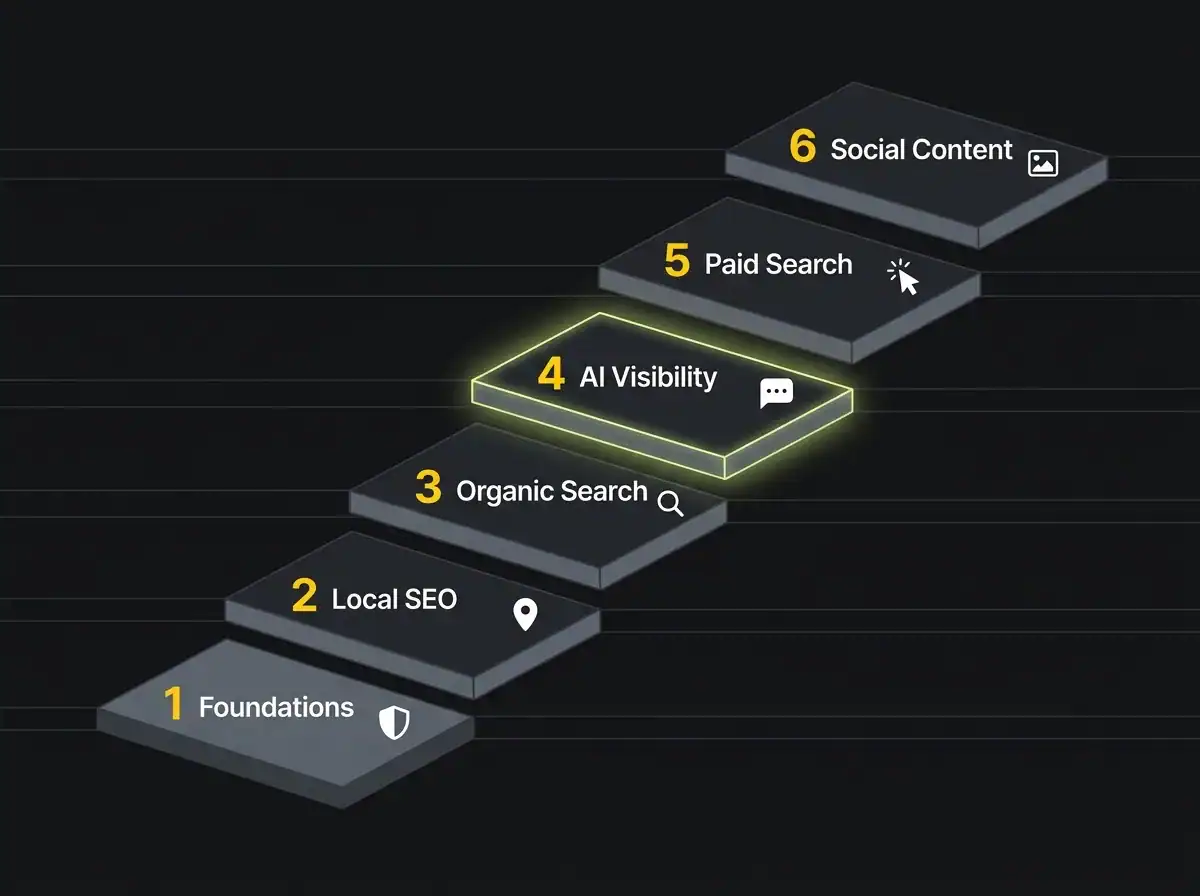
The sequence that makes sense for most UK dental practices, in order of compound return relative to time and cost:
-
Foundations. A professional website with dedicated treatment pages for each major service, accurate and complete Google Business Profile, and consistent practice name, address, and phone number across all major directories. Without these, nothing else performs to its potential.
-
Local SEO. Google Business Profile optimisation, a reviews strategy, and local citation consistency. For most practices, this is the fastest route to compound patient enquiries. Visible results typically appear within three to six months of structured, sustained work.
-
Organic search. Dedicated treatment pages with proper on-page structure, FAQ content for each major procedure, and YMYL compliance. Takes three to six months to show meaningful movement, and can take longer for competitive terms like "dental implants [city]" in urban markets.
-
AI visibility. Structured FAQ content, consistent entity information across the web, and content that directly answers the questions patients are putting to AI tools. First-mover advantage exists right now in most UK cities. This is the channel where the gap between early movers and everyone else is widest, and where the gap will close fastest once more practices catch on.
-
Paid search. Use selectively to fill the enquiry gap while organic channels compound, or to accelerate a specific high-value treatment launch. Not the first investment for most practices; the most effective as a layer on top of compounding foundations.
-
Social content. Where resource exists, prioritise cosmetic treatments where visual before-and-after content has a clear and receptive audience. General practices should build compounding channels first before committing to a regular social publishing schedule.
This is a default sequence, not a rigid rule. A newly opened practice needs enquiries immediately, which changes the role of paid search at the start. A practice with strong existing organic rankings may find AI visibility the most pressing opportunity right now. The sequence gives a starting point; your specific position will adjust it.
Frequently asked questions about digital marketing for dentists
How much does digital marketing cost for a dental practice in the UK?
Costs vary significantly by channel and scope. A structured local SEO campaign, covering Google Business Profile management, review strategy, and citation building, typically runs from £500 to £1,500 per month. Adding organic SEO for treatment-specific pages increases that. Google Ads in competitive urban areas can require £1,500 to £4,000 per month in media spend to generate meaningful enquiry volume, given click costs for high-intent dental terms. Most mixed or private practices starting their first structured digital marketing programme should expect to invest somewhere between £1,000 and £3,000 per month across a combination of channels.
What is the best marketing strategy for a dental practice?
Start with local SEO: get the Google Business Profile authoritative and complete, build a consistent flow of genuine reviews, and ensure the practice appears in the map pack for the treatments and location it serves. Layer treatment-specific organic search pages on top. For practices with cosmetic or high-value treatments, add AI search visibility work early, where first-mover advantage is still available in most UK cities. Use paid search as a complement to these compounding channels, not as a substitute for them.
How long does dental SEO take to show results?
Local SEO improvements typically show within two to four months: improved map pack visibility, more Google Business Profile views and actions, a steadier review flow. Organic search for treatment-specific pages usually takes three to six months to show meaningful movement, and up to twelve months in competitive markets for high-value terms. The timelines feel slow against the immediacy of Google Ads, but the compound nature of the results means they continue generating enquiries without further spend once established.
Do dentists need to be on social media?
General practices do not need a high-frequency social media presence to grow, though it helps. For cosmetic dental practices, particularly those offering Invisalign, composite bonding, and smile design work, Instagram is a genuinely valuable channel because the results are visual and patients want to see them. The realistic expectation for most practices is that social media builds awareness and warms patients already considering treatment, rather than generating cold bookings directly. Allocate resource to it only where someone can do it consistently and well.
How do I get more dental patients without relying on Google Ads?
Build the channels that compound rather than rent. Local SEO and a properly maintained Google Business Profile are the starting point; over a twelve-month horizon, most practices find they generate more consistent patient enquiries per pound spent than Google Ads alone. Treatment-specific pages on the practice website capture organic search from patients researching specific procedures. A structured review strategy builds the trust signals that convert that traffic into bookings. Consistent presence on Whatclinic and Whatdentist adds a further source. And structured FAQ content for AI search visibility is the emerging layer that few UK practices have addressed yet.
The clearest next step
Digital marketing for dental practices works best as a layered system. The compounding channels, local SEO, organic search, review volume, and AI visibility, take time to build but then run at near-zero marginal cost per enquiry. The rented channels fill gaps and accelerate launches but stop the moment the budget does.
The practices that grow most predictably build the compounding base first, then layer paid channels on top with a clear purpose. Most practices do the reverse.
Before deciding where to invest next, it helps to know where your practice currently appears across Google, AI tools, and local directories.
It gives a clear picture of your current digital presence across search and AI, and the gaps most worth addressing first.