Your Google Business Profile says "Active". Three dental practices near you are in the map pack. Yours is not.
The gap between those two things is exactly what this guide covers.
A GBP that is technically set up and a GBP that is pulling in patient enquiries are not the same thing. Most practices set it up once, assume it is sorted, and move on. Then a competitor with a steadier stream of reviews and a properly completed services list quietly takes the map pack position they were counting on. Sound familiar?
This is a practical guide to local SEO for UK dental practices. It is written for practice managers and owners doing their own research, not agencies. It covers the map pack, your Google Business Profile, NAP consistency, reviews, your website's supporting role, and AI search. Local search is one channel alongside referrals, NHS registration flows, and word of mouth, but for private patient acquisition in particular, the map pack is where most of the action is.
TL;DR
The four things most likely holding your practice back from the map pack: an incomplete Google Business Profile, inconsistent practice details scattered across directories, too few recent reviews, and a website that is not corroborating your GBP data. This guide covers each one. For most practices, the foundational work is DIY-able and takes one to two months to implement properly.
Why the map pack matters more than your website rank
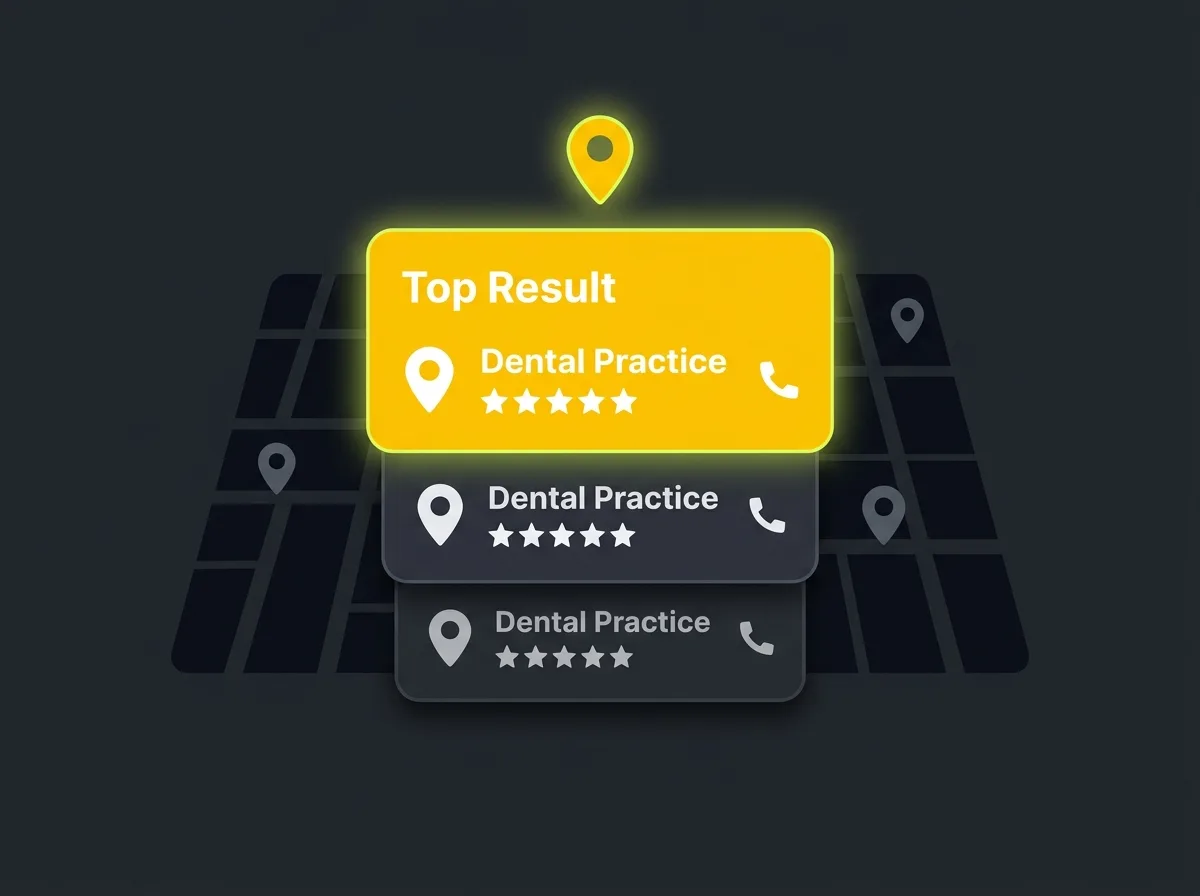
When someone searches "dentist near me" or "private dentist Birmingham", the first thing they see is not your website. It is the local 3-pack: the three businesses that appear at the top of Google with a map, star ratings, opening hours, and a call button.
BrightLocal's Local Search Ranking Factors research consistently shows that map pack results capture the large majority of clicks for location-based searches. For dental queries, where the patient is specifically looking for someone nearby, the concentration is even more pronounced. The organic website results below the map take a fraction of the attention.
This matters for one practical reason. The map pack is driven by your Google Business Profile, not your website. A practice with a modest site but a well-maintained GBP will regularly outrank a practice with a polished site and a neglected profile. Your website supports your local presence. It does not replace it.
For single-location practices focused on private patient acquisition, the map pack is where to start. It is also the foundation that runs under almost everything else in healthcare digital marketing, as our look at what actually works for UK medical practices makes clear. And the map pack mechanics for professional services follow the same three ranking factors that determine dental practice visibility: relevance, proximity, and prominence.
Google Business Profile: what complete actually means
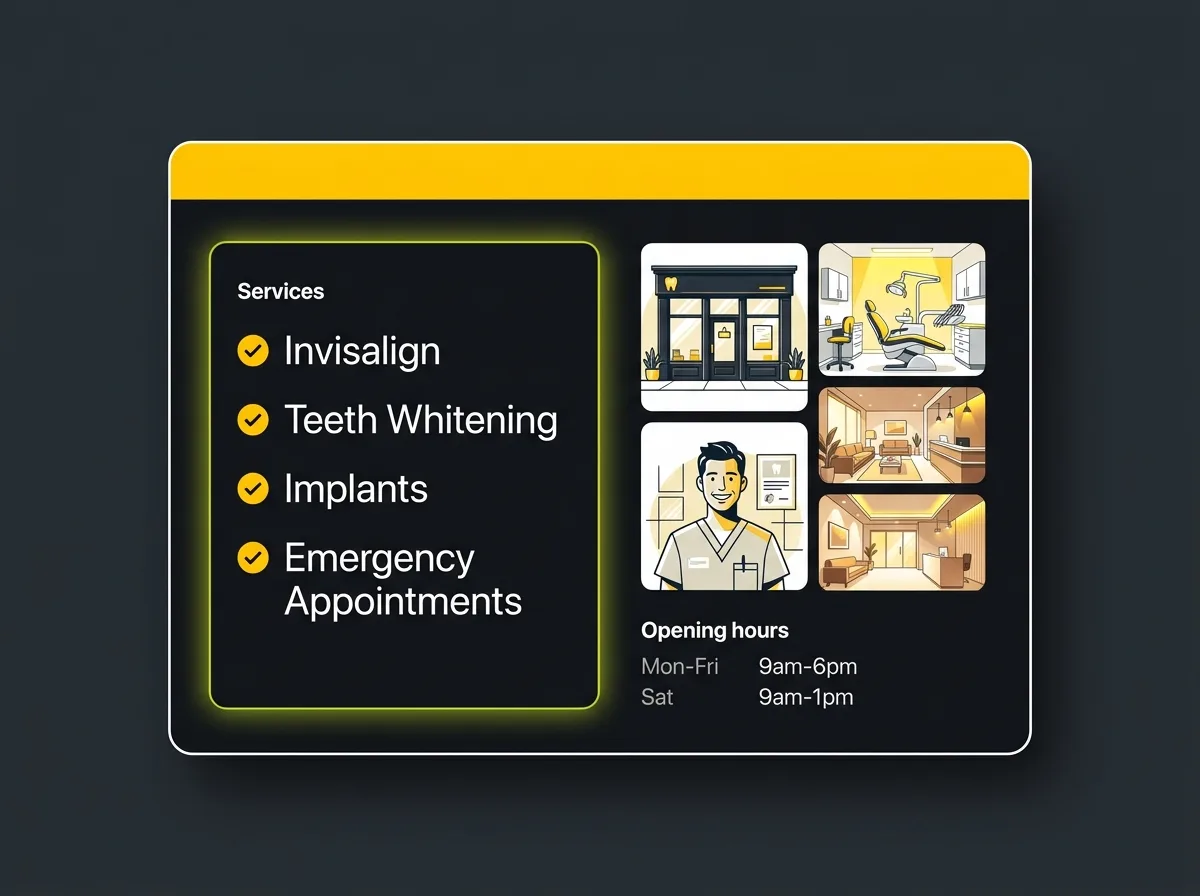
Most practices have a GBP. Most are incomplete.
Incomplete does not mean empty. It means set up to 60 percent and then left alone, with the most impactful sections still missing. The sections that cost practices the most are usually the same ones.
Primary category. "Dentist" is correct for almost all practices. Resist switching to something more specific like "Cosmetic dentist" as your primary category, because it narrows the searches your listing appears for. Use secondary categories (Cosmetic dentist, Orthodontist, Emergency dental service) for specialist treatments, but keep "Dentist" as the primary.
Services section. This is the one most practices skip entirely. The services section lets you list individual treatments by name: Invisalign, composite bonding, implants, teeth whitening, emergency appointments. Each treatment you list feeds directly into Google's relevance signals. A practice that lists "Invisalign" in its services section is more likely to appear for "Invisalign dentist near me" than one that does not. It takes an hour to fill in properly. It is worth the hour.
Photos. Google wants exterior shots, interior shots, treatment rooms, and ideally team photos. Street View counts, but it is not enough on its own. A profile with no practice-uploaded photos sends a weak signal compared to a competitor with 20. Add a proper photo set and commit to adding new ones periodically. Freshness matters.
Q&A section. This is a section almost no practice uses proactively. Patients can post questions and you can answer them, but you can also pre-populate your own questions before anyone asks. "Do you accept NHS patients?" "Are you taking on new patients?" "Do you offer emergency appointments?" Answer them yourself. Unanswered questions from two years ago are not a good look, and you will not receive a notification when someone posts one.
Google Posts. Posts appear in your GBP listing and signal to Google that the profile is being actively managed. Most practices post zero. A short monthly update about a treatment, a seasonal reminder, or a note about availability is enough to stand out. The content matters less than the consistency.
Common mistakes. An inconsistent practice name across different platforms (trading name versus registered name versus signage), a missing or outdated website URL, opening hours that have not been updated to reflect bank holidays, and no secondary categories beyond the default. Each is a small fix. Collectively, they make the difference between page two and the map pack.
For practices thinking about the channel mix beyond local search, our guide to digital marketing for dentists covers the broader picture.
NAP consistency: why small errors cost real rankings
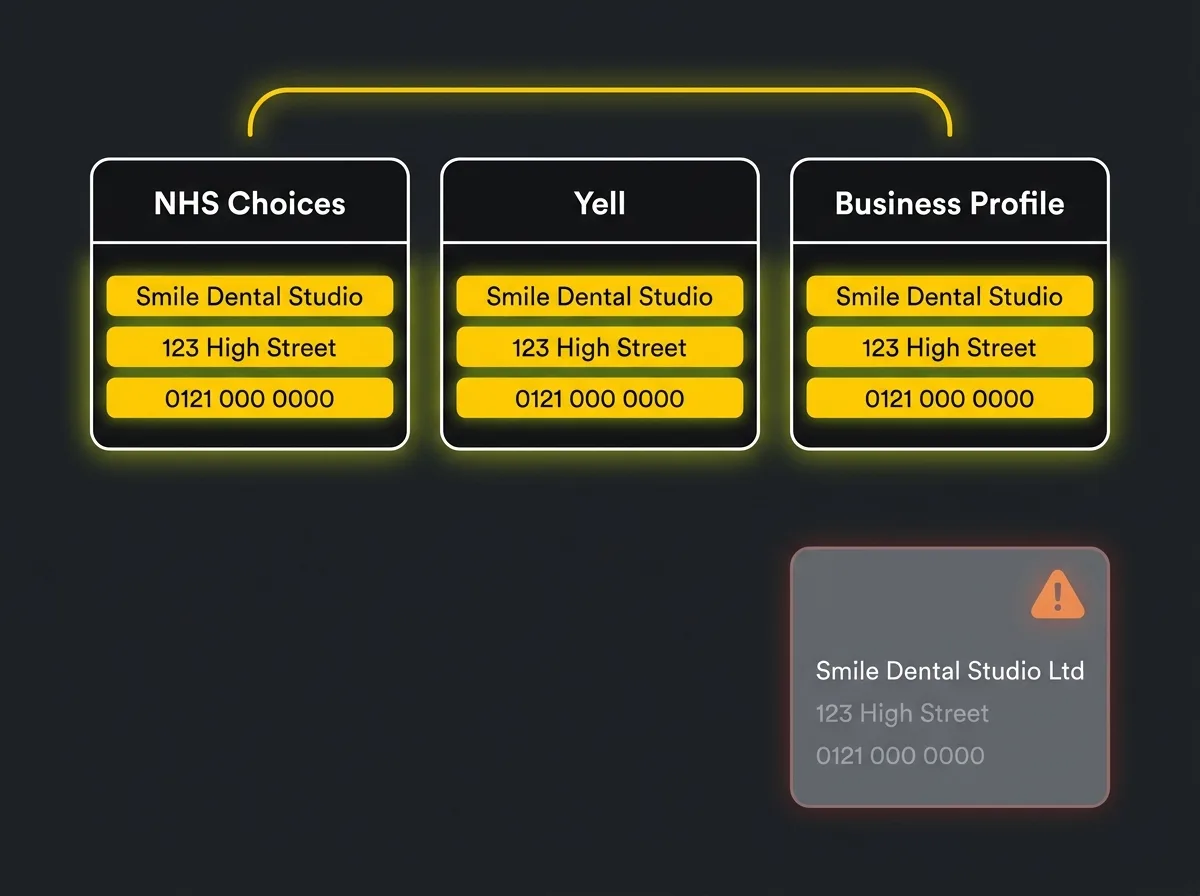
NAP stands for Name, Address, Phone number. Google cross-references these details across your GBP, your website, and third-party directories. When the data matches, Google's confidence in your listing increases and local rankings improve. When it conflicts, even in small ways, that confidence erodes.
It does not need to be dramatic. "Smile Dental Studio" in one place and "Smile Dental Studio Ltd" in another. A former address still sitting on a directory nobody maintains. An old phone number on a listing you set up four years ago and forgot. They all count against you.
The UK directories that matter most for dental practices differ depending on how the practice operates. This is a nuance the rest of the SERP largely ignores.
NHS practices. If your practice holds an NHS contract, the NHS Choices dental directory is a priority citation source. Patients use it directly to find NHS dentists, and Google treats nhs.uk as a high-authority UK health source. Your name, address, and phone on NHS Choices should match your GBP exactly. It does not update automatically when you move or change your number.
Private practices. For private-only practices, the BDA member directory and private patient platforms such as Doctify and Whatclinic carry more relative weight. NHS Choices is less relevant because you will not appear there for treatment-based searches.
For all practices. Yell, Thomson Local, Bing Places, and Apple Maps form the standard citation base. Search your practice name and address together in Google. Go through the first two pages of results and log every directory entry you find. Check the NAP on each one against your GBP. Correct at source. Your GBP data is the master record; everything else should match it.
The audit takes a few hours the first time. After that, you are only making corrections when something changes.
Reviews as a ranking signal, not just a reputation signal
Google uses reviews as a local ranking input. Not just the star rating, though that matters, but the volume, the recency, and whether you are responding to them.
The recency point is the one most practices underestimate. A practice with 200 reviews where the most recent arrived three months ago will often lose ground to a practice with 50 reviews where eight arrived this month. Google interprets recent review activity as a signal that the business is active and trustworthy. Velocity matters as much as volume.
This means the most valuable thing you can do for your reviews is not a one-off push. It is building a review request into the post-appointment workflow so that new reviews arrive consistently over time.
How to ask. The GDC standards and guidance do not prevent practices from inviting patients to leave reviews. The constraints are on incentivising reviews, asking selectively (happy patients only), or fabricating them. A neutral, post-appointment message with a direct Google review link is appropriate and is the standard approach.
In practice, the simplest implementation is a verbal mention at checkout followed by a text or email 24 to 48 hours later with a direct link. The directness of the ask at the moment of highest satisfaction is what gets results. A generic "leave us a review" email sent a week later performs significantly worse.
Responding to every review, positive and negative, signals to Google that the profile is actively managed. It also shows prospective patients that the practice engages with feedback. A practice with 80 reviews and zero responses looks different from one with 80 reviews and a thoughtful reply on each. The response takes 30 seconds. It compounds over time.
Worth knowing: a one-star review with a measured, professional response often does less reputational damage than the same review left unanswered.
Near-me searches and how proximity, relevance, and prominence interact
Google's local ranking algorithm weighs three factors: proximity, relevance, and prominence.
Proximity is physical distance from the searcher. You cannot change this. If your practice is two miles from the patient's location at the time of search, proximity puts you at a disadvantage against the practice on their street.
Relevance is how closely your GBP and website match what the patient is searching for. A practice that lists "emergency dental appointment" in its services section and on its website is more relevant to that query than one that does not. This is largely in your control.
Prominence is the practice's overall online authority: reviews, citations across authoritative directories, mentions from relevant UK health or local websites, and the overall completeness of the online presence. This is the factor you can build most actively over time.
The nearest practice does not always win. A practice two miles away with a strong review velocity, a fully completed GBP, and consistent citations will regularly outrank the closest practice with a thin profile. This is both the challenge and the opportunity: if proximity is not in your favour, prominence is how you close the gap.
Your website's supporting role (and what it cannot do alone)
Your website matters to local SEO, but not in the way most people assume. Map pack placement is driven by GBP signals, not by your organic website ranking. A modest website with a strong GBP consistently beats a polished site with a neglected profile.
What the website does is corroborate your GBP data and add supporting relevance signals. Four things matter most.
NAP in the footer. Your practice name, address, and phone number should appear in the footer of every page, matching the GBP exactly.
A contact page with an embedded map. This helps Google confirm your location data and gives patients an easy way to verify where they are heading.
Dentist schema markup. Most practices do not have this. Schema markup (schema.org/Dentist) is structured data added to your website that tells Google explicitly what type of business you are, where you are located, and what your opening hours are. For a single-location practice, a developer can add it in an hour. It removes ambiguity in how Google reads your site. If your developer has not done this, ask them.
Location language in headings and page titles. Not keyword stuffing. Just ensuring the practice location appears naturally in your homepage title, your contact page heading, and your about page. "Based in Cheltenham" in readable text is enough. Google needs to see the location in copy, not only in metadata.
For practices serving multiple areas or with a second location, a dedicated page per location, each with its own NAP, embedded map, and location-specific content, makes a material difference to which searches each site appears for.
AI search and dental patients: the channel most practices have not thought about yet
A growing number of patients now use AI tools such as ChatGPT or Perplexity before they open Google. "What is the difference between composite bonding and veneers?" "Is there an NHS dentist taking new patients in [city]?" "Best private dentist near me."
AI tools draw on website content, review signals, and structured data. Practices that are well-established in local search tend to appear in AI responses, but the thing that most improves citability is clear, readable text on the website itself. AI tools cannot read a full services list buried in a PDF. They struggle with information that lives only in images. They read and quote text that is written plainly and directly.
The practical steps here are not a separate strategy. They extend the local SEO work already described, with one addition: make sure your website states clearly, in readable text, who you are, where you are, what treatments you offer, and whether you are NHS or private. This information should not require a patient to navigate three pages to find.
A practice with a clear service and location statement on the homepage, a well-maintained GBP, and FAQ content on the website covering common patient questions is already in a stronger position to appear in AI responses than the majority of competitors. For practices that want to go further, our work in AI search visibility covers how to structure content specifically for AI citation.
What you can do yourself, and when to get outside help
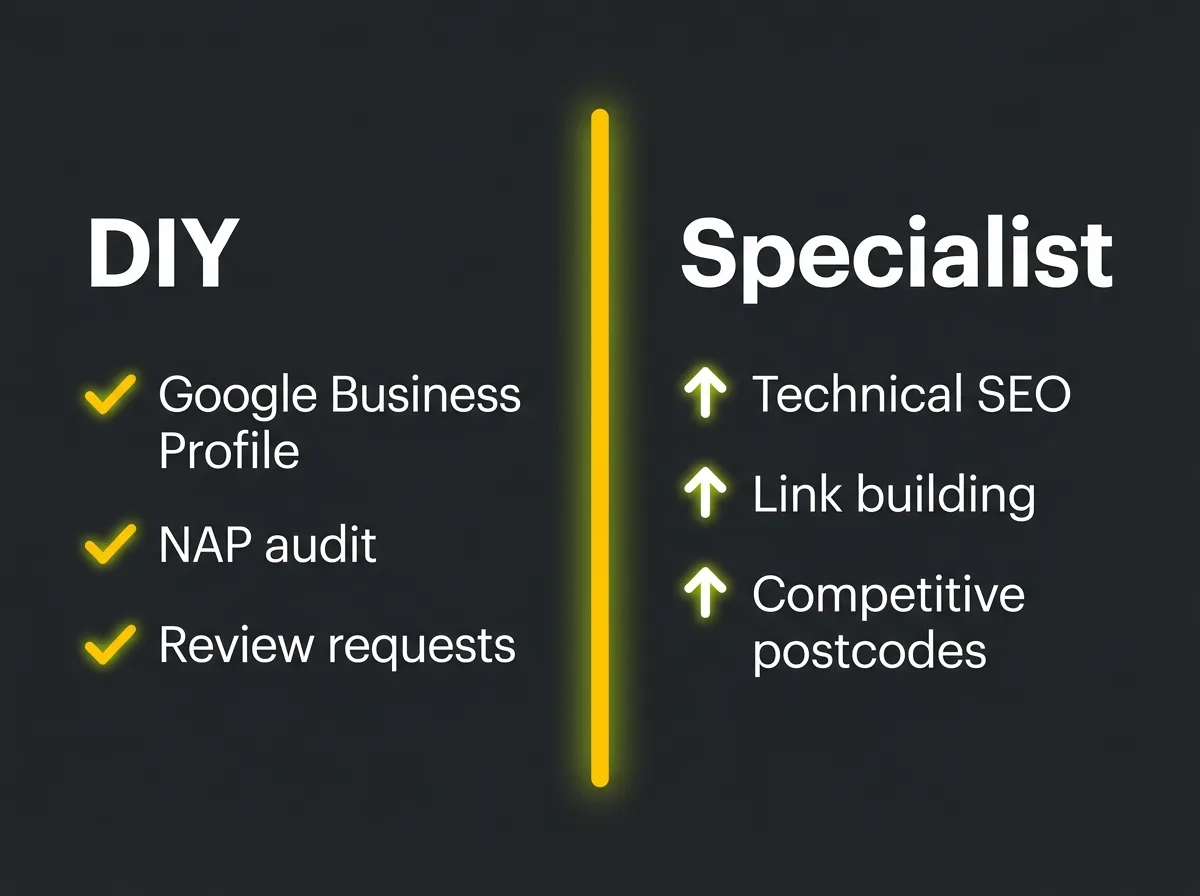
Most of the foundational local SEO work is DIY-able for a motivated practice manager. Completing the GBP fully, auditing and correcting NAP across directories, building a review request into the post-appointment workflow, and adding schema markup to the website with help from your developer: none of these require specialist knowledge. They require care and follow-through.
Where specialist support typically earns its keep is in three areas. Technical SEO issues on the website (page speed problems, crawl errors, mobile usability issues) require someone who knows what they are looking at. Building backlinks from relevant UK health and local websites is slow, relationship-led work that is hard to do efficiently in-house. And for practices in competitive city-centre postcodes where the top three map pack positions are fiercely contested, an ongoing content and citation strategy makes the difference between appearing and not appearing.
The realistic timeline for DIY foundational work is three to four months before map pack movement becomes visible. Reaching the top three in a high-competition central London or Manchester postcode is a different challenge and a longer one.
If you have worked through the foundations and decided the work is more involved than you want to handle alone, our post on working with a dental SEO consultant covers what to look for and what to expect. If you are ready to explore professional local SEO services for your practice, that is the natural next step. And if the technical SEO side is the specific gap, a specialist SEO agency can assess what your site needs before you invest in any ongoing work.
What could better local search visibility mean for your practice?
Most practice managers who work through this guide arrive at the same follow-up question: what does a better map pack position actually mean in terms of patient enquiries per month?
The honest answer is that it depends on your postcode, your current position, the competition, and whether you are NHS, private, or mixed. A generic estimate is not very useful. Your search landscape is specific to you.
Free resource: Traffic Projection Report
The Traffic Projection Report gives you a data-backed estimate of what improved local search visibility could mean for your practice in terms of monthly traffic and new patient enquiries. It is based on your specific search landscape, not a sector benchmark. If you are trying to make an internal case for investing time or budget in local SEO, the projection gives you something concrete to work from.
Frequently asked questions about local SEO for dental practices
How long does local SEO take for a dental practice to show results?
For foundational work done in-house, completing the GBP, fixing NAP inconsistencies, and building a review request process, map pack movement typically becomes visible within three to four months. Reaching the top three in a competitive city-centre postcode takes longer, often six to twelve months with consistent effort, depending on how strong the competition is.
How many Google reviews does a dental practice need to rank in the map pack?
There is no fixed number. Volume matters, but recency and velocity matter equally. A practice with 40 reviews and eight arriving each month will often outperform a practice with 200 reviews where new activity has stalled. Focus on consistent new reviews over time rather than a total target.
What is NAP consistency and why does it matter for dental practices?
NAP stands for Name, Address, Phone number. Google cross-references these details across your GBP, your website, and third-party directories. Consistent data increases Google's confidence in your listing and improves local rankings. Discrepancies, even small ones such as a missing "Ltd" or an old phone number on an unmaintained directory, can suppress ranking. For UK dental practices, NHS Choices, Yell, Bing Places, and Apple Maps are the minimum directory checks.
Can I do local SEO for my dental practice without hiring an agency?
Yes, for most of it. Completing the Google Business Profile, auditing and fixing NAP across directories, building a review request into the post-appointment workflow, and adding Dentist schema markup to the website with developer help are all achievable without specialist knowledge. Where agencies tend to earn their keep is in technical SEO issues on the site, building backlinks, and competing in high-pressure city-centre postcodes where the top three positions are actively contested.
Does having an NHS contract affect my dental practice's local SEO?
Yes, in one specific way. The NHS Choices dental directory is both a high-authority citation source and a patient-facing directory for NHS dental searches. If your practice holds an NHS contract, keeping the NHS Choices listing accurate and matching your GBP data exactly is a higher priority than for a private-only practice. For private practices, the BDA member directory and platforms such as Doctify and Whatclinic carry more relative weight.