
Two proposals are sitting on your desk. One from a specialist dental marketing agency, one from a digital agency that promises results within 90 days. Both want a significant retainer. Both assure you they understand dental.
And somewhere in the back of your mind, you keep wondering whether there is a simpler option: a single consultant who handles the SEO side without the overhead, the account managers, and the monthly call where nothing much seems to have moved.
It is a sensible question. The fact that it is hard to answer is not your fault. The gap between what different types of marketing supplier actually do day to day is not something they tend to explain clearly, and the word "consultant" does not help because it can mean anything from a genuine strategist to a one-person agency charging less.
This post explains what a dental SEO consultant actually does, when it is the right choice for a UK practice, how it compares to an agency or in-house, and what to look for before you sign anything.
What a dental SEO consultant actually does
A dental SEO consultant is a specialist who works with private dental practices to improve their visibility in search, typically on a retained basis. They focus on SEO specifically, rather than covering the full range of marketing services an agency would include in a retainer.
The recurring work covers several areas. They map your treatments to the search terms patients actually use: "Invisalign Glasgow", "private dentist Birmingham", "dental implants cost London". They audit your existing service pages and advise on how each one should read, how long it should be, and which local terms it needs to target.
They work on your Google Business Profile, because for most UK practices the local map pack is the single most valuable piece of digital real estate available. They check your site's technical health, loading speed, and page structure. They build out a review strategy, because review volume and recency are a genuine local ranking factor.
And they report back monthly on enquiries and conversions, not just keyword positions.
Rankings are vanity. Enquiries are the business.
Some consultants do all of this production work themselves. Others advise and oversee, then bring in writers or developers to produce what has been recommended. The engagement structure varies, but the strategic input is the constant. If a consultant has not made clear which of these models they operate on, ask before you commit.
Why dental SEO is not the same as generic SEO
You can hire an SEO specialist with a solid track record in e-commerce or professional services and still get mediocre results for a dental practice. Not because they are incompetent, but because dental search sits at the intersection of factors that generic SEO work does not account for.
The first is YMYL. Google classifies healthcare content as Your Money or Your Life material, and holds it to a higher trust standard than most other categories. That means the expertise, authoritativeness and trustworthiness signals on a dental site matter more than they would for a furniture retailer.
Named practitioners with listed credentials, treatment descriptions written with clinical accuracy, links from relevant healthcare directories rather than generic link farms: these things move the needle in dental where they might make little difference elsewhere. Our post on what actually works for UK medical practices covers this in detail.
The second is the UK regulatory context. The Advertising Standards Authority rules on medical claims restrict how dental practices can describe treatments and results.
A consultant writing copy for a cosmetic dental practice cannot simply use the most search-friendly language, because that language may fall foul of ASA guidance on before-and-after comparisons or claims about treatment outcomes. A consultant who does not know this will write copy that creates compliance problems.
And General Dental Council registration is itself an authority signal. A dental website that makes it easy for Google to identify that the practitioners are GDC-registered is a more trustworthy result than one that buries or omits it.
The third is treatment-specific intent. Someone searching "emergency dentist near me" is a different buyer to someone searching "Invisalign cost Birmingham". A consultant who understands dental knows how to map a content strategy to that range of intent, rather than treating a practice as a single entity to rank for a handful of broad terms.
Consultant, agency or in-house: how to choose
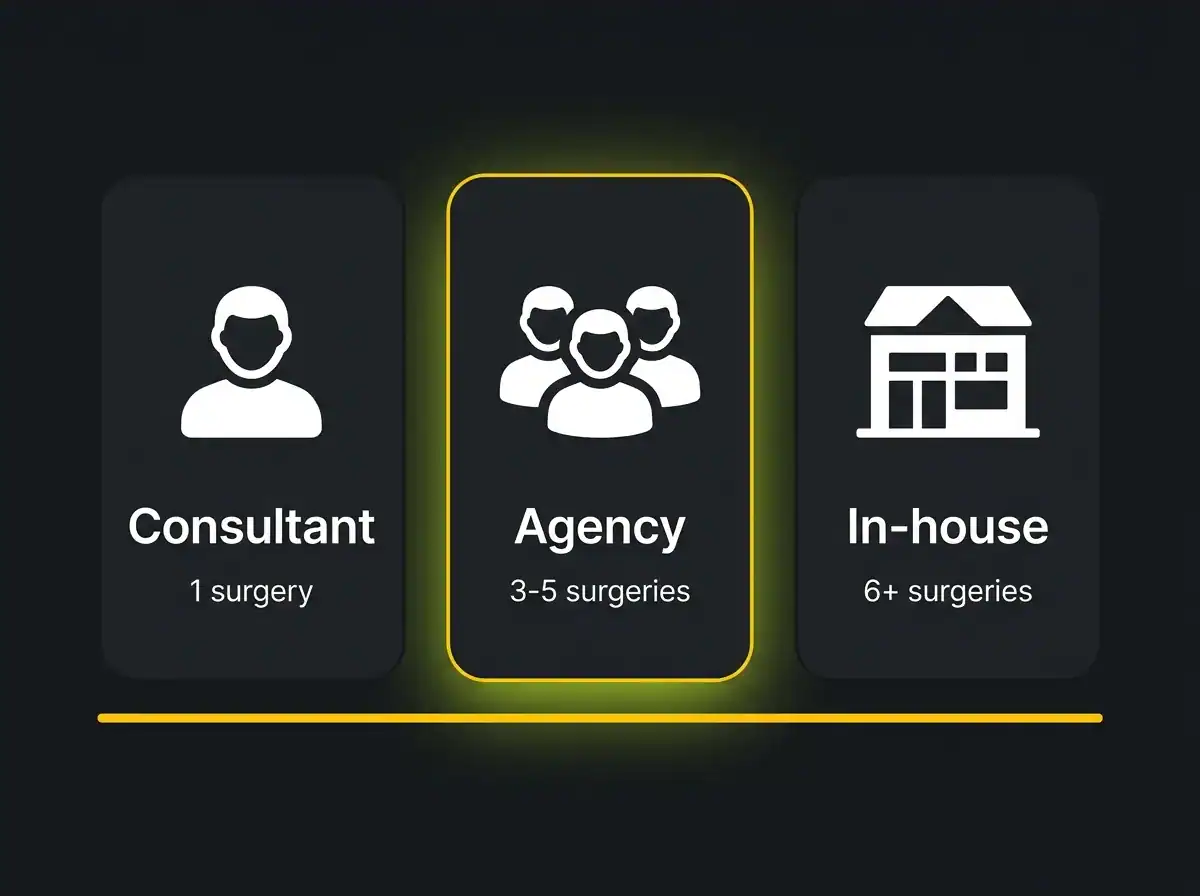
The right answer depends almost entirely on the size of your practice and what you actually need done, not just advised.
Single-surgery practices. A dental SEO consultant is almost always the right fit here. You are not generating enough volume to justify a full-service agency, and you probably do not have the internal capacity to make use of everything a large retainer would include.
What you need is someone senior enough to know what to prioritise, and focused enough to stay in their lane. A good SEO agency relationship at this stage, whether you work with an individual consultant or a small specialist team, gives you strategic input without paying for people you do not need.
Three to five surgeries. This is where the decision gets genuinely more nuanced. A consultant can still work well if the practice has some internal capacity to act on recommendations: someone who can publish content, update the website, and implement the changes identified each month. If nobody in the practice has time to do that, the consultant relationship stalls quickly. You need either a consultant who includes production support in their scope, or an agency.
Six surgeries or more, or a small group. At this scale, the complexity of managing multiple sites, multiple Google Business Profile listings, multiple local search footprints, and potentially different brand identities usually exceeds what a single consultant can manage alone. An agency with dedicated account management and a production team tends to be the better fit.
The honest caveat: a consultant who never says no to scope is selling time, not advice. If every conversation ends with the scope expanding and no clear prioritisation of what matters most, that is a yellow flag rather than a green one.
The single highest-ROI area for most UK dental practices
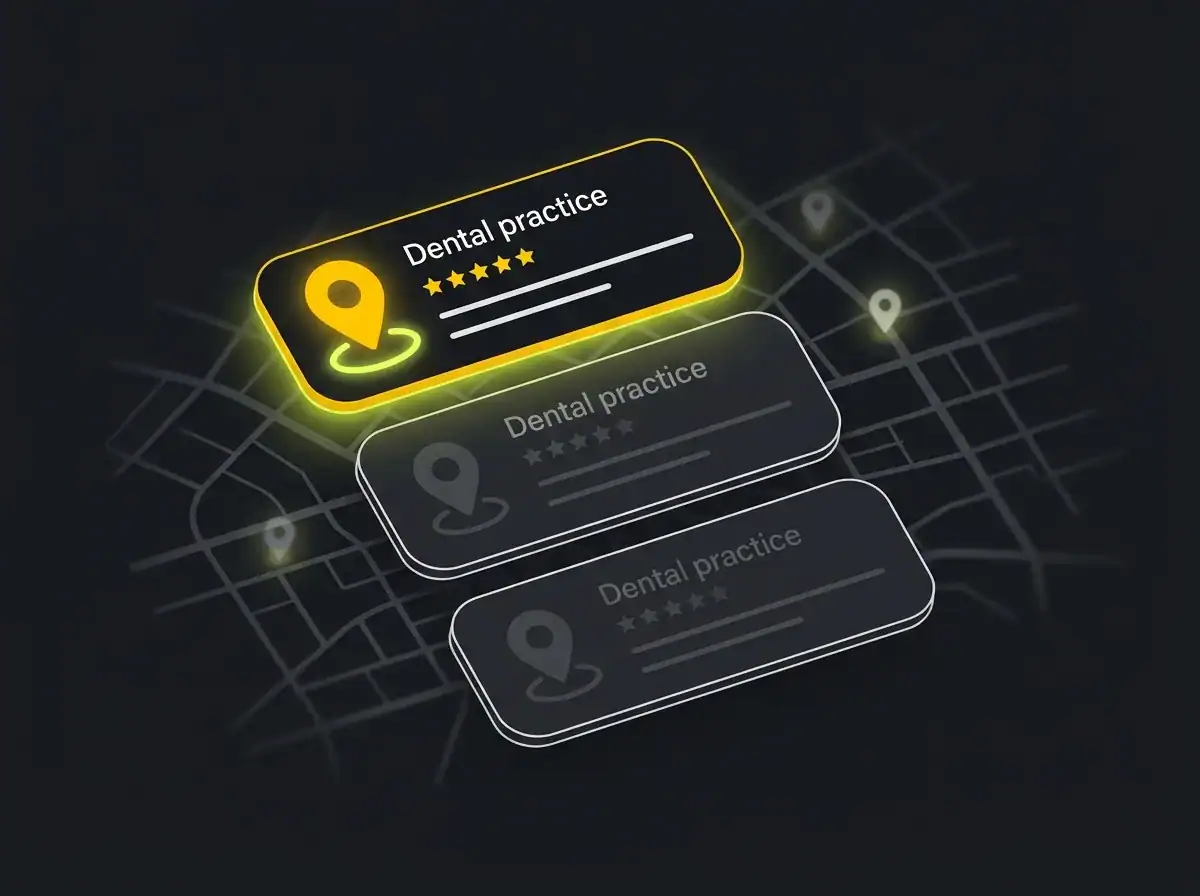
For the vast majority of UK private dental practices, the local map pack is where the patient enquiries come from. Paid ads, social media and content all have their place, and plenty of dental practices use them well. None of them, though, matches the local map pack for return: the three-result map that shows when someone in your city searches for a practice is what most new patients act on.
Most practices underinvest here significantly. The Google Business Profile guidelines set out what a well-maintained profile looks like: complete and accurate category selection, up-to-date services with individual entries for each treatment you offer, recent high-quality photos with practitioners named, a consistent flow of recent reviews, and a response to every review received. Get all of that right and you significantly improve your chances of appearing in the three-pack for searches that matter to your practice.
A structured local SEO for practices approach, covering the Google Business Profile alongside local citation consistency and location-specific landing pages on your site, typically delivers visible changes to map pack positions within three to four months. It is usually the first thing a good dental SEO consultant focuses on, because the return is faster and more direct than any other SEO activity for a local business.
The reviews question deserves specific attention. Three new reviews this month count for more than twenty reviews left two years ago. Review velocity matters. A consultant worth their fee will help you build a simple, compliant process for asking satisfied patients to leave a review. What they will not do is suggest you incentivise reviews, which falls foul of Google's terms and the GDC's guidance on patient testimonials.
How dental SEO is changing in AI search
More patients are using AI tools to research treatment options and find providers before they ever open a search engine. AI search is changing how patients find practices in a way that does not yet show clearly in standard analytics, but is already showing up in the type of enquiries practices receive.
ChatGPT, Claude and Perplexity will answer queries like "best private dentist in [city]" or "is Invisalign worth it" with confident, citable responses. If your practice is not mentioned in sources those AI engines draw from, you are not in that answer. A practice page that reads like a brochure gets skipped. A practice with clear FAQ content, named practitioners with genuine bio pages, and well-structured information about treatments gets referenced.
For dental practices, this matters more than for many other local businesses. Cosmetic and high-consideration treatments, implants, veneers, orthodontics, involve significant research periods. A patient researching dental implant costs will often ask an AI tool before they search Google, before they read reviews, and before they call a practice. AI search visibility is a second layer of discovery that compounds over time, not a replacement for traditional SEO but an addition to it.
The practical steps are not exotic. Clear FAQ pages that answer the questions patients actually ask. Named practitioners with qualifications stated in plain English. Consistent practice name, address and phone number across every directory and platform. Content that accurately describes what specific treatments involve, in language a patient can understand. These are the same things that improve traditional search rankings. A good consultant works on them as a single programme, not as separate initiatives.
How to vet a dental SEO consultant before you hire them
The most useful question to ask a potential dental SEO consultant is: can you show me what you have achieved for a dental practice, in terms of enquiries rather than keyword positions?
If they cannot point to a practice that now generates more phone calls, form submissions, or consultation bookings as a result of their work, they have not yet proven they can do what you are hiring them to do. Sound familiar? Almost every practice that has had a bad experience with an SEO supplier was sold on rankings rather than results.
Other useful questions: how do they approach pages that mention treatment outcomes, given ASA restrictions? Who does the technical work if your site needs structural changes? Do they have a view on whether your site converts the traffic they are trying to drive, or is that someone else's problem?
If the answer to that last question is "someone else's problem", make sure you know who that someone else is before you start. A practice site with serious conversion problems, slow load times, or unclear calls to action will not generate more enquiries just because it ranks better. Sometimes the most valuable thing a consultant can tell you is that dental web design needs attention before the SEO investment will pay back.
Red flags worth walking away from: guaranteed page-one rankings (nobody can ethically guarantee these), a monthly scope that expands with every conversation, no published case studies or references in dental specifically, and any suggestion to build links from irrelevant directories or to generate content at high volume without a clear purpose for each piece.
One more: ask what they would recommend you did not pay them to do. A consultant confident enough to narrow scope is one who understands what actually moves the needle.
What dental SEO actually costs in the UK
For a single-practice retainer with a UK-based dental SEO consultant, a typical range is £1,000 to £3,500 a month. The variation reflects scope, whether production support is included, and the consultant's seniority and track record in dental specifically.
Agency retainers for dental SEO tend to run higher, typically £2,500 to £6,000 a month, reflecting the team overhead and the production capacity that comes with an agency model.
Project-based engagements, a one-off technical audit, a Google Business Profile and citation programme, or a content strategy, typically range from £1,500 to £5,000 depending on scope.
If a price is significantly below these ranges, the work is almost certainly being offshored, automated, or scoped generously to win the contract and reduced quietly over time. UK private dentistry, which LaingBuisson estimates at over £4bn in market value and growing, driven partly by NHS access pressures pushing patients into private care, is too competitive in most cities to survive on cheap SEO.
The economics are not complicated. A practice that ranks well for its treatments in its city wins materially more enquiries than one that does not. The investment is not the question. The question is whether the supplier is the right one.
FAQs about dental SEO consultants
Do I need a dental SEO consultant or a dental marketing agency?
It depends on your practice size and your internal capacity to act on recommendations. A consultant suits single to mid-sized practices that need senior strategic input without paying for production overhead. An agency suits practices that need someone to handle production alongside the strategy.
How long before a dental practice sees results from SEO?
Google Business Profile improvements are typically visible within eight to twelve weeks. Organic ranking changes for competitive treatment terms take three to six months. Sustainable positions in the top three for high-value searches usually take six to twelve months of consistent work.
Can I do dental SEO myself?
Yes, to a point. The Google Business Profile basics, the review process, and keeping your treatment pages accurate are things any practice can handle internally. Technical SEO, link building, and competitive keyword targeting are harder to do well without specialist tools and experience.
Does dental SEO still matter now AI search is here?
Yes. AI engines draw from the same sources traditional search favours: accurate, well-structured content on sites Google already trusts. Good SEO and good AI visibility are the same programme. They are not competing priorities.
How much do dental SEO consultants charge in the UK?
Typically £1,000 to £3,500 a month for a single-practice retainer, depending on scope and whether production support is included. Project-based work runs from £1,500 to £5,000.
Where to start if you want a clearer picture first
Before you hire anyone, it helps to understand what a realistic 12-month traffic and enquiry trajectory looks like for your practice, given your current position and the competitive landscape in your city.
Free resource: Traffic Projection Report
We run a Traffic Projection Report for UK practices that want to see what a 12-month SEO programme would realistically deliver in terms of traffic and enquiries, before committing to any supplier. It takes less than a minute to request and gives you a clear benchmark to hold any consultant or agency to.
If you would prefer to talk it through directly, our specialist SEO support team is happy to have that conversation without a sales script attached.