
They appear on page one. Good rankings, right practice areas, their city in the anchor text. And the enquiries haven't moved.
That is the conversation we have with solicitor firms more than almost any other. The SEO worked, in the narrow sense that traffic went up and positions shifted. The bit that follows, converting those visitors into client instructions, did not.
Sound familiar?
What law firm SEO actually involves: Law firm SEO is the process of making your firm visible to prospective clients when they are actively searching for legal help. A complete programme covers three things: the technical health of your website so Google can crawl and rank it; the content that matches what your prospective clients are searching for, practice area by practice area; and the trust signals that tell both Google and your visitors that your firm is authoritative and credible.
In 2026, those three layers have a fourth sitting on top of them: an AI search layer. Tools like ChatGPT, Perplexity, and Google's own AI Overview increasingly synthesise answers to legal questions before any organic result appears. Understanding all four is what separates a programme that produces client instructions from one that produces ranking reports.
This piece covers what each layer involves, where most campaigns stall, and what to check before you commit to working with anyone.
Why legal SEO is a different discipline

Legal content sits in what Google calls YMYL territory: Your Money or Your Life. Pages that could affect a person's legal standing, financial situation, or physical safety are held to a meaningfully higher standard than content about, say, restaurant recommendations or home renovation.
A thin, generic services page in a lower-stakes sector might still perform adequately. The equivalent page in legal gets penalised harder and faster.
The practical consequence is that the baseline quality bar for law firm SEO is genuinely higher than in most other professional services sectors. You cannot cut corners on expertise signals and expect competitive rankings. Google has been explicit about this in its quality rater guidelines, and core updates since 2023 have applied that pressure in observable ways across the legal SERP.
Higher standards. Higher penalties. Worth knowing.
E-E-A-T for law firms. Experience, Expertise, Authoritativeness, and Trustworthiness are the four dimensions Google uses to evaluate legal content quality. For a solicitor firm, this means named solicitor authors on all content pages (not "the team" or "our experts"), linked credentials verifying those authors are real and qualified, and firm-level accreditations displayed prominently: Lexcel, SRA authorisation status, Resolution for family practitioners, APIL for personal injury.
Third-party review signals from verified platforms like ReviewSolicitors and Trustpilot Legal complete the picture. It is not a checklist you complete once. It is a set of signals Google reads on every crawl.
SRA advertising rules. The SRA Code of Conduct constrains what a firm can legitimately claim in its marketing. No outcome guarantees. No misleading specialist claims you cannot substantiate.
This creates an immediate test for any SEO agency pitching you: if they offer guaranteed page-one results, they are either unaware of the regulatory environment you operate in, or comfortable helping you breach advertising standards. Either way, that is not who you want managing your digital presence.
The combination of YMYL classification, E-E-A-T requirements, and SRA compliance constraints means legal SEO that cuts corners carries a higher penalty risk than cutting corners in almost any other sector. That is not a reason to avoid it. It is a reason to do it properly.
For the broader picture of how solicitors typically build their online client pipeline, our guide to law firm marketing covers the full channel landscape.
The three foundations every law firm SEO programme needs
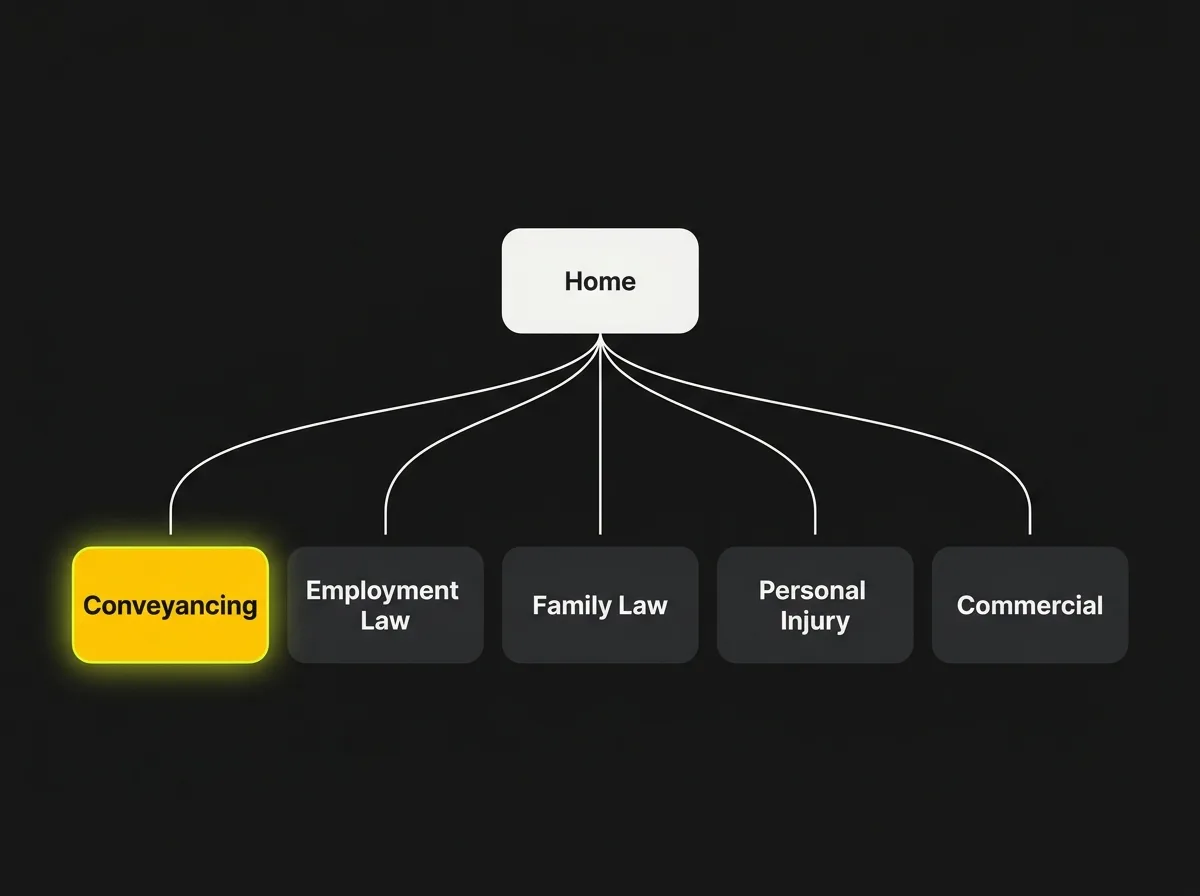
Practice area pages. The most common structural mistake on law firm websites is a single "Services" page with a list of practice areas. That page tries to rank simultaneously for conveyancing, employment law, family law, personal injury, and commercial disputes from one URL, typically with a few hundred words on it.
It ranks for none of them well.
Each practice area you want clients to find you for needs its own substantive page. "Conveyancing solicitors in Birmingham" is a different keyword from "employment law solicitors in Birmingham" and needs different content, different internal linking, and different trust signals.
Each page should answer the questions a client in that practice area actually has: what the process involves, roughly what it costs, how long it takes, and what instructing your firm looks like in practice. Generic "we offer the following services" content serves no one, not the visitor and not the search engine.
Local search and the GBP stack.

For most solicitor firms, Google Business Profile is the single highest-leverage SEO asset they are not fully using. A complete, accurate, verified profile with correct categories, consistent name, address, and phone number data, and an active review collection process is the foundation of local pack visibility.
The legal citations that carry the most authority are specific to the sector. The SRA Solicitor Lookup is one of the most powerful citations available to any UK law firm, because it is the regulator's own database and Google treats it accordingly.
The Law Society Find a Solicitor directory is the second highest-trust citation in the sector. Legal 500 and ReviewSolicitors complete the core four. Consistent, accurate data across those four sources alone represents a meaningful improvement over where most firms currently sit.
Review velocity matters more than it did two years ago. The rate at which new reviews arrive carries more weight in local pack rankings than your total review count. A firm that collected 40 reviews in 2022 and none since is disadvantaged relative to a competitor with 20 reviews collected steadily over the past 12 months.
The practical fix: build a process for requesting reviews at matter conclusion, embedded in the workflow rather than run as a one-off campaign.
For an instructive parallel from a comparable regulated sector, what professional services firms miss about local SEO covers the same structural failures in a different professional services context.
E-E-A-T signals. Named solicitor author profiles with linked SRA credentials on every content page. Firm-level trust signals visible on the site: years established, number of fee earners, SRA registration number in the footer.
Accreditations displayed on practice area pages, not only buried on an About sub-page most visitors never reach. Case outcome references where SRA rules permit the framing, discussing matters handled in general terms rather than anything implying a guaranteed result. Third-party reviews embedded from verified platforms rather than hand-picked testimonials on your own site.
Technical foundations, including mobile speed, crawlability, HTTPS, and schema markup, are necessary but not differentiating. Every firm that has invested seriously in SEO has these in place. The differentiation comes from depth of practice area content, strength of local signals, and the consistency of E-E-A-T evidence across the site.
Our SEO agency and local SEO services cover how these programmes are structured in practice.
The AI search layer most law firms have not planned for

Legal is among the highest AI Overview trigger categories in any professional services sector. When someone searches "what is conveyancing," "how does no win no fee work," or "what does an employment tribunal cost," they increasingly see an AI-synthesised answer before any organic listing.
The law firms whose content is cited in those summaries are visible before any click happens. Those whose content is not cited are invisible at the most critical stage of a prospective client's research.
This is not a future concern. It is happening now.
The client-side implication. Your prospective clients are already living in this environment. A local intent search such as "employment solicitor Manchester" is primarily resolved by the local map pack, which AI Overview affects less directly.
An informational search such as "how much does an employment tribunal claim cost" or "can I be dismissed while on sick leave" is firmly in AI Overview territory. Those searches happen before a prospective client has decided to instruct anyone. Being cited in the synthesised answer is the equivalent of being on the prospect's radar before they have started comparing firms. Being absent is the opposite.
What gets cited in AI. Structured content with clear definitions at the top of each page. Named solicitor authors with linked credentials. Specific, UK-attributed information and named entities: the SRA, the Law Society, named tribunal or court processes, specific accreditations.
A 400-word practice area page with no structure and no named author does not get cited in an AI answer. A 1,200-word page structured around the questions clients actually ask, authored by a named solicitor with a linked SRA profile, competes meaningfully for those citation slots.
Local versus informational queries. Understanding which of your practice area keywords sits in which category tells you where to invest first. Local searches, naming a practice area and a city, are primarily resolved by the local pack.
Informational searches, asking how a legal process works or what it costs, are where AI Overview has the largest effect on click-through. The split within your own keyword set determines the priority. Map it before you brief any content work.
The emerging llms.txt standard, which signals to AI crawlers which content to index and cite, is worth monitoring. It is not yet mainstream but firms building for long-term AI search visibility are beginning to implement it.
For the commercial case on why this matters beyond visibility, see why AI search traffic converts at a higher rate. Our AI search visibility service covers what structured AI citation optimisation looks like for a professional services firm.
Why most law firm SEO campaigns produce traffic but not client enquiries

This is the section that most law firm SEO guides skip. It is also the one that matters most to any firm that has already tried SEO and cannot explain why the client instructions did not follow the traffic.
SEO's job is to deliver a qualified visitor to the right page at the right moment. The firm's job, and the website's job, is to turn that visitor into an enquiry.
Most law firm SEO discussions treat those as the same problem. They are not.
A competent SEO programme can deliver a prospect who is actively looking for an employment solicitor in your city to the right page on your site. What happens next is determined entirely by the website, the content on that page, and the firm's response process. Not by the SEO.
The website failures that destroy conversion. The most common failure is a practice area page that explains what the law says without explaining what the firm does or how to instruct them. A prospective conveyancing client does not need a summary of the Land Registration Act.
They need to know whether you handle their type of transaction, roughly what it costs, how long it takes, and who they will actually speak to. The gap between explaining the law and explaining what the firm does is where most visitors leave.
Cost transparency is a persistent problem across the sector. The culture of "call us for a quote" made sense when clients came primarily through referrals and a relationship existed before the enquiry arrived. In organic search, the visitor has no prior relationship.
They arrived because Google said you were relevant. When they cannot find any indication of cost on your website, a meaningful proportion simply move to the next result. Even a range, or a clearly structured "how we structure our fees" page, removes the barrier. The firms that have added this content consistently see better conversion from the same traffic.
Contact information buried in the footer is a mobile UX failure with a direct cost. On a smartphone, if finding the phone number requires scrolling to a footer, a proportion of visitors will not find it. If the contact form routes to a shared inbox with a multi-day response time, the prospect has often already instructed a firm that responded within a few hours.
The enquiry response gap. The visit-to-enquiry conversion is only half of it. A significant proportion of online enquiries to law firms receive a response too slow to retain the prospect.
The visitor who submits a contact form at 7pm on a Tuesday and hears back on Thursday afternoon has often already instructed whoever called them back on Wednesday morning. Organic search delivered the lead. The firm's response process lost it.
That gap is invisible in a rankings report.
Practice area specificity. A visitor who searched "employment law solicitor Bristol" is considerably further along in their decision than one who searched "what is constructive dismissal." Both might land on the same employment law page.
Serving a generic area-of-law overview to both fails the high-intent visitor, who already understands the legal context and wants to know if your firm can actually help them. Practice area pages that differentiate between types of enquiry and direct each toward a clear next step convert meaningfully better than pages that cover the whole subject area in broad terms.
For what a law firm website needs structurally to convert organic traffic into client instructions, our guide to law firm website design covers the specific requirements in detail.
What a 12-month law firm SEO programme actually looks like
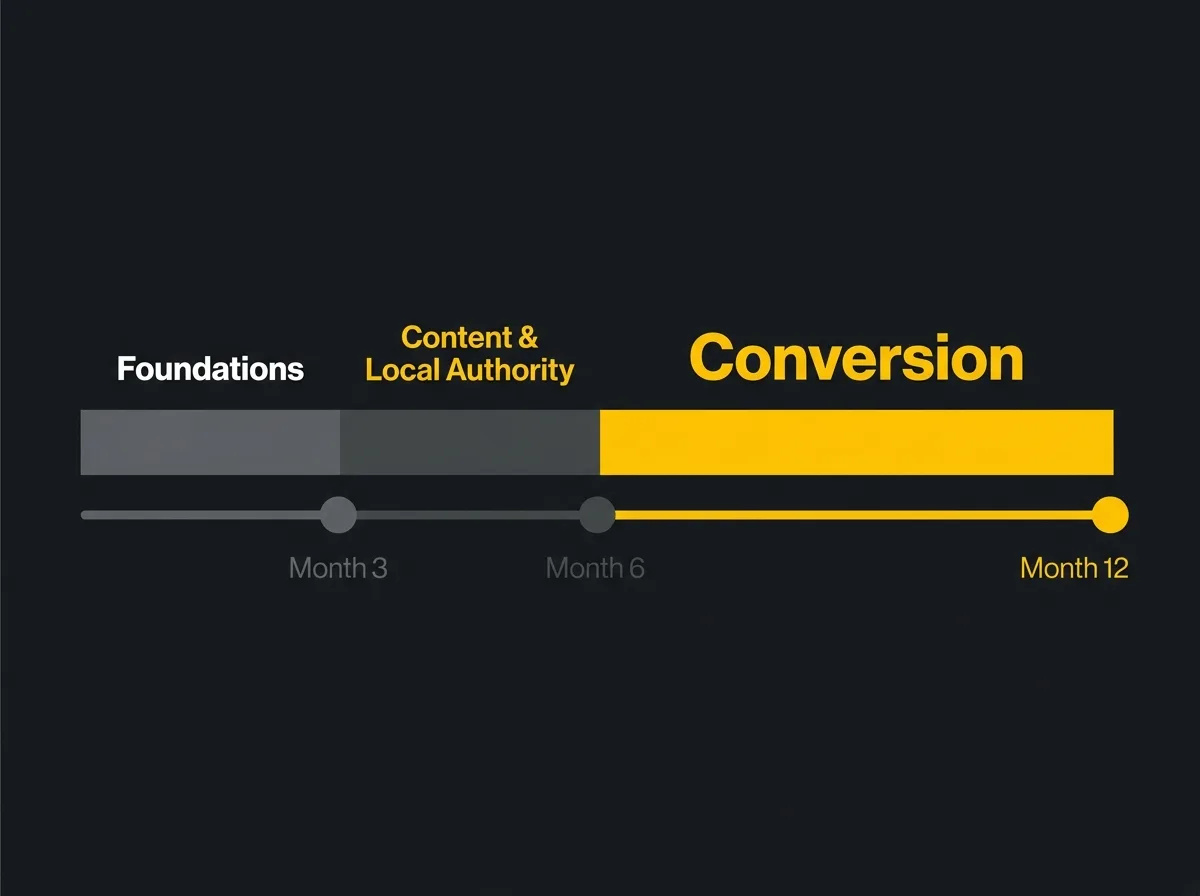
A realistic timeline matters because many law firm partners have been sold SEO programmes with the implied promise of rapid results. First ranking movement in competitive legal markets takes months. Attributable enquiry volume takes longer still.
The timeline is what lets you track whether the campaign is on track, even before the enquiries materialise.
Months 1 to 3: Foundations. Technical audit and priority fixes: crawlability, mobile speed, HTTPS, structured data, indexation errors. GBP optimisation and verification: correct primary categories, accurate service area data, consistent NAP data, initial review collection process.
Citation accuracy check across the four primary legal directories. Site architecture review: is the practice area page structure correct, are any pages cannibalising each other for the same keywords, is internal linking directing authority where it needs to go?
Months 3 to 6: Content and local authority. Practice area content production, one substantive page per core service area as a minimum, written to answer client questions, authored by a named solicitor, structured for both human readability and AI Overview citability.
Internal linking from new pages to related content and to the homepage. Citation building across sector-specific directories. Review velocity strategy: a defined, templated process for requesting reviews from clients at matter conclusion, embedded in the matter management workflow rather than run as a periodic campaign.
Months 6 to 12: Authority and conversion. Link acquisition from credible legal and local sources: placements in Law Society publications, regional business press, appropriate thought leadership in legal trade media, PR around case outcomes where SRA rules permit the framing.
Conversion rate analysis: which practice area pages produce enquiries, which do not, and what the specific barriers are on the ones that do not convert. Content gap review: which questions in your practice areas is the site not currently answering? Measurement framework review: is Google Search Console tracking correctly, are enquiry sources being attributed to organic accurately?
Realistic expectations. First ranking movement for secondary and long-tail keywords typically appears at months three to six. Meaningful, attributable enquiry volume from organic: months six to twelve.
This varies significantly by practice area. Personal injury and residential conveyancing in major cities are among the most competitive legal SEO markets and take longer. Niche areas, for example agricultural property law in a specific region or employment tribunal representation in a mid-sized city with limited competition, can move meaningfully faster.
UK cost context: most single-office solicitor firms invest between £800 and £2,500 per month for a competent programme. Sole practitioners in less competitive markets may see meaningful results from programmes toward the lower end of that range. Firms targeting multiple locations or highly competitive practice areas nationally will need to budget at the upper end or beyond it.
The variation is genuine, not a pricing exercise: it reflects the actual amount of content production, link acquisition, and technical work required to compete in your specific market.
For how professional services firms approach long-term organic investment as part of a broader growth strategy, our guide to B2B SEO strategy covers the wider picture.
What to check before hiring a law firm SEO company
This section is for the partner or practice manager who has read enough to know they need help and is now evaluating who to work with.
Start here.
Questions to ask every agency.
-
Can you show us results for a comparable firm? Comparable means similar size, similar practice areas, similar geographic market. A competent agency will have case examples. They may not be able to share client names without permission, but they should be able to describe the firm, the market, the programme, and the measurable outcome. "We work with lots of law firms" is not an answer.
-
How do you handle SRA compliance in content creation? If the response is vague, or if they refer you to generic legal content templates, that is a red flag. SRA compliance in content is not a template problem.
It requires understanding what claims a solicitor can and cannot make in their own marketing, and building that constraint into every piece of content produced. An agency that cannot explain this confidently does not understand the environment you operate in.
- How do you report on enquiries and client instructions, not just keyword positions and traffic? Rankings and traffic are inputs. Enquiries are the output. An agency that cannot or will not connect their SEO work to enquiry volume is not measuring the thing that matters to you.
Red flags.
Guaranteed page-one results: technically impossible, since no agency has a contractual arrangement with Google, and a disqualifying signal about how seriously the agency understands the regulatory context their client operates in.
Monthly reports dominated by rankings data with no enquiry attribution: the single most common sign that a programme is being measured by what is easy to report rather than what is useful to the firm.
No discussion of your website's conversion readiness before the campaign starts: an agency proposing to drive more traffic to a website without first assessing whether that site converts visitors into enquiries is optimising for their deliverables, not your business outcomes.
What a credible brief looks like. Keyword mapping by practice area with honest competition assessment and realistic timelines. A current-state audit covering both technical issues and conversion blockers. A defined measurement framework connecting organic traffic to enquiry sources. A named contact who understands the sector's regulatory constraints, not just the mechanics of search.
CT approaches law firm SEO by mapping practice area keyword demand for your specific market, auditing for conversion blockers alongside technical issues, and reporting on enquiries rather than just rankings. Our SEO agency page covers how that works in practice.
Frequently asked questions about law firm SEO
How much does SEO cost for a solicitors firm?
For most single-office firms, a competent programme runs between £800 and £2,500 per month, depending on the number of practice areas, the geographic market, and how competitive the target keywords are. Sole practitioners in less competitive markets may see meaningful results from programmes toward the lower end of that range.
Firms targeting national coverage or highly competitive practice areas such as personal injury will need to budget at the upper end or beyond it. The variation is real: cost reflects the volume of content production, citation building, and link acquisition required to compete in your specific market.
How long does law firm SEO take to produce results?
Initial ranking movement for secondary and long-tail keywords typically appears at months three to six. Meaningful, attributable enquiry volume from organic search is a months-six-to-twelve outcome in most markets.
Highly competitive practice areas in major cities, particularly residential conveyancing and personal injury, take longer to move significantly. Niche areas in less saturated markets can move faster. Any agency promising significant results within 30 or 60 days in a competitive legal market is either working in a genuinely uncompetitive location, or not giving you the full picture.
Is local SEO or national SEO more relevant for solicitors?
Local for most firms. A single-office solicitor firm serving a defined geographic area benefits most from local pack visibility and GBP-led optimisation, where rankings are determined primarily by proximity, relevance, and authority within a geographic radius.
National SEO is relevant only for firms that genuinely take instructions from anywhere in England and Wales and whose practice areas make that commercially sensible: certain IP work, specific employment law specialisms, and some commercial disciplines are more geographically agnostic than conveyancing or family law.
Can a law firm do SEO without an agency?
In principle, yes. In practice, the E-E-A-T requirements, SRA compliance constraints on marketing claims, and content volume demands of a competitive legal SEO programme mean most firms benefit from external resource. The technical and content workload is substantial.
The YMYL penalty risk for low-quality legal content is higher than in most other sectors. Firms that manage SEO in-house successfully tend to have a practice manager or marketing coordinator with genuine digital knowledge alongside external technical support. Attempting it without either usually means internal time spent on low-leverage activity while technical and authority issues go unaddressed.
See what organic search could realistically deliver for your firm
Before committing to a programme, it helps to understand what your specific practice areas could actually attract from organic search in your market. The Traffic Projection Report maps this out: which keywords are genuinely within reach for a firm of your size and geography, what realistic traffic volumes look like, and what the upside looks like at different investment levels.
You get a clear picture of the opportunity before you commit to anything. No sales call required to access it.
Get your free Traffic Projection Report