
Having a visual brand is not the same thing as having a brand strategy. For most UK small businesses, that distinction is the whole problem.
You have a logo. A website. Probably some social channels with consistent colours. It all looks like a proper business. But the enquiries are not quite right. The price conversations are harder than they should be. Every year the marketing budget goes up and the results stay roughly the same. That is not a creative problem. It is a strategy problem, and no amount of design work will fix it until the strategy is clear.
This post covers what brand strategy actually means, why having the visual brand without the thinking underneath it is a commercially expensive mistake, the five questions every business must answer, a practical build sequence, and how brand clarity affects your visibility in both search and AI tools.
In one sentence: brand strategy is the set of deliberate decisions that determines who you are for, what you stand for, and why someone should choose you over every other option available to them.
What brand strategy actually is (and what it isn't)
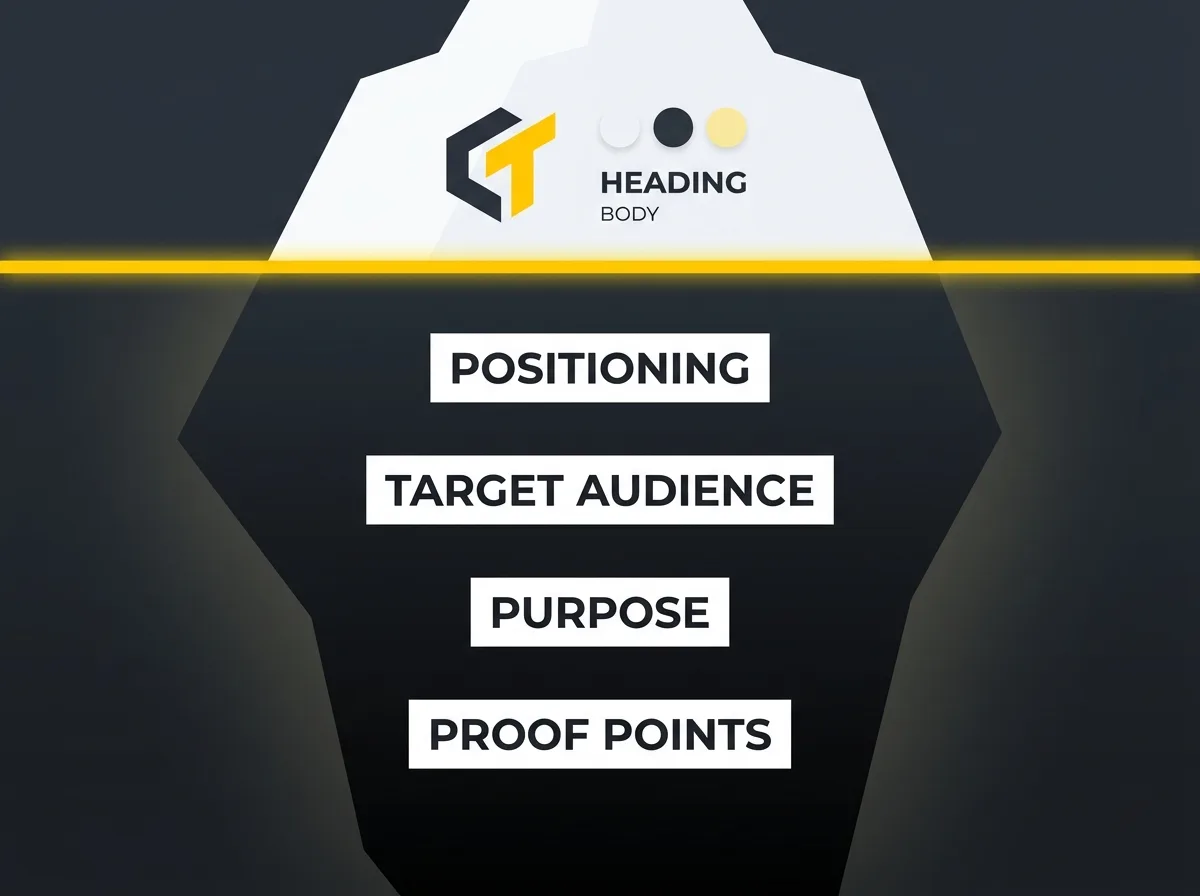
Brand strategy is not your logo. It is not your colour palette, your font choices, or your tone of voice guidelines. Those things are the outputs of a strategy. They are what strategy looks like once it has been translated into visual and verbal form.
Here is the distinction that matters: brand identity is the expression; brand strategy is the thinking that drives it.
Brand identity is what your business looks like. Brand strategy is what your business stands for and who it stands for it with. One is the costume. The other is the character wearing it.
The cleanest definition: brand strategy is the set of deliberate decisions that determine how you position yourself in the market, who you serve, what you stand for, and how you communicate all of this consistently. Search engines and AI tools are increasingly treating this as a structured, verifiable position, not just a marketing claim, but more on that later.
Most UK SMEs have spent time and money on the identity: a professional logo, a properly built website, a style guide. Far fewer have done the strategic work that should have come first. The result is a visual brand that looks coherent but does not do much commercially, because it is not anchored to a clear position, a specific audience, or a genuine reason to choose you.
Why does it matter in practice? Because businesses that start with identity and skip strategy tend to redesign every three or four years and get roughly similar results. The logo changes. The website gets refreshed. The enquiry quality stays about the same. The underlying positioning problem has not been touched.
A new logo cannot fix a positioning problem.
Only the strategic work can do that. For a closer look at the visual and identity side, the small business branding post covers what brand identity involves and where it fits. This post focuses on what should come before that work starts.
Why brand strategy determines what your marketing can do
Without a clear brand strategy, marketing tends to produce a specific and recognisable set of frustrations. Generic messaging that resonates with no one in particular. Constant pressure to compete on price because you cannot articulate clearly why you cost more. Enquiries that are technically in your sector but not quite the right fit. Marketing spend that resets each year rather than building on itself.
This last point is the most expensive. Marketing investment compounds when every piece of content, every campaign, and every conversation reinforces the same clear position. Without strategy, each activity pulls in a slightly different direction. The cumulative effect is noise rather than signal.
With a clear strategy, things start to change. Targeting becomes more focused, which means reaching the right buyers earlier in their decision. A clearer reason to choose you reduces price pressure, because buyers can see what they are actually paying for. Better-fit enquiries reduce wasted time in the sales process. And marketing compounds because every touchpoint says the same thing.
The commercial logic is direct: spending more on paid advertising or content without a clear strategy just amplifies the current signal, whatever that signal happens to be. If it is vague, spending more makes the vagueness louder.
ONS business demography data illustrates the scale of churn among UK small businesses year on year. Multiple factors contribute to those numbers. One consistent pattern is businesses that could not clearly articulate why someone should choose them over a cheaper alternative.
Brand clarity does not guarantee growth. But the absence of it is a consistent drag on businesses that have not addressed it.
Five questions your brand strategy must answer
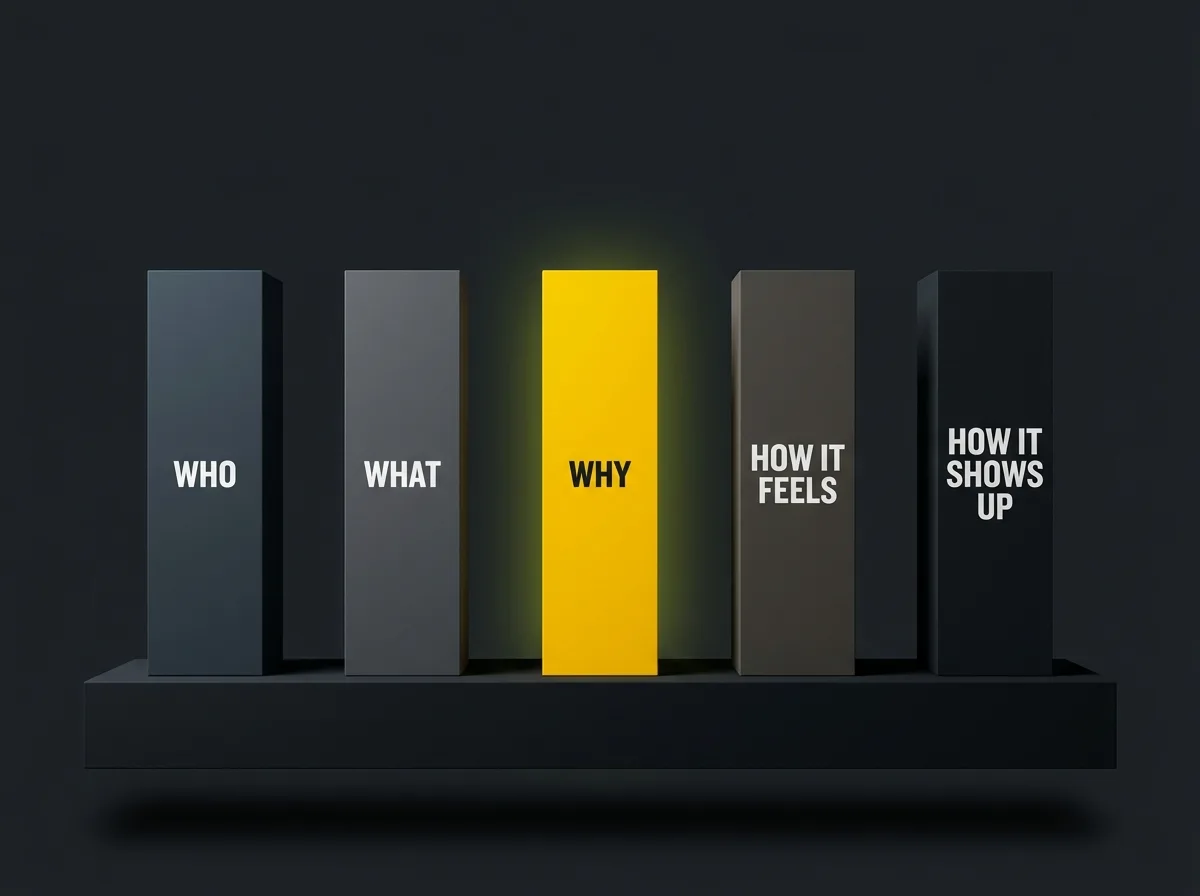
These are not marketing questions. They are business decisions that happen to drive your marketing. A brand with clear answers to all five is in a fundamentally different commercial position from one that can only answer the first two.
1. Who exactly are you for?
Not "SMEs" or "businesses in the UK." The more specific the answer, the more clearly you can speak to the right people. A law firm that serves owner-managed businesses in the professional services sector has a different buyer, a different conversation, and a different set of proof points than one that serves anyone who walks through the door. Specificity here is not a constraint on the business. It is a commercial advantage.
2. What do you help them with that no one else helps them with in quite the same way?
This is the positioning question. Not what services you provide, but what makes your approach genuinely different. The method, the outcome, the guarantee, the way you work. This is harder to answer than most businesses expect, because the honest answer requires knowing what your clients actually value rather than what you think they value. The unique value proposition post goes deep on this.
3. Why should they believe you?
Proof, not claims. "We care about our clients" is a claim. A named client who achieved a specific outcome after working with you is proof. Track record, specific results, the way you work, how long you have been doing this, what qualifications sit behind the service. The proof has to be real and specific. Vague reassurance in the absence of evidence is visible immediately, and it usually produces the price sensitivity the business is trying to avoid.
4. What does it feel like to work with you?
This is the experiential promise. It shows up before the first call in how the website reads, during the project in how communications are handled, and afterwards in how problems are resolved. The feeling clients describe when they recommend you to a colleague is almost always the most accurate answer to this question. It is rarely what you have written in the "our approach" section of your website.
5. How does this show up consistently?
Once you have clear answers to the first four, how do the words, the look, the channels, and the behaviours all reinforce the same position? This is where strategy becomes identity and then execution.
Most businesses can answer one and two roughly. Three and four are where the real work happens. Five is where everything either holds together or collapses under the weight of inconsistency.
How to build your brand strategy: a practical sequence
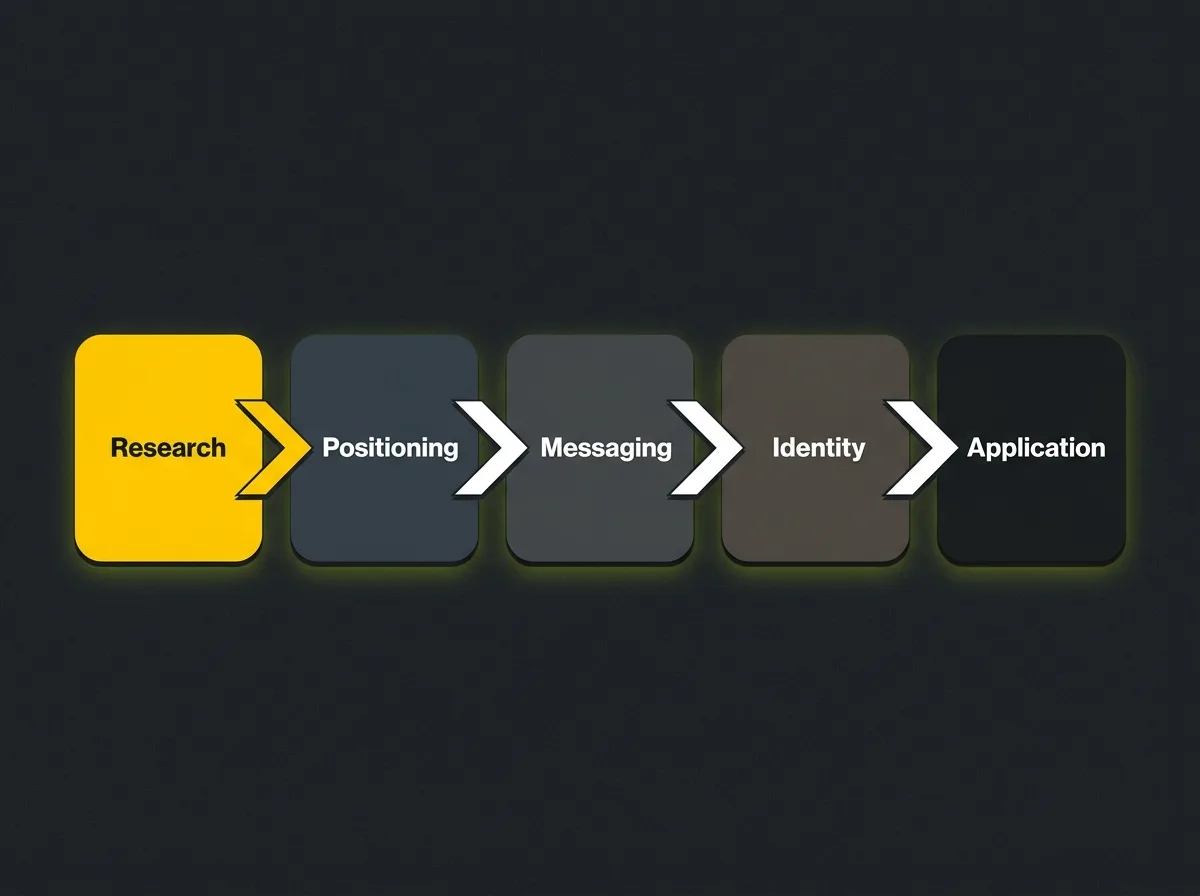
The sequence matters as much as the content. Many businesses go straight to production, the logo, the website, the social templates, and then try to reverse-engineer the strategy from what they have already built. That is like drawing the map after you have already arrived.
1. Research before you write anything.
Talk to your best existing clients. Not a survey. Actual conversations. Ask them what they value most, what made them choose you over someone else, and what they say when they recommend you to a colleague. Their language is almost always more accurate and more persuasive than anything produced in a workshop. They have already done the articulation work. Your job is to listen carefully enough to hear it.
2. Define your positioning.
Where do you sit in the market, and what makes that position defensible? Positioning is not "we are the best." It is a specific, honest claim about what makes you the right choice for a specific type of buyer in a specific situation. A boutique accountancy firm that specialises in construction businesses has a positioning. One that serves "anyone who needs accounts" does not.
3. Build your messaging foundation.
From the positioning comes the one-line description of what you do and who for, three proof points that substantiate the claim, and tone of voice principles that govern how everything is written. These must flow directly from the positioning, not be produced by a copywriter working from a brief that says "professional but approachable."
4. Align your identity.
Once strategy is clear, check whether the visual brand reflects it. If you are positioning as a precise, premium firm but the logo was a budget job from 2016, there is a mismatch that works against everything the strategy is trying to say. This is the moment when a brand refresh makes commercial sense, not as a stylistic exercise but as a business decision.
A proper brand identity agency starts with the strategy, not the moodboard. If an agency leads with visual options before asking the strategic questions, that is a warning sign worth taking seriously.
5. Apply it consistently.
Website, content, outreach, proposals, client onboarding, social profiles. Strategy only creates commercial value if it appears everywhere, not just on the homepage. Brand consistency is one of the quietest sales tools a business has, because it works on trust over time rather than through any single touchpoint.
This is not a one-afternoon exercise. It is also not a six-month agency project. For most service businesses, a solid brand strategy can be drafted in a handful of concentrated sessions, assuming the research has been done. The research is the long part. The writing that follows is relatively fast once the thinking is genuinely clear.
How brand strategy affects your visibility online (and in AI search)
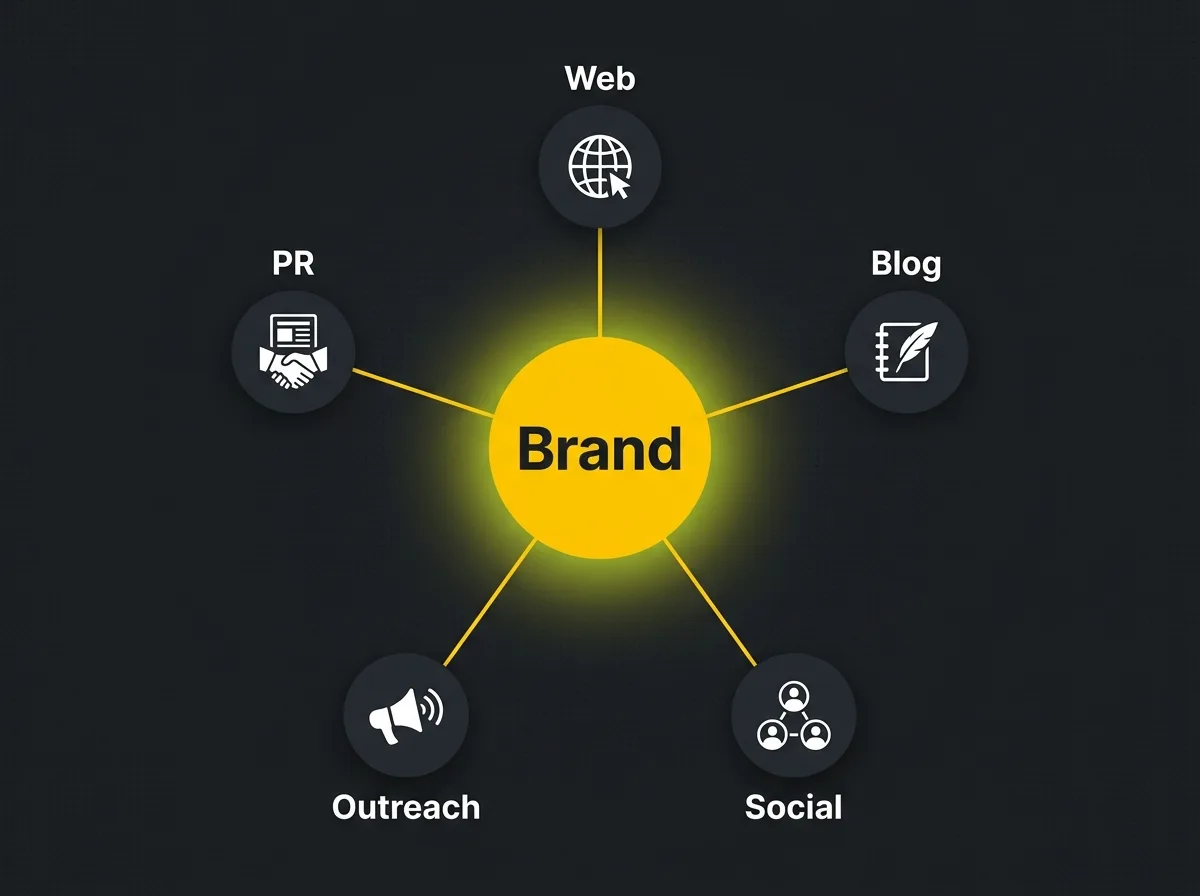
A clear brand strategy makes search more focused and more effective. When you know exactly who you serve and what problem you solve, you know what to write about, which terms to target, and which buyers you are trying to reach. Generic businesses with unfocused positioning produce generic content that ranks for nothing specific and convinces no one in particular.
This is not a side benefit of brand clarity. It is a direct commercial output of it.
A well-defined position tells you that your website design needs to speak a specific language to a specific buyer. It tells you which topics your content programme should return to consistently. It tells you which search terms your ideal clients actually use, rather than a broad category that includes every competitor you have ever faced.
The AI search dimension adds something new and worth understanding. Search engines and AI tools build a model of what your brand stands for based on everything you publish across the web. Consistent, on-strategy content reinforces that model. Contradictory or unfocused content, where each piece takes a different angle or addresses a different audience, weakens it.
When someone asks ChatGPT, Perplexity, or Claude to recommend a web design agency for a healthcare business, or a specialist accountancy firm for the construction sector, the AI draws on the patterns in its training. A brand with a clear, consistent position across its content is more likely to surface than a generalist with an incoherent content history. BrightEdge research on AI search has consistently identified entity clarity as a significant factor in brand visibility in AI-generated recommendations.
AI search visibility is already influencing how buyers discover and shortlist businesses. Worth knowing.
Brand strategy is not a prerequisite for traditional search in isolation. But a clear position makes every content investment more focused, every keyword decision more purposeful, and every piece of content work harder than it would without direction. The alternative is producing content without a clear point of view, which is expensive and leaves the authority-building to competitors who have done the strategic work.
When to work on brand strategy yourself and when to get help
There is a version of this work you can do yourself. There is also a version where outside expertise makes a material difference.
Do it yourself if you are early-stage and need to get thinking done before spending on production. Or if your business is still evolving enough that locking down a full position would constrain you. Or if you have the time and intellectual honesty to talk to your best clients and sit with what they say before writing a word.
Get outside help when something specific is broken. When your messaging is inconsistent across platforms and your own team cannot agree on how to describe what you do. When you keep winning clients but they are the wrong clients. When you keep losing to competitors you know are less capable and cannot explain why. When you redesigned the brand recently and it improved the aesthetics but not the enquiry quality.
What a good outside engagement produces is clear enough to define. Answers to the five questions above, a written positioning statement, a messaging guide, and a brief for identity work. Not a mood board. Not a logo and a colour palette with no rationale behind them. The deliverable is strategic clarity, and then the identity work that expresses it.
A good branding agency will tell you what kind of engagement you need before they tell you what it costs.
Frequently asked questions about brand strategy
What is a brand strategy?
Brand strategy is the set of deliberate decisions that determine how a business positions itself in the market, who it serves, what it stands for, and how it communicates all of this consistently. It is the thinking that drives all brand decisions, from messaging to visual identity to channel choices. Without a clear strategy, brand decisions tend to be reactive and disconnected from commercial goals.
What is the difference between brand strategy and brand identity?
Brand strategy is the thinking: the positioning, the target audience, the proof points, the experiential promise. Brand identity is the expression of that thinking in visual and verbal form: the logo, the colour palette, the typography, the tone of voice. Strategy should always come first, because identity without strategy tends to look coherent but not work commercially. A business can have a strong visual identity and a weak brand strategy, and many do.
How long does it take to develop a brand strategy?
For most small and medium-sized businesses, a working brand strategy can be completed in four to eight weeks when done properly. The research phase, talking to existing clients and mapping the competitive landscape, is usually the longest part. The writing and structuring that follows tends to go faster once the thinking is genuinely clear. A rushed strategy tends to replay the same unfocused positioning the business already has; the time invested in research pays for itself in the clarity of everything that follows.
Do small businesses need a brand strategy?
Yes, though the level of formality should match the stage of the business. An early-stage business needs at minimum a clear answer to who it serves and what makes it different. A growing business that is spending on marketing and not seeing results needs a strategic review before spending more. The most expensive mistake is treating brand strategy as something only large businesses need and continuing to invest in marketing that lacks a clear position.
What are the key elements of a brand strategy?
A complete brand strategy covers a specific target audience definition, a positioning statement describing the market position and the differentiator, proof points that substantiate the claim, an experiential promise describing what it feels like to work with the business, and a messaging foundation covering the one-line description, tone of voice principles, and key themes. From this foundation, identity work (logo, colour, typography) and content direction both follow.
Once your brand strategy is clear, the next question is how visible it actually is. You might have the strongest position in your sector and still be invisible to the buyers who would choose you if they could find you.
Free resource: Traffic Projection Report
The Traffic Projection Report shows where your business currently stands in search, where the real opportunity is, and what a focused search programme could realistically achieve over the next 12 months. It is a useful starting point whether the brand strategy work is complete or just beginning.