
You've downloaded a brand strategy template, opened it, and discovered the first task is organising a workshop. The second appears to require someone who organises workshops professionally.
Meanwhile, your proposal uses the old logo, your website describes services you barely offer any more, and somebody wants a decision about colours.
Sound familiar?
The problem is rarely a shortage of opinions. You need a short set of decisions that helps everyone describe the same business.
This brand strategy template gives you seven sections to copy into a document and complete. Each has an instruction, an example and a practical test.
We'll use a hypothetical UK renovation company throughout. It is an illustration, not a Creative Tweed client story. The same questions work for a law firm, private clinic or accountancy practice.
Aim for a useful first draft in an afternoon. Then check the assumptions against customer conversations before commissioning new design or rewriting the website.
The page is a starting point. What you do with it is where the value appears.
Decide what the business means before choosing how it looks
A brand strategy template is a structured document recording who your business serves, why those customers should choose it, and how you will communicate that choice. For a UK service business, it should guide everyday decisions about proposals, website pages, customer experience and marketing.
Strategy sets the direction. Your identity expresses it through your name, logo, colours, typography and imagery.
Order matters.
If your positioning is unclear, commissioning brand identity work leaves the designer guessing whether you should look accessible, premium, technical or reassuring. Those choices need a reason beyond somebody liking dark blue.
A marketing plan then decides how you reach people: channels, campaigns, responsibilities and budgets. This page gives that plan a direction.
The trade-off is depth. One page will not capture extensive customer research or resolve several competing services with different audiences. It can expose those questions before they become expensive design revisions.
Copy this one-page brand strategy template
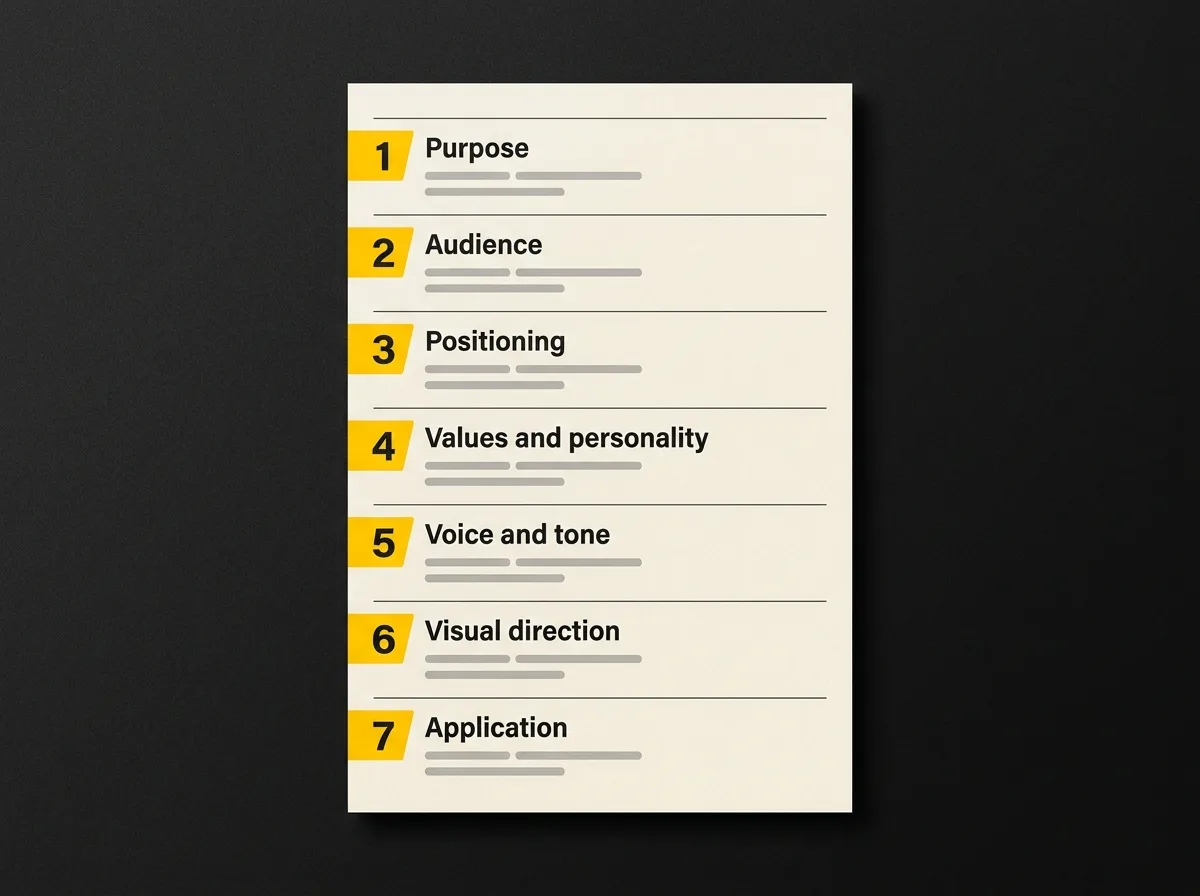
Copy the following seven prompts into a document. Keep the completed answers to roughly 350 to 450 words, using supporting notes separately.
No special software required.
-
Purpose: We exist to do what, for whom, so that what changes?
-
Audience: Our priority customer is whom, facing what situation, after trying what already?
-
Positioning: For this audience, we are what kind of business, offering what specific difference, supported by what proof?
-
Values and personality: Which three values guide our behaviour, and what would a customer observe?
-
Voice and tone: Which three words describe our writing, and what example sentence demonstrates them?
-
Visual direction: What should the business look and feel like, which references help, and what must remain practical?
-
Application: What will change on our website, in our content and in our sales materials, with an owner and review date?
Treat the first six as decisions. The seventh makes somebody responsible for using them.
Now work through each one.
Section 1: Give your purpose a job
Purpose explains the useful change your business exists to make. It should help you make choices about clients, services and how you work.
Simon Sinek's Golden Circle is a recognised starting point: consider why the organisation exists before describing how it works and what it sells.
Keep it grounded.
Complete this sentence: “We exist to [action] for [audience] so that [outcome].”
For our hypothetical renovation company: “We exist to make complex home renovations understandable for homeowners, so they can make decisions without guessing what happens next.”
That could influence how the company explains quotations, schedules and changes. It gives the team something to act on.
“We exist to transform lives through exceptional construction” offers rather less help when someone needs to explain an unexpected plumbing bill.
Test your sentence against a difficult decision. Would it affect which projects you accept or how you communicate delays? If it changes nothing, tighten it.
Purpose also gives your unique value proposition a direction. The proposition must then explain the practical benefit a customer receives.
Section 2: Describe the moment your customer needs you
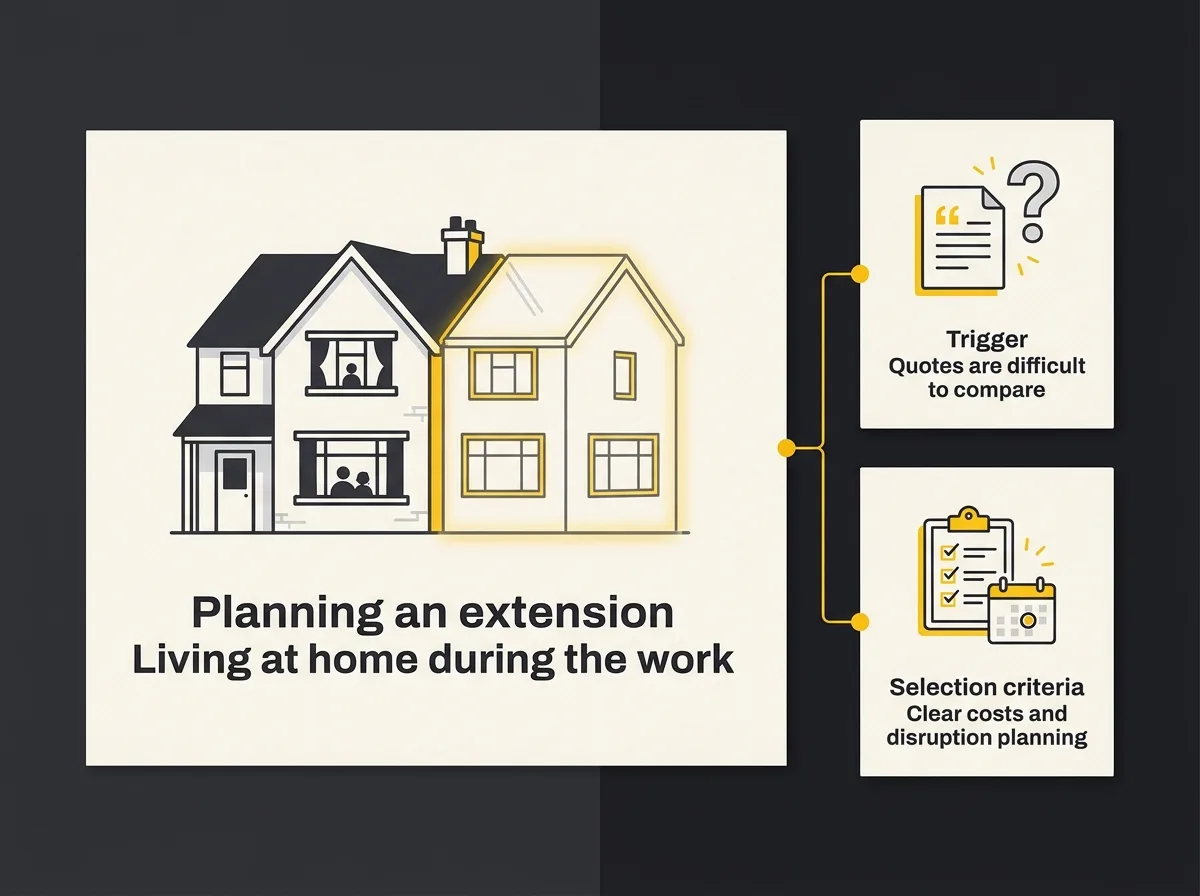
Write two sentences about one priority customer. Include their situation, the problem they need resolved and what makes choosing difficult.
For the renovation example: “Our priority customer owns a family home and is planning an extension while continuing to live there. They have received quotations with different exclusions and cannot tell which contractor has allowed for the whole job.”
Now you have something useful.
That description suggests content about comparing quotations, living through building work and understanding provisional costs. “Homeowners aged 35 to 65” gives you very little of that.
The Christensen Institute's Jobs-to-be-Done approach focuses on the progress people seek in particular circumstances. Apply that thinking by asking what has happened to make this customer look for help now.
Check recent enquiries, sales notes and conversations with good customers. Record the words they use before translating them into marketing language.
You can serve other people. This section simply gives your main message a clear recipient.
The mistake is choosing “anyone who needs our service”. It keeps your options open by leaving every later decision unresolved.
Section 3: Make your difference survive a comparison
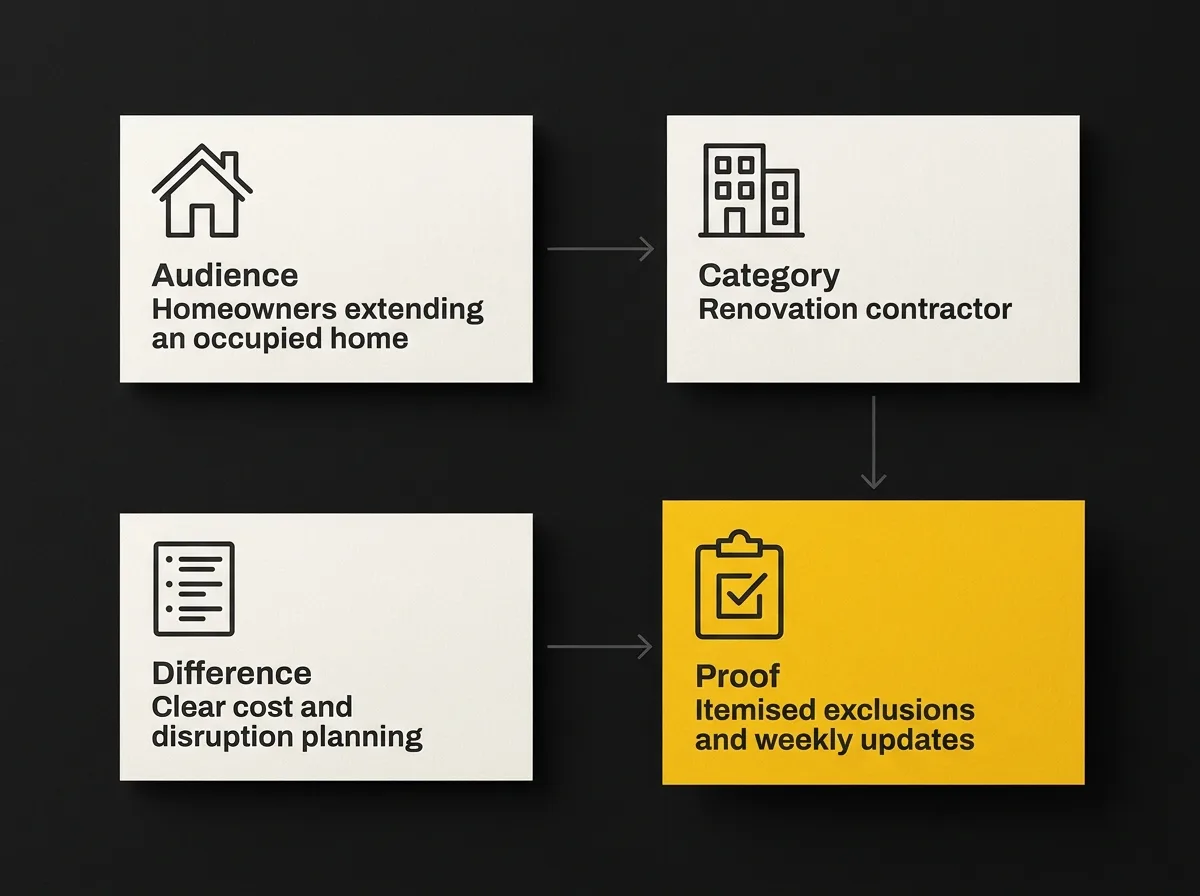
Positioning explains why a particular customer should choose your business over the alternatives they are considering.
Use this structure: “For [audience], [business] is the [category] that [difference], because [proof].”
For our illustrative contractor, a possible statement would be: “For homeowners extending an occupied property, we provide renovation work with clear cost and disruption planning, supported by itemised exclusions and a weekly written update.”
Only use that promise if the business actually delivers it.
Proof comes first.
Find the process, qualification, record or customer evidence that supports your difference. Then decide how strongly you can describe it.
“Better quality and excellent service” could appear on almost any competitor's website. “Only” and “best” need evidence too. You do not need to claim exclusive ownership of a useful service to give customers a reason to choose it.
Ask two questions: could a competitor repeat this word for word, and would your best customers recognise it?
If both answers reveal a problem, revisit the evidence. Good small business branding starts with a defensible choice, before anyone starts debating the business cards.
Section 4: Turn values into things customers can observe
Choose three values to begin with. Add a fourth or fifth only if each changes a distinct behaviour.
For every value, complete: “A customer would see this when we…”
For the hypothetical contractor, that might produce:
-
Clarity: We explain quotation exclusions before the customer accepts the work.
-
Accountability: We name the person responsible for resolving a problem and confirm the next update.
-
Respect: We agree how we will protect occupied rooms and manage access before starting.
These are examples to adapt, not promises to copy without checking.
The poster can wait.
A useful value affects behaviour when the choice is inconvenient. Clarity matters most when explaining an extra cost, rather than when everything is comfortably on budget.
For personality, add three plain descriptors such as calm, practical and approachable. Ask whether they fit how the team behaves, including under pressure.
Brand archetypes can offer vocabulary later, but choosing one is optional. You can write a perfectly useful strategy without spending an afternoon deciding whether your company is a sage.
Section 5: Show people how the brand sounds
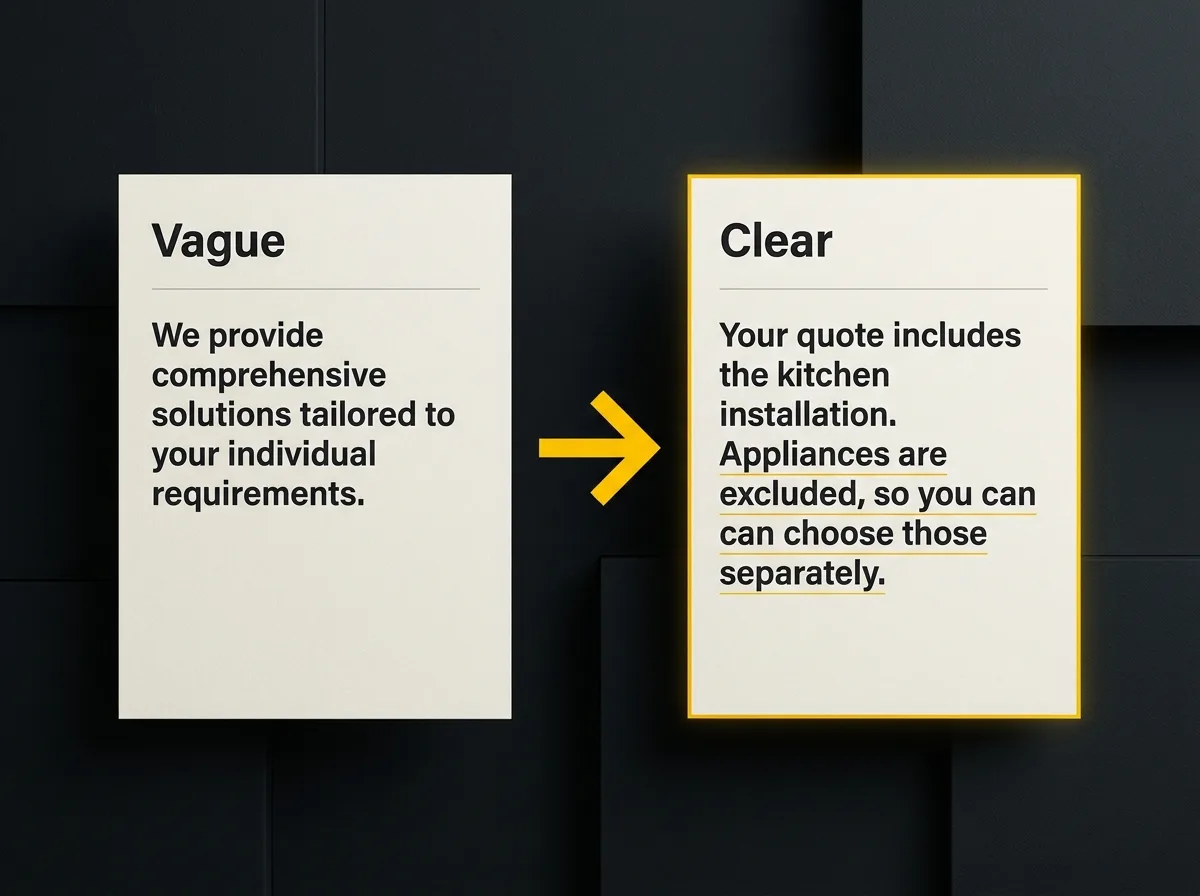
Voice is the recognisable character of your writing. Tone adjusts to the situation: a complaint response needs different handling from a project announcement.
Write three descriptors, then demonstrate them with a sentence your team might actually need.
For our example, “plain, calm and specific” could produce: “Your quote includes the kitchen installation. Appliances are excluded, so you can choose those separately.”
Compare that with: “We provide comprehensive solutions tailored to your individual requirements.”
One answers a question. The other occupies space.
Examples beat adjectives.
Add one more example for a difficult moment: “The inspection has identified additional work. We will explain the options and costs before asking you to approve anything.”
This gives people a standard they can apply to proposals, emails and website copy. It also makes brand consistency easier to maintain when several people write for the business.
Test the voice by reading it aloud. If nobody in your team would say it to a customer, it probably needs another pass.
Section 6: Brief the visuals before asking for options
This section records the direction for design. You are giving a designer useful constraints and references, rather than completing the identity yourself.
Write down the impression you need to create and the places the design must work.
Be practical.
For our renovation company: “Reassuring, clear and established. The identity must remain readable on site signage, vehicle graphics, quotations and a mobile website.”
Find three visual references and explain what you like about each. It might be the readable typography, restrained colours or clear organisation of information. Avoid asking for another business's identity with your name inserted.
Include existing assets that customers recognise. Replacing everything creates cost, from uniforms to proposal templates, and needs a reason.
This brief should also inform website design. Colours and typography need to support readable pages, clear navigation and visible next steps.
A beautiful pale-grey button is still a problem if nobody can find it.
Section 7: Make every answer change something
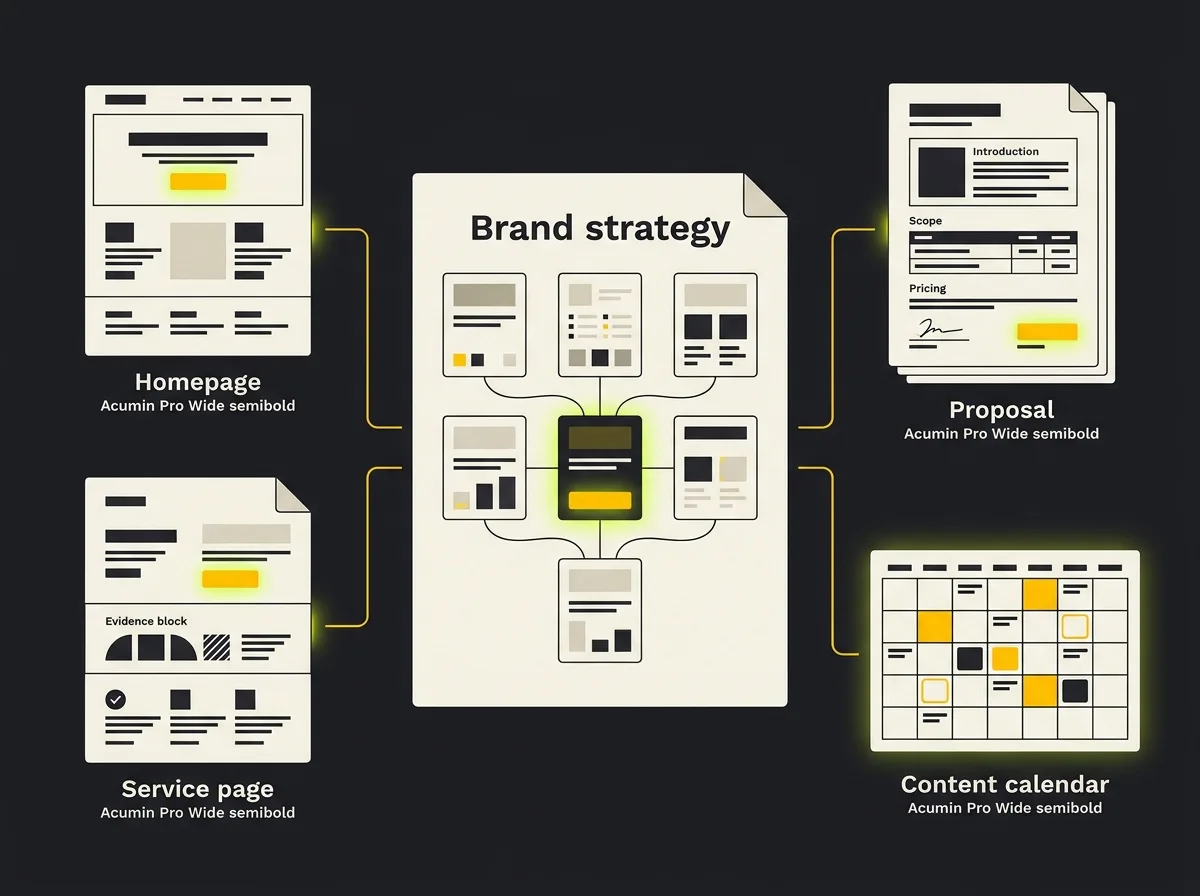
Your final section records the first changes, the person responsible and a review date. This is how the strategy reaches customers.
Start small.
Choose one important service page and one proposal template. Use the six decisions to revise them before spreading the changes everywhere.
Here is how each answer translates into work:
-
Purpose shapes the homepage message. Explain the customer benefit in ordinary language. For the illustrative contractor, that could mean leading with clarity about renovation costs and disruption, supported by a clear description of the service.
-
Audience shapes content priorities. Answer the questions that delay a suitable buyer's decision, such as what a quotation includes or how an occupied renovation works.
-
Positioning shapes service pages and search priorities. Prioritise relevant work, locations and buying questions. Check actual search demand before committing to a keyword plan.
-
Values shape the evidence. Show an example project schedule or explain the quotation process, where permission and confidentiality allow.
-
Voice shapes the wording. Apply the same clear language to page titles, descriptions, proposals and follow-up emails.
-
Visual direction shapes presentation. Make the pages and documents recognisable, readable and easy to use.
-
Application sets responsibility. Name who makes each change, when it goes live and when you will assess it.
Clear descriptions also give search engines and AI tools less contradictory information about your business. That alone does not secure rankings or recommendations.
Measure what happens after the changes. Track relevant enquiries, customer fit and recurring sales questions alongside traffic. A clearer brand may improve understanding without immediately increasing visitor numbers.
Review the page after your next few sales conversations. If prospects still misunderstand the same thing, revise that part of the strategy and its application.
Give the first draft a realistic deadline
Set aside an afternoon for drafting if you already know your customers and services well. Treat that as a planning allowance, not a completion promise.
Bring recent proposals, enquiry notes and customer feedback. If two owners disagree about the audience, record the disagreement and gather evidence before polishing the wording.
That is useful progress.
The copyable template costs nothing to use. Your time, research and any commissioned design are separate commitments. If you seek outside help, ask for a scoped quote covering research, decisions, outputs and revisions.
One page works well when a business has a clear core offer. Several divisions or very different customer groups may need separate strategies and supporting research.
Avoid three traps: copying competitors' wording, describing an ideal business you cannot yet deliver, and treating the document as permanently finished.
Keep ambitions in your planning notes. Keep customer-facing promises tied to what happens today.
Frequently asked questions about brand strategy templates
The practical questions matter here.
How long does a brand strategy take?
You can draft this one-page version in an afternoon if the main decisions are already clear. Allow more time to check customer evidence and resolve disagreement. Research, interviews and several distinct audiences can make the wider work substantially longer.
What is the difference between brand strategy and brand identity?
Brand strategy records your audience, positioning, promises and communication direction. Brand identity expresses those decisions through elements such as your logo, colours, typography and imagery. The strategy helps explain why a design is appropriate.
How many pages should a brand strategy be?
Use one page for the decisions people need regularly. Keep research and detailed guidance separately. Larger organisations may need more documentation, but length should follow the complexity of the business rather than a template's empty boxes.
Can a small business create a brand strategy without an agency?
Yes. An owner with a clear offer and access to customer feedback can make a useful start. Outside support becomes more valuable when the team cannot agree, the evidence is thin or several audiences need different messages.
Does completing a brand strategy mean we need a new logo?
No. You may discover that your existing identity works well and the bigger problem is unclear messaging or inconsistent application. Assess what needs to change before paying to replace recognisable assets.
Finish the page, then put it somewhere useful
Copy the seven prompts, draft the answers and share them with someone who speaks to customers every day. Ask which parts they can support with evidence and which sound like wishful thinking.
Then use the page.
Give it to anyone who writes, designs or sells for your business. Assign the first website and proposal changes, and put the review date in the diary.
Once your positioning is clear, the next question is whether suitable customers can find you when they search. That needs evidence about demand, competitors and your current visibility.

Free resource: Traffic Projection Report
Request a report to explore relevant keyword opportunities and what a stronger search presence could mean for your business. Use it alongside your completed strategy to decide where to focus next.