A client came to Creative Tweed able to describe their business in a single, confident sentence. The tagline was good. The logo was one they had paid properly for. They had values printed in the company handbook and a colour palette their designer had approved three years earlier.
What they could not do was describe their brand consistently. The website read differently to their proposals. The proposals read differently to how they answered the phone. None of it matched the way the MD talked about the business at events.
Sound familiar?
The brand was not incoherent by design. It had simply never been defined precisely enough to hold together under real pressure.
The brand identity prism is the tool that surfaces that gap before it becomes a problem. Unlike most brand frameworks, it keeps both sides of the relationship in view: not just what you intend to project, but how it lands on the people you are trying to reach.
That distinction matters.
If you have encountered the term in a workshop, an agency pitch, or a branding course and wondered whether it applies to a business like yours (specifically because every article you have read uses Nike and Apple as examples), this article explains the model in plain English. It uses examples from UK professional services and trade businesses rather than global corporations.
It also covers the step every competitor article skips: what you actually do with the output once the template is filled in.
For readers who want more foundational context before working through the prism itself, what actually matters in small business branding is a useful starting point.
What the brand identity prism is, and why Kapferer built it
Jean-Noel Kapferer, Professor of Marketing at HEC Paris, introduced the brand identity prism in his 1992 book Strategic Brand Management (Kogan Page). The problem he was solving was not aesthetic. It was conceptual.
Brand managers at large companies were routinely confusing brand identity with brand image. Brand identity is what the brand intends to stand for. Brand image is what customers currently perceive. These two things can diverge significantly, and conflating them produces brand strategy that chases perception rather than builds something coherent from the inside out.
Worth knowing.
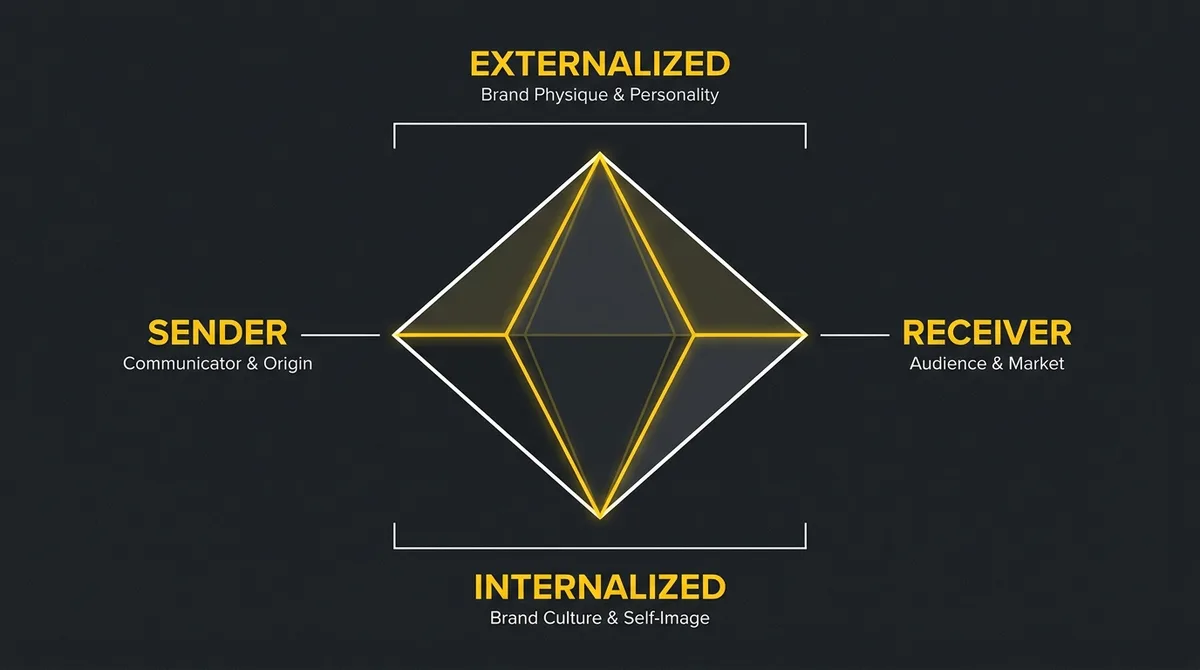
The prism gives that distinction a structure you can actually work with. Six facets, arranged with specific geometry. The left side relates to the brand as sender: the signals the brand consciously constructs and puts into the world. The right side relates to the customer as receiver: how those signals are interpreted and internalised.
The top two facets are externalised and visible to the outside world. The bottom two are internalised values and self-perception. The middle two mediate between the brand and the customer.
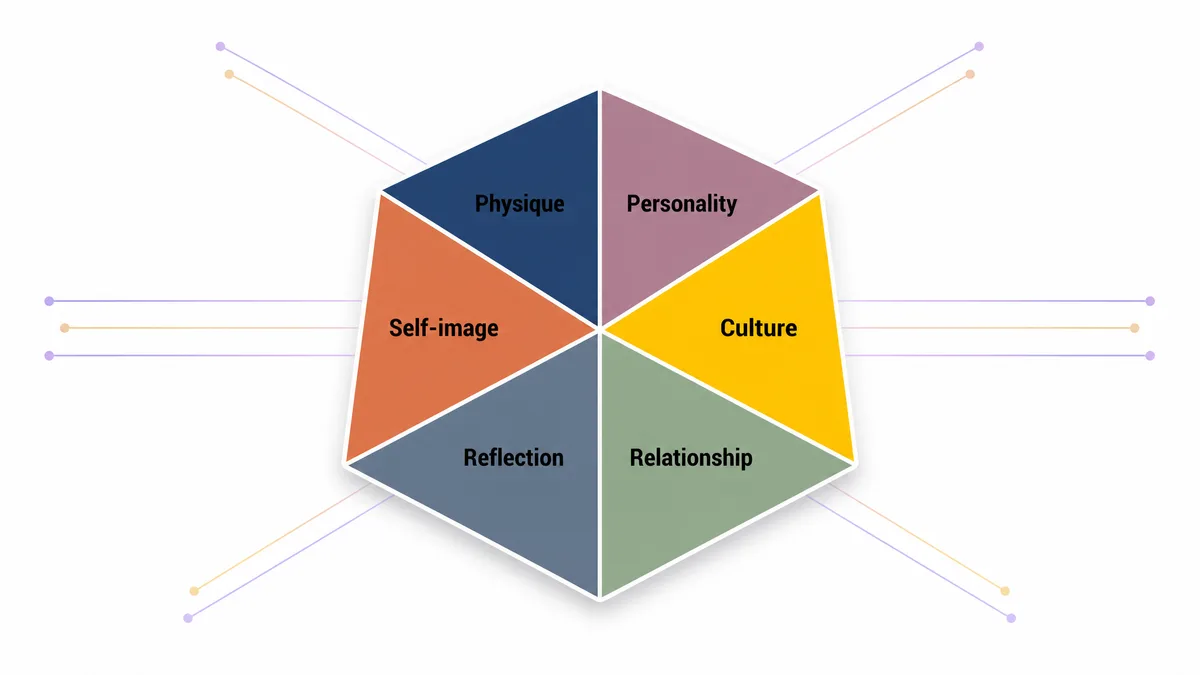
The six facets are Physique, Personality, Culture, Relationship, Reflection, and Self-Image.
None of these were chosen arbitrarily. Together, they insist that brand identity is not simply a visual system. It is a set of promises, behaviours, and signals that exist in relationship with the people the brand is trying to serve.
That framing is why the model remains useful more than thirty years after publication.
Academic research examining the applicability of Kapferer's prism specifically to SMEs (published via the London Metropolitan University repository) confirms what practitioners find in practice: the framework scales from global corporations to owner-managed businesses without losing its diagnostic value. The six facets are no less relevant at sixteen employees than at sixteen thousand.
The six facets in plain English

Most treatments of the six facets use Nike and Apple to illustrate them. Accurate examples. Completely useless if you run a structural engineering firm in the East Midlands, a private dental practice in Surrey, or an accountancy practice with eighteen staff and a strong regional client base.
Different context. Different examples.
Here is what each facet means for a UK professional services or trade business.
Physique. The tangible, visible dimension of the brand. For a UK B2B business this covers the logo, the colour palette, the visual quality of proposals and tenders, the look and feel of the website. It also includes the consistent, literal attributes of what the business delivers: the finish quality on a construction project, the precision of a legal document, the response speed of a consultancy retainer.
A useful diagnostic question: what would someone recognise instantly even if the logo were removed?
Personality. How the brand communicates. Tone of voice, register, whether the brand is formal or approachable, authoritative or collaborative, precise or conversational. A useful test: if your brand were a person at a professional networking event in your sector, how would they introduce themselves and what would they talk about?
Many UK SMEs have never made an explicit decision about brand personality, which means it defaults to the founder's individual style and shifts whenever someone else writes a proposal or posts on LinkedIn.
Culture. The values and principles that actually generate the brand's output. Not the aspirational values written in a pitch deck. The operating principles the business would never compromise on, even under commercial pressure.
For many UK SMEs, Culture is shaped directly by the founder's background and what they have seen go wrong in their sector. A construction company run by a director who came up through site management will have different cultural values baked into their process than one run by a commercial director who came up through tenders and margin negotiation.
Culture is what shapes consistency across the team. If you hire ten more people next year, Culture is the question of whether they will make decisions the way the founder would make them.
Relationship. How the brand interacts with customers and the nature of the bond it builds over time. Is the relationship transactional or relational? Expert-and-client, or collaborative partnership? Built on reassurance, on challenge, or on accountability?
In B2B markets, Relationship has become a stronger differentiator as technical capability has commoditised. Two solicitors or two engineering firms can have near-identical credentials and very different client relationships. The Relationship facet makes the intended client experience explicit rather than assumed.
Reflection. The image of the typical user the brand projects in its communications. Not the statistical average of who actually buys from the business, but the customer the brand presents as its intended audience.
When this is misaligned with reality, the consequences are concrete: the brand attracts prospects who do not convert, or creates friction for exactly the buyers it most wants to reach. A mid-market professional services firm whose language and imagery reflects a very large corporate client will make its actual sweet-spot clients (growing owner-managed businesses) feel like they are in the wrong room.
Self-Image. The subtlest facet, and the one most often skipped entirely. Self-Image describes how the brand wants customers to feel about themselves as a result of using it. In consumer brands this shows up as aspiration: wearing a brand signals something about who you are.
In B2B contexts the dynamic is quieter but real. A client who appoints a rigorous, strategy-led brand agency is signalling, to themselves and to their market, that they take quality seriously. A client who uses a premium accountancy firm is implicitly positioning their own business at a level where that relationship makes sense.
Self-Image is the brand's role in the client's own narrative.
Where the prism gets interesting: the gaps between facets

Most articles treat the six facets as a checklist. Fill in Physique, tick. Fill in Personality, tick. Print the template and frame it. Done.
The actual diagnostic value of the prism comes from the tensions between facets, not from each one in isolation.
That's where it gets useful.
Consider a few common misalignments UK SMEs run into. If Physique communicates premium quality (a considered visual identity, high-end client-facing materials, a polished website) but Personality communicates something very casual or even slightly jokey, customers receive conflicting signals. The look says "serious firm". The words say "friendly small operation".
Neither impression is wrong in isolation. Together, they create uncertainty. And uncertainty slows decisions.
If Reflection does not match who actually buys from the business, the marketing creates friction rather than momentum. A healthcare provider whose materials reflect highly corporate language will create friction for the GPs and patients they are actually trying to reach.
If Culture diverges from Relationship (the way clients are treated day-to-day), trust erodes. This is the gap that surfaces in online reviews and falls away in referral rates. Clients do not always articulate what has gone wrong. They just stop recommending you.
These tensions are the conversations the prism makes possible. Without a shared framework, these misalignments are hard to name and therefore hard to address systematically. The prism does not resolve them automatically.
But it makes them visible and discussable, which is the prerequisite for fixing anything.
Brand consistency across every touchpoint begins with diagnosing these gaps. The prism is the map.
How to run a brand identity prism for your business

Who to involve. The founder or MD, a senior team member who understands the business at an operational level, and at least one person who interfaces regularly with clients. More than four people tends to slow the process without improving the quality of the output.
Too many voices, and aspiration crowds out honest description.
Format. A facilitated workshop of 60 to 90 minutes, or a self-directed session using a printed or digital template. The facilitated version produces more honest answers because it prevents the founder from completing the exercise alone, based on what they want the brand to be.
Self-directed sessions are useful for preparation but tend to produce polished aspiration rather than accurate description without someone in the room to push back.
Sequence. Start with Physique, the most concrete and easiest to agree on, and work toward Self-Image, the most abstract and the most likely to surface genuine disagreement. Starting with Culture tends to produce the values statements from the company handbook rather than honest descriptions of actual behaviour.
Starting with Physique anchors the conversation in observable reality before you work toward the more interpretive facets.
The key discipline. Describe what is, not what you wish were true.
No shortcuts.
A prism built on aspiration is a useful document for a rebranding launch. It is useless as a diagnostic.
Other common mistakes worth avoiding when UK SMEs attempt the prism:
-
Using global brand examples throughout the session. If the group keeps referencing Apple or Patagonia, the answers drift toward those brands rather than toward what the business actually is.
-
Conflating Reflection with target audience. They are related but not identical. Reflection is the image the brand projects. Target audience is a demographic and behavioural description of who you are trying to reach. A business can have a precise Reflection facet and a separate, more detailed audience definition alongside it.
-
Treating the completed template as the deliverable. The prism is a diagnostic and a brief. Framing it as the end goal misses the point of the exercise entirely.
What the prism does not do, and where you still need specialist help
The brand identity prism defines brand identity. It does not design it.
After completing the prism, a set of real decisions remains outstanding. A visual identity that reflects the Physique and Personality facets accurately. A messaging framework drawn from Culture and Relationship. A website and content strategy that embodies the Reflection and Self-Image facets for the right audience. These are execution steps, and they require creative and strategic skills that are separate from running a facilitated workshop.
That's where most UK SMEs stall.
The prism creates clarity about what the brand should be. Turning that clarity into a coherent, visible identity across every touchpoint (website, proposals, digital channels, printed materials, how the phone is answered) is a different kind of task entirely. How brand design builds trust before a prospect makes contact is the next stage of that journey, and it starts from the prism output.
The prism also does not resolve your unique value proposition on its own. It identifies what your brand stands for across six dimensions. It does not automatically surface the specific, defensible claim that separates you from competitors with similar credentials. That work is adjacent and complementary.
For businesses that already have a brand but suspect it has drifted since it was last defined (or that completed a brand exercise several years ago and have since outgrown it), a brand refresh addresses the gap between what the prism says you are and what your current identity actually communicates in the market.
When you work with a brand identity agency, the prism output becomes the brief that drives creative execution. It replaces the vague instruction ("we want to look more premium" or "we want to feel more approachable") with a structured set of facets that the designer, copywriter, and web team can build against coherently.
That is the difference between a brand that feels right and a brand that works.
Brand identity, digital presence, and why consistency matters beyond the logo
A well-defined brand identity has practical effects beyond aesthetics.
Google Search Central documentation makes clear that search engines understand brands as entities: a coherent set of signals spanning the website, linked external references, structured data, and consistent language. When those signals point in the same direction, Google can resolve the entity cleanly and attribute authority accordingly.
When the signals conflict, the entity graph becomes harder to read. Inconsistency introduces noise that undermines rankings.
AI search tools such as ChatGPT and Perplexity work similarly. They are more likely to recommend and cite brands whose identity appears consistently across multiple independent sources. A brand that presents one way on its website, another in its PR coverage, and something else in its case studies creates exactly the kind of ambiguity that AI tools resolve by citing a competitor instead.
It compounds.
The brand identity prism is the upstream work that makes downstream brand consistency possible. Without a precise definition of what the brand stands for across all six facets, consistency across digital touchpoints is accidental rather than intentional.
Accidental consistency does not hold when the team grows, the service offer evolves, or a new channel requires new content in a format the brand has never used before.
The question the prism leaves you with
The brand identity prism is one of the more durable brand strategy tools available because it refuses to let you focus only on what you want to project. The Reflection and Self-Image facets keep the customer in the picture throughout, which is where most internal brand exercises fail.
That matters.
Kapferer designed the model to create honesty: about what a brand genuinely stands for, where the internal view and the external perception diverge, and what still needs to change. For UK SMEs, that honesty is what separates a brand defined once from a brand that compounds in value over time.
Once you know what your brand is, the next question is whether your digital presence is visible enough to reach the audience you have just defined. The Traffic Projection Report shows where you currently stand and what is realistically achievable with a structured search programme, built on a brand your customers can actually recognise and trust.
If the prism session surfaced questions your team could not agree on, that is a useful signal. Not a problem to defer. Those tensions are exactly where a brand strategist earns their place. Find out how Creative Tweed works with UK SMEs on brand identity.
FAQ
Is the brand identity prism still relevant?
Yes. The fundamental tension Kapferer identified in 1992 (between brand identity and brand image, between what a brand intends to project and what customers actually perceive) has not changed.
What has changed is the number of touchpoints where that gap becomes visible. Digital channels, review platforms, AI-generated search results, and social content all expose inconsistency faster and more publicly than was possible when the model was first published. The prism is, if anything, more useful as a diagnostic tool in a world with more signals and less patience for brands that feel incoherent.
Can the brand identity prism be used for small businesses?
Yes, and arguably it is more useful for small businesses than for large ones. Large brands have dedicated brand teams, brand books, and internal governance processes to manage consistency.
Owner-managed businesses have none of those structures, which means brand identity is more likely to drift, fracture across team members, or remain undefined entirely. Academic research examining the applicability of Kapferer's model to SMEs confirms the framework applies without modification. The prism provides structure for making explicit what is otherwise implicit, which is exactly what a growing business needs before it scales its team or its marketing spend.
What is the difference between brand identity and brand image?
Brand identity is what the brand consciously constructs and intends to stand for. Brand image is what customers currently perceive, based on all the signals they have received.
These two things can diverge significantly, and managing a brand means narrowing that gap over time. The brand identity prism is a tool for defining the identity side of that equation clearly enough to act on it. Without that definition, you are managing perception with no fixed point of reference.
Do I need an agency to complete the brand identity prism?
Not to fill in the template. The exercise can be done internally, and a self-directed session using a printed or digital template is a legitimate starting point.
The value of working with an agency comes in two places: the facilitation of the session itself (which produces more honest answers than a founder completing it alone) and the translation of the prism output into a coherent visual identity, messaging framework, and digital presence. The prism is the diagnosis. The agency delivers the treatment.