
Most brand strategy projects don't fail because of bad design. They fail because no one agreed what the business was trying to become before the design brief was written.
That sounds obvious until you watch it happen. The company grows, the team expands, a website refresh gets commissioned, and somewhere in the middle of debating colour palettes, everyone realises they can't quite agree on who the brand is actually talking to.
Or what makes it different. Or why a prospect should choose it over the obvious alternative.
Sound familiar?
If you are losing pitches you should be winning, if your brand still looks like the version from three years ago, or if your sales team and your marketing team describe what you do in noticeably different ways, this article is for you.
It covers what brand strategy consulting actually involves, the three provider types and which one suits your situation, what the engagement process looks like, and what it costs in the UK in real money.
What brand strategy consulting actually is (and what it isn't)
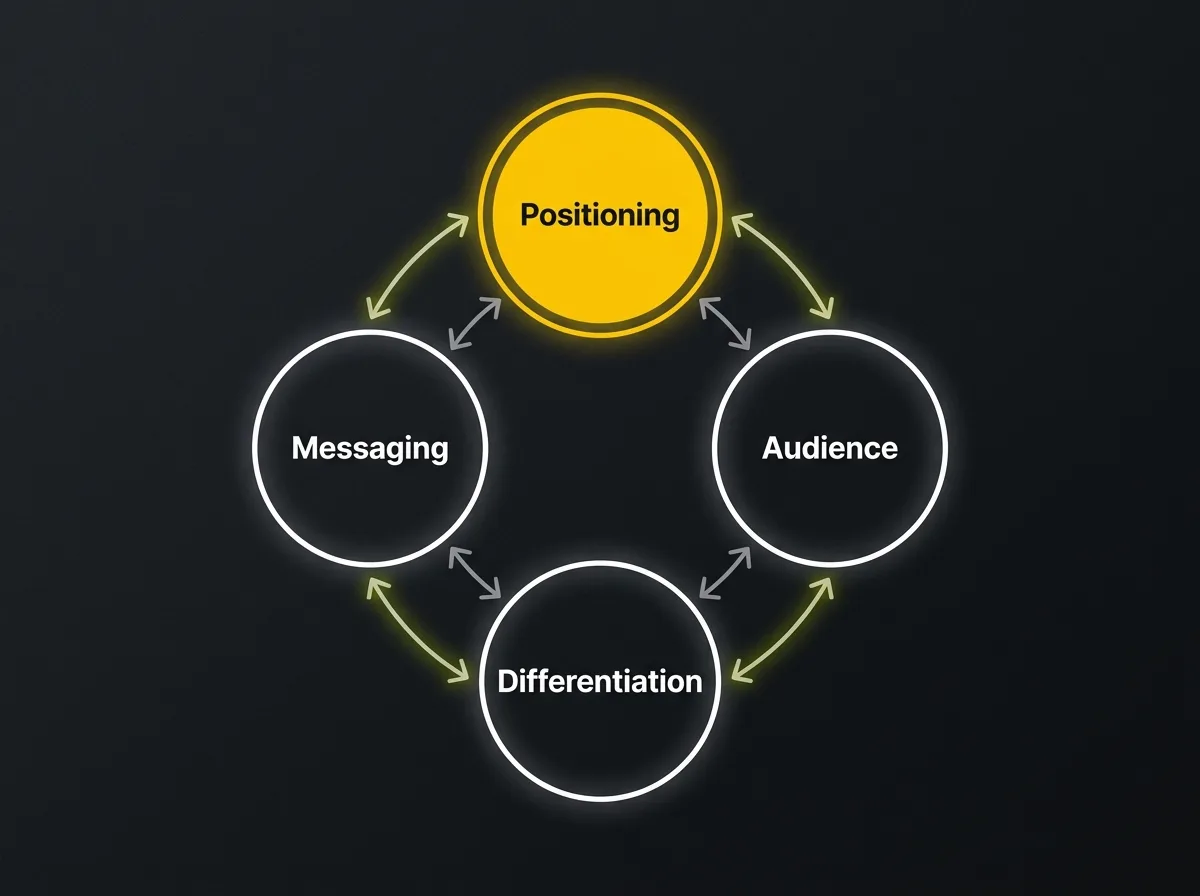
Brand strategy consulting is the structured process of deciding what your business stands for, who it is for, how it is different from every alternative, and how all of that gets communicated consistently. It happens before any design work starts.
That is the short version.
The slightly longer version: it is the work that gives everything else a shared anchor. Your website, your SEO content, your sales collateral, your social media presence. Without it, each channel speaks slightly differently, which compounds confusion rather than building trust.
The problem is usually invisible from inside the business. It is very visible to the prospect who has just looked you up cold.
What brand strategy consulting is not: it is not logo design. It is not a tagline exercise. It is not a brand guidelines document, though that often follows from it. It is not a marketing campaign plan.
These things can all come after brand strategy work, but they are outputs built on the foundation, not the foundation itself.
A thorough engagement typically delivers four things: a clear positioning statement, a messaging hierarchy that tells you what to lead with and what to say next, an audience definition specific enough to be useful, and a tone of voice guide that keeps communication consistent regardless of who is writing it.
Done well, this gives you the building blocks your unique value proposition can be drawn from, and makes every downstream investment more effective because web design, content, paid ads, and SEO are all pulling in the same direction.
One more distinction worth making: brand strategy consulting is not the same as brand consultancy in the aesthetic sense. You are not commissioning someone to make your business look better. You are commissioning someone to help you agree, at a foundational level, what your business actually is.
That distinction matters more than most businesses realise before they start.
Five signals you're ready for it (and one signal you're not)
The businesses that get the most from brand strategy consulting are rarely the ones that feel stuck. They tend to be the ones going somewhere, and finding that their brand has not kept pace.
Here are the five clearest signals.
Growth has outpaced the brand. The company has evolved significantly since the founding stage, but the brand still reflects who you were at an earlier point. New clients are won in conversations, not before them. Something is not translating before the introduction happens.
You are losing pitches on perception, not capability. You win when people know you. When they do not, you struggle. That gap is almost always a brand problem, not a sales problem.
The capability is there.
The clarity is not.
You are expanding into new markets or audiences. What resonated with your first set of clients may not translate to the next. A new sector, a new geography, a move upmarket. These transitions tend to expose brand assumptions that were working fine until they suddenly were not.
Your team describes the business differently depending on who is speaking. If sales, marketing, and leadership each have a slightly different version of what you do and who it is for, every client-facing channel carries that inconsistency.
It compounds.
You are about to make a significant marketing investment. A new website, an SEO programme, a paid campaign, a content strategy. Building any of these on an unclear brand foundation means the investment works harder than it needs to and delivers less than it should.
The one signal you are not ready: if you need to modernise your visuals or update a logo without changing what the business actually stands for, a brand refresh may be the right scope at a fraction of the cost.
A refresh updates how you look. Brand strategy work changes what you say and why. The distinction matters for both budget and brief.
Consultant, consultancy, or full-service agency: who you actually need

There are broadly three types of provider in the UK market for this work. Choosing between them is less about credentials and more about what your situation requires.
Fit beats credentials.
Freelance brand strategist. Works at the strategic level only. Delivers frameworks, positioning documents, and messaging guides. You own the execution, or coordinate other specialists to carry the thinking through into design and content.
This is typically the most cost-efficient option for businesses that already have design or development resource in-house, or that want the strategic foundation without committing to a wider scope. The risk is that the thinking stays in a document rather than flowing through into how the business actually communicates.
Specialist brand consultancy. Teams whose sole focus is brand strategy and identity. Stronger research depth, more structured facilitation, and better equipped to handle complex or multi-stakeholder engagements. Suited to mid-market and growth-stage businesses with a defined project budget.
Usually handles strategy through to brand guidelines and visual identity as an integrated body of work.
Full-service agency with a brand strategy phase. Handles strategy and execution together, so the thinking that comes out of the strategy work flows directly into web design, digital marketing, and content without losing anything in translation between separate suppliers. More joined-up for businesses that need both clarity and momentum.
The thing to verify: ask how they separate strategy from execution in their process. An agency that treats the strategy phase as a box to tick before the work they actually want to do is not the same as one that treats it as the foundation the rest depends on.
For branding for smaller businesses, the freelance route often makes sense as a starting point, particularly where budget is the binding constraint. For businesses preparing for meaningful growth or a significant marketing investment, the specialist consultancy or full-service model usually warrants the step up.
Creative Tweed works across brand strategy, web design, and search visibility as a connected set of disciplines rather than separate services. That means the thinking from a brand strategy engagement can feed directly into site architecture, SEO foundations, and content without rebriefing from scratch at every stage.
For businesses that need clarity and then forward momentum, the brand identity agency service covers both sides of that.
What the process looks like in practice
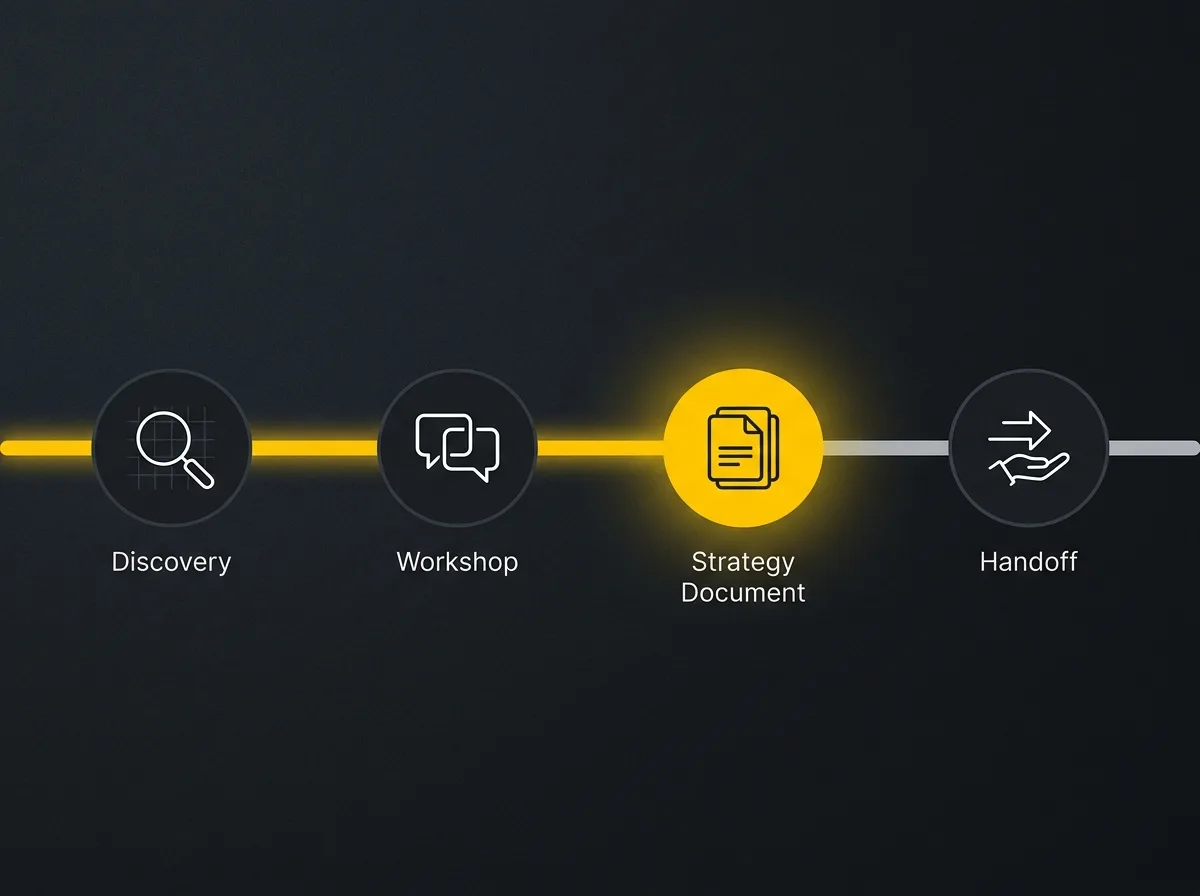
Every decent brand strategy engagement follows roughly the same shape, even if the language varies by provider.
Phase 1: discovery. Stakeholder interviews, sometimes a customer research component, a competitor audit, and a review of your current market positioning. The input-gathering stage.
A good consultant does not skip this even under time pressure.
The quality of what comes out of the strategy is directly proportional to the quality of what goes in here.
Phase 2: workshop or strategy session. Typically one or two facilitated sessions with founders or senior stakeholders. The goal is not to confirm what leadership already thinks. It is to surface what the business actually believes about itself, its audience, and its competitive position.
Sometimes those beliefs are well-founded. Sometimes they reveal assumptions that have been quietly holding the business back.
Phase 3: strategy document and messaging framework. The core deliverable. A good strategy document answers four questions clearly: what do we stand for, who are we for, how are we different, and how do we talk about it. It includes a positioning statement, a messaging hierarchy, and tone of voice guidance specific enough to be immediately usable.
That document becomes the brief for everything that follows.
Phase 4: handoff or rollout. How the strategy gets used. Depending on scope, this may include a brand identity phase covering the visual language, a web design application, or a content strategy briefed against the new positioning. This is where how brand design builds trust before any conversation happens becomes the visible output of all the strategic work above it.
Timeline from discovery to strategy document: typically four to twelve weeks, depending on the provider type and how many stakeholders need to be involved.
One thing to watch for: any provider who shows you design concepts before asking hard questions about your business objectives is prioritising their workflow over your outcome.
Good brand strategy work is uncomfortable in places.
The questions should not be easy.
What brand strategy consulting costs in the UK
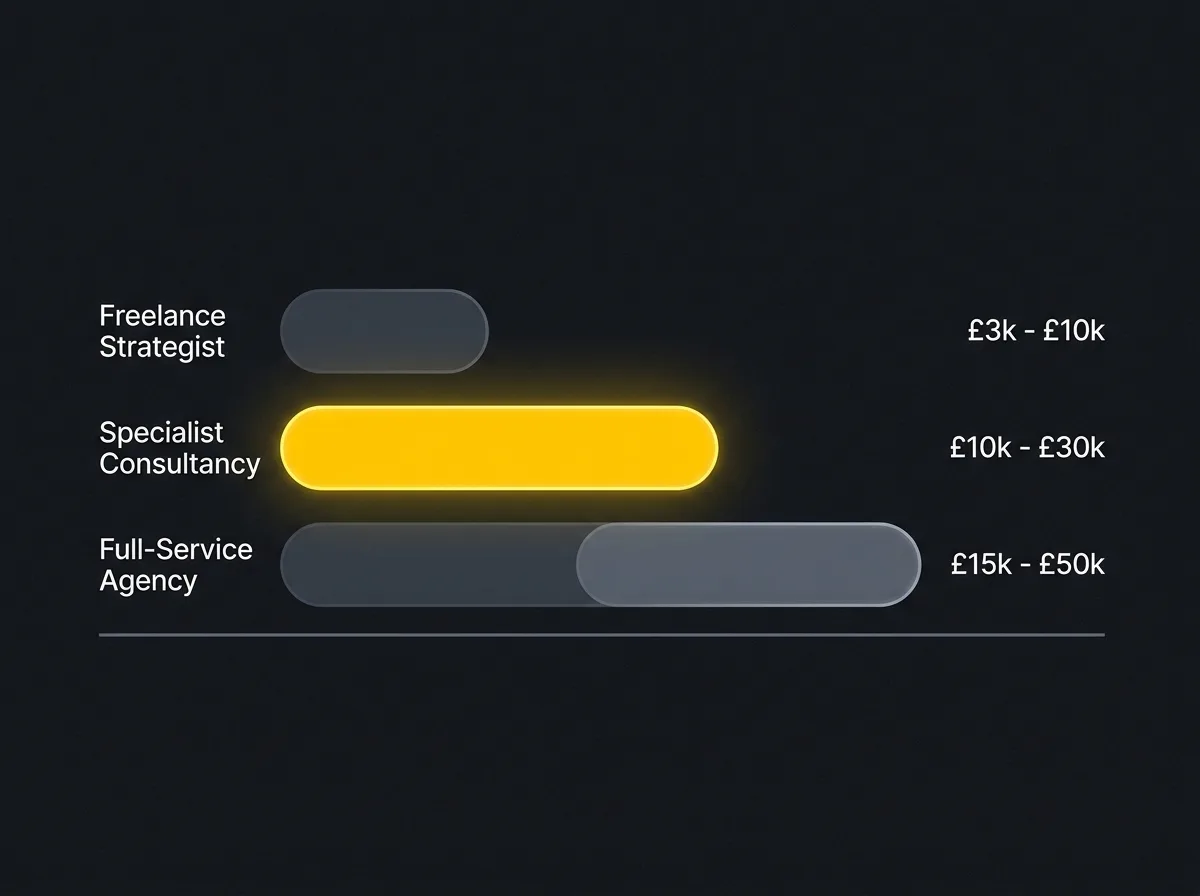
Pricing in this market is not particularly transparent, which is partly why businesses arrive at the conversation without a clear sense of what they should expect to pay.
Here are the ranges that reflect the UK market in 2026.
Freelance brand strategist: typically £3,000 to £10,000 project-based for a defined scope, usually covering positioning, a messaging framework, and tone of voice guidance. At the lower end, this is often a solo practitioner working across a handful of sessions. At the higher end, it reflects more structured research and a more thorough deliverable set.
Specialist brand consultancy: typically £10,000 to £30,000 for a full positioning and messaging engagement with stakeholder workshops and a comprehensive strategy document.
This range reflects teams with more research capacity, structured facilitation methodology, and outputs that carry through to brand guidelines. Twine's UK brand strategist rate data and work published by Elements Brand Management broadly support these figures as consistent with what serious UK practitioners are currently charging.
Full-service agency with brand strategy included: typically £15,000 to £50,000, depending on scope. This usually includes brand identity execution following the strategy phase, and often extends into web design and digital marketing setup.
What drives cost up: a larger stakeholder count, more complex competitive landscapes, multi-market scope, or a requirement for original consumer research. What drives cost down: a clear brief, a single market, a small decision-making team, and a leadership team that has already done some of the strategic thinking internally.
The return is downstream and measurable.
Improved conversion rates as the brand creates consistent first impressions. Stronger close rates as messaging better matches how the buyer thinks about their problem. More coherent marketing performance because every channel is speaking from the same foundation. The investment case for brand strategy work is almost always made in the downstream numbers, not the deliverable itself.
Is brand strategy consulting the right next step?

If your business has grown but your brand has not kept pace, if you are about to invest significantly in marketing, or if your team cannot consistently agree on what you stand for, these are the moments when brand strategy consulting earns its cost several times over.
Worth knowing.
If the signals are not there yet, a focused brand refresh or a positioning review might be the more proportionate starting point. Not every business is ready for full strategy work. Knowing which is which is itself useful clarity.
Before commissioning a brand strategy engagement, it is worth understanding what the search visibility opportunity looks like on the other side of it. Because the two conversations, what you stand for and how well you get found for it, are closely connected.
Free report: Traffic Projection Report
The Traffic Projection Report shows where your current search visibility stands and what becomes possible when your brand and your marketing channels are aligned to a clear message. A practical starting point before the bigger conversation.
Frequently asked questions about brand strategy consulting
How long does a brand strategy engagement take?
Most engagements run between four and twelve weeks from initial discovery to delivery of the strategy document. The main variable is the number of stakeholders involved and whether any customer or market research is included.
A focused engagement with a small leadership team can move quickly. A complex multi-brand or multi-market project takes longer.
Timeline clarity is worth discussing explicitly before you start. Scope creep in the discovery or workshop phase is one of the most common reasons projects run over budget and over schedule.
What is the difference between brand strategy and brand identity?
Brand strategy is the thinking. It defines what your business stands for, who it is for, and how it is different. Brand identity is the visual expression of that thinking: your logo, colour palette, typography, and the design language that carries the strategy into every touchpoint.
A strong brand identity built on unclear strategy tends to look polished but not land.
Strategy is what gives a brand identity something real to express. The two are closely related, but strategy always comes first.
Sequence matters.
Can a small business afford brand strategy consulting?
Yes, though the scope needs to match the budget. A freelance brand strategist working with a clear brief can deliver a solid positioning foundation and messaging framework for £3,000 to £7,000, which is a realistic investment for a smaller business with one or two decision-makers.
The mistake to avoid is either skipping strategy entirely because it feels expensive and building everything else on an unclear foundation, or over-specifying the scope when something leaner would do the job.
The right question is not whether you can afford it, but what you would do differently with this clarity in place.
What should I ask a brand strategy consultant before signing?
The most useful single question is: "How do you distinguish between what we think we stand for and what our market actually values?"
The answer tells you quickly whether this is someone who facilitates a workshop and writes up what they heard, or someone who brings genuine outside perspective and is willing to challenge your assumptions.
It is also worth asking to see one example deliverable from a previous project, a positioning statement or messaging document, anonymised, so you understand what you will actually receive.
And ask what happens if the first draft does not feel right. A clear revision process is a sign of professionalism, not uncertainty.