The report arrives the same day every month. A link, usually, or a PDF. It opens on a dashboard full of charts, a keyword rankings table, and a performance summary that reads mostly positive. Most of the numbers are up.
You scroll to the end. You reply with "thanks." And somewhere between opening and closing the tab, the question you actually want answered slips by unanswered.
Sound familiar? Most businesses receiving monthly SEO reports are getting professionally assembled summaries of data that are difficult to interpret and nearly impossible to act on. The report looks thorough. It may genuinely be thorough. But thorough and useful are not the same thing, and the metric that matters most, whether the investment is producing more qualified leads from search, often does not appear anywhere in it.
This guide is written for the business owner or marketing manager on the receiving end of those reports. We will cover which metrics belong in a good monthly report, which ones are mostly padding, what the best reports include that most still do not in 2026, and a practical framework for judging whether yours is doing its job.
Why most SEO reports are built to impress, not inform
The incentive structure is the root problem. An agency that is paid a monthly retainer for SEO services needs to demonstrate progress each month. When genuine progress is slow, as it often is during the first six to twelve months of a new programme, there is a pull toward metrics that look good rather than metrics that tell the truth.
This is not always deliberate. Many agencies have genuinely convinced themselves that the metrics they report are meaningful. The effect is the same either way: a polished document full of green indicators that tells you very little about whether the investment is working.
The most common vanity metrics in a reassurance report include total keywords ranking, raw impressions from Google Search Console, overall domain authority, and monthly page views without a traffic source breakdown. Each of these can rise steadily even when organic enquiries are flat or falling. Total keywords ranking increases as any page on your site gets indexed, not because you are ranking for commercially valuable terms. Domain authority is a metric from third-party tools, not a Google ranking signal, and it moves according to that tool's own algorithm, not your search performance. Impressions climb whenever Google shows your site in results, regardless of whether anyone clicks. Page views increase whenever any traffic source sends visitors, not just organic search.
None of these metrics are useless in isolation. The problem is using them as the headline story in a report about SEO performance.
The test your report should pass: read it end to end, then ask two questions. Are we getting more qualified leads from search this month? And why did the numbers move the way they did? If the report cannot answer both, it is not reporting on your SEO. It is reporting on data. Probably reassurance.
For businesses working with a transparent SEO agency, outcome-first reporting is the standard. The report answers those two questions first, then provides the supporting data. That ordering matters.
The metrics that actually matter in your monthly report
A good report does not need to contain everything. It needs to contain the right things, clearly enough that you can make a decision from them. These are the metrics that earn their place.
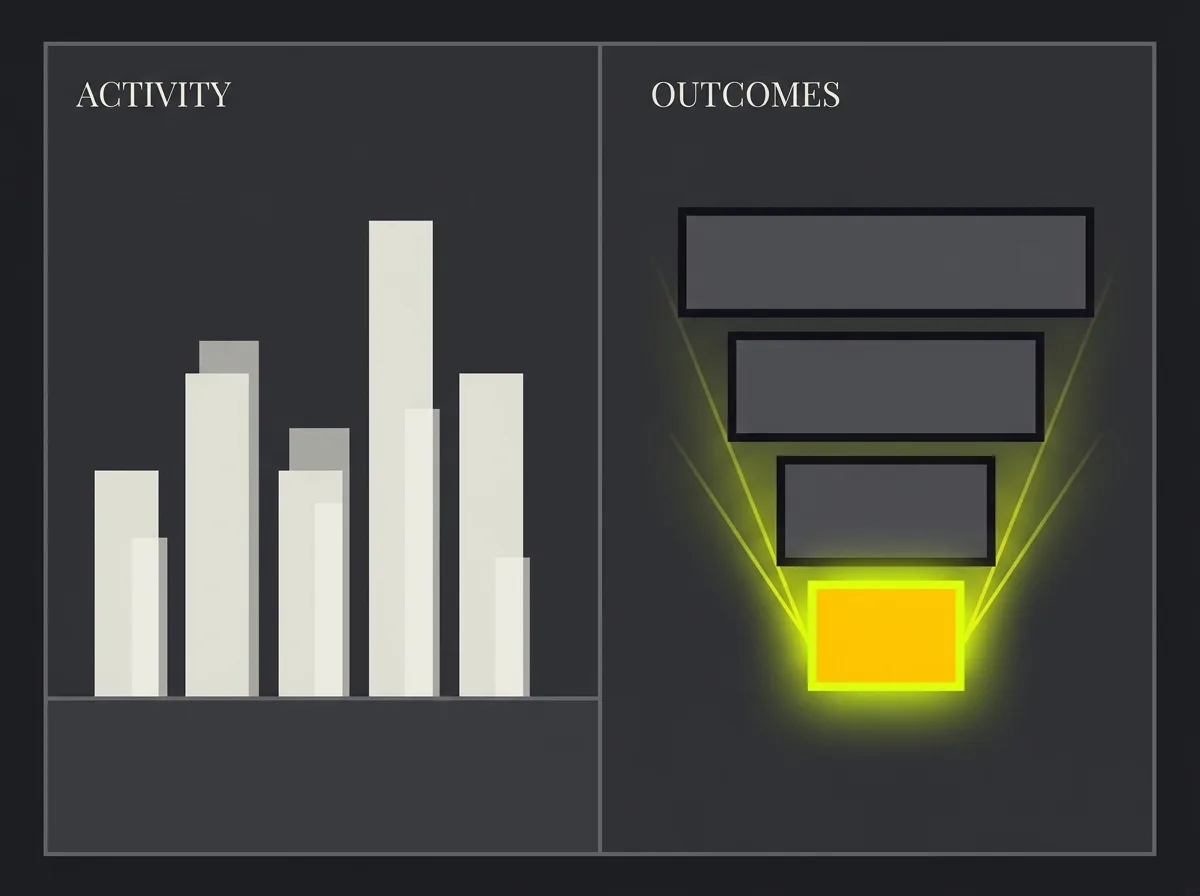
Organic conversions. This is the number that connects SEO to business outcomes. Not sessions, not visitors; the actual enquiries, form completions, phone calls, and live chat conversations that came specifically from organic search. A properly configured GA4 account surfaces organic as a traffic source breakdown for each conversion event. If your report only shows traffic data without conversion breakdowns by channel, that is the first gap to raise with your agency.
Non-branded organic traffic. A significant portion of most established sites' organic traffic comes from branded searches: people looking specifically for your company name or a close variation of it. They would have found you regardless of your SEO investment. Non-branded organic traffic strips those visits out and shows the visibility you are actively building among people who did not already know you. It is one of the clearest measures of genuine search progress, and it is the figure most likely to be buried or missing from a reassurance report.
There is a difference.
Keyword ranking movement for commercially relevant terms. Not the total count of keywords. Which commercially relevant terms moved upward this month? Which slipped, and by how much? Which are within striking distance of page one and trending in the right direction? A position-three ranking for a term your customers actually search is worth considerably more than fifty mid-page-two rankings for informational queries that nobody acts on. Ask your agency to show you movement on the terms that matter to your business, not a raw count of everything your site appears for.
Click-through rate trends. If your site is appearing in more search results but fewer people are clicking through, that is a signal, not a success. It usually means your page titles or meta descriptions are being outcompeted in the results. Improving them can drive meaningful traffic growth without any change in ranking position. A report that shows impressions without click-through rate context is telling half the story.
Top and bottom page movers. Which specific URLs gained organic clicks this month, and which lost them? This is the granularity that makes everything else actionable. A page dropping off without explanation might mean a ranking loss, a technical crawl issue, a page that has been accidentally de-indexed, or a shift in how Google interprets the query. Catching it in the monthly report rather than six months later is the difference between a recoverable situation and one that compounds.
A structured approach to tracking and acting on these metrics is what separates a genuine B2B SEO strategy from a collection of loosely connected activities. The data should drive the next month's priorities, not sit in an appendix.
The technical section: brief but worth checking
Technical SEO lives in the unglamorous part of the report, usually toward the back. It should not be skipped.
Crawl coverage. How many of your pages are indexed in Google versus how many you have submitted via your sitemap? A gradual, unexplained decline in indexed pages is a warning sign. Left unchecked, it tends to translate into ranking losses on the pages Google is visiting less frequently. Your report should flag this and note whether anything is being done about it.
Core Web Vitals. Google's suite of page experience metrics. The report should include a status summary and flag any URLs that are failing. One specific thing worth checking: INP replaced FID as Google's interaction metric in March 2024. INP, Interaction to Next Paint, measures how quickly a page responds to user input. FID, First Input Delay, was its predecessor and was retired. If your report references FID in the Core Web Vitals section, it is using a retired signal. A small detail, but a revealing one about how closely the agency is keeping up.
Backlinks. The most frequently misrepresented section of any SEO summary. Raw link count tells you almost nothing. What matters is the quality of the sites linking to you: topical relevance, genuine editorial authority, the kind of citation that Google weighs positively. The useful figure is net change in referring domains month-on-month, alongside some context on where new links came from and whether any low-quality links have been identified and disavowed.
"We built 12 links this month." Push back on it. Ask where.
The depth of insight available in this section depends partly on the marketing analytics tools your agency is using. Platforms like Ahrefs, Semrush, and Screaming Frog surface considerably more granular technical data than Google Search Console alone. If the technical section of your report is consistently thin, it is worth asking what data sits behind it.
The metric most reports are still missing: AI search visibility
Here is the honest picture of search in 2026: a growing share of commercial queries no longer end with a Google click. Someone asking ChatGPT "who are the best [service category] providers in [their area]?" and acting on that answer has completed a buying journey without ever loading a search results page. No click. No session recorded in your analytics.

Industry data citing Similarweb puts UK visits to ChatGPT at 252 million in August 2025, a 156% increase year-on-year. Perplexity, Microsoft Copilot, and Claude are handling a further share of the same intent-driven queries. The businesses mentioned in those answers are being recommended to buyers who have already decided to act. The businesses not mentioned are invisible in that part of the journey.
Most SEO reports in 2026 say nothing about this.
AI search traffic converts at a significantly higher rate than traditional search. The reason is that users arriving from an AI recommendation have been through a filtering layer already. They are not browsing options. They are verifying a decision they have largely already made. That changes the commercial significance of the traffic considerably.
The question worth putting to your agency at the next report review: "Are we tracking our visibility in AI search? Do we know whether we are being cited when someone asks about our service category on ChatGPT or Perplexity?"
Forward-thinking agencies are using tools like Otterly, Nightwatch's AI tracking module, and Profound to run scheduled queries across AI platforms and measure citation frequency and share of voice. The industry benchmarks are still forming, but the principle is familiar. The businesses building presence in AI search in 2026 are establishing a compound advantage that later entrants will find difficult to close.
Tracking AI search visibility as part of an SEO programme is increasingly table stakes for a complete, forward-looking monthly report. An agency that cannot answer your question about AI citation should at least have a clear view on when they plan to address it.
How to tell if your SEO reporting is genuinely good
This is where it gets practical. There are consistent patterns in weak reporting and consistent patterns in strong reporting. Knowing both makes the monthly review considerably more useful.

The red flags:
-
Every metric is green, every month, without any acknowledgement of what did not work. Real SEO has difficult months. Algorithm updates, seasonal patterns, competitor movements, and indexation changes all affect performance. A report that never shows a negative trend is not reflecting reality. It is managing your perception of it.
-
There is no explanation for why something changed. "Traffic went up 4%" is a number, not a report. A proper report tells you which page gained ranking, what caused it, whether an algorithm update is involved, and what the agency did or did not do that contributed. Numbers without context are decoration.
-
The report makes no mention of your actual business goals. If there is no data on enquiries, calls, or conversions from organic search, the report is measuring website activity rather than SEO performance. The distinction matters enormously.
-
Rankings are reported without showing movement. "We rank for 62 keywords" tells you nothing about whether those rankings are improving or declining, whether the terms are commercially relevant, or whether any of them are near a threshold that would actually deliver traffic. Rankings need trend data and commercial context to be useful.
-
There is no plan for next month. A report that ends with a summary of the period, with no explanation of what is being done next and why, has told you history. You need a plan.
The green flags:
-
Difficult months are reported honestly, with a cause identified and a response set out. This is the clearest signal that an agency is accountable to outcomes rather than to maintaining the relationship.
-
Branded and non-branded traffic are clearly separated and both explained. The report makes clear what is earned and what is being done to grow the earned side.
-
Organic conversion data appears near the top of the report. It is treated as the headline metric, not an afterthought buried in an appendix.
-
AI search visibility is tracked, or explicitly discussed with a clear position. The agency does not have to be tracking it formally yet, but they should be able to tell you where they stand on it.
-
Recommendations are specific, mapped to goals, and carry timescales. "We will publish and index two new service pages targeting [keyword], which we expect to begin ranking within eight to twelve weeks." That is something you can return to at the next review and hold the agency to.
The question that cuts through any report in a single exchange: "What changed this month and why?" If the answer does not go beyond restating the headline figure, you have learned something important about the quality of the reporting.
What good reporting makes possible
When the monthly report is honest and outcome-focused, the relationship between you and your SEO investment changes.

You can hold the agency accountable to results rather than activity. Publishing content, building links, and resolving technical issues are all things an agency can report regardless of whether they moved any meaningful metric. Outcomes are what you are paying for, and a good report makes that visible month by month.
You can also make budget decisions with genuine confidence. Which pages are driving enquiries? Which are not, and why? When the monthly report answers those questions, you can redirect effort toward what is working and pull back from what is not. Those are decisions that compound over time.
And practically, you stop having to read between the lines. A well-constructed monthly report takes fifteen minutes to understand and leaves you with a clear sense of what happened, why, and what is happening next.
That is the standard.
If you are not sure what realistic SEO performance looks like as a baseline for your site, the Traffic Projection Report is a useful starting point.
Free resource: Traffic Projection Report
It shows what organic traffic could realistically look like for your site, based on real search data for your target keywords and competitor landscape. Knowing what you are building toward is where clear reporting begins.
Frequently asked questions about SEO reporting
What should be in a monthly SEO report?
A good monthly SEO report should cover organic conversions (not just sessions), non-branded organic traffic growth, keyword ranking movement for commercially relevant terms, click-through rate trends from Google Search Console, and a view of which pages gained and lost organic traffic that month. It should also include a technical health summary covering crawl coverage and Core Web Vitals, a backlinks section with quality context rather than raw link counts, and a forward-looking plan for the month ahead. In 2026, AI search visibility should be either tracked directly or explicitly addressed as a standing agenda item.
How do I know if my SEO agency is reporting correctly?
After your next report, ask: "What changed this month and why?" A transparent agency will give you a specific answer that connects search activity to a business outcome. Strong signals include organic conversion data treated as the lead metric, honest reporting of difficult months with a cause and a response, and a recommendations section with specific actions and timescales you can follow up on. If the monthly review consistently leaves you uncertain whether the investment is working, the reporting is not serving you.
What SEO metrics actually matter?
The metrics that matter are the ones connected to business outcomes: organic conversions from search, non-branded organic traffic growth, and ranking movement for commercially relevant terms. Metrics that often inflate the picture without reflecting real progress include total keywords ranking without commercial context, domain authority (a third-party tool metric, not a Google ranking signal), raw impressions without click-through rate data, and total page views without a source breakdown.
Does AI search affect my SEO reporting?
Yes, and most reports do not yet account for it. AI tools including ChatGPT, Perplexity, and Microsoft Copilot are intercepting a growing share of commercial search journeys before any Google click occurs. A forward-looking monthly SEO report should either track AI citation data or include a clear discussion of how the agency plans to address it. The businesses that begin tracking and building AI search visibility now are building a position their competitors will find increasingly difficult to recover.