
You published 15 blog posts last year. Traffic went up for a month after each one and then dropped back. Your content isn't accumulating into anything.
Sound familiar?
That pattern has a name. It is not bad luck and it is not slow results. It is what happens when content is published without a system underneath it. Each article starts from zero because there is nothing holding it up, no surrounding structure, no cluster of related pages reinforcing its authority.
An SEO content strategy is the plan that decides which topics to target, in which order, how they connect, and how you measure whether they are working. Without it, content is just publishing.
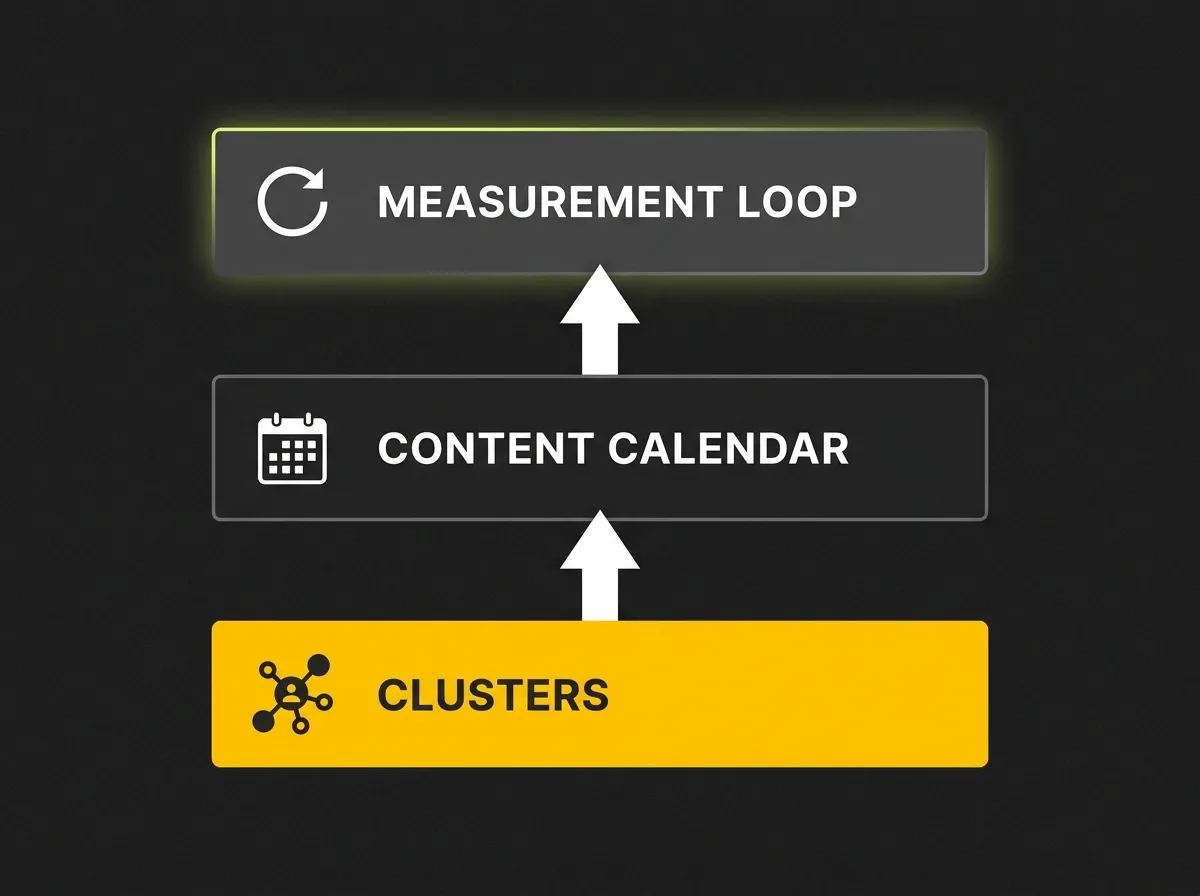
What this guide covers is a compound system with three layers: keyword clusters (what to write), a sequenced content calendar (in what order to publish), and a measurement loop (what to do with the data). Remove any one of those layers and the compound effect breaks.
Build all three and the pages you publish in month one are still earning you rankings in month eighteen.
What "compounding" actually means for SEO content
Think about compound interest for a moment. Money saved in a box earns nothing. Money invested earns returns, and those returns earn returns of their own. Over time, the difference is not just bigger, it is structurally different. One is linear. The other multiplies itself.
It compounds.
Content works the same way. A page ranking for a specific term builds topical authority in that subject area. A second related page inherits some of that authority through internal links and thematic relevance. A third reinforces the first two. By the time you have a full cluster of pages built around a topic, each new piece lifts the others, not just itself.
The opposite is scattered content. Unrelated topics, no internal links, no recurring theme that Google can associate with your domain. Every post starts at zero.
The result is the pattern you probably already recognise: traffic spikes, drops, spikes, drops, without ever climbing.
Google's approach to ranking in 2026 rewards depth, not volume. Topical authority, sometimes called entity SEO, means demonstrating genuine coverage of a subject through a network of related, well-connected pages. Google's core update guidance has consistently moved in this direction, making clear that in-depth coverage of a topic outperforms scattered keyword targeting.
A domain that thoroughly owns a subject beats a domain that dabbles across twenty of them.
For businesses building search visibility over the long term, this is actually useful news. Once a cluster of ten or twelve well-targeted pages is built, the compound effect protects you. New entrants need to build similar depth before they can compete. Scattered publishers never catch up.
Start with keyword clusters, not keyword lists
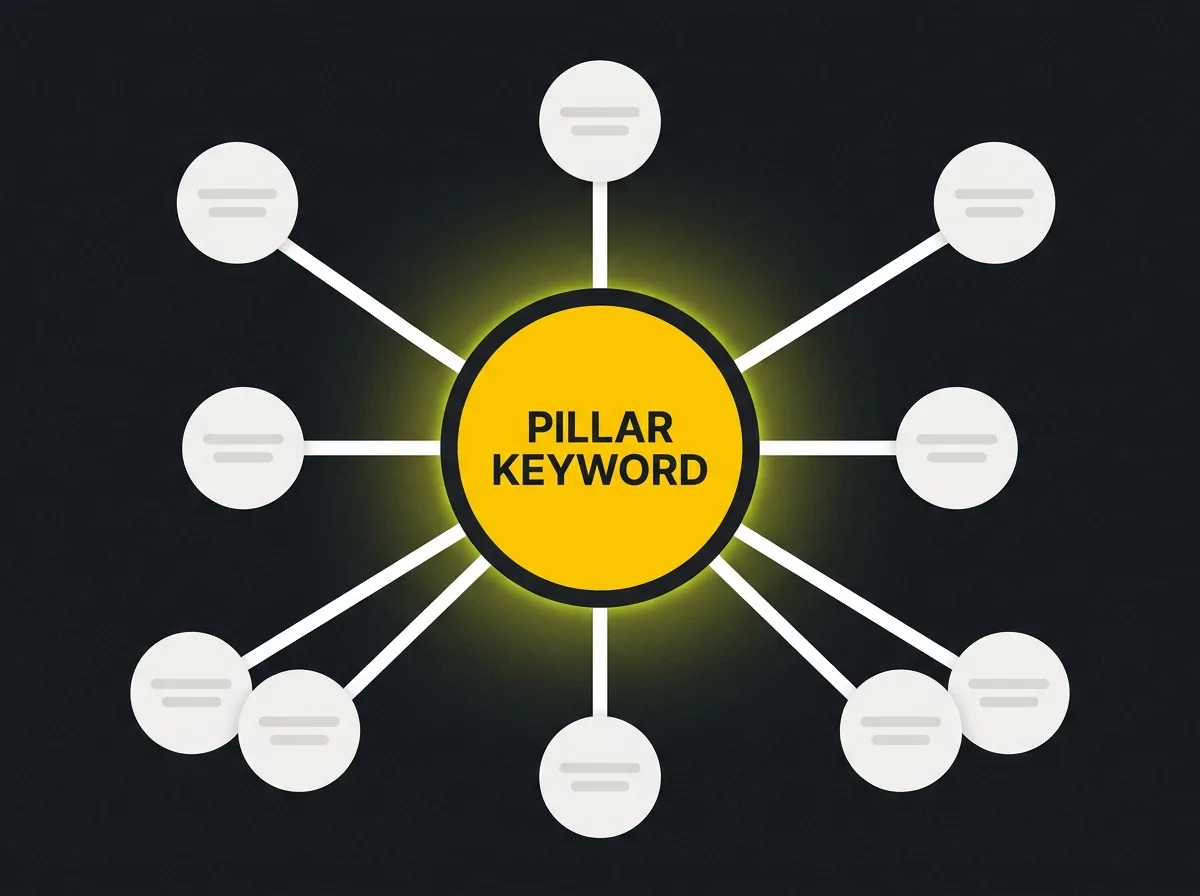
A keyword list gives you targets. A keyword cluster gives you a system.
The difference sounds subtle. It is not. A keyword list says: here are 30 search terms we should try to rank for. A keyword cluster says: here is a seed topic, here are the eight supporting questions that surround it, here is the search intent of each one, and here is the sequencing logic for publishing them.
A cluster starts with a seed keyword, the primary topic you are building authority for. Around it sit supporting keywords that share topical relevance and belong on the same conceptual branch. These are not just similar phrases. They are the questions, comparisons, and definitions that a searcher naturally moves through as they research the main topic.
Here is a practical example.
If you are a law firm targeting solicitor-related searches, your seed keyword might be "SEO for solicitors." The cluster around it would include terms like "local SEO for law firms," "legal website design," "how to rank on Google as a solicitor," and "Google Business Profile for law firms." Each one targets a distinct search query. But they all reinforce the central topic, and a reader completing one page finds the next relevant page waiting. Google sees a domain that genuinely knows its subject.
Search intent within a cluster matters as much as the keywords themselves. The pillar page, built around the seed keyword, is usually an informational guide answering the broad question. Supporting cluster pages dig into specific aspects: how-to posts, comparison posts, definitional posts. Each targets a different intent within the same topic.
Together they cover the subject completely, which is exactly what Google rewards in 2026.
This is how content pillars work in practice. Not a single definitive article, but a network of connected pages that together dominate a topic area. The cluster map is the foundation.
Build the map before you build the calendar.
The practical starting point. Write down the three or four subjects your ideal clients care most about. For each one, list every question they ask, every comparison they make, every term they might search for on that topic. Group those questions under their seed keyword. That is your cluster map. It takes an afternoon. Most businesses skip it entirely and wonder why their content never compounds.
Free resource: Traffic Projection Report
If you want to see what a structured content programme could realistically deliver for your specific domain, the Traffic Projection Report gives you a model based on your site, your target keywords, and realistic growth assumptions. Worth looking at before you finalise your cluster map.
Build the content calendar around clusters
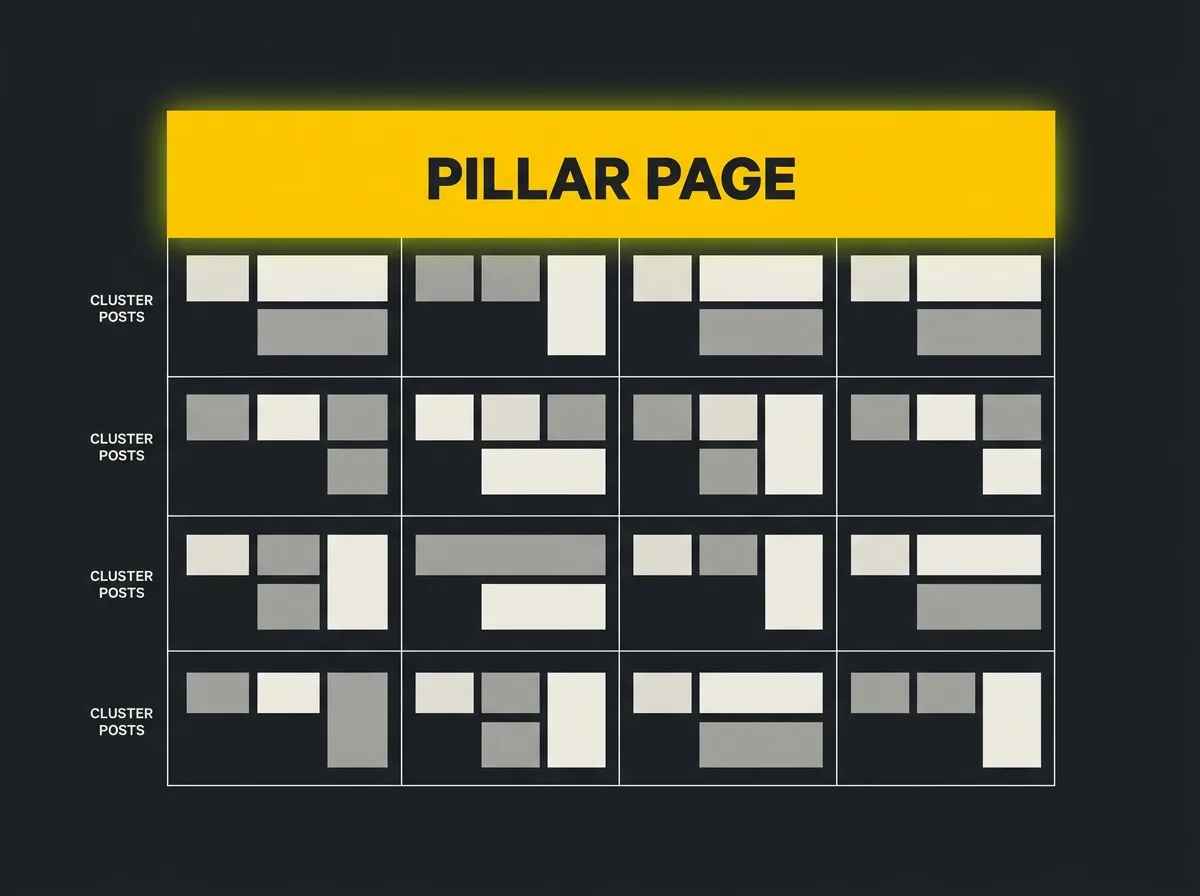
The calendar is the sequencing layer, not the planning layer. That distinction matters more than it might sound.
Most content calendars are built around ideas: what seems interesting this month, what is topical, what someone suggested in a meeting. A cluster-based calendar is built around a deliberate sequence. The cluster map has already decided what to write. The calendar decides when.
Sequencing logic. The pillar page comes first. It needs to exist before cluster posts can link back to it. Publishing supporting posts before the pillar creates orphan content with no centre to point toward. Publish the pillar, then release cluster posts over the following weeks and months, each linking back to the pillar and to one or two related cluster posts.
Cadence guidance. For most B2B businesses with limited in-house resources, one solid piece per week or one per fortnight outperforms three thin pieces per week. Depth matters more than frequency. A 2,500-word guide that earns links and holds readers for five minutes signals genuine expertise. A cluster of eight such guides signals authority.
Publish less, publish better.
Content refresh scheduling. Most content calendars never account for this. Every post that reaches six months should be assessed: is it getting impressions? Is it getting clicks? A post with growing impressions but poor click-through rates does not need a companion post; it needs a better title and meta description. Refreshing a ranking post is often faster return on investment than publishing something new.
Handling off-plan opportunities. Trending topics and unexpected questions have a place, but they should not derail the cluster programme. A practical rule: if an off-plan piece does not fit into any existing or planned cluster, decide whether it is worth starting a new cluster before you write it. A one-off post on a standalone topic contributes nothing to the compound effect.
It is just more content saved in the box.
The calendar should also mark internal linking milestones. When a cluster has enough published pages to properly cross-link, that is worth tracking explicitly. Internal linking is not a housekeeping task. It is the compound mechanism itself.
On-page fundamentals that sustain the compound effect
A cluster map and a sequenced calendar are the strategy. The on-page elements are what make the strategy actually work at the page level.
Worth knowing.
Internal linking. Every new cluster post should link back to the pillar page and to one or two related cluster posts. This is how authority distributes across the network. A strong pillar page builds domain authority for its topic; internal links share that authority with newer, weaker pages in the cluster. Without internal links, the cluster exists conceptually but not structurally.
Google cannot follow what it cannot crawl.
Specificity is the proof here. Adding three targeted internal links to an existing post often moves rankings without any other change required.
Title and heading discipline. One primary keyword per page. Sentence-case headings that describe what the section actually covers. The target keyword belongs in the H1 and in at least one H2. Keyword-stuffing across every heading is an old tactic that signals low quality. Write headings for readers, not search engines.
E-E-A-T signals. Experience, Expertise, Authoritativeness, and Trustworthiness. These matter more now that AI-generated content fills the results at volume. Named authors, first-person examples, real data, specific situations. An article that says "one professional services firm we worked with found that…" demonstrates genuine experience in a way a generic guide cannot.
AI search readiness. AI tools like ChatGPT, Perplexity, and Claude handle a substantial share of informational queries. According to Typeface's 2026 Content Marketing report, AI Overviews appear in roughly 88% of informational searches. That means content strategy now has to account for two discovery paths: traditional organic search and AI citation.
The good news is that the same content quality that ranks in Google is also what AI tools tend to cite.
Three structural additions help: a clear definition block near the top of each article, a FAQ section near the bottom addressing derivative questions, and named claims with clear attribution. These are also the core principles behind answer engine optimisation. Building AI-readiness into your content strategy from the start is not a separate project. It is the same project, done properly.
For a detailed look at how AI search traffic behaves differently once it arrives on your site, why AI search traffic converts at higher rates covers the conversion mechanics.
How to measure whether your strategy is compounding

Most teams track keyword rankings individually. That is the wrong unit of measurement for a compound strategy.
Checking whether "SEO for solicitors" moved from position 12 to position 9 this month tells you about one post in isolation. You cannot see the compound effect from that view. The compound effect is only visible when you look at the cluster as a whole.
Here is how.
The rising tide test. In Google Search Console, filter your performance report by a topic area using the search query filter or by URL path if your content is organised under topic-specific folders. Look at impressions over the past six months, segmented by individual pages within the cluster. If the cluster is compounding, you will see impressions rising across multiple pages simultaneously. Three or four pages gaining impressions together over a 90-day window is the compound signal. One post gaining impressions while others stay flat is not compounding; it is a standalone performance.
CTR as a correction signal. High impressions but low click-through rates mean the title and meta description are not matching what the searcher expected. If a post is ranking in position 6 to 12 but getting a click-through rate under 1%, a single title rewrite can unlock meaningful traffic from a page that is already doing the heavy SEO work. Check the queries report in Search Console to see what people are actually searching when they see that page.
The title might not be matching their intent at all.
GA4 for lead conversion. Rankings and impressions tell you whether content is being found. GA4 tells you whether it is doing anything useful once it is found. Map your organic landing pages to goal completions: enquiry form submissions, phone click events, lead magnet downloads. A post ranking in position 6 that converts visitors at 3% is worth more to your business than a post ranking at position 2 that converts at 0.2%.
This conversion layer is what separates a content strategy from a content programme.
For more on how content fits into the B2B SEO strategy picture, that post goes into the lead conversion angle in more detail.
The three-signal decision. If impressions are growing consistently and clicks are following, extend the cluster; the topic is building authority and there are more related keywords to claim. If impressions are there but clicks are not, refresh the underperforming posts by improving titles, meta descriptions, and opening paragraphs. If a post has had no impressions after six months, it has either the wrong intent targeting or the wrong keyword difficulty for your current domain; redirect it to a related stronger page or consolidate the content.
What to do when the compounding stalls
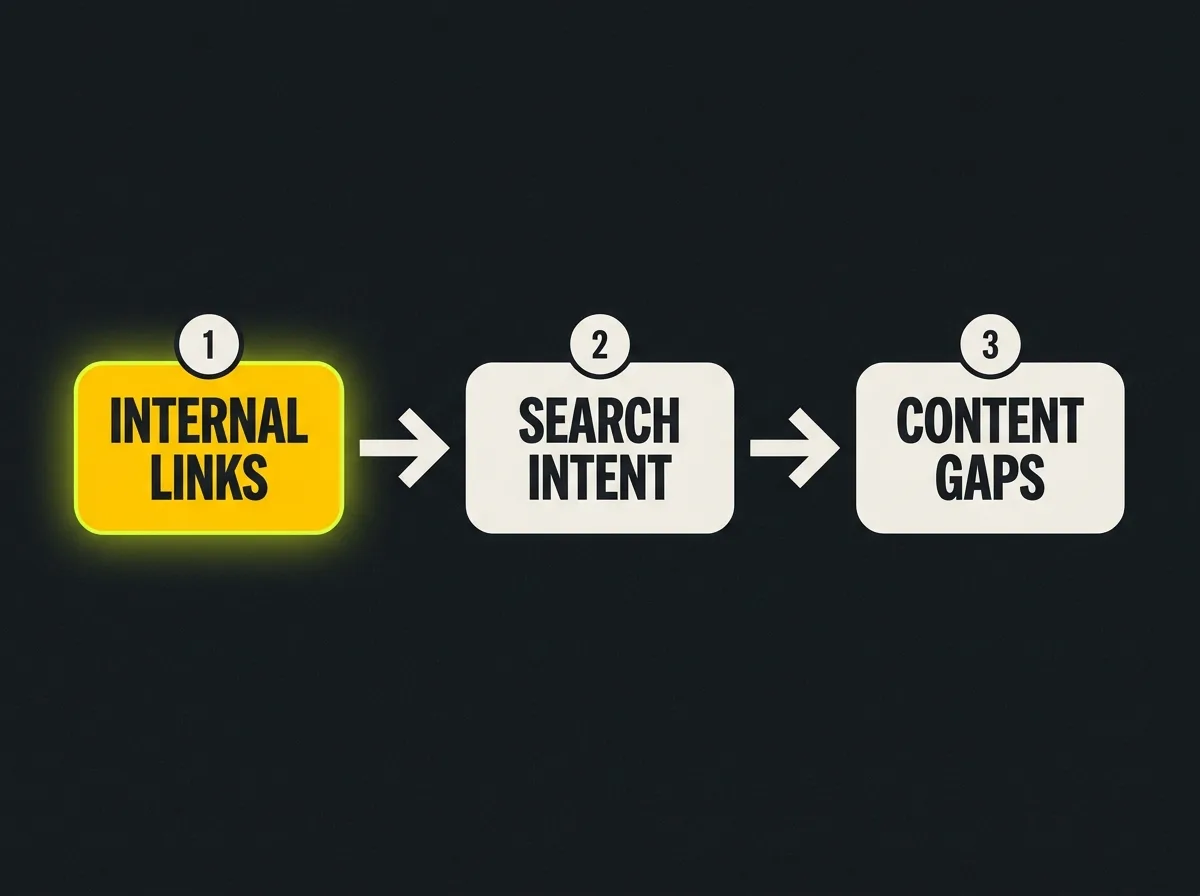
Compounding does not always start cleanly. There are three common reasons it stalls, and knowing the diagnostic sequence saves a lot of wasted effort.
Thin clusters. One pillar page and no supporting posts. The pillar gets published, the team moves on to the next topic, and the cluster never reaches the depth that generates topical authority. A single post cannot compound with itself. The minimum viable cluster is usually five to seven pages before the topical authority signal becomes visible in your Search Console data.
Missing internal links. Posts exist but do not point to each other. This is the most common failure mode and the cheapest to fix. Open any published cluster post and count how many internal links it has to other pages in the same cluster. If the answer is zero or one, the authority distribution is broken.
Add the links. Rankings often shift within weeks, with no other change required.
Wrong intent targeting. An informational keyword targeted with a page that reads like a sales brochure, or a commercial comparison keyword targeted with a 3,000-word educational guide when the searcher wants a short, scannable answer. Google matches content to intent, not just to keywords. If your page's format does not match what the searcher expects to find, it will not rank regardless of how many times the keyword appears.
Secondary culprits include keyword cannibalisation (two posts in the same cluster targeting the same term, splitting authority rather than stacking it) and no AI readiness in the content structure (missing definition blocks, no FAQ section, no clearly attributed claims for AI tools to cite).
The diagnostic sequence: internal links first (five minutes, highest return), then intent alignment for underperforming posts, then cluster depth. Only after those checks should you consider creating new content.
A content strategy is not a document you file away after the calendar is built. It is an ongoing programme. The cluster map gets extended. The measurement loop feeds decisions back into what gets published. The calendar gets revised as topics build momentum.
That maintenance mindset is the difference between a strategy that compounds and one that flattens out quietly after six months.
Frequently asked questions about SEO content strategy
These come up in almost every strategy conversation.
What is an SEO content strategy?
An SEO content strategy is the plan that determines which topics to target, in which order to publish content, how individual pages connect to each other through internal links, and how you measure whether the programme is working. It is distinct from a content calendar (which covers scheduling) and a keyword list (which covers targets). A strategy ties all three elements together into a compound system where each piece of content strengthens what came before it.
What is keyword clustering in SEO?
Keyword clustering is the process of grouping related keywords around a central seed topic, rather than treating each keyword as an independent target. The seed keyword becomes a pillar page; supporting keywords become cluster posts that link back to the pillar. Because all the pages in a cluster cover the same broad topic, they reinforce each other's authority in Google's eyes, producing the compound effect that isolated posts cannot achieve on their own.
How do you build a content calendar for SEO?
Start with the cluster map, not the calendar. Once you know which clusters you are building and which supporting posts belong in each cluster, the calendar becomes a sequencing tool: pillar page first, then supporting posts in the weeks and months that follow. Each cluster should reach five to seven pages before you shift fully to the next cluster. Build in a six-month review window for every published post so that refresh decisions are scheduled rather than reactive.
How do you measure whether SEO content is compounding?
Look at impressions across the whole cluster in Google Search Console, not just individual post rankings. If impressions are rising across multiple pages in the same topic area simultaneously over a 90-day window, the cluster is compounding. If only one page is gaining impressions while others stay flat, you have a standalone performer, not a compound system. In GA4, map organic landing pages to goal completions to see which content is actually producing enquiries, not just traffic.
How often should a small B2B business publish to build topical authority?
One well-researched piece per week or one per fortnight is the right cadence for most small B2B businesses. Publishing three thin articles a week produces volume without depth, and depth is what topical authority requires. A 2,500-word guide that earns links and holds readers for several minutes signals genuine expertise. A cluster of eight such guides signals authority. Frequency matters far less than quality and consistency within a planned cluster.
Build the system, not just the calendar
A compounding content strategy has three layers: clusters to determine what to write, a sequenced calendar to determine the order, and a measurement loop to tell you what to do with what you learn. Each layer depends on the others.
Here is why that matters.
A cluster without a calendar is a map with no journey. A calendar without measurement is publishing on hope. Measurement without clusters gives you data with nowhere useful to apply it.
Most businesses have the calendar. They are missing the cluster map and the measurement loop. That is why the traffic spikes and drops, spikes and drops, without ever accumulating into anything durable.
If you want to see what a properly structured programme could realistically deliver for your site, in terms of traffic, rankings, and leads, the Traffic Projection Report gives you a model built around your domain, your target keywords, and realistic growth assumptions. It is the clearest way to understand what compounding looks like in your specific context before you commit to building it.
And if the programme itself is something you would rather hand to an SEO agency than build in-house, we can walk you through exactly how we approach this for clients.