
You have been posting on Instagram four times a week for six months. Likes are up. Your client list hasn't moved.
That's not a social media problem. It's a channel mix problem, and it's the thing most marketing advice for personal trainers quietly skips over.
The short version: Effective marketing for personal trainers separates channels that build an asset over time from channels that only work while you feed them. Referrals, Google Business Profile, local SEO, and content marketing compound: each week of effort adds to a base that keeps producing enquiries. Organic social and paid ads are stop-start: reach exists while you're active, then disappears. For a sole trader with limited time and a tight margin, that distinction changes everything. Build the compounding channels first. Use stop-start channels to amplify. Your client pipeline becomes something that grows rather than something you maintain.
Most marketing guides for PTs treat all channels as roughly equal. Post more. Get a website. Collect reviews. The implicit message is that doing more of everything will eventually pay off. It doesn't, especially not for a sole trader running back-to-back sessions who has, at most, a few hours a week to spend on marketing.
This guide covers the full landscape honestly, including organic social (the channel you're probably already spending the most time on), then maps out which channels to prioritise and in what order. For a broader view of how this fits into fitness marketing as a whole, that link is worth a read too.
The two types of marketing channel (and why the distinction matters)
Every marketing channel a personal trainer uses falls into one of two categories. Getting clear on which is which changes the whole picture.
Compounding channels build an asset. Each unit of effort adds to a base that keeps producing, even when you step away. A blog post that ranks in Google keeps bringing visitors twelve months from now. A Google Business Profile with 60 genuine reviews consistently outranks one with six, because quantity and recency both influence where you appear in local search results. A referral system doesn't reset every month; the relationships you build keep delivering. These channels take longer to get started. But they don't stop working when you do.
Stop-start channels require constant input to produce output. Organic social posts reach people while you're posting and fade within hours once you stop. Boosted posts and paid ads work while the budget runs. Events produce while they're happening. None of this is worthless, but it's a different kind of investment and a fundamentally different relationship with your time.
Paid ads can work for some PTs in some contexts. This guide is built around the without-paid-ads question because most PTs asking it have a good reason, usually a disappointing early experience. That's a legitimate position. Build the compounding channels first and you'll have a far stronger foundation if you ever revisit ads later.
For a sole trader, the distinction matters because you cannot afford to rebuild your marketing base every month. Spending the majority of your limited marketing time on a channel that stops the moment you're too busy to post is not a sustainable strategy. Compounding channels are the foundation. Stop-start channels are the amplifier you add once the foundation is solid.
Referrals — your biggest channel, mostly left to chance
Think back to your last ten clients. How many came from Instagram? How many came because someone who already knew you, or knew your work, pointed them your way?
Almost every PT who does this exercise gets the same answer. Word of mouth is already doing most of the heavy lifting. The problem isn't that referrals don't work. It's that they happen passively, without a system, which makes them unpredictable and leaves revenue on the table every month.

The difference between passive and systematic referrals is significant. Passive is when a happy client mentions you unprompted. Systematic is when you've built a deliberate process: the right moment to ask, a clear and non-awkward way to frame it, and a simple mechanic for the person referring.
The right moment is just after a visible result. After a client hits a milestone they've been chasing for months. After a session where they surprised themselves. After they've told you something is going better than they expected. Not randomly. Not in a group text to your whole client list.
The ask itself doesn't need to be formal or transactional. "If you know anyone who's trying to get where you were three months ago, I'd love to help them. Just send them my way." That's usually enough. You're giving a happy client an easy way to do something genuinely useful for someone they care about.
You can add a mechanic: a free session for the referring client, a small discount for both parties, a thank-you gift. The mechanic matters less than the timing and the ease. PTs sometimes resist formalising referrals because it feels like a pyramid scheme. It isn't. It's removing the friction that stops happy clients from doing something they already want to do.
Research consistently shows that referred clients have higher retention rates, lower price sensitivity, and higher lifetime value than clients acquired through cold channels. They arrive with a warm endorsement rather than a cold search result, which changes the quality of that first conversation immediately. A systematic referral process can be implemented this week, at zero cost. No other channel in this guide offers that combination.
Google Business Profile — the free local visibility tool most PTs underuse
When someone searches "personal trainer Manchester" or "PT near me," the first results to appear are the map pack: three local businesses listed beneath a map. Google Business Profile (GBP) is what controls whether you appear there, and in what position. The UK health and fitness sector tracked by industry body ukactive is a crowded one. In most UK cities, there are dozens of qualified PTs within a few miles of any postcode. The map pack is where that competition plays out.

Most PTs either have no GBP set up, or have one that's incomplete and hasn't been touched since they created it two years ago. That's a significant missed opportunity. GBP is free. It is also the most direct route to appearing in front of someone who is actively searching for exactly what you offer, in your area, right now.
A fully optimised GBP includes: a complete business description naming your specialism and service area, the correct primary category (Personal Trainer), professional photos of you in your training environment, active posts at least once a fortnight, and a consistent mechanism for requesting reviews from clients after every session milestone.
Reviews are the single most lever-able element. Both quantity and recency influence map pack ranking. According to BrightLocal's UK consumer research, the vast majority of UK consumers trust online reviews as much as a personal recommendation from someone they know. That figure has remained consistently high across multiple years of their annual survey. For a PT, a strong review profile is a credibility signal working around the clock without any ongoing effort from you.
One new review per week is a realistic target for an active PT. Ask after every milestone. Make it easy: a direct link to your GBP review page sent via WhatsApp takes ten seconds to share and removes every excuse not to click.
The setup is 30 to 45 minutes. The ongoing maintenance is 10 to 15 minutes a week. The cost is zero. If you want professional support with the broader local search picture, our local SEO for service businesses covers the whole landscape, from GBP to citation building to location-based keyword targeting.
A website that actually earns its keep
Most PT websites are digital business cards. They exist, they describe what you do, and they look fine on a desktop. But they're passive. A visitor arrives, reads a few lines, and leaves without making contact. The site didn't give them a compelling enough reason to take the next step, or the next step wasn't obvious enough to take.
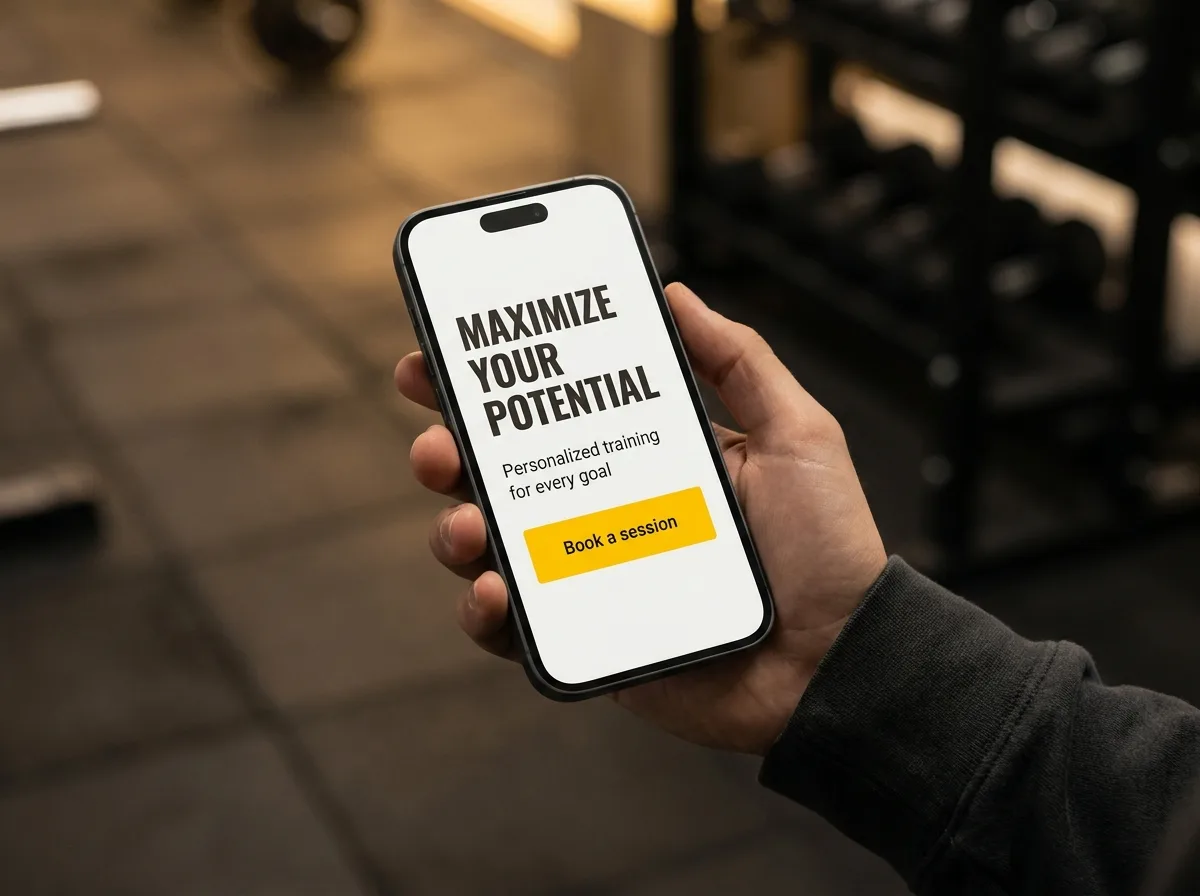
A website that converts visitors into enquiries does a few things differently. Above the fold: a clear statement of who you work with and what outcome you deliver. Not "I help people get fit" but something specific to your niche. "I help busy professionals in Birmingham lose body fat and build functional strength without giving up their weekends." A visitor who matches that description should feel immediately like they've found the right person.
Social proof needs to be visible early, not buried near the footer. Testimonials with real names, photos if possible, and specific outcomes. "I lost 11kg in four months and kept it off" is more persuasive than "great trainer, highly recommend." The first is evidence. The second is a courtesy.
The next step has to be obvious and low-friction. A booking widget, a WhatsApp link, a Calendly button. Something a visitor can click without filling in a five-field contact form and waiting three days for a reply. The harder you make it to get in touch, the fewer enquiries you get.
Location should appear naturally throughout the page. Your town or city in the page title, in the main heading, in the body copy. This matters for both Google and for the visitor. Someone searching "personal trainer in Leeds" needs confirmation within the first five seconds that you're in Leeds.
Content marketing and SEO — the slow channel that compounds longest
Blog content and search engine optimisation is the longest-runway channel in this guide. A new post typically takes three to six months before it starts generating consistent organic traffic. That timeline puts most PTs off. It shouldn't.

Once a post ranks, it keeps producing without ongoing spend. A post that genuinely answers "how much does personal training cost in Glasgow?" will attract that search every month, indefinitely, from people who are at a decision-making stage. That is a fundamentally different kind of lead than a follower who liked an Instagram post.
The searches that convert well for PTs: location-based queries ("personal trainer Sheffield"), question-based queries ("how many PT sessions do I need to see results"), and transformation-based queries ("how to build muscle over 40"). Each represents a prospective client at a different point in their decision. Content that answers those questions thoroughly and from real experience is what Google rewards.
The practical commitment: one well-researched, genuinely useful post per month is more effective than ten thin posts per week. Write from experience. A post about what actually changes in a client's body and mindset after twelve weeks of consistent training, written from real sessions with real clients, will outrank a generic "benefits of personal training" listicle every time.
Before you start, it's worth mapping out the content pillars for a service business that will anchor your content. Three or four themes connecting all your posts around your specialism. That structure means your posts build authority together rather than sitting in isolation.
If you want support with keyword research, content planning, and the technical side that most PT blogs never touch, our content SEO support covers all of it.
Organic social — important for trust, not reliable for cold bookings
This section deserves honesty. Instagram and TikTok are not zero-value for personal trainers. A consistent social presence builds familiarity. It shows personality. It demonstrates expertise over time. It means that when someone hears your name from a referral or finds you on Google, they can check you out immediately and decide whether you're someone they'd want to train with. In that role, social media genuinely matters.
The honest limitation is equally real. Organic reach on Instagram and TikTok has declined significantly over the past several years. Posting four or five times a week doesn't reliably produce cold bookings. The conversion path from follower to paying client is long, unpredictable, and for most PTs, the time invested doesn't stack up against the return.
What social media is genuinely good at is warming up leads who found you through a different channel first. They heard your name from a friend, or found your site on Google, or saw your GBP listing. They come to Instagram to check whether you look like someone worth trusting. That check is important. But it's not the same as social media being a lead generation engine.
The posts that move the needle are different from the posts that get likes. Client results with context: not just a before-and-after photo, but the story of what changed and what the real obstacle was. Process content: clips that show your approach, your programming rationale, what a session actually looks like. And your honest, specific take on the questions your clients ask you most. That last type is underrated. A PT who posts a clear, nuanced answer to "is cardio or weights better for fat loss?" is demonstrating expertise in a way that a transformation photo cannot.
The healthiest relationship with social is one platform, posted consistently but not obsessively. Two or three times a week is sustainable and effective. More than that is usually a sign the channel is filling the time that should go to compounding channels.
Partnerships and local networks — high conversion, often overlooked
Referrals from complementary professionals convert at a higher rate than almost any other source. A physiotherapist who recommends you to a patient who needs to rebuild strength has done more qualifying work in thirty seconds than a week of Instagram posts.
The best partnership targets for PTs: physiotherapists and sports injury clinics, who regularly see clients ready to progress from rehabilitation to structured training. Nutritionists and dietitians, who see people actively changing their body composition. GP surgeries and community health teams, particularly for weight management referrals and post-cardiac patients. Corporate HR and wellbeing leads, if you have daytime slots to fill.
The mechanics here are relationship-building, not a sales campaign. A short introductory email, a coffee, a mutual referral understanding. Three to five strong professional referral partners will consistently outperform a broad networking approach.
For PTs with daytime availability, corporate wellness deserves specific attention. Many medium-sized UK employers now hold wellbeing budgets and are willing to fund employee PT sessions. The pitch is slightly different: outcomes framed around productivity and reduced absence rather than individual fitness goals. But the contracts tend to be recurring and the conversion rate is high.
AI search and PT visibility — what is already changing
Tools like Google's AI Overviews, ChatGPT, Claude, and Perplexity are increasingly used to answer questions like "how do I find a personal trainer near me?" The PTs who appear in those AI-generated answers tend to share a profile: a well-maintained review record, a website with structured content that names their specialism and location clearly, and a track record of genuine online expertise.
The mechanism isn't mysterious. AI tools pull from the same sources that influence traditional Google rankings. Strong GBP reviews, quality website content, named expertise, local citations. A PT who has invested in local SEO is building AI search visibility as a byproduct, without any additional effort.
The extra step worth taking: make sure your website explicitly answers the questions people ask AI tools. A FAQ section on your homepage or services page, covering your specialism, your location, your pricing range, and your approach, gives AI tools something structured and quotable to work with. It's the same principle as writing for Google, applied one step further.
AI search traffic converts at a higher rate than traditional search because users arrive in verification mode, not comparison mode. They've already formed an intent; they're checking whether you're the right answer. That's worth understanding now, not in a year's time.
Where to start — a 90-day channel priority
By now you've seen a lot of channels. The natural question is: which one first?
Month one: GBP and referrals. Get your Google Business Profile fully set up and optimised. Complete the description, add professional photos, and create a simple system for requesting reviews after every milestone session. At the same time, identify the moment in your client journey when you'll make the referral ask, and start doing it consistently. Both actions have a fast feedback loop and zero cost. GBP improvements begin influencing local rankings within weeks.
Month two: website audit. Look at your current site honestly. Does it load fast on mobile? Does it name your location in the first heading? Does it tell a visitor within five seconds who you work with and what outcome you help them achieve? Is there an obvious, low-friction next step above the fold? If the answer to any of those is no, fix the constraint before investing further in driving traffic to it. Sending people to a website that doesn't convert is the most common way PTs waste the gains from their GBP and referral work.
Month three and beyond: start publishing content. One genuinely useful, well-researched post per month on a question your ideal clients actually search. Set up Google Search Console (it's free) to track which queries are starting to surface your site, and use that data to decide what to write next.
The point is not to do all of this at once. Pick the channel with the fastest feedback loop and start there. Each completed stage builds the foundation for the next.
The honest picture of what this builds
Personal training is a business where visibility is everything. The PT across town who shows up in local search, has 60 reviews, and publishes useful content once a month will consistently win clients over an equally skilled trainer who relies entirely on Instagram and hope.
None of the channels in this guide require an agency budget. What they require is consistent effort directed at the right places.
If you want to see what incremental search traffic could mean for your PT business specifically, the Traffic Projection Report gives you a projection based on your location and services: what traffic volume is realistic in your area, and what that could translate to in enquiries and bookings per month. It's free and it takes about two minutes.
Or, if you're ready to talk through local SEO or a website that actually generates enquiries, get in touch.
Frequently asked questions about marketing for personal trainers
How do personal trainers get clients without paid ads?
The most reliable channels for PTs without paid ads are Google Business Profile reviews and local SEO, which together determine whether you appear when someone searches "personal trainer [your city]"; a systematic referral process with current clients; and content marketing that answers the questions your ideal clients are already typing into Google. These channels take longer to ramp up than a paid campaign, but they compound over time and keep producing enquiries without ongoing spend.
Is Instagram enough to fill a personal training diary with clients?
For most PTs, no. Organic reach has declined significantly across social platforms and the path from follower to paying client is long and unpredictable. Instagram and TikTok are genuinely useful for building trust and warming up leads who first find you through another channel, but they rarely work as standalone lead generation engines. PTs who rely exclusively on social for new clients tend to experience inconsistent booking patterns. The channels that reliably fill a diary are GBP, referrals, and local search.
How long does local SEO take to show results for a personal trainer?
Google Business Profile improvements typically influence your map pack visibility within four to eight weeks, as review quantity, recency, and profile completeness all affect rankings fairly quickly. Organic rankings for blog content take longer: usually three to six months before a new post generates consistent traffic. The GBP is the right starting point precisely because it has the fastest feedback loop of the compounding channels, and it costs nothing.
What is the most cost-effective marketing channel for personal trainers in the UK?
A systematic referral process costs nothing and tends to produce the highest-quality clients: longer retention, less price sensitivity, fewer no-shows. Google Business Profile is also free and has an outsized impact relative to the setup time. For PTs with a modest budget to invest beyond free channels, local SEO is consistently the highest-return option for in-person delivery models. It connects you with people actively searching for a PT in your area at the exact moment they're ready to commit, which is as warm a lead as you can get outside of a personal referral.