
"We spent £2k on Facebook ads over three months. Got four enquiries. Two actually called back, and neither turned up to their trial."
Sound familiar? That line, or something very close to it, comes up in almost every conversation we have with gym owners and personal trainers who are now considering a fitness marketing agency for the second or third time. The first experience involved a campaign, a lead-gen funnel, and a lot of talk about systems. The results were disappointing. Now they want to understand why, and whether going back to an agency makes more sense than running it themselves.
The question is not whether you need marketing. It is how to tell which kind of agency is actually worth paying, and what to check before you sign anything.
This guide covers what a fitness marketing agency does in 2026, the full mix of channels that actually bring gyms members, what realistic UK fee ranges look like, and a concrete checklist for every discovery call. Written for UK gym owners and personal trainers who have been around this block at least once.
What a fitness marketing agency actually does in 2026
Strip away the pitch and most fitness marketing agencies do one core thing: run paid social. Meta ads aimed at your local postcodes, a lead form, an automated follow-up into your booking system (MindBody, ClassPass, a CRM, Mailchimp or Klaviyo), and a monthly report counting the leads. Some wrap it in the language of funnels and systems, but that is the engine underneath.
The honest picture is often narrower than the pitch. A lot of agencies describing themselves as fitness marketing specialists are primarily paid social shops with a portfolio of gym clients. Content strategy, search visibility, local SEO, website conversion, and AI search visibility are either handled at surface level, outsourced to subcontractors, or simply not offered. That is not always a problem. Paid social lead generation does real work for gyms at the right stage. But knowing which box you are actually paying for is useful before you commit.
UK Active's annual fitness industry research consistently shows growth in UK gym and health club membership, but the digital channels doing the acquisition work are shifting. Pure paid social returns are flattening for operators who have already run multiple campaign cycles through the same system. The playbook still works. It just works less reliably if you keep running the same version of it at the same local audience.
The breadth question worth asking before you start comparing agencies: do you need a full-service agency, or are you better served by a paid social specialist for lead generation combined with a separate partner for search, local SEO, and conversion? For some gyms those are two different conversations with two different providers. That is not a failure of strategy. It is sometimes just the honest shape of the problem.
How gyms and PTs actually get members
Here is the part most agency pitches skip. Paid social is one channel out of six, and for a lot of gyms it is not even the most productive one. Before you judge any agency, get clear on the full picture of how people actually find and choose a gym.
Organic social. Instagram and TikTok are where most gyms build an audience, and Reels in particular do real work: a coach demonstrating form, a member's progress, the atmosphere on the floor at 6am. It is slow, it lives or dies on consistency, and it rewards personality over polish. For a personal trainer especially, it is often the single biggest source of enquiries. No agency should wave it away.
Referrals and community. The cheapest member you will ever sign is the one a current member brings with them. Buddy referrals, challenges, the group chat that keeps people turning up on a wet Tuesday. It is not marketing in the agency sense, but it out-converts almost everything else, and a good operator guards it.
Reviews and your Google Business Profile. Someone searching "gym near me" looks at three businesses, checks the star rating, reads a couple of reviews, and decides. On that search your profile and your review count are doing more selling than your website.
Paid social. Meta Ads still fill classes, particularly for a launch, a January push, or a new site. It works fast and it stops the moment you stop paying. Useful, not a foundation.
Local search. Ranking for "gym in [town]" and the map pack brings people who are actively looking, without paying for every click. Most gyms leave this almost untouched.
AI search. Newer, and growing quickly. People now ask ChatGPT or Perplexity for a gym recommendation and get named answers back. More on the last two below, because that is where the real gap usually sits.
No single one of these is the answer. The mistake is betting the whole business on one of them, usually paid social, because that is the thing that got sold to you. A good agency can talk about all six and tell you honestly which two or three matter most for where you are right now.
Specialist or generalist: a quick word

You will see this framed as the big decision: a fitness specialist who knows your world, or a generalist with broader skills. In practice it matters less than the pitch makes out. A specialist arrives knowing the seasonal patterns and your booking software, so the ramp-up is quicker. The risk is that a hundred other gyms are running the same playbook, the creative burns out, and you end up looking like every other gym in town.
What actually matters is not the label. It is whether the agency covers the channels that count for your stage, and whether it can show it has grown a business like yours. Ask those two things and the specialist-or-generalist question mostly answers itself.
How much does a fitness marketing agency cost in the UK
Fee structures in fitness marketing vary considerably, and how an agency prices its work tells you something about what sits beneath it.
The broad UK market runs across a few distinct bands. Starter retainers under £1,000 per month usually mean a junior account manager running one channel, most commonly paid social. There is a place for this for solo PTs or micro-gyms with very limited budgets. The strategic input is limited, and any learning curve cost comes directly out of your campaign results.
Mid-market retainers between £1,500 and £3,500 per month cover the typical specialist fitness agency model. Paid social management, monthly consultation, some campaign creative, and a monthly report. For that budget you should expect genuine strategic input alongside the execution, not just account management and a dashboard link.
Bespoke retainers from £3,500 to £8,000 per month represent multi-channel work with meaningful strategic ownership across search, paid, local SEO, conversion, email, data, and increasingly AI search visibility. At this level you are paying for a team, not a practitioner.
A few things to understand about how the money actually works. Most retainers exclude media spend. The agency fee covers management and strategy. Your ad budget sits on top of that, and for paid social to deliver meaningful results, most UK agencies working in this space recommend a minimum monthly ad spend of £500 to £1,500 in addition to the management fee. Plan for this separately from day one.
Performance pricing models (pay per lead, revenue share) appeal to owners who have been burned before. They hide the agency's margin in the lead cost calculation, which means the headline numbers look attractive but the economics often work out worse than a transparent retainer once lead quality definitions and conversion thresholds get negotiated in detail.
What real value looks like (and what is a waste)
The metrics that matter in fitness marketing are customer acquisition cost, member lifetime value, retention rate, and the paid-to-organic ratio over time. An agency should be able to speak fluently to all four, or at minimum the first three. If they cannot, the measurement framework is not going to improve.
The metrics that are usually a waste of time to lead with in a monthly report: reach, page likes, video views, engagement rate as a standalone number. These are inputs. An agency that reports impressions when you ask about members is either measuring the wrong thing or hoping you will not notice the gap between the two.
The red flag most gym owners recognise too late: an agency that talks about leads but never about what happens to those leads once they enter the funnel. Lead generation is not member acquisition. Forty enquiries converting at ten percent is a worse result than twenty enquiries converting at fifty percent, and the report that shows forty enquiries looks better on paper. Leads that churn at month three are not growth. They are expensive churn at a short delay.
The insight most paid-social-only approaches skip entirely: the cheapest member is the one already in the building. A properly built retention email programme through Klaviyo or Mailchimp, structured around your member lifecycle, will typically do more to lower overall acquisition cost than another round of cold prospecting. An agency that treats retention as a marketing function rather than a separate operations problem is worth taking seriously.
For gyms and studios that have started thinking about search as a longer-term channel, there is a meaningful conversation to be had about SEO that brings the right people in rather than paying indefinitely for paid visibility. Organic search does not work as fast as paid social. But it does not switch off when the budget runs out.
Local SEO is where most fitness marketing leaves money on the table
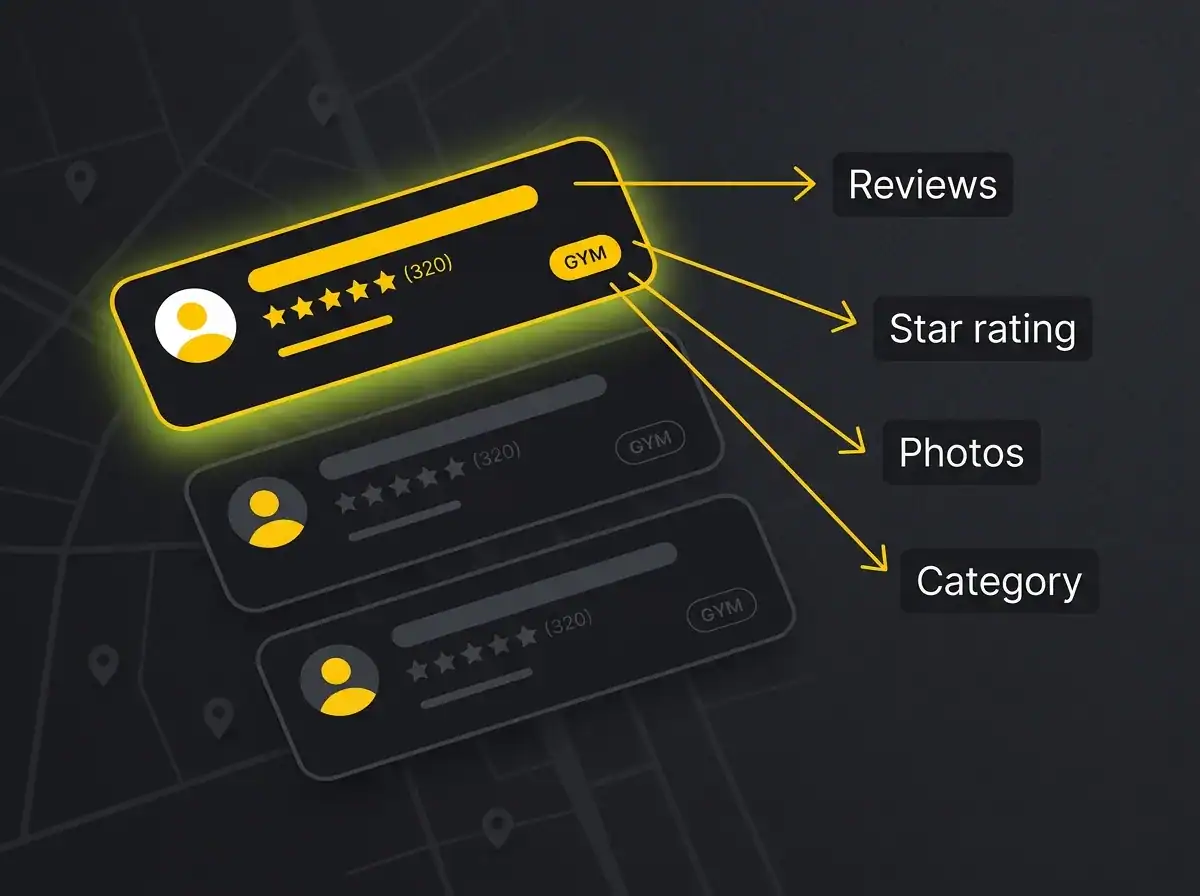
Gyms, studios, and personal trainers are fundamentally local businesses. The person searching for a gym is looking for something within a reasonable distance, and they are almost certainly searching on their phone. Most paid social lead-gen funnels treat location as an audience targeting layer rather than the core of the acquisition strategy. The distinction matters more than most agencies acknowledge.
The Google map pack is where a significant amount of local gym discovery actually begins. A prospective member typing "gym near me" or "personal trainer [town]" is not scrolling through a long results page. They are looking at the three businesses in the map pack, checking the star rating, reading a couple of reviews, looking at the photos, and then either clicking through or closing the tab. Ranking in that map pack drives walk-ins and tour bookings without any paid spend on top of the cost of doing it well.
Google's Business Profile documentation is fairly direct about the ranking signals: relevance, distance, and prominence. Prominence in practice means an optimised profile with a genuine and recent review presence, up-to-date photos, accurate business categories, correct opening hours, and consistent information across the wider web. For most independent gyms and PT businesses there is significant headroom to improve on most of these, and the investment is primarily time rather than ad budget.
What good looks like: an optimised Google Business Profile with regular photo updates, a genuine strategy for encouraging existing members to leave reviews (and responding to every review, including the difficult ones), location-specific pages on the website for any business with a defined service area or multiple sites, and consistent business information across directories.
What most fitness marketing agencies do: treat it as a one-time setup task and move on.
If you ask a prospective agency how they approach local SEO and Google Business Profile for their gym clients, the answer should be specific. Which platforms they monitor. What review velocity targets look like. What happens when a listing is suspended or has inaccurate information. If the answer is vague, that is the answer.
AI search is starting to recommend gyms

ChatGPT, Claude, Perplexity, and Gemini now answer prompts like "best gym in [city]" and "what should I look for in a gym" directly. With named business recommendations, reasoning about which type of gym suits which type of person, and sometimes quite specific observations about reviews, facilities, or pricing. This has developed relatively quickly. Eighteen months ago it was a curiosity. Now it is a real discovery channel for local fitness businesses in any city with active users on these platforms.
The people doing these searches tend to be further along in the decision process than a typical Google searcher. They are asking the AI to do some of the evaluation work for them. The result is that AI search traffic converts at a far higher rate than conventional search traffic, because users who arrive via AI recommendation have already been partially pre-qualified by the model's reasoning. That is worth understanding when you are assessing which channels deserve attention.
What makes a gym citable in AI search: consistent and accurate business information across the web, a strong and recent review presence, a website that clearly describes what type of training you offer and who it is for, structured content that answers common gym-evaluation questions, and for more technically attentive operators, a correctly configured llms.txt file that helps AI crawlers understand the business.
Most fitness marketing agencies are currently doing very little here. It is new enough that many have not yet built AI search into their service. That will change. In the meantime it represents a meaningful gap between what specialist fitness agencies currently offer and what is actually starting to drive a portion of local discovery. If AI search visibility is on your requirements list, ask about it specifically in any discovery call.
How to evaluate a fitness marketing agency before you sign
The checklist below is built for the discovery call. Most agencies will spend the first forty minutes pitching before asking what you actually need. These are the questions worth having ready before they start.
Case studies in your specific business model
Ask to see case studies for the type of gym or PT business you run. A small independent gym, a boutique studio, a solo personal training operation, and a large multi-site chain are different businesses with different economics and different competitive environments. An agency with fifteen gym clients and none in a format similar to yours is an unknown quantity going in.
Transparency on fees, ad spend, and where the margin sits
A credible agency will show you clearly what the management fee covers, what ad budget you need to carry separately, and what the breakdown looks like in practice. If the numbers are hard to extract at the pitch stage, expect that to continue.
Metric maturity
Do they talk about customer acquisition cost and member lifetime value, or primarily about leads and reach? Ask what their definition of a conversion is, and how they track what happens to enquiries after the initial contact. Thin answers here tend to indicate thin measurement throughout the engagement.
Search and local SEO competence
Ask specifically: how do you approach Google Business Profile and local search for your gym clients? Do you cover on-site SEO or website content? If local SEO is vague or conspicuously absent from the pitch, do not assume it is included because it sounded implied somewhere. It almost certainly is not.
A view on AI search
Ask whether they are doing anything to help clients appear in AI-generated recommendations. A considered answer, even one that explains why they are cautious about prioritising it, is more useful than a blank expression. The blank expression is informative in its own way.
Contract length and exit terms
Reasonable contract lengths for ongoing fitness marketing retainers run three to six months with a clear exit clause. Twelve-month commitments with limited break clauses transfer all the risk onto the gym owner. Ask what happens at month four if you are not satisfied with the direction of the work.
Reporting cadence and what it actually covers
What metrics appear in the monthly report, and what does the review conversation look like? An agency that cannot describe the contents of the first month's report during a discovery call will send you a PDF of engagement stats in month three. Ask to see an anonymised example report from a current client if possible.
Fit with your existing tools
If you use MindBody, ClassPass, a specific CRM, or an email platform, check that the agency is familiar with it and can connect campaign reporting to your actual membership data. Measuring leads in isolation from your booking system creates a gap between the campaign and the outcome that tends to stay unexamined.
Red flags worth noting: promises of guaranteed leads or guaranteed membership growth. No interest in member retention as a marketing function. A dismissive or vague response to local SEO. Lock-in contracts of twelve months or more with no realistic break clause. Monthly reports that cover only paid social metrics regardless of what else is supposed to be active in the account.
Three questions worth asking directly in the call:
-
"How do you measure success beyond lead volume, and what does that look like in month three for a gym like mine?"
-
"What happens to the campaign if I need to pause ad spend for a month?"
-
"Can you show me an anonymised monthly report from a current gym client?"
Where Creative Tweed fits

We are a search and conversion agency. We help businesses get found by the right people and turn that attention into enquiries, whatever sector they work in. The work covers search visibility and traffic through organic search, local SEO, and AI search, plus website conversion and the measurement that tells you whether any of it is paying off.
For a gym or PT business, that usually means the side of the picture the paid social route leaves untouched. Ranking in local search. Building the reviews and profile presence that win the "gym near me" moment. Getting cited when someone asks an AI tool for a recommendation. Making sure the website turns a curious visitor into a booked trial. The channels that compound, rather than the ones that stop the day you pause the budget.
If you are starting from zero and need to fill classes in the next eight weeks, a paid social push will get you there faster, and we will say so. If you want to build acquisition that keeps working without constant reinvestment, that is our half of the picture.
Want to see what search visibility could realistically deliver for your gym or PT business over the next twelve months? Our Traffic Projection Report maps the organic opportunity specific to your location and services. Not generic benchmarks from an adjacent market. A clear picture of where the search traffic is, which competitors are currently getting it, and what it would realistically take to compete for it.
Frequently asked questions
Do I need a specialist fitness marketing agency?
Not necessarily. What you need is an agency that covers the channels your growth actually depends on. If your only goal is fast paid social lead generation, an agency already running that playbook for gyms will get you there quickly. But if your real gap is search visibility, local discovery, reviews, or website conversion, a paid-social-led fitness shop is unlikely to have depth there. Start from the problem you are trying to solve, not from whether the agency happens to call itself a fitness specialist.
What does a fitness marketing agency actually do?
Most UK fitness marketing agencies primarily manage paid social campaigns, principally Meta Ads, and the lead-generation funnels that feed into booking platforms and CRM tools. Some also cover Google Ads, referral programmes, and member retention email sequences. Search, local SEO, and AI search visibility are offered by fewer agencies in this space and typically to a lower depth than their core paid social service.
How is a fitness marketing agency different from a generic digital marketing agency?
Less than the labels suggest. An agency that calls itself a fitness specialist will often have gym case studies and a ready-made paid social playbook, while a broader agency tends to go deeper on search, local SEO, conversion, and AI visibility. But the label is not the thing to judge. What matters is which of the channels above the agency actually covers for a business at your stage, and whether it can show it has grown one like yours. Weigh them on that rather than on whether "fitness" is in the name.
How much should I pay a fitness marketing agency in the UK?
Retainers range from under £1,000 per month for a single-channel junior management model up to £3,500 to £8,000 per month for multi-channel strategic work. The typical specialist fitness agency mid-market retainer runs £1,500 to £3,500 per month. Budget a minimum of £500 to £1,500 per month in ad spend on top of any management fee if you are running paid social campaigns, as this is almost always excluded from the retainer.