You're in the map pack. You're getting some calls. But the competitor you know is roughly the same size as you appears above you for almost every local search that matters. You've claimed your Google Business Profile, you're on a few directories, and you've asked satisfied customers for reviews. So what are you missing?
The answer is rarely one big thing.
It is almost always a cluster of smaller gaps: a GBP that is 60% complete, three or four missing trade directory listings, a review response rate of zero, and a website footer with no address on it. Each gap is minor. Together, they explain the position.
These 10 checks cover every layer of local SEO. Google Business Profile completeness, NAP consistency, citation coverage, review signals, on-page local signals, technical health, local links, competitor benchmarking, and the AI search layer that most audit guides still treat as an afterthought. You can work through all 10 in one sitting using only free tools, and by the end you will know precisely where you stand.
Here is what you are checking:
-
Whether your Google Business Profile is genuinely complete, not just claimed
-
Whether your name, address, and phone number are consistent everywhere they appear
-
Whether you are listed in the right UK directories, including trade-specific ones
-
What your review velocity and response rate actually look like
-
Whether your website sends the right local signals to Google
-
Whether your service area pages are doing real work or just sitting there
-
Whether Google can reach and read your website properly
-
Where your local backlinks are coming from, and what is missing
-
How the top three businesses in your map pack compare to your own profile
-
Whether your business appears when someone asks an AI tool for a recommendation
If you find gaps and want professional help closing them, a proper local SEO service addresses all of these layers in one coordinated process.
Check 1: is your Google Business Profile actually complete?
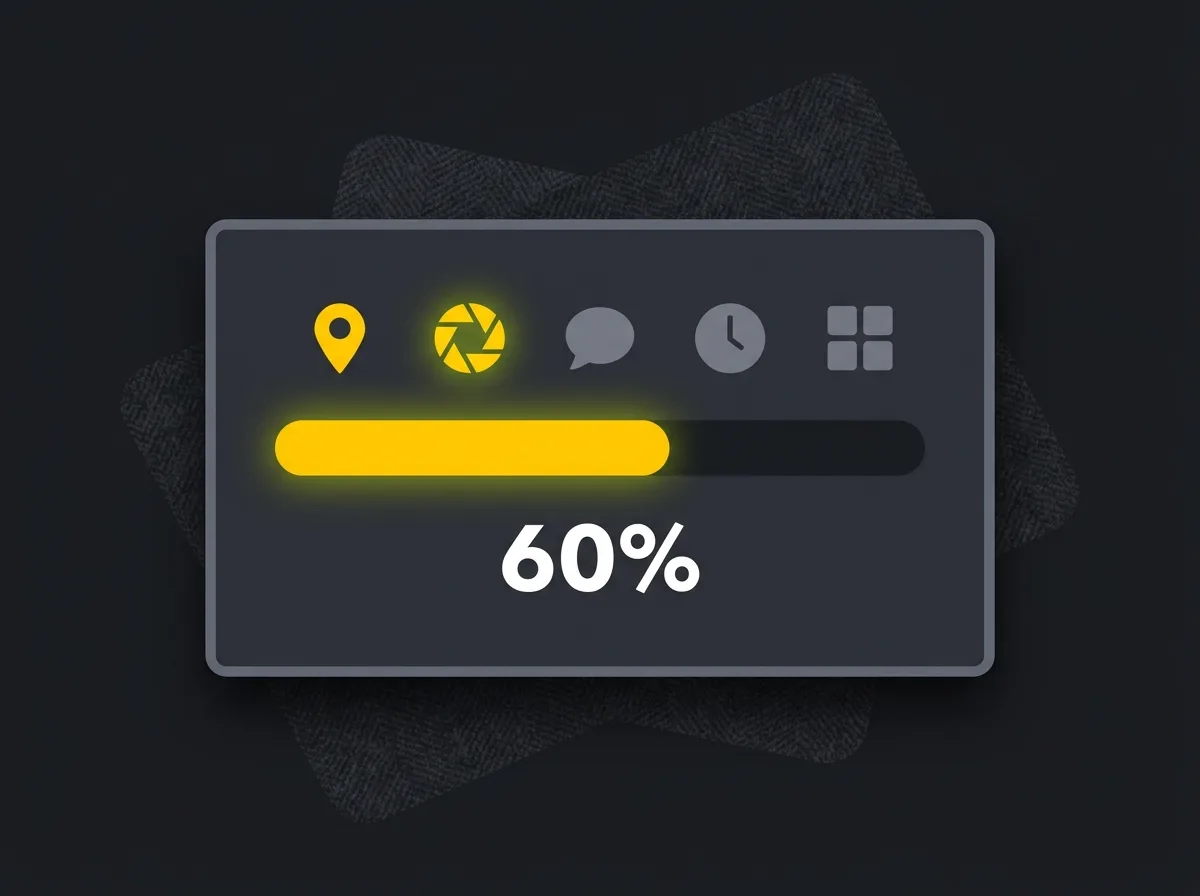
Claimed and verified is the minimum. It is not complete.
Most businesses set up their Google Business Profile, confirm their details, and consider it done. Google's completeness signals go considerably further, and the gap between a claimed profile and a genuinely complete one is where most map pack position differences begin.
Primary category. This is the single most important signal on your entire GBP. Not your description, not your secondary categories. Get this wrong and you are competing in the wrong lane. A boiler engineer who lists themselves under "Plumber" rather than "Heating Contractor" will struggle for heating-specific queries regardless of how good everything else is.
Secondary categories. Use all the relevant ones. A business offering both gas work and electrical services should list both. Secondary categories are free ranking signals that most profiles leave blank.
Services section. Populate it with specific services rather than vague terms. "Emergency boiler repair" and "annual boiler service" outperform "heating services" because they match actual search queries.
Q&A section. Most businesses leave this entirely empty. You can ask and answer your own questions, which means you control what appears there. Use it to address what your customers actually ask: parking, payment terms, callout charges.
Photos. Google reads the freshness of your photo uploads. A profile last updated two years ago with three images signals a business that has stopped paying attention. Add real photos of real work, real staff, and real premises.
Posts. Barely any service businesses use Google Posts consistently. Even one or two a month signals active operation and keeps the freshness signal alive.
Your action step: open your GBP dashboard, work through each of these elements, and note honestly what is missing. If your primary category is even slightly off, fix that first.
Check 2: is your NAP consistent everywhere?
Name, Address, Phone. Consistent across every listing, directory, and webpage. Not approximately consistent. Exactly.
Google treats inconsistent NAP as evidence of an unresolved entity. If it cannot clearly identify who you are, it will be less willing to recommend you. A plumbing firm listed as "J. Andrews Plumbing Ltd" on their website, "Andrews Plumbing" on Yell, and "J Andrews Plumbing" on Checkatrade creates a small but real uncertainty that builds across every listing it encounters.
UK businesses face a few specific pitfalls here that US-centric guides miss entirely. "St" versus "Street", "Ltd" versus "Limited", trading name versus Companies House registered name, and geographic naming ("Birmingham" versus "West Midlands" versus "Sutton Coldfield"): all of these fragment your entity signal across directories.
Multi-location businesses face this at every branch. Each location needs its own consistent NAP. Listing a branch office with the head office phone number is a common mistake, and one Google notices.
To check without paying for a tool: Google your business name in quotes, then Google your phone number in quotes. Every result is a citation. Open each one and check whether the name and address match your master version exactly.
Sound familiar? A single afternoon fixing these discrepancies is often worth more than a month of trying to build new links on top of a fragmented foundation.
Check 3: are you listed in the right UK directories?
Not all directories carry equal weight. Domain authority, topical relevance, and whether Google actively trusts the source all vary considerably. Being listed on 50 low-quality directories is less useful than being accurately listed on 8 authoritative ones.

The core general directories every UK service business should appear on are: Yell, Thomson Local, Bing Places, Apple Maps, and Facebook Business. If you are missing any of these, that is a priority fix. They are where Google looks first when building its picture of a local UK business.
Beyond the generals, trade-specific directories often carry more weight, not less. Checkatrade, TrustATrader, Which? Trusted Traders, Bark.com, and MyBuilder matter for trades. Doctify and NHS profile pages matter for healthcare. The Law Society finder and FCA register matter for financial and legal services.
Here is the part most guides miss. For any regulated trade or profession, your registration body almost certainly has a member directory. Gas Safe Register, NICEIC, NHBC, CITB, CHAS, Trustmark for trades. RICS, ICAEW, SRA for professional services. CQC for healthcare providers. These directories are high-trust, verified, editorially maintained, and Google treats them accordingly.
If you are a registered member of any of these bodies and your website is not linked from their directory, you are leaving a free authoritative citation uncollected. This is the most underused local SEO opportunity in the UK service sector, and it costs nothing but a quick check.
Whitespark's Local Search Ranking Factors survey consistently highlights citation quality and relevance as significant ranking signals in local pack results. Trade body listings sit at the top of the quality tier precisely because they are difficult to fake.
The post on what accounting firms get wrong about local SEO goes deeper on sector-specific citation patterns for professional services if you want more detail on that territory.
Your action step: list every directory you currently appear on. Cross-reference against the tiers above. Prioritise any trade body and professional body listings you have not yet claimed.
Check 4: what do your review signals actually look like?
Your overall star rating matters. But Google's review signals are more sophisticated than a simple average, and most businesses focus on the wrong metric.
According to BrightLocal's Local Consumer Review Survey, review recency is consistently rated as one of the most important factors consumers use when judging whether to trust a local business. A practice or firm with 40 reviews and 5 in the last month projects recent legitimacy in a way that a business with 120 reviews and none in six months simply cannot match, regardless of the higher total count.
Review velocity. How many reviews have you received in the last 90 days? If the answer is zero or one, this is the first thing to address in this section.
Response rate. Do you respond to every review, including the negative ones? Google reads responsiveness as an active engagement signal. A one-star review sitting unanswered for 18 months does more damage than the star deduction alone. It tells prospective customers that no one is paying attention, and it tells Google the same thing.
Review spread. Google reviews are the primary signal for local ranking, but your wider reputation footprint matters too. Trustpilot, Checkatrade, and sector-specific platforms like Doctify for healthcare can appear in AI Overviews and general search results, building your overall trust profile beyond the map pack.
UK consumers tend to scrutinise reviews more carefully for certain categories. A healthcare practice or a solicitor's firm with fewer than 15 recent reviews looks thin to anyone scanning before they call.
Your action step: check your review velocity (last 90 days), your response rate (aim for 100% including negatives), and which platform produces the most visible reviews for your sector.
Check 5: does your website send the right local signals?
Your Google Business Profile and your website should work together as a coherent, consistent picture of your business. When they contradict each other, or when your website gives Google no explicit local information at all, that ambiguity chips away at your map pack performance.
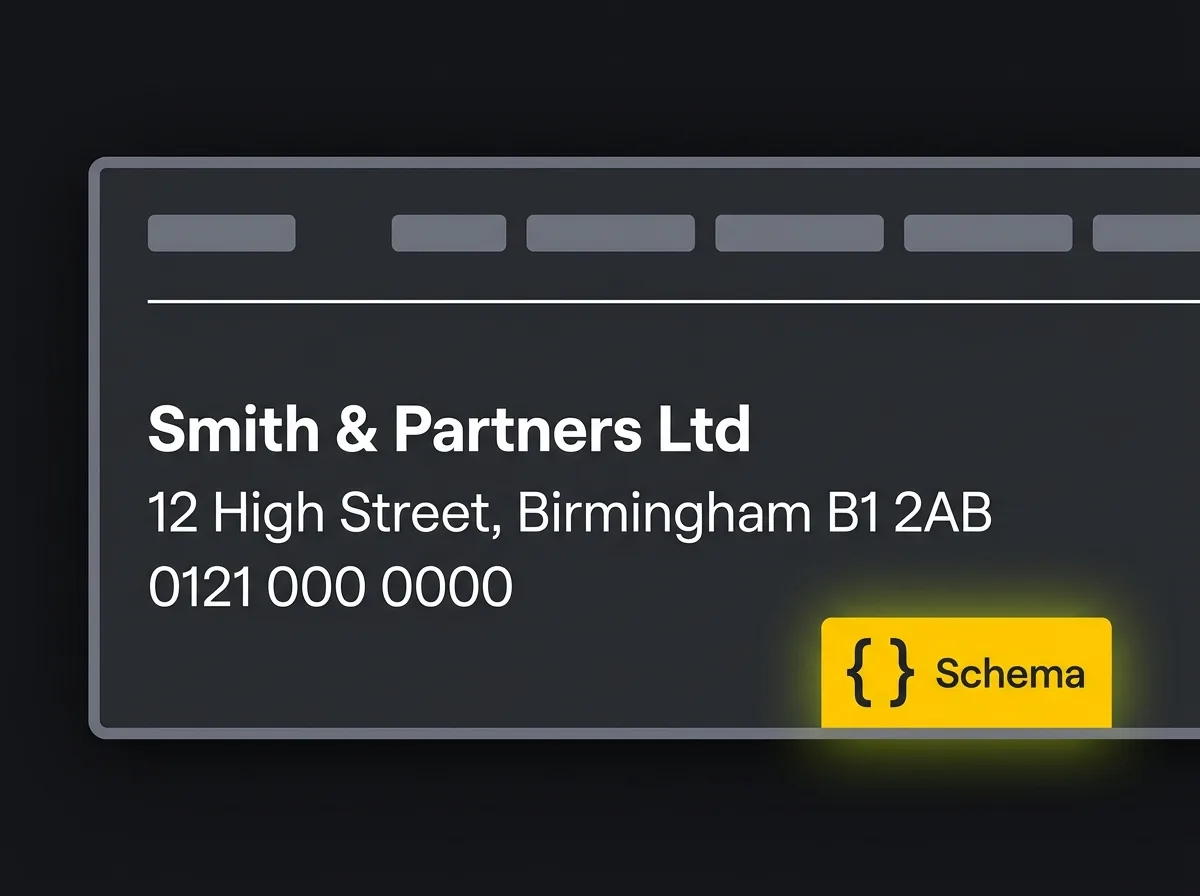
NAP in the footer. Your full name, address, and phone number should appear in the footer on every page. Not just the contact page. The footer is where Google crawlers reliably look for location information. If it is missing, the crawler has to infer it from context, and inferred signals are weaker than explicit ones.
LocalBusiness schema markup. This is structured data that tells Google explicitly who you are, what you do, where you operate, and when you are open. Most service business websites do not have it. Its presence will not transform your rankings overnight, but it removes a layer of ambiguity Google would otherwise have to resolve on its own. You can check whether it exists by viewing the page source on your homepage and looking for a script tag with type="application/ld+json". If it is not there, it is worth adding.
Title tags. Every service page and location page should include the service and the location. "Drain unblocking Derby" is a title tag. "Our services" is not. Check your five most important pages and note what their title tags actually say.
H1 headings. The main visible heading on each page should confirm what the page covers and where you serve. "Plumbing services in Shrewsbury" is an H1. "Welcome to our site" is not.
Contact page specifics. Three quick checks: your address appears as readable text (not only inside a map embed), your phone number is a clickable link, and your opening hours match your GBP exactly. Even minor discrepancies create entity uncertainty.
Your action step: view the page source on your homepage and contact page, check for LocalBusiness schema, check your footer for full NAP, and check your top five pages for location-specific title tags.
Check 6: are your service area pages doing real work?
If you serve a radius rather than operating from a fixed premises that customers visit, service area pages are how you signal relevance to Google for locations beyond your registered address. This applies to plumbers, builders, landscapers, pest control companies, drainage specialists, mobile healthcare services, and anyone else who goes to the customer rather than the other way around.
The problem is that most service area pages are thin. They are the same copy with a town name swapped in. "Professional plumbing services in Wolverhampton" reads identically to "Professional plumbing services in Birmingham" because nothing changed except the city name. Google has seen this pattern at scale and largely discounts it.
A genuine service area page contains unique content relevant to that specific location. Local references, specific nearby areas served, anonymised testimonials from customers in that town, or local associations and memberships in that region. It reads as if someone who actually works in that area wrote it for someone in that area.
The test is straightforward. Load one of your service area pages. If you could swap any other town name in without changing a single other word, the page is thin.
For professional services firms operating across multiple offices, each location should have its own GBP profile, its own review pool, and its own area page. The post on local SEO for solicitors covers the multi-branch complexity in detail for legal firms, but the same principles apply to accountants, physio practices, and any multi-site service business.
Your action step: audit one existing service area page. Ask honestly: would a resident of that town feel this was written specifically for them?
Check 7: can Google actually use your website?
This is not a deep technical audit. It is three checks that catch the issues most likely to undermine everything else you have done.
Mobile usability. The majority of local searches happen on mobile. A website with usability problems on mobile is compromised at the exact moment it matters most. In Google Search Console, under Experience, check Core Web Vitals for mobile. Any red or orange signals are worth fixing before anything else on this list.
Crawl errors. In Google Search Console, go to Indexing and check Coverage. Look for pages that are blocked, returning errors, or excluded from the index. A service page returning a 404 error does not exist to Google, regardless of how well-written it is.
Page speed. Run your homepage through Google PageSpeed Insights (free). A mobile score below 50 is a material ranking disadvantage. You do not need a perfect score. But a score that is visibly poor will hold rankings back regardless of your other local signals.
If you have not yet verified your website in Google Search Console, do that first. It takes about ten minutes to set up and gives you direct visibility into how Google reads your site. That is it.
Your action step: log into Google Search Console, check Coverage for errors and Core Web Vitals for mobile, then run your homepage through Google PageSpeed Insights.
Check 8: where are your local backlinks coming from?
Local backlinks are one of the most underused levers in local SEO. Most service businesses focus on citation directories and never ask who is actually linking to their website from genuinely local, relevant sources.
A link from your local Chamber of Commerce member directory, a regional newspaper article covering an award you won, a supplier's partner page, a local charity's website where you sponsored an event: these tell Google your business is genuinely embedded in its local community and not just a listing that appeared one day.
Trade body directories. This bears repeating, because it is that valuable. Gas Safe, NICEIC, NHBC, CITB, Trustmark, RICS, ICAEW, SRA: if you are registered and their member directory links to your website, you have a follow link from a high-trust, topically relevant domain. If you are a registered member and they do not link to you, contact them and ask to be added. Free. Takes five minutes.
FSB and Chambers of Commerce. Both typically include member directories with links. If you are a member and not listed with a link to your website, that is a straightforward fix worth doing this week.
Local press. If your business has done anything worth covering locally, have you made it easy for the local paper or a trade publication to write about you? Award wins, charity partnerships, apprenticeship programmes, and notable project case studies all give local journalists a reason to mention your website.
To check your current profile: Google Search Console's Links section (free) shows your top linked pages and most common linking domains. Ahrefs' free tier shows a sample of linking domains. Between the two you get enough to understand where your authority currently comes from.
Your action step: list every trade body, professional membership, and business association you belong to. Check whether each one links to your website. The ones that do not are a free to-do list.
Check 9: how do you compare to the top three in your map pack?
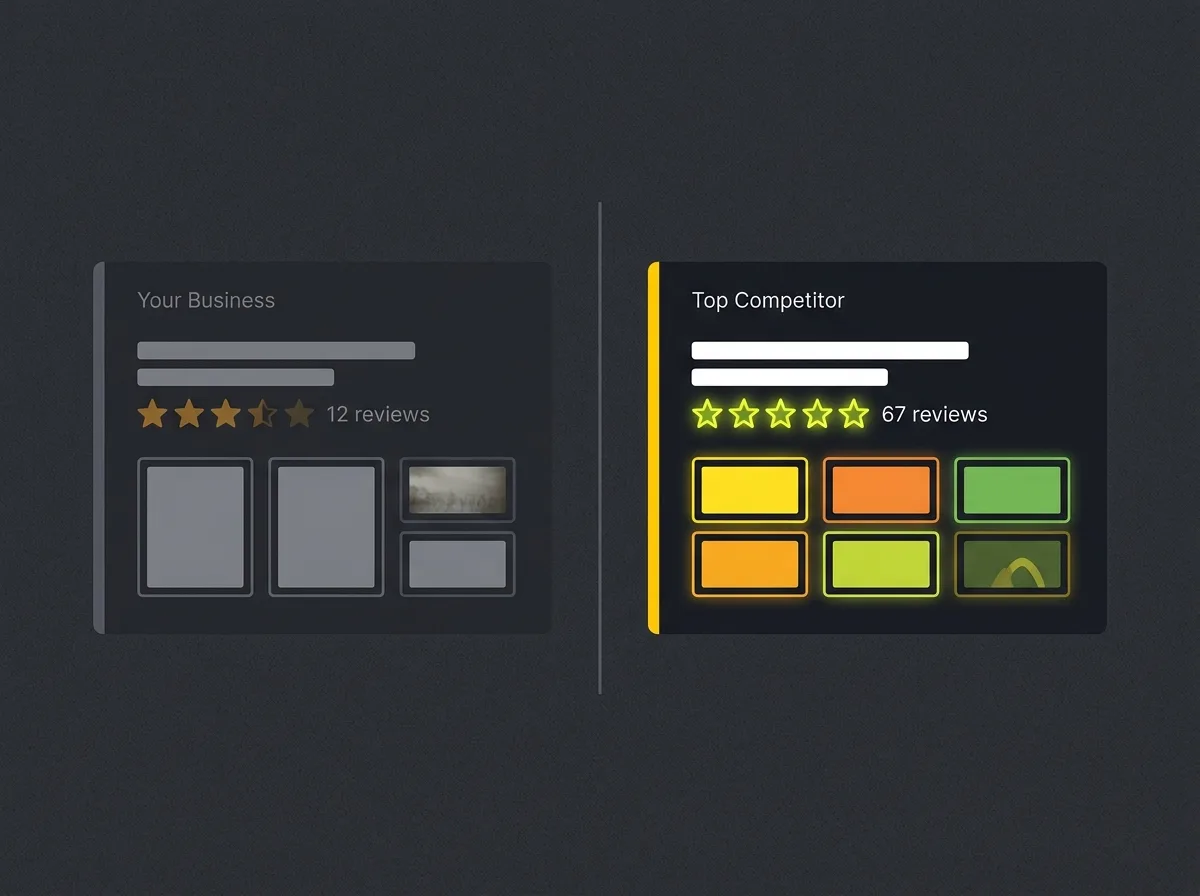
The quickest way to understand what you are missing is to look at what the businesses above you have done. Not their websites. Their local profiles.
Open a browser in incognito mode and search for your main service and location. Note the top three businesses in the map pack. For each one, check:
-
How many reviews do they have in total, and how recent are their last five?
-
How complete does their GBP look? Photos, posts, Q&A answers, a full services section?
-
What primary and secondary categories have they selected?
-
Search their business name in quotes and note which directories appear that yours do not.
Then compare that picture to your own profile against the same criteria.
In most competitive local markets, the gap between rank 1 and rank 4 is smaller than the businesses involved realise. It is often a combination of 15 to 20 more recent reviews, one or two trade directory listings you are missing, and a more complete photo gallery. None of those require a large budget or a paid tool to fix.
The comparison also surfaces opportunities you would not find by looking only at your own profile. If all three competitors appear on a directory you had not heard of, that is a citation gap worth addressing this week.
Your action step: complete this comparison for your top two or three priority service-plus-location search terms. Build a short list of what the top three have that you do not, then fix the easiest gaps first.
Check 10: is your business visible in AI search?
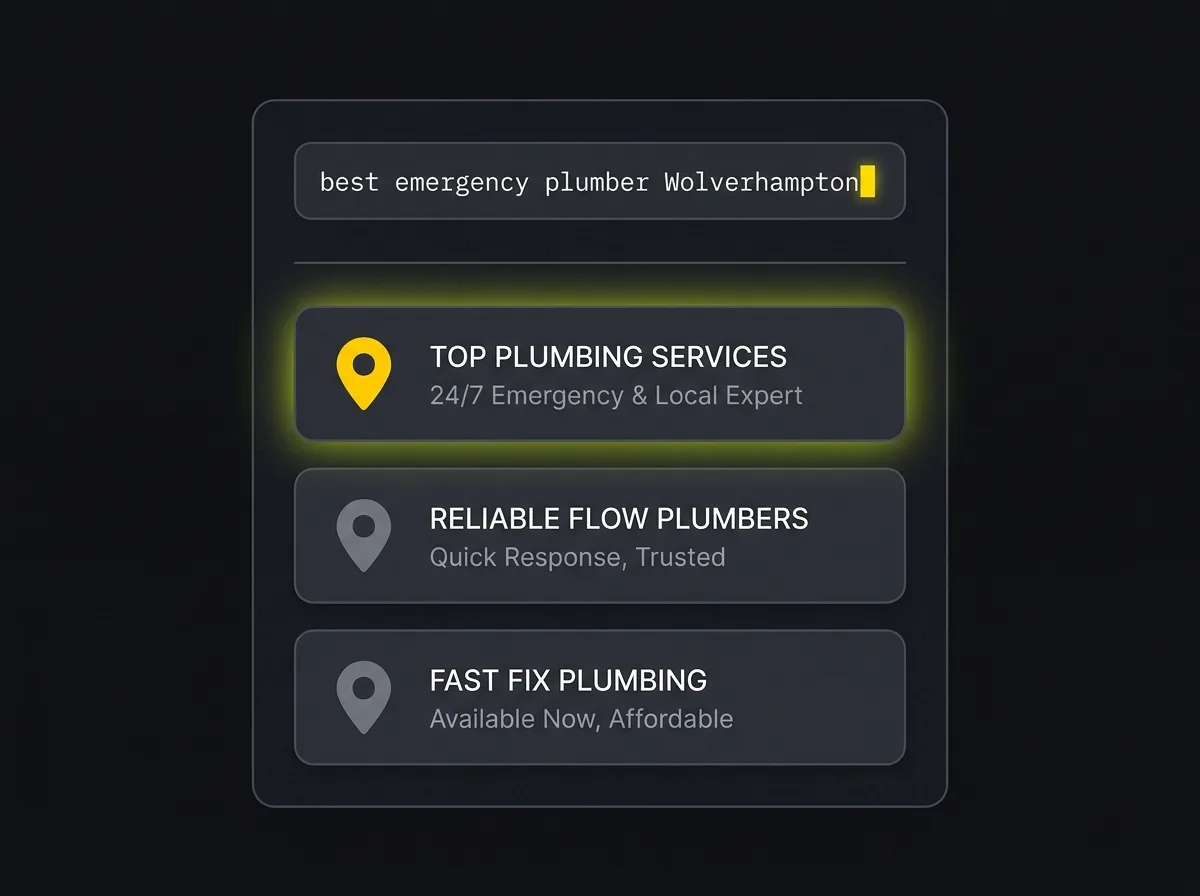
This check has no equivalent in most local SEO audit guides published before 2026. It is here because the search landscape has shifted in ways that most audits have not yet caught up with.
AI Overviews now appear for a significant and growing proportion of local search queries. Research from BrightLocal and SOCi tracking this space shows that when a user searches for something like "emergency plumber Wolverhampton" or "best physiotherapist near me", they may see an AI-generated summary above the traditional results. Whether your business appears in that summary depends on a different set of signals to your traditional map pack position, though the two overlap considerably.
The core factors are entity clarity, structured data, and consistency. Entity clarity is the biggest one.
It means that Google and its AI layer understand unambiguously who you are, what you do, and where you operate. If your NAP is inconsistent across directories, your GBP category does not match your website copy, and you have no LocalBusiness schema, you have an entity clarity problem. Entity SEO describes the work of making your business a clearly defined entity in Google's knowledge graph, rather than a collection of keywords that needs to be interpreted from context.
The most direct way to check your AI visibility is to test it now. Open ChatGPT, Perplexity, or Google with AI Overview active, and type: "best [your service] in [your town]" or "who are the top [your service] providers in [your area]". Note whether your business appears. Note who does appear, and how they are described. This takes 90 seconds and produces a result that surprises almost every business owner who tries it.
If you do not appear, the gap is usually entity clarity. The fixes are the same ones from checks 1 through 5. Consistency and clarity compound across both traditional local ranking and AI visibility.
If you want a structured picture of where you currently stand in AI search specifically, our AI SEO service includes an AI visibility assessment as the starting point.
Your action step: run the prompt test above for your top three services and note whether you appear, who does appear, and how those businesses are described.
What to do with your audit findings
You have run the 10 checks. You have a list of gaps. The next question is what to fix first.
Critical: fix this week. GBP completeness issues (particularly the primary category), NAP inconsistencies across major directories, and any mobile usability or crawl errors in Google Search Console. These are the foundations everything else sits on, and fixing them produces the fastest visible change in map pack position.
Important: fix this month. Citation gaps in core UK directories and trade body listings, review velocity (putting a consistent review request process in place), and on-page signals like LocalBusiness schema and title tag formatting. These compound over weeks rather than days.
Advanced: build over time. Service area page depth, local backlink acquisition, and AI search entity clarity. These take longer to show results but have a compounding effect that the critical and important fixes do not.
Not everything needs to happen at once. Working through the critical tier first, then the important tier, produces the best return on your time.
Once you have worked through what you have found, the natural next question is what fixing those gaps is actually worth in traffic and enquiries.
Free resource: Traffic Projection Report
Enter your website and your market and get a realistic projection of the traffic available to you if you close the gaps the audit surfaced. No commitment, no sales conversation required.
If you want professional help implementing the fixes, our local SEO agency covers the full process: citation management, GBP management, on-page local signals, local link building, and AI search entity work. If your broader search presence needs attention beyond local, our SEO agency services cover the full picture.
Frequently asked questions about local SEO audits
How long does a local SEO audit take?
Between 30 minutes and 3 hours, depending on how many locations you operate from and how systematically you work through each check. A single-location service business running through all 10 checks for the first time typically takes around 90 minutes. Multi-location businesses or those with a large number of existing citations to review should allow more time.
What does a local SEO audit include?
A thorough local SEO audit covers Google Business Profile completeness, NAP consistency across all citations, coverage of relevant UK directories including trade-specific and trade body listings, review velocity and response rate, on-page local signals including schema markup and title tag formatting, basic technical health checks, local backlink sources, a direct comparison against the top three map pack competitors, and AI search visibility. This guide covers all 10 areas.
Can I do a local SEO audit myself?
Yes. The 10 checks in this guide require only free tools: your Google Business Profile dashboard, Google Search Console, Google PageSpeed Insights, BrightLocal's free citation finder tier, and Google itself. The only thing the free approach lacks compared to a paid tool is the speed of data gathering. The accuracy is comparable.
How often should I run a local SEO audit?
Every six months as a baseline, or whenever your map pack position drops noticeably. Local search is not static: competitors gain reviews, new businesses enter your area, and Google updates its signals. A twice-yearly audit keeps you aware of gaps before they compound into a significant position drop. If you operate in a competitive local market, quarterly is worth considering.