Your venue is stunning. Couples love it when they visit. Your Instagram is full of beautiful photography, and the images genuinely do the place justice. But direct enquiries from Google have slowed down.
You're paying Hitched or Bridebook commission on a good chunk of your bookings, and when you search for "barn wedding venue [your county]", you're not on the first page. The venue three miles away, with a less impressive setting, is. Sound familiar?
Most SEO guides will tell you to "fix your website" and "sort out your Google listing". That advice isn't wrong, but it misses something more important: there are three distinct stages to how couples search for a venue, and most venues are only visible for one of them. This guide covers all three, what Google and increasingly AI tools serve up at each stage, and what a venue needs to do to show up at the right moments.
SEO for wedding venues is the process of making your venue discoverable in Google search, Google Maps, and increasingly AI platforms at every stage of the couple's search, from first inspiration through to booking enquiry.
TL;DR – Your Google Business Profile is the single highest-impact fix available and most venues have left it half-finished – Dedicated landing pages for your key styles and locations are where the real long-tail ranking opportunity sits – AI tools like ChatGPT and Perplexity are becoming part of how couples discover venues before they open Google – SEO is a compound channel: slower to build than a Hitched listing, but it doesn't charge per enquiry and gets stronger over time
Why couples don't search the way most venues think they do
Ask most venue managers what their couples search for and you'll hear something like "wedding venues in [county]" or their own venue name. Both are true. But they're describing the end of the journey, not the beginning.
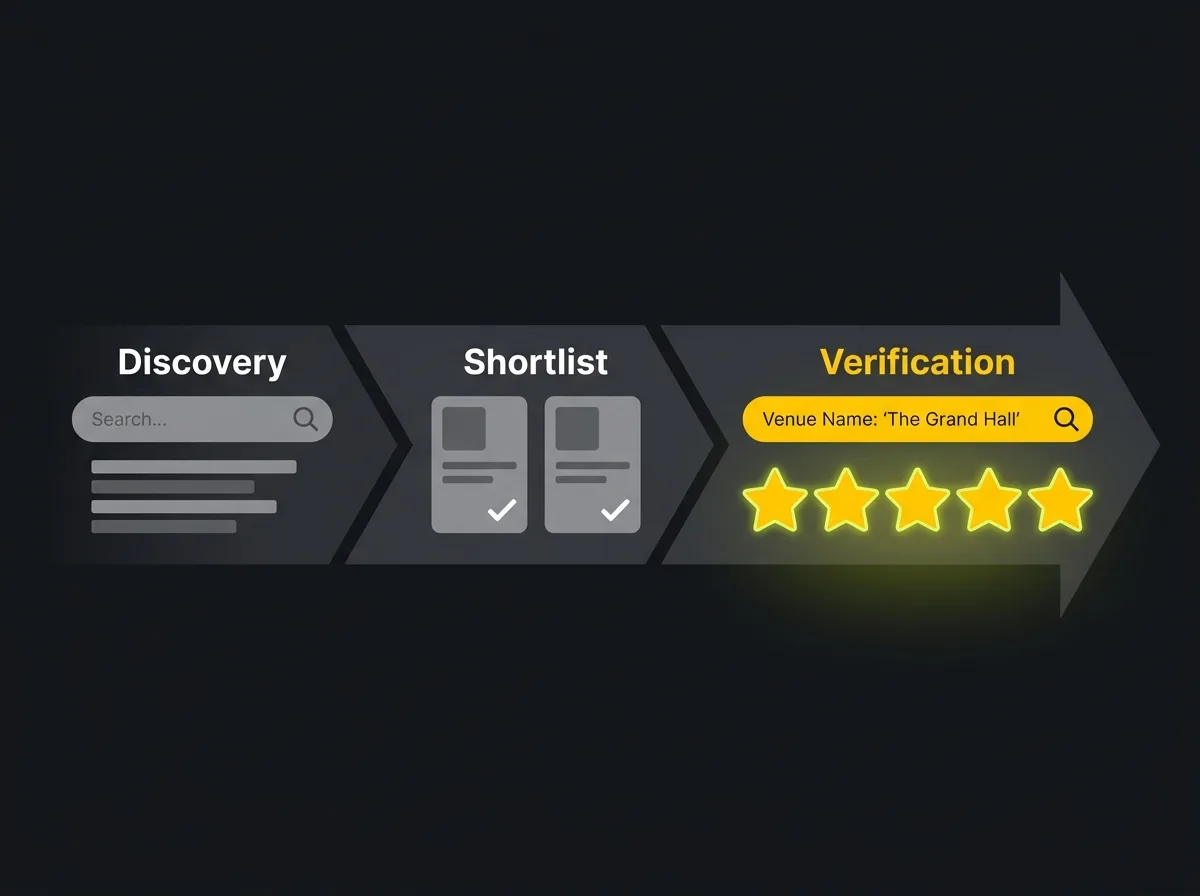
The couple's search runs through three distinct stages, and each one surfaces different content.
Stage one: discovery. The couple has just got engaged. They're browsing, not deciding. Searches look like "barn wedding venues with accommodation", "outdoor wedding venues UK", "wedding venues in Wiltshire". They're exploring styles and geography. Google serves a mix of the local map pack, editorial guides, and directory listings. The couple isn't ready to enquire. They're building a mental list.
Stage two: shortlisting. Now they know roughly what they want. The searches get more specific: "intimate wedding venue for 50 guests Yorkshire", "converted barn with own accommodation Wiltshire", "manor house wedding venue for 80 guests Cheshire". These are higher intent, and the results shift. Individual venue pages start competing with the directories, especially for niche combinations of style, capacity, and location.
Stage three: verification. The couple has a shortlist. They're now searching your venue by name, reading your reviews, comparing you against one or two others. If you're not already on their list, this stage doesn't help you at all.
Most venues invest almost all their attention at stage three. The real search volume, and the real competitive opportunity, is at stages one and two. That's where a structured approach to local SEO makes its biggest difference. Most venues are invisible for both.
Your Google Business Profile is doing more work than your website for most searches
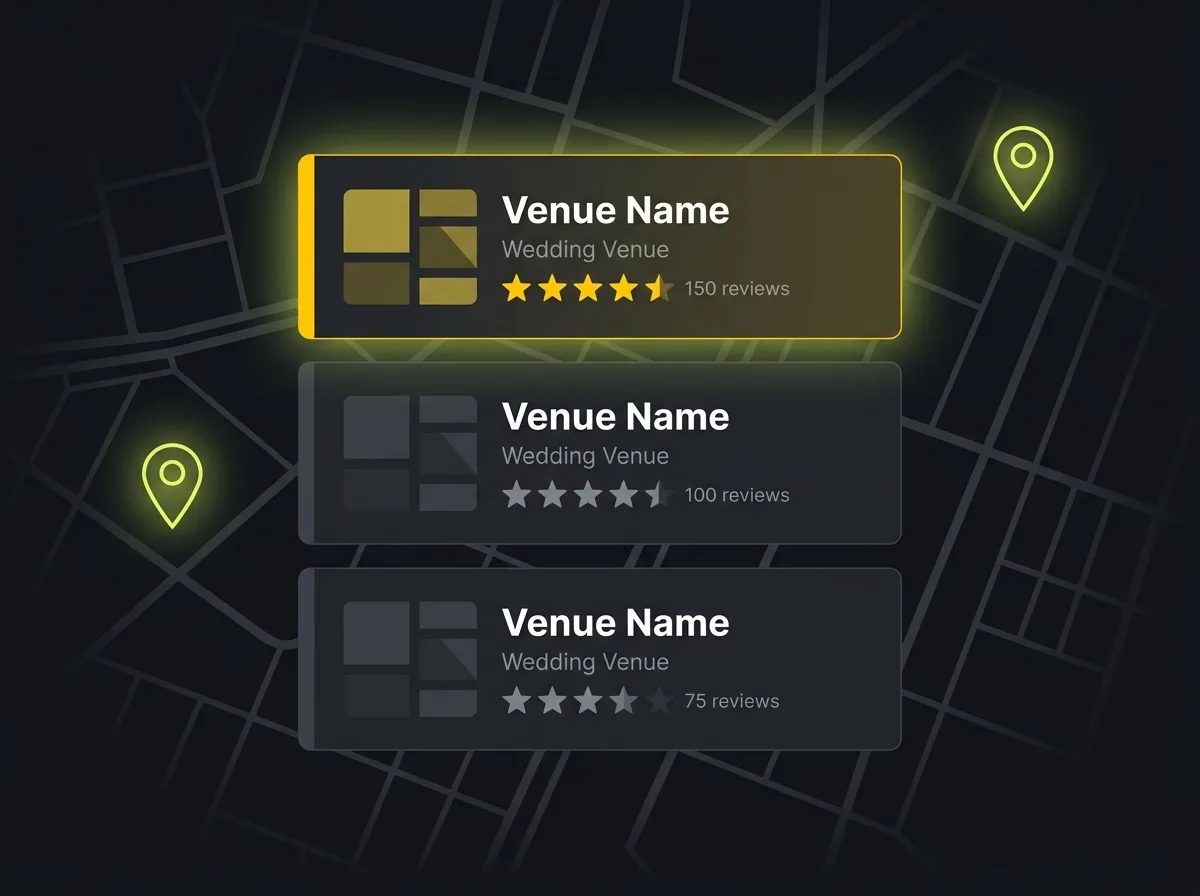
When a couple searches "outdoor wedding venues in Oxfordshire" or "wedding venues near me", the first thing they usually see is not a list of websites. It's Google Maps. A cluster of three local results with photos, star ratings, and a brief description. This is the local pack, and your Google Business Profile determines whether you're in it.
Most venues have a GBP. The question is whether it's been properly completed, because a half-finished profile consistently gets outranked by a finished one, even when the underlying venue is more impressive.
What full GBP optimisation actually involves. The primary category should be "Wedding Venue", with "Event Venue" as a secondary. Every attribute should be filled: outdoor space, indoor space, on-site accommodation, catering, parking, accessibility. Capacity figures and a description that names your county and nearby towns. You need at least 30 photos covering ceremony spaces, reception rooms, grounds, bridal preparation areas, and evening settings. At least one new post per month keeps the profile active.
Reviews: recency matters more than volume. A venue with 40 reviews from the past 12 months will frequently outrank one with 200 reviews from 2019. Google treats recent reviews as a stronger signal of an active, relevant business. A systematic post-wedding review request, sent a week or two after the day, is one of the cheapest competitive advantages available.
Most venues leave it to chance.
Response rate. Responding to every review, positive and negative, within 48-72 hours is a GBP engagement signal. A brief, personal response to a glowing review takes 90 seconds. It's something most venues skip consistently, and it's a small but measurable ranking factor. According to Google's own research on local search, nearly half of all Google searches carry local intent. For a venue with a defined geographic catchment, the GBP is where most of that intent lands first.
The landing pages most wedding venue websites are missing
Around 240,000 couples marry in England and Wales each year, according to ONS marriage data for England and Wales, and every one of them searches for a venue before they book it. The problem is that a venue website with a homepage, a gallery, a contact page, and a downloadable PDF of packages cannot rank for any of the specific searches those couples type at stage two.
Google needs a dedicated page about each meaningful variation of what your venue offers. Without it, you simply don't exist for the searches that matter most.
The pages that rank for long-tail discovery queries follow a consistent pattern: a specific style or capacity combined with a specific location. "Rustic barn wedding venue Wiltshire." "Intimate wedding venue for 50 guests Yorkshire." "Country house wedding venue with accommodation Kent." Each of these is a real search a real couple types. Each one needs its own page.
These pages need real written content, not just photography. Three hundred words at a minimum, describing what that particular style or capacity actually looks like at your venue, naming your county and nearby towns, and including a handful of testimonials relevant to that type of wedding. Thin pages that are mostly images and a price guide won't rank. Google needs text to understand what a page is about.
Real wedding features compound over time. A properly written real wedding post, "Sophie and James's summer wedding at [Venue Name], Oxfordshire" with venue-specific keywords, location references, and photography credits, is both editorial content and an indexed page. One feature gives you one additional ranking opportunity. Ten features, spread across different styles and seasons, give you ten. They accumulate in a way that a directory listing simply cannot replicate.
The Hitched and Bridebook question deserves an honest answer here. These platforms rank for high-volume generic terms: "wedding venues in Cheshire", "wedding venues near Manchester". Their domain authority for those terms is enormous, and trying to outrank them directly isn't a good use of resources. What they don't have is dedicated pages for every style-plus-location long-tail combination. "Lakeside wedding venue with accommodation North Yorkshire" is not a phrase Hitched has a specific page for. Your venue could own it. Maintaining your directory listings makes sense because they deliver leads. Building the long-tail alongside them is what reduces your commission dependency over time.
For venues thinking about how AI search changes this picture, structured content with specific location and style detail is also what gives AI search visibility a grip on your venue as a recommendation, which brings us to the section most SEO guides skip entirely.
What AI search means for venue discovery in 2026

Couples are increasingly starting their venue research before they open a search engine. They type "recommend luxury wedding venues in the Cotswolds" into ChatGPT, or "best outdoor wedding venues in Yorkshire for 100 guests" into Perplexity, and get a structured set of recommendations drawn from across the web.
This behaviour is early but real. And the venues appearing in those AI-generated answers share specific characteristics.
LocalBusiness schema is the most practical action here. It's a short piece of code, added by your web developer or through a plugin like Yoast or RankMath, that tells Google and AI crawlers precisely what your venue is, where it is, and what it offers. Not complicated to implement. Still missing from the majority of venue websites.
FAQPage schema on your FAQ page is equally underused. If your site has a page that answers questions like "how many guests can we accommodate" and "do you allow outside caterers", marking that content up with FAQPage schema tells search engines (and AI tools) to treat it as a structured answer source.
Perplexity, in particular, cites sources. A well-written real wedding feature with clear location detail, named county, capacity information, and a specific style description can earn a Perplexity citation when a couple searches for venues in that area. You can read more about how AI traffic converts for service businesses generally, but for wedding venues the specific opportunity is in being the richest, most structured local source when AI tools assemble recommendations.
AI search is not replacing Google. But the venues building structured content and maintaining active profiles now will benefit when AI-driven discovery becomes a standard part of the planning process. The foundations are the same ones that improve your organic ranking anyway.
Where SEO fits in the broader picture for wedding venues
Let's be honest about the full landscape for a moment, because a guide that treats SEO as the only channel worth caring about is selling you something.
Instagram and TikTok are real acquisition channels for wedding venues. Short video tours, real wedding reels, and behind-the-scenes setup content generate genuine awareness, particularly among younger couples who research visually. CT doesn't offer social media management, so there's no self-interest in saying this, but ignoring it would make the picture incomplete.
Referrals from wedding planners, photographers, caterers, and florists are some of the highest-converting enquiries a venue receives. A recommendation from a trusted supplier carries more weight than any page ranking. These are relationship-dependent and slower to build, but worth investing in systematically.
Paid search can buy immediate visibility for competitive terms while organic search builds. If you've recently rebranded or launched a new venue website, Google Ads targeted at your priority style and location terms can bridge the gap.
And Hitched and Bridebook deliver volume. For most venues, they're a meaningful source of bookings and worth maintaining.
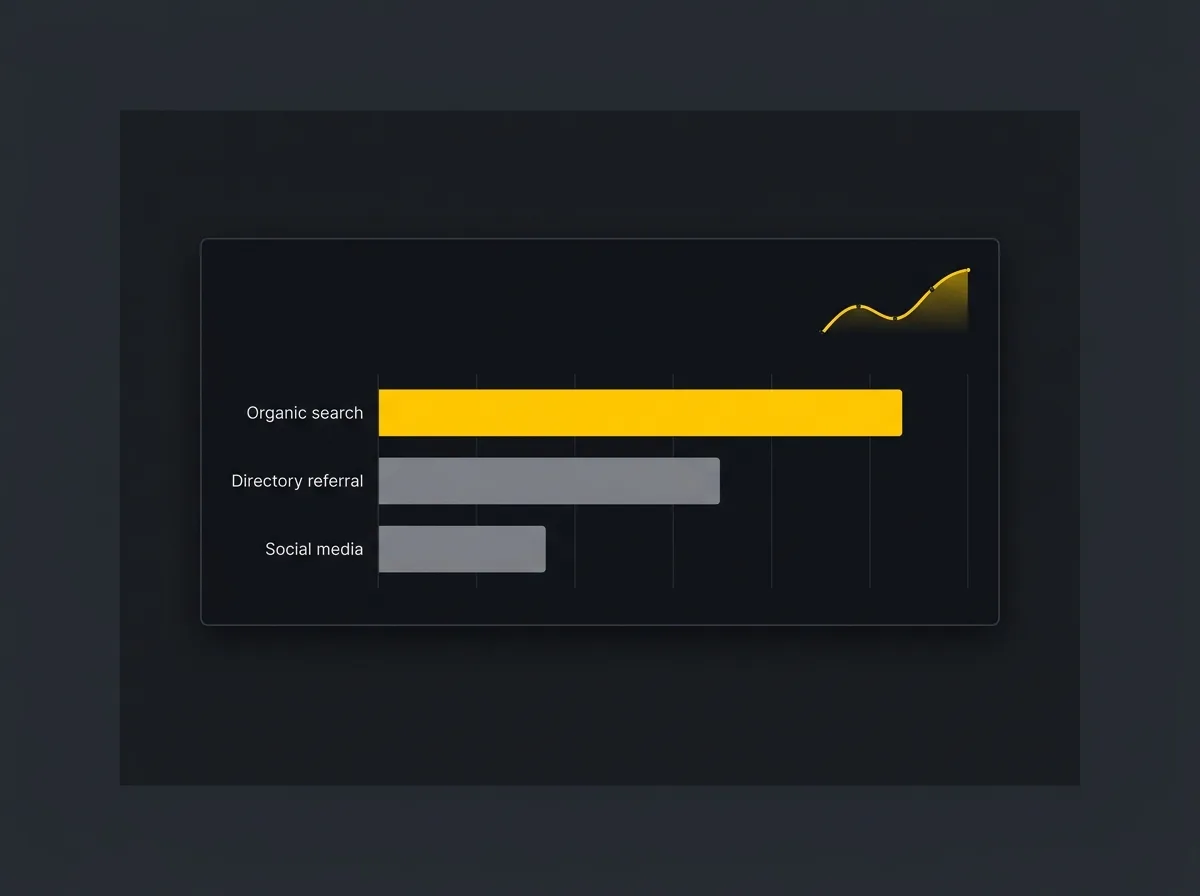
Where organic search fits in all this is as the compound channel. It takes 3-6 months before landing page work produces visible ranking improvements. But it doesn't charge per enquiry. It doesn't switch off when a budget runs out. It gets stronger over time as content and authority accumulate.
The practical argument is about commission dependency. If you're currently getting 60% of your bookings through directories at, say, 10-15% commission per booking, and you could shift 20 percentage points of that to direct organic enquiries over 18 months, the financial case is significant. A well-structured SEO strategy doesn't replace your directory presence overnight. It builds alongside it, gradually reducing the proportion of bookings that cost you commission every time.
What to expect from wedding venue SEO (and how to know if it's working)
Timeline expectations first, because most venues get burned by agencies that don't set these clearly.
GBP improvements can show in local pack rankings within 4-8 weeks. That's the fastest win available, and the majority of the work is free. Organic ranking improvements for dedicated landing pages typically take 3-6 months before they're visible in search. AI search presence builds more slowly still, usually 6-12 months, as content authority accumulates and AI platforms index more of your published material.
The metrics that actually matter for a venue. Total website traffic tells you almost nothing useful on its own. A venue with 2,000 monthly visitors and 40 enquiries is doing significantly better than one with 10,000 visitors and 25 enquiries. What you need to track is: enquiry volume by source (does your contact form ask how couples found you?), GBP impressions, calls and website clicks in the Insights tab, Search Console impressions for your priority keywords, and map pack ranking for your key location and style searches.
Google Search Console is free and takes about 15 minutes to set up. Once connected, go to "Search results" and look at which queries are sending visitors. Queries with good impressions but low click-through rates are page title problems. Queries you rank for that you didn't expect are content opportunities. The blank spaces in your data are where you're invisible at stages one and two.
One red flag worth naming. If your website traffic is growing but enquiry rates are flat or falling, the problem is conversion, not visibility. Beautiful photography doesn't substitute for a clear call to action, transparent information about capacity and pricing, and a fast mobile experience. If the website makes couples work to find out whether you're even suitable for them, many will simply go elsewhere. This is worth understanding in the context of what to expect from hospitality SEO more broadly, where the same pattern of traffic-without-enquiries shows up repeatedly.
Three things you can do this week to get started
Starting with SEO can feel overwhelming if you're not sure where to begin. These three actions are the clearest first steps, in the order that produces the fastest results.
-
Audit your Google Business Profile. Log into your GBP at business.google.com and check: is "Wedding Venue" your primary category? Do you have at least 30 photos? Have you responded to your last ten reviews? Is every attribute completed? Are you posting at least monthly? Twenty minutes of audit work usually reveals several gaps with immediate ranking implications.
-
Connect Google Search Console. If your site isn't in Search Console, set it up. Once connected, go to the "Search results" tab and look at which queries are sending visitors. The gaps in your data are the searches you're invisible for at stages one and two. That's your content brief.
-
Plan one dedicated landing page. Choose your most-enquired venue style and your primary county. Brief a page specifically about "[style] wedding venue [county]": what the space looks like, what capacity it holds, which nearby towns it serves, and two or three testimonials from couples who had that type of wedding. This page, properly written and published, is the most direct SEO action with measurable ranking impact within a few months.
Free resource: Traffic Projection Report
If you want to see what organic search could realistically deliver for your specific venue before committing to anything, a Traffic Projection Report models the traffic opportunity based on your current position and your priority keywords. It's free, takes a working day to produce, and gives you something concrete to make a decision from.
Frequently asked questions about SEO for wedding venues
How long does SEO take for a wedding venue?
It depends on which part of SEO you're working on. GBP improvements are the fastest: changes to your Google Business Profile can show in local pack rankings within 4-8 weeks. Organic ranking improvements for landing pages typically take 3-6 months to become visible. AI search presence is the slowest to build, usually 6-12 months, as it depends on content authority accumulating over time. These timelines assume consistent effort rather than a one-off activity.
Is SEO worth it for a smaller or independent venue?
Yes, and arguably more so for independent venues than for large hotel chains with national brand budgets. Smaller venues can own niche long-tail terms that directories don't build specific pages for: "intimate barn wedding venue Wiltshire", "outdoor wedding venue for 60 guests Kent". National directory pages don't compete seriously for these. A boutique venue with well-targeted landing pages can outrank them for the searches that actually match what the venue offers.
Do we need separate pages for each wedding style we offer?
Yes. A single "Weddings" page with photography and a contact form will not rank for "rustic barn wedding venue Cheshire" or "outdoor wedding venue with accommodation West Sussex". Google needs a dedicated page with real written content about each specific style, capacity, and location combination you want to rank for. It takes more effort to create, but it's the actual mechanism that produces long-tail rankings.
Can AI tools like ChatGPT recommend my venue?
Increasingly, yes. The venues appearing in AI-generated recommendations tend to share specific characteristics: a complete and active Google Business Profile, LocalBusiness schema on their website, published real wedding content with full location detail, and consistent contact information across the web. It's not guaranteed and AI-driven discovery is not yet the primary channel for most couples. But venues building these foundations now are better positioned as that changes.