
"We can get you to page one for 'boutique hotels in the Cotswolds.'"
The pitch lasted an hour. The agency covered domain authority, backlink targets, and content calendars. They had a traffic forecast projected out twelve months. What they didn't mention, in sixty minutes, was Booking.com.
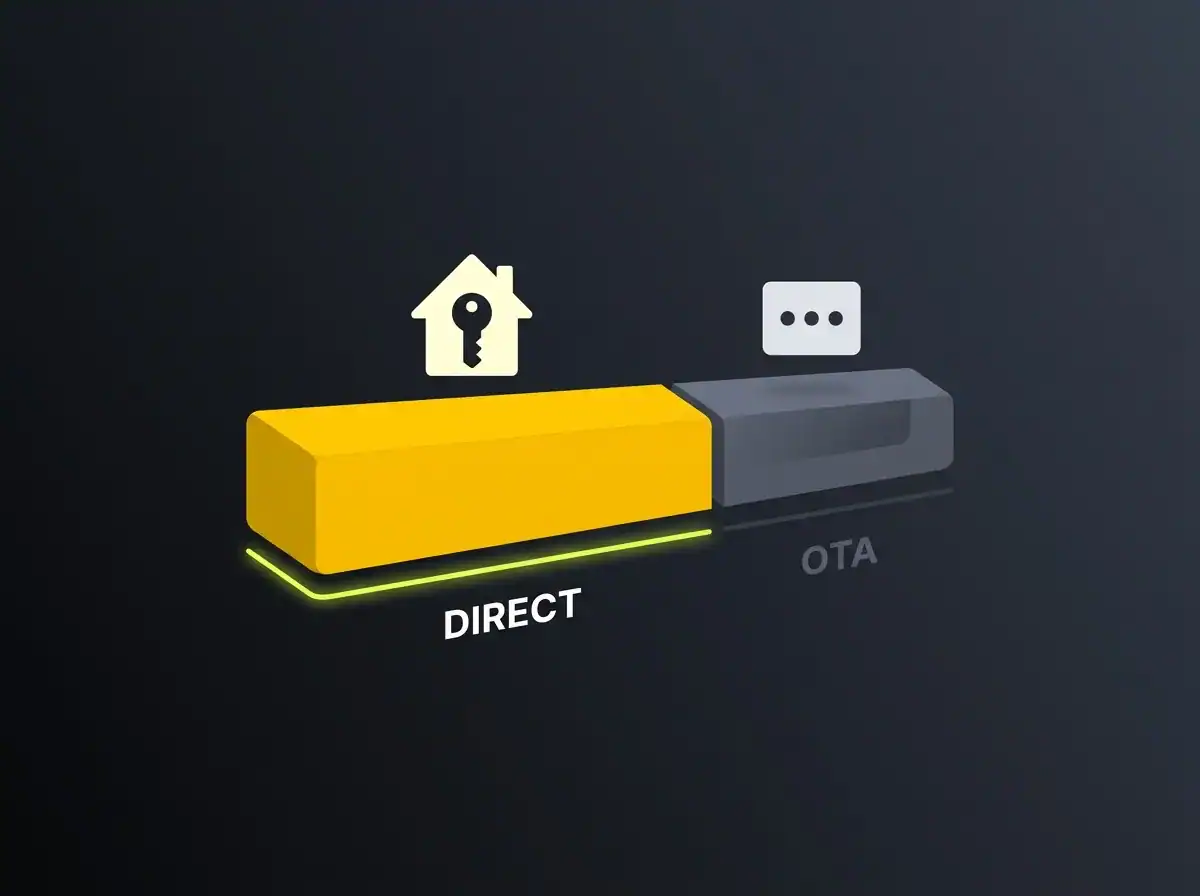
The hotel owner already knew the problem. It wasn't rankings. It was commissions. At somewhere between 18 and 22 percent per booking, the OTAs were taking a meaningful slice of every room sold through their platforms. Occupancy was holding up. Direct bookings were drifting down. Profit per room was getting quietly, consistently worse.
When the question came up, the agency had no answer on what improved rankings would do to that commission cost. They had no position on what happens when your own website and Booking.com compete for the same branded search query. Revenue didn't come up once.
That gap, between what a generic agency pitches and what a hotel actually needs, is what this guide is here to close.
Hotel SEO is a genuine discipline with specific deliverables and a clear line to revenue. But you only get those things from someone who understands what you're actually selling: a room, a night, a direct booking that keeps the full margin in your business rather than paying a fifth of it to an intermediary.
This is the buyer's guide the market is missing. What hotel SEO services should include, how to measure whether they're working, and what to ask before you commit to anything.
Why hotel SEO is not just regular SEO with hotel keywords
Generic SEO agencies treat hotel work like any other local business. It isn't.
There are five dynamics in hospitality that don't appear in most SEO playbooks. If the agency you are considering can't speak to all five, they are guessing.
OTA cannibalisation. When someone searches for your hotel by name, Booking.com and Expedia are bidding on that query too. If your own website doesn't rank for branded searches or doesn't convert when it gets the click, the OTAs win the booking and take their commission. Generic agencies rarely think about branded search as a revenue protection exercise. For hotels, it is one of the most important things to get right.
Rate parity. Most hotels are locked into rate parity agreements with their OTA partners, which means you can't undercut them on price. The lever you do have is value: an SEO programme that drives guests directly to your website, where you can offer early check-in, a room upgrade, or a breakfast package that the OTA listing doesn't carry. That value proposition only works if your direct booking channel is strong enough to be the destination.
Seasonality. Hotel search demand is deeply seasonal, and not always in obvious ways. A ski lodge in Aviemore has completely different traffic patterns in February versus July. A city hotel in Edinburgh has a spike around the Festival and a quiet November. An SEO programme that ignores your seasonal shape will produce ranking reports that look fine in the wrong months and flat in the months that actually matter.
Room-type pages. Most hotels have between five and twenty distinct room types. Each one is a ranking opportunity for queries like "sea view suite Cornwall" or "dog-friendly rooms Peak District." Generic agencies treat these pages as internal site navigation. A hotel SEO programme treats each room-type page as a commercial keyword target in its own right.
Research versus booking queries. The person typing "luxury hotels in Edinburgh" is in early research mode. The person typing "Edinburgh hotel free parking pet friendly" is ready to book. An SEO programme that only targets the high-volume research terms will grow your traffic and move your revenue very little.
None of this is complicated once you understand the vertical. But you need someone who has understood the vertical before they start work on your site.
What a proper hotel SEO programme actually includes
A properly structured hotel SEO programme covers seven areas. Here is what each one involves and why it matters.
Technical SEO. Core Web Vitals, mobile performance, structured data markup for hotels and room types, and where applicable, schema for prices and availability. Most hotels have accumulated years of technical debt: slow pages, broken redirects, duplicate content across similar room descriptions. This is invisible to guests but it is what search engines read first, and a programme has to clear it before rankings will move reliably.
On-page SEO. Your homepage, room-type pages, offers and packages pages, and meetings and events pages all need to be built around what your target guests are actually typing, not what you want to say about your property. That means proper title structures, clear and relevant page copy, and an internal linking logic that tells search engines which pages matter most.
Content. Local area guides, "things to do near [your hotel]" pages, event-based content tied to your local calendar, FAQ content that captures the questions guests ask before booking. This is the compounding part of the programme. Pages published this year will still drive bookings two years from now, with no ongoing cost per click.
Local SEO. Your Google Business Profile is the most immediate driver of local direct search visibility and one of the most consistently underdone areas of hotel marketing. More on this shortly.
AI search visibility. Travellers increasingly start their research in ChatGPT, Perplexity, and Gemini before they reach a traditional search engine. A modern hotel SEO programme needs an AI search visibility component that ensures you appear in those conversations rather than ceding them to OTA platforms.
Link building. Coverage in travel and lifestyle publications, local authority sites, and partner organisations. This builds the domain strength that makes rankings stable over time rather than volatile when algorithms shift.
Reporting. Not a ranking report. A proper reporting layer connects organic search performance to your booking engine so you can see organic direct bookings, the branded versus non-branded organic split, and month-on-month movement in your direct-to-OTA ratio. Rankings are a lagging indicator. Revenue is what you are actually tracking.
Local SEO for hotels is its own discipline
When a guest types "hotels near King's Cross" or "boutique hotel with parking near Bath Spa", Google pulls its local results from a combination of your Google Business Profile data, your website, and your review profile. Most hotels have underinvested in all three.
Google's hotel category documentation covers features unavailable to most other business types: room rate integration, amenity filters, and a direct booking button that bypasses the OTA layer entirely. Most hotel GBP profiles are set up at launch and never revisited. Missing amenity data, outdated photos, no strategy around the review volume and recency that determine local pack position. That's the norm, not the exception.
Location-of-stay queries are their own keyword category. Searches like "hotels near Wembley Stadium", "hotel with spa near Manchester Piccadilly", and "pet-friendly hotel near [local venue]" represent guests who know what they want and are in booking mode. These queries convert at high rates because the intent is specific. They are also winnable for independent hotels that treat local SEO as a serious channel.
For hotel groups with multiple properties, local SEO for hotels becomes more complex. Each property needs its own properly built location page on the group website, optimised independently for its local market. Template clones with a changed postcode and swapped photos will not rank. Each page needs genuine local relevance through the content it carries and the local links it earns.
The interaction with metasearch platforms like Trivago and TripAdvisor is worth noting too. These platforms draw on similar data signals to organic local SEO, which means the local SEO work reinforces your paid metasearch presence rather than sitting in a separate channel.
AI search visibility is the next OTA risk and the next OTA opportunity
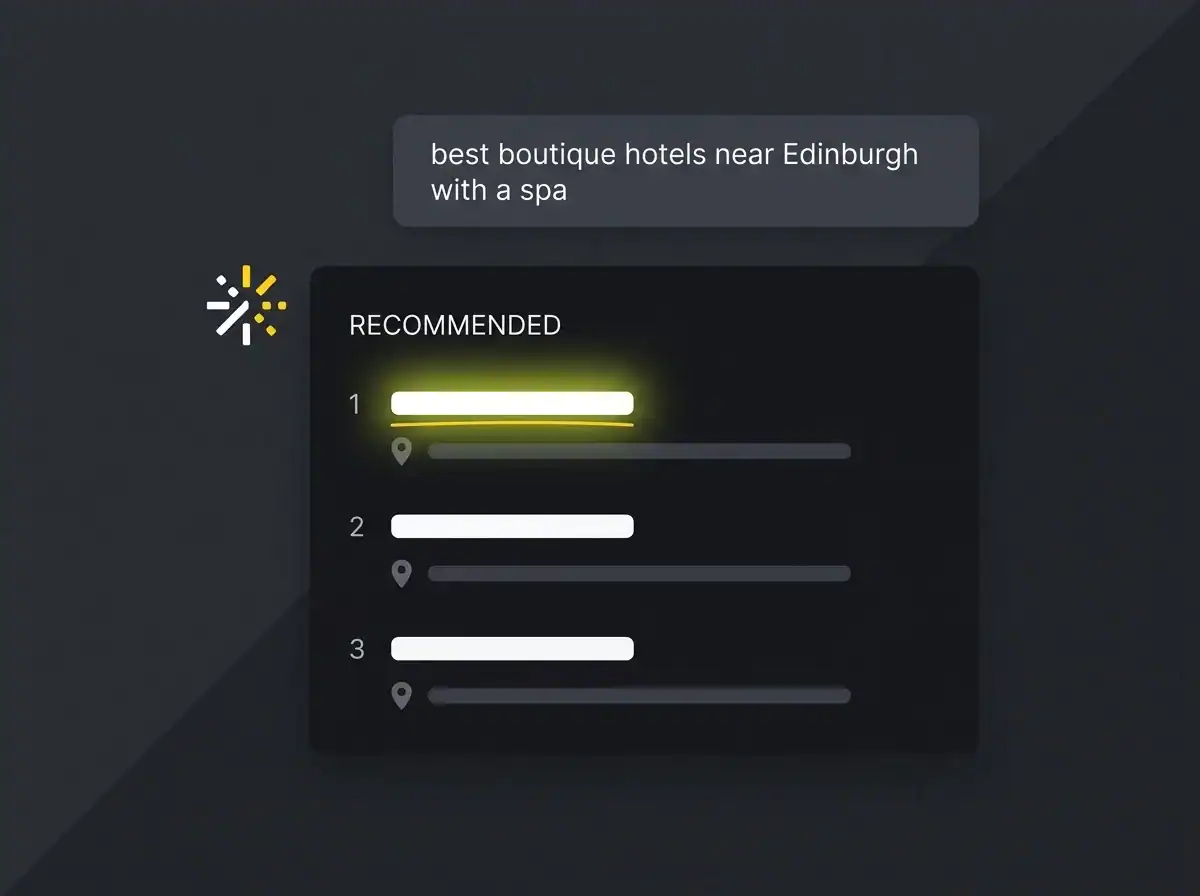
Sit with this question for a moment. A potential guest opens ChatGPT and asks: "What are the best boutique hotels near the Cotswolds with a spa?" The response comes back with four properties. Yours isn't one of them.
Where does that booking go?
This is not a hypothetical. Booking.com and the major OTA platforms invest heavily in structured data and content to ensure AI tools cite and recommend them in hotel research queries. Most independent hotels don't yet know this is happening, let alone doing the work to compete.
The risk is straightforward. If AI tools learn to default to OTA results, because that's the most consistently structured hotel data available to them, the commission problem doesn't get solved by SEO. It moves upstream. You lose the booking before the guest has even typed a query into Google.
The opportunity is equally real. Hotels that build their AI search presence now are doing so before the competition has noticed the shift. What AI visibility for hotels actually involves is closer to structured content work than traditional link building: clear entity information stated plainly and consistently across your website, review profiles, and directory listings; citable FAQ content that answers the questions travellers genuinely ask; a site structure that gives AI tools clear signals about who you are and what you offer.
AI search traffic converts at a much higher rate than traditional organic search because users arrive having already completed the comparison step. A traveller who found you through a Perplexity recommendation is further along in their decision process than someone who clicked through from a Google results page. That conversion dynamic matters particularly for hotels, where a booking means specific dates and a meaningful spend.
A hotel SEO programme in 2026 without an AI search visibility component is only covering half the landscape. The channel is early and the standards are low. For independent hotels willing to move now, the first-mover advantage is significant.
How to measure hotel SEO results that actually move revenue
Rankings are the metric hotels get sold on. They are not the metric that tells you whether the SEO is working.
The metrics that actually matter are these:
Organic direct bookings. Your booking engine should fire GA4 events every time someone completes a reservation. Filtered to organic traffic sources, this tells you how many bookings came from guests who found you through search and booked without going through an OTA. This is the number you are moving. Everything else is context for it.
Branded versus non-branded organic split. Branded traffic, people searching your hotel name directly, is mostly existing demand. Non-branded traffic, people searching location queries, room-type terms, or "things to do near" content, is new demand your SEO is generating. A programme that grows only branded traffic is protecting what you already have. A programme that grows non-branded traffic is expanding the pool of guests who can find you at all.
Direct-to-OTA booking ratio. What percentage of your bookings arrive direct versus through OTA platforms? According to UKHospitality, OTA commission costs remain one of the primary margin pressures for UK independent hotels, with rates commonly running between 15 and 25 percent. Moving this ratio by ten percentage points over a twelve-month programme is a structural improvement to your business, not just a marketing metric.
AI visibility share. How often does your hotel appear when travellers ask AI tools about properties in your area? The measurement infrastructure is still developing, but tracking it from the start of your programme gives you a baseline when the tooling catches up.
Rankings, total organic sessions, and domain authority are all useful as context. None of them is the goal.
What good looks like across the first year follows a clear pattern.
At 90 days, the technical and on-page foundations should be in place. Your Google Business Profile should be fully built out, your key commercial pages properly optimised, and the first content pieces targeting local and non-branded queries published. AI visibility should be baselined.
At 180 days, you should see measurable improvement in branded direct bookings as your own site begins competing more effectively for guests who already know your name. The first gains on non-branded commercial queries should be visible in Search Console, even if volumes are still modest.
At 365 days, the metric to watch is the direct-to-OTA ratio. SiteMinder's data from Hotel Kragemann, which recorded a 15 percent increase in direct bookings through improved search strategy and booking engine, gives a useful third-party benchmark for what a well-run programme can deliver over twelve months. Exact figures depend on your starting point and competitive market. But the direction of travel should be clear and measurable, and any agency worth working with should be able to show you both.
What to ask before hiring a hotel SEO agency
Before you sign with anyone, put these questions to them directly.
Have you worked with hotels before? Not "hospitality broadly" and not "a resort in Portugal once." Which properties, what was the starting problem, and what did the results look like in terms of direct booking performance? An SEO agency that knows hospitality should be able to describe the specific hotel dynamics they've navigated: branded search cannibalisation, seasonal traffic patterns, room-type keyword strategy.
How will you measure direct bookings? If they look uncertain, stop the conversation there. The entire point of hotel SEO is to increase direct revenue. An agency that can't explain how to connect GA4 events to your booking engine and filter for organic traffic is not going to produce results you can measure or defend.
What is your position on AI search? If they haven't thought about it, they are behind. AI search is already reshaping how travellers discover properties. An agency that treats it as irrelevant or future-speculation hasn't been paying attention.
What does your reporting actually show? Ask to see a redacted example. It should show organic direct bookings, the direct-to-OTA ratio trend, and progress on the specific query targets the programme is working on. A report that is a collection of keyword positions is not hotel SEO reporting.
What does your first 90 days look like? The answer should be: technical audit and fixes, GBP optimisation, on-page improvements to the highest-value commercial pages, and the start of a content programme. "Strategy and discovery" is not a sufficient first quarter.
Red flags: ranking guarantees without caveat, no answer on OTA cannibalisation, pricing based entirely on the number of keywords tracked, no mention of Google Business Profile, AI search absent from the conversation entirely.
Where SEO fits alongside paid, metasearch, and your booking engine
SEO is not a replacement for Google Hotel Ads, metasearch bidding, or paid brand defence. It is the long lever that makes everything else more effective over time.
Paid channels and metasearch generate demand right now, at a cost per click. SEO builds the organic base that generates demand continuously, without the per-booking cost. A stronger organic position lowers your cost-per-acquisition across paid channels because your baseline direct traffic is already moving before a single pound of paid spend is involved.
Your booking engine matters more than most agencies will admit. The best SEO programme cannot fix a checkout flow that is confusing, slow, or poorly optimised for mobile. Hotel website design and the guest's journey from search result to confirmed booking are part of the same conversion problem. If your organic traffic is arriving and not booking, the answer is almost never more SEO. It is usually a booking flow that is asking too much of the guest.
The stack that works: SEO builds the floor, paid and metasearch capture demand spikes, and a well-designed booking flow converts the traffic you have earned.
The next step before you commit to anything
You are renting your demand from Booking.com. That is the plain version of the OTA dependency problem, and it is the problem hotel SEO is there to solve.
A proper hotel SEO programme addresses the specific dynamics of your vertical: branded search protection, room-type keyword opportunities, local search, AI visibility, and a reporting layer that connects everything to direct booking performance. It delivers measurable results at 90-day intervals against a clear framework, not a quarterly screenshot of improved rankings.
If you want to see what a programme could realistically deliver for your specific property, the Traffic Projection Report gives you a baseline built on your actual search footprint, your keyword opportunities, and the competitive landscape for your location and category.
Free resource: Traffic Projection Report
We model your organic traffic potential from your current search position, your room-type and location keyword opportunities, and the direct booking gap between your property and the competitors already ranking in your area. You'll see a realistic picture of what an SEO programme could move, in specific numbers, before you have committed to anything.
Own your demand. Don't rent it from the OTAs.