
Three agencies. Two months. The pitches were almost identical.
Keyword research. Google Business Profile. Content marketing. Link building. Every agency said roughly the same things, in roughly the same order, at roughly the same price. One mentioned E-E-A-T. Another said something about AI search without explaining what that actually meant for a Birmingham accountancy practice trying to attract more business owner clients.
You have done the meetings. You know you need SEO. What you cannot work out is what a decent service should actually look like, what separates a good agency from one that sends you a rankings spreadsheet every month and calls it a job done, and whether what you are being quoted represents value.
Good.
That is the exact question this article answers.
What do SEO services for accountants include?
A proper SEO service for an accountancy firm covers keyword strategy targeting the terms prospective clients actually search, content that builds topical authority within Your Money or Your Life territory, technical SEO ensuring the site is correctly structured and crawlable, local SEO for geographic competition, and quality link building from relevant industry sources.
Good reporting connects the work to enquiry volume, not rankings. A well-run programme typically produces measurable organic enquiry growth within six to twelve months.
This article covers what good looks like across each of those areas, what to measure, and what to ask before you commit.
Why accountancy SEO is harder to evaluate than it looks

Accountancy sits in what Google calls Your Money or Your Life territory. That classification affects everything. Google holds content on accountancy websites to a higher credibility standard than it applies to a plumber or a restaurant, because bad advice on financial matters carries real consequences.
E-E-A-T is not a box to tick.
E-E-A-T, which stands for Experience, Expertise, Authoritativeness, and Trustworthiness, is the bar every page needs to clear before it stands a genuine chance of ranking. In practice, this has direct consequences for what good content means in an SEO service. Content written by a generalist with no financial services background reads differently to content produced by someone who understands management accounts, Corporation Tax, or the distinction between a compliance service and an advisory one.
Google's quality raters notice the difference. Clients can too.
The B2B client acquisition cycle also changes how SEO has to work for accounting firms. A company director looking for a new accountant does not Google "accountant Birmingham" and sign a fee agreement the same afternoon. They research over weeks, compare on reputation and specialism, ask their networks, and often arrive at a decision that feels more like being recommended than being found.
SEO has to support that longer journey.
That changes which keywords matter. Research-phase terms, the questions prospects type into Google six weeks before they are ready to choose, are often as valuable as transactional terms. An agency that targets only "accountant near me" while ignoring the questions a prospect asks earlier in the process is missing half the job.
There are also more than 30,000 registered accounting practices in the UK. Competition varies significantly by city, by specialism, and by firm size. An agency that does not start with competitive analysis for your specific market is skipping the step that determines whether any of the subsequent work makes sense.
That is not automatically a red flag. But it is the first question worth asking.
What a good SEO service for an accountancy firm should actually include
The standard agency pitch is a version of the same checklist: keywords, local SEO, content, links. That list is not wrong. The problem is it tells you nothing about whether the work is being done well, or whether it is calibrated for how accountancy firms actually win clients online.
The specifics are where good agencies separate themselves.
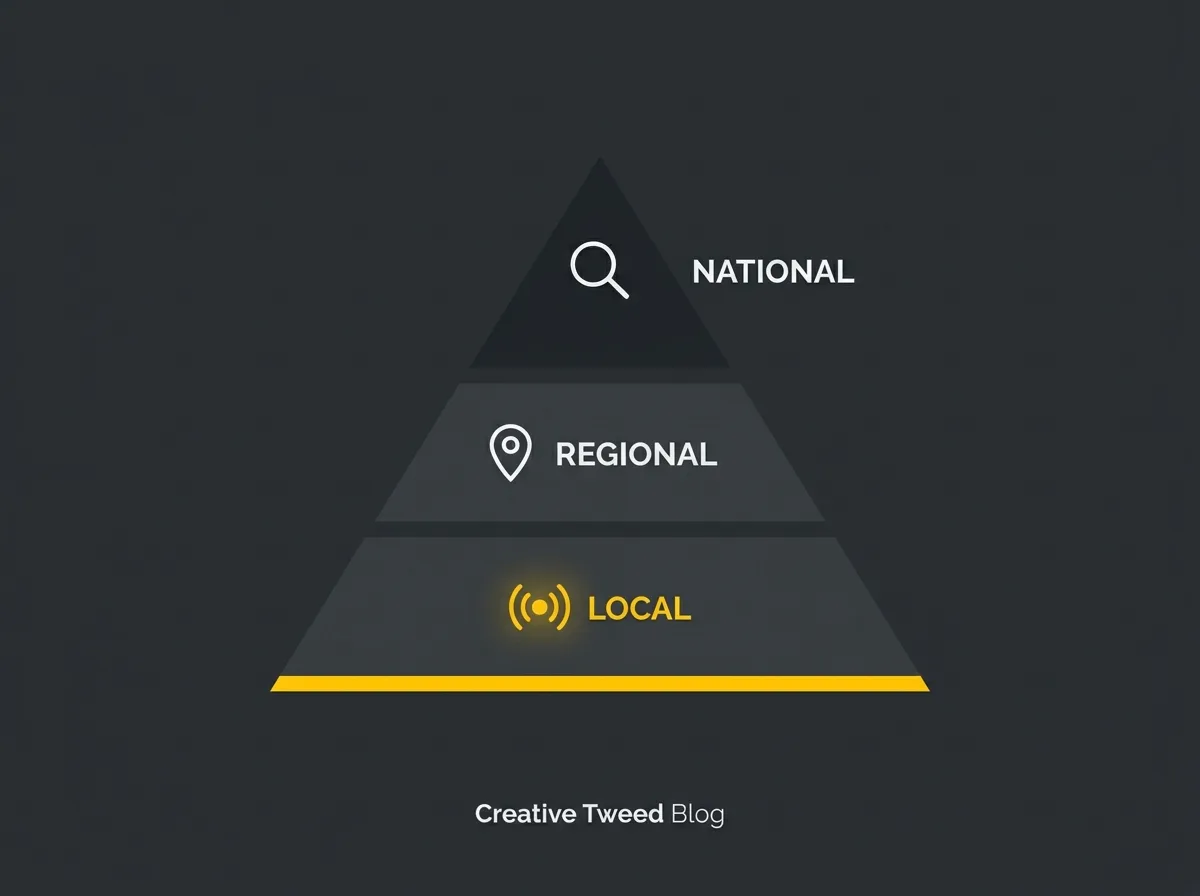
Keyword strategy built across three tiers. A strong SEO services approach for an accountancy practice works across three levels at once. National service terms cover prospective clients searching for a specific type of accounting work regardless of location: "small business accountant," "management accounts service," "R&D tax relief specialist." Regional terms target a city or area: "accountant Manchester," "Birmingham tax accountant." Local intent terms cover the final research stage: "accountant near me," "tax accountant in Solihull."
The right mix depends on the firm's growth ambitions and the geography it serves. A common red flag: an agency that pitches purely on keyword volume without explaining which tier each term sits in. High-volume accountancy terms are often dominated by aggregators, directories, and comparison platforms. Chasing them without a clear rationale wastes budget.
Content deliverables. At minimum, every core service area should have a dedicated page built around the right terms and with genuine depth. Beyond that, an ongoing content plan builds topical authority over time, answering the questions prospective clients are searching during the research phase.
For YMYL content, this means work produced with real sector knowledge. ICAEW and ACCA govern what accounting firms can and cannot say in public-facing communications. An agency with no awareness of where content might stray into regulated advice territory is a liability, not an asset.
Technical SEO. Page speed, mobile usability, a secure connection, and correct schema markup are the foundations. For accountancy sites, LocalBusiness schema and AccountingService schema are both relevant and genuinely useful for search visibility. This is table stakes rather than a differentiator, but it needs to be within scope. If an agency's initial process does not include a technical audit, ask why.
Local SEO as a component, not the whole service. Google Business Profile optimisation, local citation consistency, and review generation are a distinct workstream within a broader SEO programme. They matter. Many practices have been pitched on local SEO as if it were the complete solution, which rarely fits a practice with multiple specialisms or national ambitions.
Our piece on what accounting firms get wrong about local SEO covers the map pack and Google Business Profile angle in depth. This article is about the broader service.
Link building. A mention or link from AccountingWeb, ICAEW, a regional chamber of commerce, or a relevant financial publication carries genuine weight. Directory spam does not. When evaluating any agency, ask where they build links and what a good link looks like for a firm like yours.
"We have a network of sites" is not an answer.
How AI search is changing how business owners find accountants

Business owners in 2026 increasingly use ChatGPT, Claude, and Perplexity as part of the research journey. A company director who needs a new accountant might ask an AI assistant "who is the best accountant for a 10-person business in Leeds?" without opening Google at all.
If the agency pitching you is not talking about this, they are not thinking about the full picture.
Run that query through ChatGPT or Perplexity now. You will get a serviceable checklist: keyword research, local SEO, E-E-A-T content, technical basics. The answer is not wrong. It is also not specific to your firm, your market, or your competitive position.
That specificity gap is exactly why AI search converts at a significantly higher rate than traditional search: users arrive having already done their research, verifying a choice rather than comparison shopping between five options.
What does this mean in practice? E-E-A-T signals, structured content, reviews, directory citations, professional body membership, and published articles all feed into how AI tools cite and recommend professional service firms. It is not a separate programme from SEO. It is the same work done to a higher standard.
What to look for in the agency conversation: do they mention AI search visibility at all? Do they understand the difference between ranking in Google and being cited in an AI summary? Do they have a view on how Perplexity sources recommendations for local professional service firms?
Blank stares here are a meaningful data point.
What good reporting looks like, and what's just noise

Most SEO agencies report rankings. Rankings are easy to move for low-value terms, easy to present attractively, and nearly impossible to connect to new client enquiries. Knowing that your practice ranks fourth for "what is a balance sheet" tells you nothing about how many business owners contacted you because of it.
That is the core reporting problem.
The same issue applies to impressions and session counts. Organic traffic going up is not a bad outcome in itself. But traffic rising while enquiries stay flat is a very specific and very common failure mode.
What to ask for instead is organic enquiry volume: contact form completions and calls tracked from organic sessions. Google Search Console data showing which pages and queries are generating qualified clicks tells you far more than a rankings table. Google Business Profile actions, phone clicks, direction requests, and website clicks from the local panel, are all trackable and meaningful. Conversion rate from your key organic landing pages rounds out the picture.
A monthly report should surface three or four numbers the practice actually cares about. Sixty-five columns is not reporting. It is noise.
The red flag is an agency that cannot or will not show conversion data from organic search. If their only output is a rankings spreadsheet and an impressions graph, ask why conversion data is absent. Ask anyway, even if the question feels uncomfortable.
The quality of the answer, or the absence of one, is useful information before you sign anything.
Questions to ask and red flags to watch for

Before you commit to anything, three questions are worth putting directly to any agency you are seriously considering.
Ask them before you get to pricing.
-
What does success look like at six months and at twelve months, and how will we measure it? The answer should be specific to your firm and your market, not a generic description of how SEO works. If you get "it depends on many factors" without any follow-up specifics, that absence tells you something useful before you have spent a penny.
-
Who specifically will work on my account, and who writes the content? Large agencies often win pitches with senior staff and deliver with junior contractors. Content written by someone with no accounting background will underperform in YMYL territory. Ask to see examples of accountancy content they have produced and who produced it.
-
Can you show me a sample report from a current professional services client? Not a case study. A redacted version of the actual monthly report they send to a live client. If it leads with sixty-five columns of rankings data and no enquiry figures, you now know what your reporting will look like.
Red flags worth taking seriously:
-
Guaranteed rankings. Nobody in Google's ecosystem can guarantee a specific position on a competitive term.
-
Long lock-in contracts with no performance break clause. Confident agencies earn renewal rather than write it into the contract.
-
Content produced by anonymous writers with no professional services background.
-
Link building that cannot be explained at a URL level. A portfolio of named links is the standard; "we have a network" is not.
-
Zero mention of AI search or E-E-A-T in how the agency describes its approach.
On timelines: three to six months is a reasonable window for the foundational work to be fully in place. Technical fixes resolved, Google Business Profile optimised, and initial content published. Six to twelve months is the normal window for meaningful organic enquiry uplift in most UK accountancy markets, where the B2B buyer journey is long and competition is real.
Worth knowing: this is an honest timeline, not a stall.
Any agency promising significant results in 90 days should be asked specifically which results, measured how.
On budgets: under £500 per month typically covers template audits and minimal ongoing activity, with results to match. £800 to £1,500 per month covers active content creation, local SEO management, and technical maintenance, which is appropriate for most regional practices.
£1,500 to £3,000 per month is a more complete programme with content at scale and active link building, suited to larger or national-reach firms.
The most common problem in this market is mid-range pricing for entry-level outputs. The sample report question is exactly how you tell which camp you are likely to be in.
The difference is specificity
The thing that separates an adequate SEO service from a good one is specificity. Specific keyword targets for where your firm actually competes. Content that demonstrates real accounting-sector knowledge rather than generic financial services copy. Reporting that connects the work to enquiries rather than impressions.
Specificity shows up in the details.
If three agencies have pitched you with identical-sounding promises, the differences will show up in the specifics: the sample report, the content examples, the named sites where they have built links for similar clients, the clarity of the answer when you ask what success looks like at month six.
Before you brief any agency: Traffic Projection Report
Before you approach agencies, it helps to have a number in mind. What could SEO realistically deliver for your practice, given who you are competing with and the market you operate in, over the next 12 months? The Traffic Projection Report gives accounting firms exactly that figure, built from your actual market data rather than a generic estimate. It turns "is SEO worth it for a firm like ours?" into a conversation you walk into with a benchmark rather than a blank sheet.
For a broader view of where search visibility fits into the picture for professional services firms, the hub page is a useful starting point once you are ready to look at the wider picture.
Frequently asked questions about SEO services for accountants
How much do SEO services for accountants cost?
Most regional accounting practices should expect to invest between £800 and £1,500 per month for an active programme covering content, local SEO management, and technical maintenance. Larger firms targeting national-reach terms or multiple service lines typically sit in the £1,500 to £3,000 range. Under £500 per month tends to cover minimal activity with results to match. The most reliable guide before committing is asking the agency for a sample monthly report and a content example from a current professional services client.
How long before I see results from SEO?
Three to six months is a reasonable window for the foundational work to be fully in place: technical fixes resolved, Google Business Profile optimised, and initial content published and indexed. Meaningful organic enquiry uplift typically takes six to twelve months in most UK accountancy markets, where the buyer journey is long and competition is high. That is a normal, honest timeline. Any agency promising significant results in 90 days should be asked specifically which results they are projecting and how they will be measured.
What should my monthly SEO report include?
A monthly SEO report for an accounting firm should lead with organic enquiry volume: contact form completions and calls tracked from organic sessions. Google Business Profile actions, including phone clicks, direction requests, and website clicks from the local panel, are the next priority. Google Search Console data showing which pages and queries are generating qualified traffic rounds out the core picture. Rankings are useful context but should not be the headline metric. If the report leads with a large spreadsheet and no clear enquiry data, ask for it to be restructured.
How do I know if my SEO agency is doing a good job?
The clearest signal is whether organic enquiry volume is trending upward over a six to twelve month window. Secondary signals include Google Business Profile action growth, improvement in rankings for service-line and regional terms that reflect genuine client intent, and new enquiries where the client specifically mentions finding the practice online. Rankings for low-intent terms, and impressions growth with no corresponding movement in conversion, are not the measure. If the agency cannot show an organic enquiry trend, ask why that data is not in the report.
Do I need a specialist accountancy SEO agency?
Not necessarily, but you do need an agency that understands what YMYL content requirements mean in practice, knows how the B2B client acquisition cycle affects keyword strategy for professional services, and has produced accountancy content before. The better question to ask is about capability: does the agency understand the specific constraints of accountancy SEO, and can they show evidence of work in professional services? The sample content and the sample report will tell you more than any specialism claim on an agency's website.