
A design engineer at a tier-two automotive supplier types "SS316 sheet metal precision cutting West Midlands" into Google. She needs a confirmed supplier within two weeks. No time for trade directories. No time to ring round and wait for callbacks. She wants three credible options in the next 20 minutes.
She finds a US-based company, a generic directory listing, and an article from 2019.
The precision fabrication business three miles away, the one that has run this exact process for fifteen years with ISO 9001 on the wall, does not appear. Its website has a services page with three bullet points, a contact form, and a PDF catalogue that Google cannot read.
That's manufacturing SEO in one scene.
You probably already know that buyers are researching online before they call. The real question is what, specifically, they're searching for, and whether your business appears when they do.
Most manufacturing SEO guides answer with advice lifted from e-commerce playbooks: target high-volume keywords, publish a blog, build some links. Not wrong. Just written for businesses where search volume correlates with buyer intent, and a sale closes in a week.
That describes almost nothing in UK manufacturing.
This piece explains how industrial search actually works, who is doing the searching, and what it takes to be visible across a buying cycle that can run from six months to eighteen.
Understanding why every B2B business needs an SEO strategy is a start. Understanding what that strategy looks like when your buyers speak in ISO standards and tolerances is the harder, more valuable part.
Why manufacturing search is different from almost every other B2B sector
UK manufacturing is not a niche. Make UK puts employment in the sector at around 2.7 million people, with manufacturing consistently among the largest contributors to UK export earnings. That is tens of thousands of businesses competing for the attention of industrial buyers who increasingly research suppliers online before making any direct contact.
Most SEO models were not built for this.
The standard B2B SEO model assumes one or two decision-makers, familiar search vocabulary, and a buying cycle measured in weeks. In SaaS, in professional services, even in many areas of construction, this broadly holds. In manufacturing, almost none of it does.
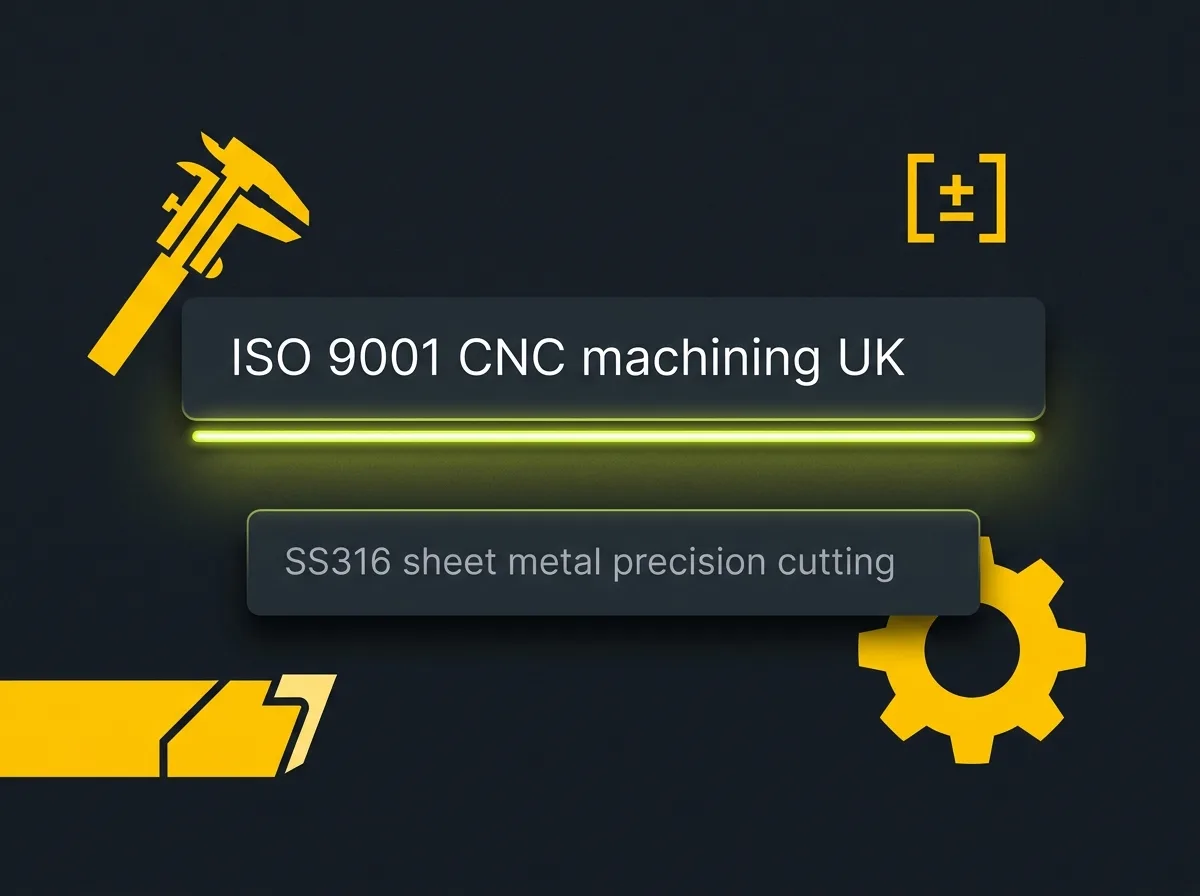
The specification problem. An industrial buyer is not searching "good metal fabricator" or "UK sheet metal company." They are searching for the precise technical specification of what they need.
"Aluminium 7075-T6 tight tolerance CNC turning Midlands." "IATF 16949 approved automotive stamping UK." "Electroless nickel plating on copper alloy components."
These are not niche variations of ordinary keywords. They are exactly what procurement managers and design engineers type when they have a live requirement. Standard SEO guides never discuss them, because individual specification queries carry tiny search volumes.
Low volume does not mean low value.
The person searching "AS9100 aerospace precision casting UK" is not browsing. They have a live project, a budget, and a timeline. Their intent is about as high as it gets in B2B.
A single enquiry from the right tier-one buyer can be worth more than a year of generic web traffic. The question is not whether the query has volume. The question is whether your business appears when it is typed.
The sales cycle problem. Manufacturing buying cycles routinely run six to eighteen months from initial supplier research to purchase order. The engineer who searches today might not raise the internal RFQ for three months. The procurement manager comparing shortlists won't place an order until Q3.
That means organic search has to work across the entire evaluation process, not just at the final decision.
A manufacturer who shows up only for commercial queries ("request a quote") misses the majority of the journey. Discovery, technical validation, compliance review: all of these stages involve search activity, and none of them end in an immediate phone call.
The generalist guide problem. Most manufacturing SEO advice was written for SaaS or retail, then lightly rebranded. "Create content your customers want." "Build links from industry sites." "Make sure your site loads fast." All technically accurate. All missing the point about which content, structured around whose vocabulary, for a buying process that bears no resemblance to the scenarios those guides had in mind.
The gap is the opportunity.
The three people who search before your sales team gets the call
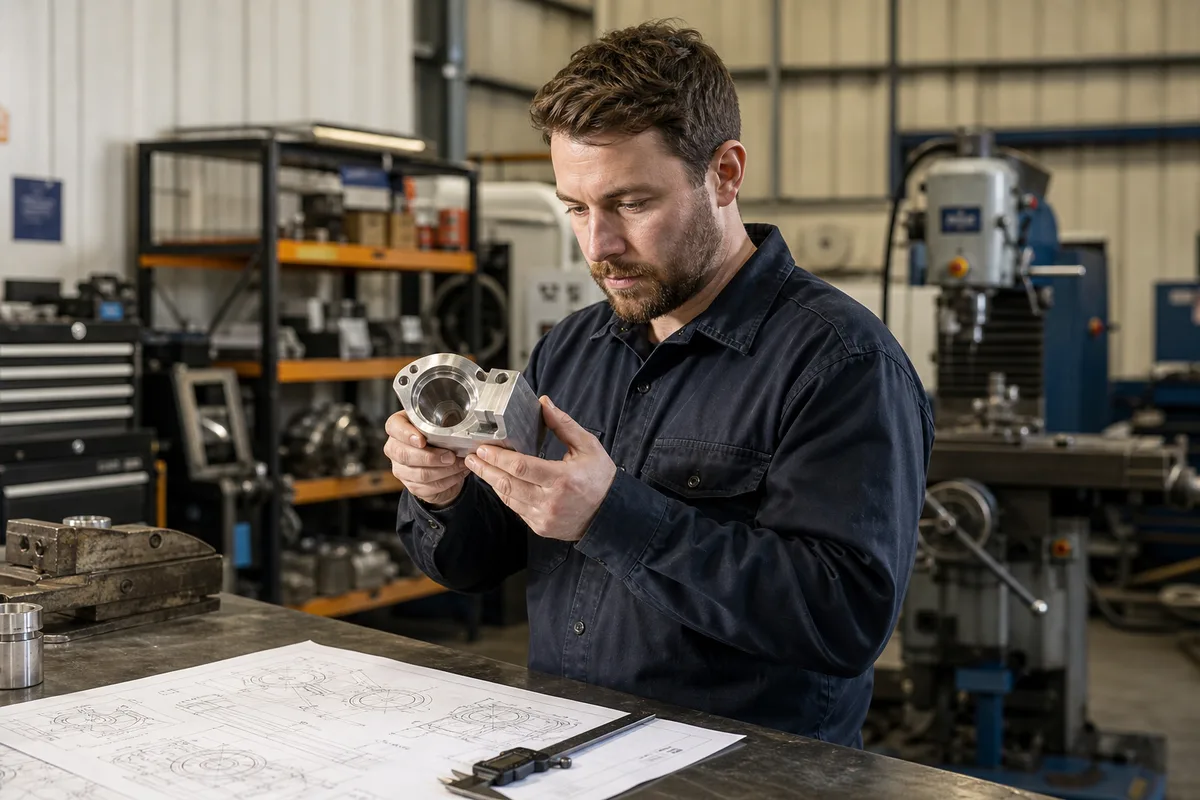
Before any RFQ lands in your inbox, at least two or three people have already searched for a business like yours. They are using completely different vocabulary and looking for entirely different signals.
That matters.
If your website speaks only to one of them, you are invisible to the others.
Design engineers. These are the people who actually specify what gets made. They search materials, tolerances, surface finishes, dimensional constraints, and process certifications. They want to know whether a supplier can meet the drawing requirements before they bother flagging the name internally.
A typical engineer search looks like: "minimum wall thickness 0.5mm SS304 laser cutting," "tight tolerance 5-axis CNC milling titanium UK," or "EN 9100 aerospace inspection capability." They are not comparing prices. They are building a technical shortlist.
If your website cannot answer technical questions, you will not make that shortlist, and the procurement team will never hear your name.
Procurement managers. Once an engineer flags a potential supplier, procurement takes over. Their searches look completely different. They are looking at supply chain risk, financial stability, geographic location, delivery track record, and certifications that matter to their own compliance obligations.
"ISO 9001 certified UK supplier tier-two automotive" or "British-made machined components, alternative to offshore." They are managing risk as much as finding a price.
Risk evidence beats capability claims. Every time.
Case studies from comparable sectors, visible accreditation badges, and named client industries do more for procurement confidence than any capability claim written in paragraph form.
Operations directors and plant managers. Often overlooked in manufacturing SEO discussions. These are the people who live with the supplier relationship after the purchase order is placed. They search for reliability evidence: track record in similar applications, quality metrics, customer references, and signals of how a supplier performs when things go wrong.
A plant manager at a food production business researching packaging machinery suppliers will search for compliance (BRC, HACCP), but also for case studies from similarly regulated environments. They want to understand what happens at week twelve, not just week one.
Here is the implication for your content strategy. A keyword plan built around "metal fabrication company UK" or "CNC machining services" reaches a fraction of the actual search activity happening in the months before any RFQ is raised.
A complete B2B SEO strategy for a manufacturing business goes three layers deep: by persona, by buying stage, and by application or process. Each layer requires different content, different vocabulary, and different signals of credibility.
The businesses that show up consistently across all three personas are the ones that win work without cold calling.
The types of content that actually move industrial buyers from search to RFQ
Once you understand who is searching and what they need to find, the content strategy becomes less complicated. Generic content about "why manufacturers should invest in marketing" does not help a design engineer build a technical shortlist.
Here is what does.
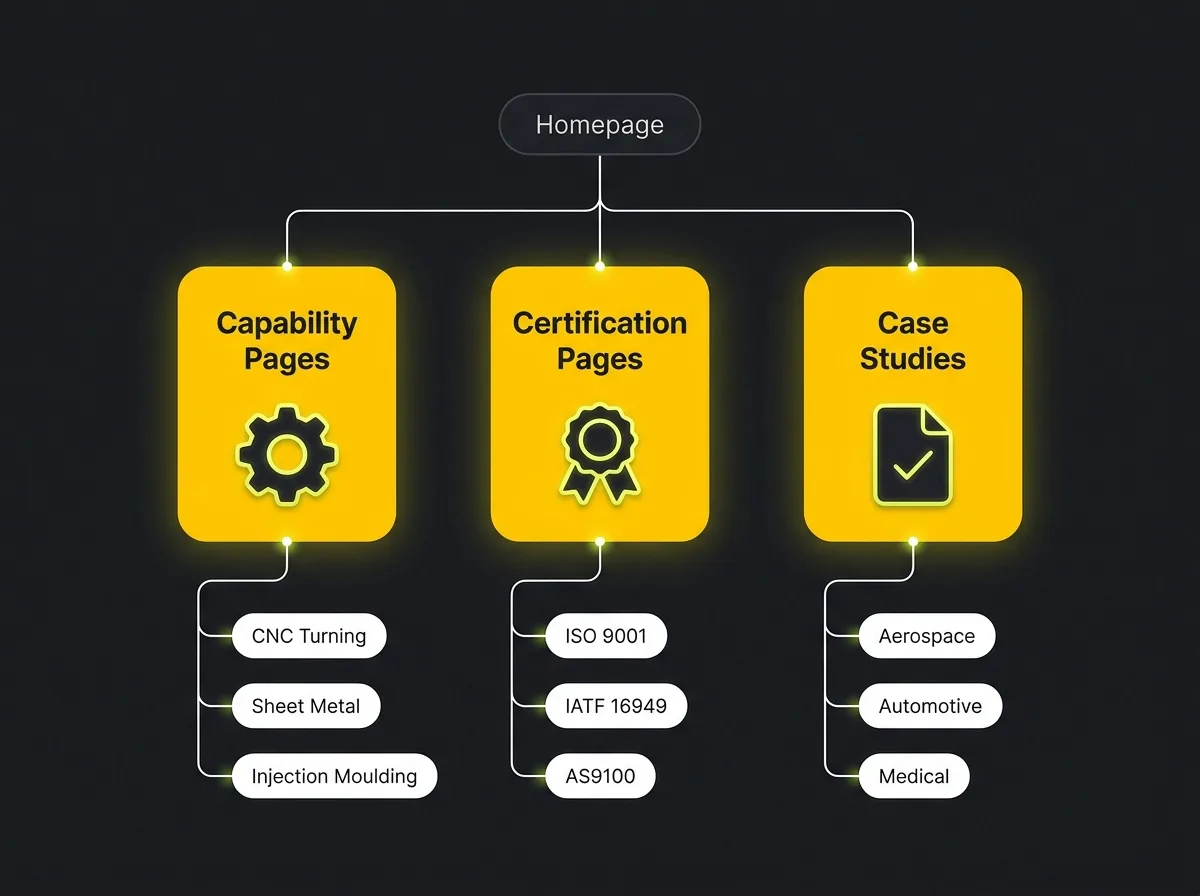
Capability pages. Not a single "services" page listing eight processes in three sentences each. Individual pages for each major capability: CNC turning, sheet metal fabrication, injection moulding, surface finishing, precision assembly.
Each page should include the specific materials the business works with, the tolerances it holds, the quality standards it meets, the sectors it has served, and the volume range it can handle. These are the pages that rank for specification queries and give engineers the information they need to form a technical opinion without making a phone call first.
Certification and accreditation pages. Buyers search by certification. "ISO 9001 manufacturer UK" is a real query with real commercial intent behind it. "IATF 16949 approved supplier West Midlands" is a real query.
If your accreditations are buried in a single line on your about page, you are missing enquiries from buyers who are specifically filtering by that credential. Each major certification deserves its own dedicated section, with enough context for Google to understand what the standard requires and why it matters to your target sectors.
Application-specific case studies. "Aerospace component fabrication case study" can rank and convert. "Case study: we made a product for a large company" cannot.
The application, the engineering challenge, and the measurable result are what buyers search for.
A precision engineering business that has worked with tier-one aerospace suppliers should have case studies that name the application, the technical challenge, and the outcome. The customer's name matters far less than the industry context and the specification detail.
Technical guides and FAQ content. Design engineers search with specific technical questions: "what is the minimum wall thickness for aluminium sheet metal cutting," "difference between anodising and hard anodising for aerospace applications," "EN 1090 execution class requirements for structural steel."
These are low-volume queries, but they build topical authority, attract exactly the persona three months away from an RFQ, and earn citation in AI-generated responses. Technical content that answers real specification questions is the longest-range asset in manufacturing SEO.
What does not work. PDF brochures that exist only as downloads and cannot be read by search engines. A single contact page with no specification content anywhere near it. "About us" pages written for trade show visitors rather than for an engineer doing due diligence at 9pm.
These are the defaults on most manufacturing websites.
Which is exactly why the gap exists.
Manufacturing web design: why SEO traffic doesn't convert if the site can't close
Even if a manufacturer gets the SEO right and starts appearing for specification queries, the website still has to do its job.
Most do not.
The typical manufacturing site was built to impress at a trade show, not to convert organic search traffic. There is a homepage with a headline about quality and reliability, a services page listing processes in two sentences each, an about page with a company history, and a contact form.
For a buyer who arrived via a specific technical search query, this structure answers none of their questions.
They cannot find out whether the business holds the tolerance they need. They cannot verify the certification they require. They cannot see a case study from a comparable application.
They leave.
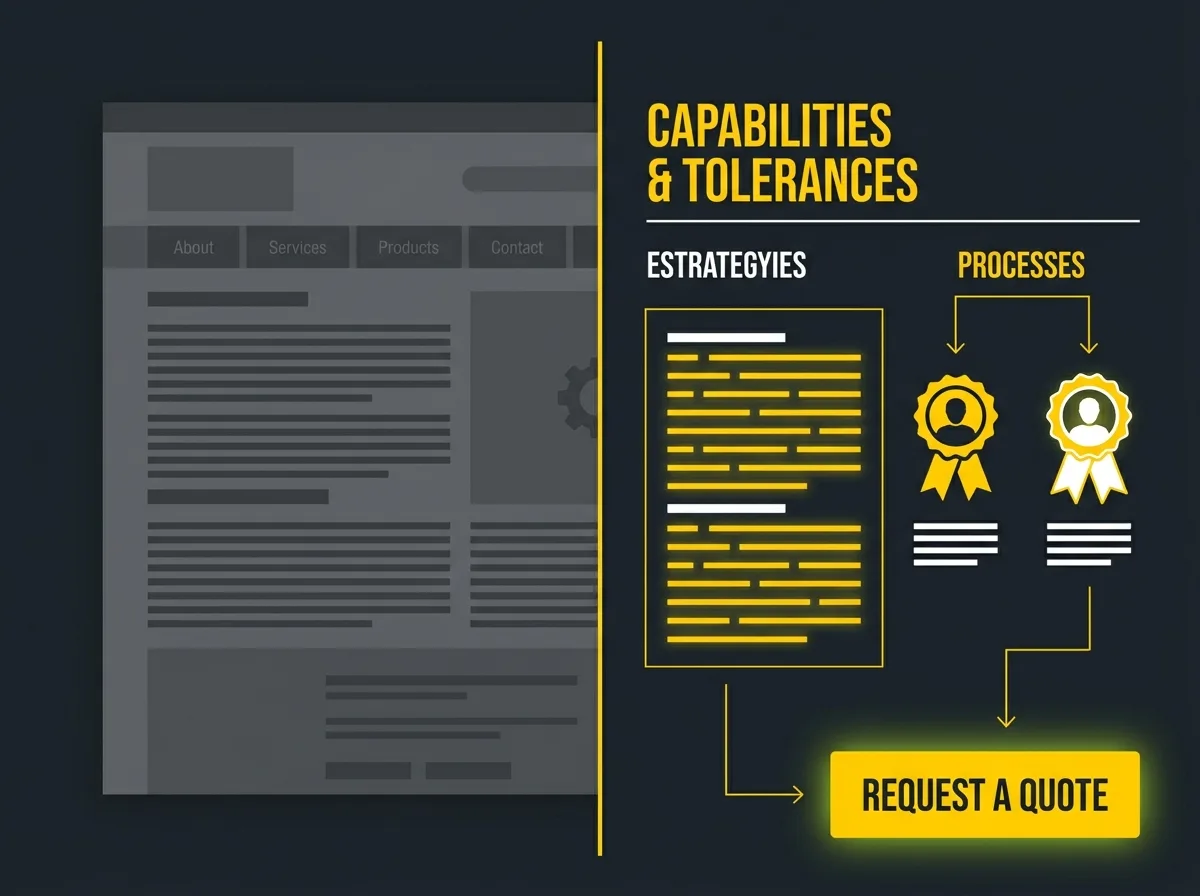
Good manufacturing web design solves this by structuring the site around how buyers actually evaluate suppliers, not around the business's internal categories.
That means clear navigation by process or application rather than a generic "products and services" dropdown. It means specification detail visible without a download, not buried in a PDF behind a click. It means enquiry routes and RFQ prompts on every capability page, not just on a dedicated contact page that buyers have to hunt for separately.
Soft conversion points matter here too.
A design engineer who is not ready to request a quote might be willing to download a materials data sheet, access a process capability statement, or read a sector-specific case study. These are legitimate next steps in a long buying journey, and they give the manufacturer visibility into who is engaging with the site before the phone ever rings.
Those principles are explored in detail in what B2B website design needs to turn visitors into enquiries, which covers the conversion architecture behind specification-led B2B sites.
Technical performance matters as much as structure. Core Web Vitals, mobile speed, and proper site architecture are prerequisites. A manufacturing site with five hundred pages of specification content is only as valuable as its ability to be indexed and served quickly.
Many industrial businesses rely on PDF catalogues for product detail. That content is largely invisible to search engines unless it also exists as crawlable HTML. The PDF can stay. The text needs to live on the page too.
Free resource: Traffic Projection Report
If you are not sure what organic search could realistically deliver for your manufacturing business, the Traffic Projection Report gives you a data-backed estimate based on your sector, your competitors' search footprint, and the keywords your buyers are actually using. Worth doing before committing budget to a content or SEO programme.
How AI search is changing the way procurement teams find suppliers
Procurement teams are increasingly using ChatGPT, Claude, and Perplexity as research tools before they open a supplier directory or send a formal RFQ. Forrester's B2B buyer research consistently shows that buyers want to self-educate through digital channels long before engaging any supplier directly. AI tools have made that early-stage shortlisting faster than ever.
A procurement manager might ask: "which UK manufacturers specialise in aluminium die casting for automotive tier-two supply chains?" The AI tool answers with a shortlist.
The businesses that appear in those answers are the businesses that get the early conversation.
This changes something important about manufacturing SEO. Page one of Google is still necessary. It is no longer sufficient on its own.
What makes a manufacturer appear in AI-generated supplier shortlists is exactly what makes them rank in traditional search: structured, specific content built around the vocabulary their buyers actually use.
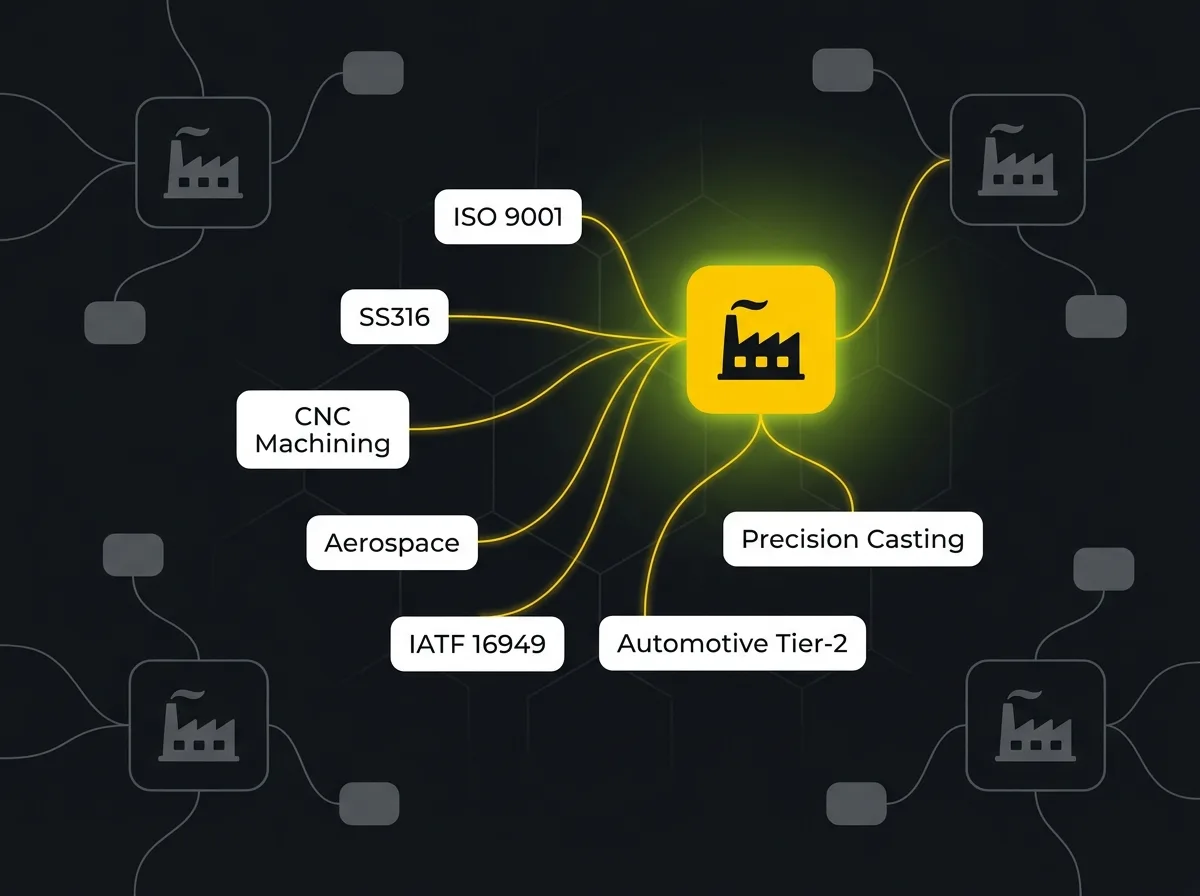
Named entities matter. The materials (SS316, 7075-T6, polycarbonate, glass-filled nylon). The standards (ISO 9001, IATF 16949, AS9100, EN 9100). The applications (aerospace, automotive, food and beverage, medical device). The processes (5-axis CNC machining, HVOF thermal spray, electroless plating).
AI tools parse these named entities and use them to match supplier capabilities to buyer requirements. The more specific and structured your content, the more accurately an AI tool can represent what your business does.
FAQ content plays a specific role in AI citation. Questions that design engineers and procurement managers actually ask, written in the vocabulary they use and answered with specific, credible responses, are what AI tools lift when generating shortlists. Technical guides covering material selection, process comparisons, certification requirements, and application considerations are cited far more often than capability claims buried in paragraph form.
A well-structured capability page is also worth describing in a brief llms.txt file, which signals to AI crawlers which pages represent your core offering.
The SEO and AI overlap. The content strategy for AI search visibility and the content strategy for Google rankings are not separate programmes. The specification content, the structured capability pages, the technical FAQ content, and the named entities that make a manufacturer findable on Google are precisely the content signals AI tools use for citation.
Build one and you build both.
Measuring manufacturing SEO when your sales cycle is 12 months long
Standard SEO reporting, taken at face value, tells a manufacturing business almost nothing useful. A 20% increase in organic traffic sounds promising. Whether those visitors are engineers searching relevant specification queries or unrelated clicks that bounce in three seconds is a completely different question.
Manufacturing SEO measurement needs to go deeper than traffic volume.
Organic traffic to the right pages. Total site traffic is a distraction. What matters is organic traffic to capability pages, certification pages, and application case studies specifically. These are the pages that attract the buyers you want. If total traffic rises but these pages are flat, the SEO is not working for the right audience.
Vanity metrics don't close deals.
Specification-level keyword rankings. Tracking position movements for long-tail specification queries, not just headline terms, tells you whether the content is reaching the right searchers. "ISO 9001 automotive machining UK" ranking on page one is more commercially useful than a generic process term ranking on page three.
RFQ and enquiry attribution. Contact form submissions, RFQ requests, and phone enquiries attributed to organic search in Google Analytics or your CRM give you the clearest signal that the traffic is converting.
Setting this up properly at the start is worth the time. Trying to reconstruct it retrospectively when someone asks whether SEO is working is considerably harder.
Won deal attribution. For businesses with well-maintained CRM records, tracking the proportion of won projects where the buyer's first recorded touchpoint was organic search is the most valuable metric of all. Many manufacturers have no idea whether the biggest contract they won last year began with a Google search.
A single well-tracked data point here is more persuasive for internal investment decisions than any report on keyword rankings.
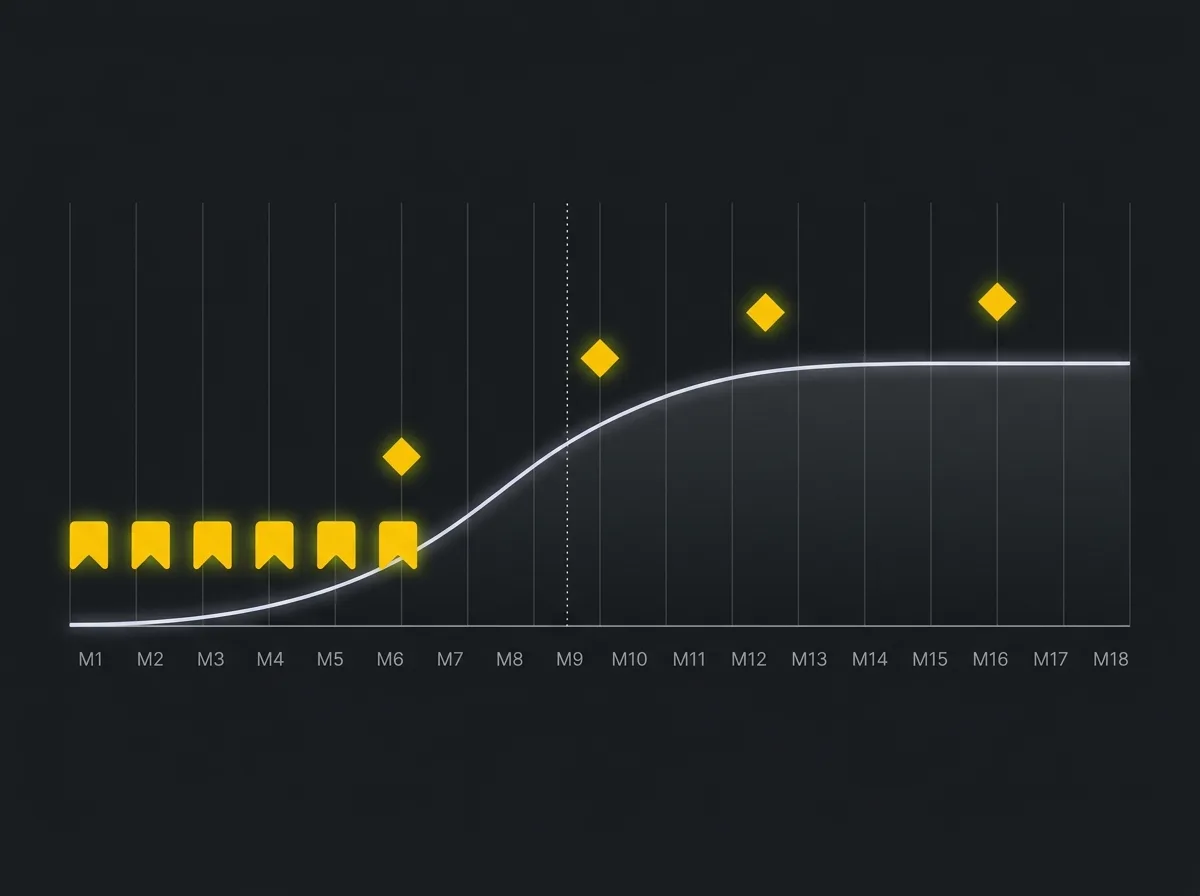
Realistic timelines worth setting internally: specification-level long-tail content typically shows ranking movement within three to six months of publication. Building topical authority across application and process categories takes six to twelve months of consistent investment. AI search visibility builds as content accumulates, but it compounds rather than arrives overnight.
The compounding argument. PPC stops the day the budget does. Organic search compounds.
A well-structured capability page published now can deliver enquiries next year, in three years, indefinitely. For a manufacturing business where a single additional RFQ from the right tier-one customer can be worth six figures, even a handful of those enquiries over the lifetime of one well-written capability page returns many times the investment.
That is the fundamental case for manufacturing SEO. One that tends to land well with people who understand long sales cycles and high contract values.
Frequently asked questions about manufacturing SEO
Does SEO actually work for B2B manufacturing companies?
Yes, though not in the way most guides describe. Manufacturing SEO is most effective when it targets the specific vocabulary buyers, engineers, and procurement managers use at each stage of the evaluation cycle, rather than chasing generic terms with high search volume. Specification-led capability pages, certification content, and application case studies consistently attract industrial buyers with genuine purchase intent.
Results take longer to appear than in consumer markets. But the conversion rate from qualified organic traffic is typically strong, because the intent behind industrial search queries is high.
How long does manufacturing SEO take to work?
Expect ranking movement for specification-level long-tail queries within three to six months of publishing well-targeted capability content. Building topical authority across a full range of application and process queries takes six to twelve months of consistent investment.
AI search visibility, where your business starts appearing in AI-generated supplier shortlists, develops as structured content accumulates and can move faster than traditional SERP rankings when site architecture is clear. The timelines are longer than in consumer markets, but the sales cycles that follow are also longer, and the compounding value of the content is significant.
What should a manufacturing website include for SEO?
Individual capability pages for each major process, with specific materials, tolerances, certifications, and sectors served included as crawlable text. Dedicated sections or pages covering major quality certifications (ISO 9001, IATF 16949, AS9100, EN 9100). Application-specific case studies that name the industry, the technical challenge, and the measurable outcome.
Technical FAQ content answering questions that design engineers and procurement managers actually search. A low-friction enquiry route on every capability page. And product specifications and process data in HTML, not only in PDF format.
How is AI search changing things for manufacturers?
Procurement teams are increasingly using AI tools to shortlist suppliers before raising a formal RFQ. The manufacturers that appear in AI-generated responses are the ones with structured, specific content using the vocabulary of their buyers: materials, standards, applications, certifications, and sectors served.
The content strategy for AI visibility and the content strategy for Google rankings are largely the same. Building specification-led, technically credible content for Google also builds your presence in AI-generated shortlists.
Where should a manufacturing business start with SEO?
Start with the capability pages. If the website cannot clearly tell a buyer whether the business holds the tolerance, works with the material, and carries the certification they need, no amount of blog content or link building will compensate.
Once the core capability content is in place and properly structured, the next layer is application case studies and technical FAQ content. From there, the site has enough material for both Google and AI tools to understand precisely what the business does and who it is relevant to.
The manufacturers who show up consistently in organic search, and increasingly in AI-generated shortlists, are not necessarily the biggest businesses in their sector. They are the ones whose websites can answer a design engineer's technical questions at 9pm, when no sales rep is available and the engineering team needs a shortlist by morning.
That is the practical value of manufacturing SEO. Not traffic for its own sake. The right buyer, at the right stage of their evaluation, finding you before they find a competitor.
Free resource: Traffic Projection Report
If you want a data-backed picture of what organic search could realistically contribute to your pipeline, the Traffic Projection Report models projected traffic and enquiry potential based on your sector, your competitors' search footprint, and the keywords your buyers are actively using.
Or, if you are ready to talk specifics, our manufacturing SEO services start with exactly that conversation.