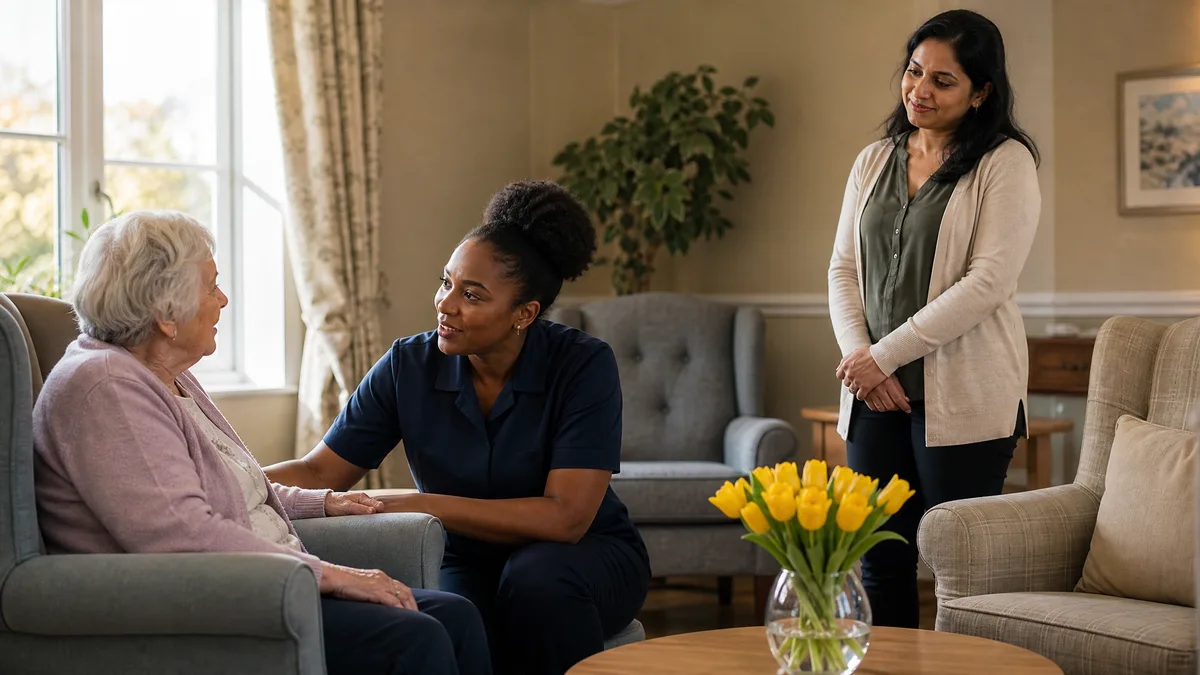
Three beds. Six weeks. A website, an active Facebook page, a listing on carehome.co.uk, a Good CQC rating, and a Google ad that has been running since April.
Still no calls worth counting.
This is the situation more care home managers are describing, and the frustration is specific. They are not ignoring marketing. They are doing the things they have been told to do.
The problem is not effort. The problem is sequence.
Most care home marketing is built around channels rather than around the moment families actually decide. And those two things are very different.
Care home marketing strategy: the short version
A care home marketing strategy works backwards from the moment a family types a search, mapping every platform and channel they use to compare, validate, and choose a home. The goal is to make sure your home is visible and credible at each one.
The highest-return channels for most homes are Google Business Profile and local search, where shortlists are formed; carehome.co.uk, where trust is won or lost; Google reviews; professional referral networks from hospital discharge teams and GPs; and a website that confirms what search has already promised.
Social media and paid advertising both play a role. But they deliver more once these foundations are solid.
How families actually search when a placement becomes urgent

Most care placements are triggered by a health event. A fall. A hospital admission. A gradual decline that crosses a threshold a family can no longer manage at home.
The search that follows happens quickly, often under real emotional pressure and sometimes in something close to crisis.
The first move for most families is a Google search. "Care homes near me." "Dementia care home in [town name]." "Residential care [postcode]." They scan the map pack, click through to a Google Business Profile to look at photos and read reviews, then visit the CQC website to check the inspection rating.
After that, many head to carehome.co.uk to read reviews from the families of current and former residents. Some cross-reference on aggregator platforms like Lottie or NHS.uk.
Here is the part that matters most. The shortlist of three to five homes a family will seriously consider is typically compiled entirely from those digital signals, before any care home manager knows they are being evaluated.
By the time a family picks up the phone, they have usually already decided which homes they are interested in and which they have ruled out.
That shortlisting happens silently.
Care sector research is consistent on this point: the vast majority of UK families begin a care home search online before making any direct contact with a home. That pattern has strengthened over recent years.
The UK care home sector is intensely local by nature, with LaingBuisson's annual care market analysis tracking a market in which competition for placements is almost always won or lost within a tight geographic radius, the distance families can realistically travel to visit.
The families doing this research are not browsing casually. They are comparing under emotional and time pressure, often managing a parent's crisis while running their own lives.
Warmth, transparency, and clarity of information carry outsized weight. A care home that looks hard to reach, hides its fees, or has an outdated website is filtered out before anyone has spoken to the manager.
That shortlisting happens quickly and without warning.
Understanding what actually works in healthcare SEO gives useful context here. The search behaviour patterns that govern how patients find medical practices map closely onto how families find care homes, with local proximity and review signals doing the heaviest lifting.
Local search and your Google Business Profile

"Care homes near me" is the highest-intent search in the sector. What appears in response is the Google map pack: a block of three listings showing the home's name, star rating, number of reviews, photos, and a direct call button.
Map pack presence is where most first impressions are formed.
Appearing there is more immediately valuable than a position-one organic ranking for most care homes.
Google Business Profile is the mechanism that determines map pack presence. It is not optional for any home with ambition to fill beds. A well-maintained profile needs recent, genuine photos of the building, communal areas, and staff rather than stock images. It needs accurate contact details, listed services, and a description that includes the location and care types naturally. And it needs a consistent, recent stream of reviews.
The local SEO basics that underpin map pack eligibility matter too. The care home's full address and care types should appear on every page of the website. The postcode should be in the homepage title tag. The name, address, and phone number should be identical across every listing: carehome.co.uk, Lottie, NHS.uk, Yell, and any other directory the home appears in.
These are not technically demanding to put right. They are table stakes for local visibility.
Map pack ranking is influenced more by reviews and proximity than by domain authority. A home with 40 recent Google reviews and an actively managed Google Business Profile will typically outrank a home with a more technically polished website but 12 reviews from 18 months ago.
That is a genuinely useful framing for care home managers who feel the problem must be their website.
Often it is not.
Reviews, CQC ratings, and the reputation system families actually use

Families validate a care home through three distinct sources, and they weight each one differently. Understanding how each works changes how you manage your reputation.
CQC rating. This is a baseline gate. An Inadequate or Requires Improvement rating will disqualify most homes from most family shortlists before any other factor is considered. A Good rating signals that a home has passed independent scrutiny.
According to CQC's State of Care report, the majority of registered care homes in England hold a Good or Outstanding rating. That means families use the CQC rating as a threshold rather than a differentiator. An Outstanding rating is a genuine competitive advantage and should be treated as one.
Display the CQC badge on your homepage and link it directly to the full inspection report rather than just showing the rating. Families who check the report will find it without having to hunt for it separately, and transparency at that level builds trust before any conversation has happened.
carehome.co.uk. Families read it the way a traveller reads TripAdvisor. Volume, recency, average score, and whether the home owner has responded to reviews all influence how trustworthy the profile appears.
Many care homes treat a carehome.co.uk listing as a static directory entry to update occasionally. In practice it is a live asset that needs the same active management as Google reviews: prompting families to leave reviews after positive moments, responding to every review, and monitoring for patterns that suggest something worth addressing.
A profile with eight reviews from two years ago communicates neglect regardless of what those reviews actually say.
Google reviews. These appear directly in the map pack and are typically the first review signal a family sees after a local search. A difference of 4.2 versus 4.5 in average rating, visible right there in the search results, can determine whether a family clicks through or moves to the next listing.
The margin is that thin.
A simple, consistent process for inviting satisfied families to leave a review, timed shortly after a positive moment in the care relationship, is among the highest-return activities available to any care home. It costs nothing in budget.
Compounding over 12 to 18 months, it produces a meaningful competitive edge over homes that have not done this.
It compounds.
Professional referrer networks: the channel most marketing guides ignore

Hospital discharge teams, GP surgeries, community care coordinators, social workers, and NHS care navigators refer a significant proportion of care home placements, particularly for NHS-funded and local authority-funded residents. Many operate on informal preferred lists built from relationships, reliable communication, available capacity, and consistent quality of care.
Worth the investment.
A care home with strong relationships with the right hospital ward, the right GP surgery, or the right discharge coordinator will consistently receive referrals that no digital campaign can replicate.
For privately-funded placements, the same dynamic operates at lower intensity. A GP or hospital nurse who mentions a home in passing to a worried family is making a recommendation that carries more weight than any advertisement.
Families at the point of decision often feel overwhelmed. A trusted healthcare professional's endorsement can short-circuit the research process entirely.
Cultivating these relationships is not advertising in the traditional sense. It involves having a named contact at key local GP practices and hospital wards, keeping discharge teams updated on capacity proactively, and communicating reliably during the admissions process.
It also means maintaining a CQC rating that a referrer would feel comfortable endorsing. These inputs are operational and relational.
The comparison is not unlike the referral networks that govern patient flows in other parts of the healthcare sector, which our guide to healthcare marketing for UK clinics explores in more depth.
Consistently underrated.
What your website needs to do, and what it cannot
Most families land on a care home's website not to discover it for the first time, but to confirm what they have already seen in the map pack, on carehome.co.uk, and from a referrer.
The website is a validation step, not a discovery engine.
That distinction changes what the website actually needs to do. In the confirmation role, a care home website must do the following without making the visitor work for it.
Display the CQC rating clearly and link to the full inspection report. Show real photographs of the building, communal areas, gardens, and staff rather than stock images. Publish fee ranges or indicative fees by care type transparently, because a large proportion of families cite fee clarity as a deciding factor.
Hiding fees creates friction at exactly the moment a family is already anxious. Make care specialisms obvious on the homepage. Provide a clear, easy-to-find phone number with operating hours.
Staff profile pages, virtual tours, resident activity content, and family testimonials all strengthen the signal that a home is warm and well-run. These are trust signals for a decision that is fundamentally about people.
What the website rarely needs to do is generate organic discovery traffic from scratch. Local search handles discovery. The website converts the traffic that local search delivers.
The specific elements that make this conversion reliable in a high-trust, high-stakes setting are covered in our guide to what healthcare websites need to convert.
Social media, paid advertising, and where the budget often goes wrong
Social media plays a genuine role in care home marketing. Just not the one most care home managers hope for.
Families do check a care home's social profiles. They do it after finding the home through local search or a referrer, not as a discovery mechanism. An active, warm, human-feeling Facebook or Instagram feed reinforces the trust that other channels have already built.
A dormant or generic feed introduces doubt. That is the correct framing for social media in this sector: it is a confirmation channel, and a relatively easy one to maintain well.
As a direct occupancy driver, paid social advertising performs modestly at best for most care homes. Most people are not looking for a care home until they need one urgently, and when that moment arrives they turn to Google or a trusted referrer rather than a Facebook ad. Local targeting helps, but the comparison with local search is not close.
Google Ads for care home search terms can be effective. But they amplify existing local search strength rather than substitute for it. Running Google Ads without a strong Google Business Profile, solid reviews, and a website that converts is an expensive way to send traffic to a page that will not act on it.
The foundations come first.
Where budget most commonly goes wrong: print advertising in local publications with no conversion path and no way to measure results; Google Ads sending traffic to a homepage with no clear enquiry route; paid social spend before the phone enquiry process is working reliably.
The phone call is the weakest link in most care home marketing chains. Families ring, no one answers, they move to the next home on their list.
That is a conversion problem. No advertising budget fixes it.
AI search and care home discovery in 2026
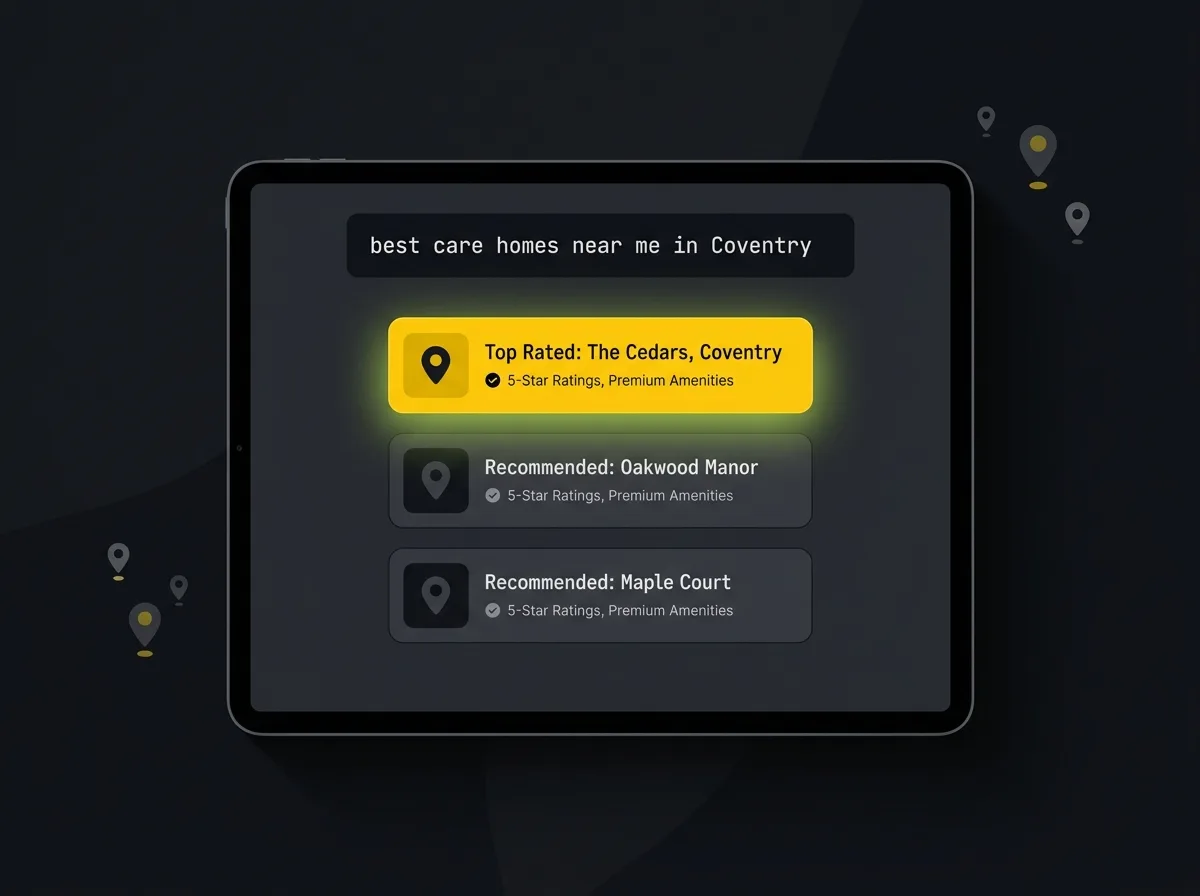
A growing share of families, and some healthcare professionals, now ask AI tools directly: "What are the best care homes near me in [town]?" or "Which care homes in [area] have good dementia care?" ChatGPT, Perplexity, and Google's AI features compile answers from review platforms, directories, and indexed content.
Worth knowing.
When care home operators ask AI how to market their home, what comes back today is a generic five-point list with no UK specificity. It mentions reviews, a website, and social media. It does not mention CQC, carehome.co.uk, Lottie, hospital discharge teams, or any of the UK-specific mechanics that actually determine occupancy.
The AI answer is accurate at a surface level and useless in practice.
For care home operators, AI search creates a new layer of visibility to manage. A home with weak reviews on carehome.co.uk and Google, limited presence on Lottie and NHS.uk, and a website that does not clearly name its location and care types may be invisible in AI-generated answers regardless of how it ranks in traditional search.
The practical response is largely the same as strong local SEO: a well-maintained Google Business Profile with recent reviews, active management of carehome.co.uk and Lottie profiles, and a website that clearly names location and care types.
Consistent name, address, and phone details across every listing matter too. AI reads what Google reads.
A home that is visible and credible in local search is in the best position for AI search too.
AI search traffic converts at notably higher rates than standard organic clicks, because the people arriving via AI have already had their question answered and are in verification mode rather than browsing. If AI search visibility is a priority for your home, a dedicated audit can establish specifically how you appear in ChatGPT, Claude, and Perplexity answers for care home queries in your local area.
A realistic starting point for a home with empty beds
A care home with empty beds and no clear marketing foundation should follow a sequence rather than spreading budget across every available channel at once.
Get the sequence right.
-
Audit and fully update your Google Business Profile. Recent, genuine photos; services listed correctly; a description that includes your location and care types; accurate contact details. This takes a morning and is the single highest-return marketing action available to most care homes.
-
Introduce a review process. A simple, consistent way of inviting satisfied families to leave a review on Google and carehome.co.uk after a positive moment in the care relationship. Not a mass email campaign. A personal, timely request at the right moment.
-
Check your website's local basics. Your full address, postcode, and care types should appear on every page. Your postcode should be in the homepage title tag. Your name, address, and phone number should be identical on every directory listing.
-
Display your CQC rating prominently. On the homepage, with a direct link to the full inspection report. If your rating is Good, show it clearly. If it is Outstanding, make it the first thing anyone sees.
-
Start a referrer relationship programme. A named contact at local hospital wards and GP surgeries, with proactive capacity updates when beds become available. The most underrated step in this list, and the one most likely to fill beds that digital channels miss.
-
Assess whether your website converts the enquiries local search delivers. An unanswered phone, a broken contact form, or an unclear call to action loses families who were already close to choosing you. Worth checking before spending another pound on advertising.
Paid channels, social media strategy, and content marketing all have a place. They work considerably better once this foundation is solid.
To understand exactly where your search visibility stands today and what enquiries you might be missing to nearby competitors, CT's Traffic Projection Report shows you the gap between your current position and what a well-managed local presence could realistically deliver. It covers your current ranking positions, your map pack presence, and where nearby competitors are outperforming you. No commitment required.
Frequently asked questions about care home marketing
What is the most effective way to market a care home?
The most effective care home marketing starts with local search visibility: a fully maintained Google Business Profile, a consistent stream of recent Google and carehome.co.uk reviews, and a website that clearly names your location, care types, and fees.
Layer in active management of professional referrer relationships with hospital discharge teams and local GP surgeries.
These two channels, local search and professional referrers, account for the majority of care home placements. They are also the two most commonly underinvested in plans that focus instead on social media and paid advertising.
How do families in the UK find care homes?
Most UK families begin the search online, typically with a Google search for "care homes near me" or a care-type search with a local place name. From there they use the Google map pack to shortlist homes, cross-reference CQC ratings on cqc.org.uk, and read reviews on carehome.co.uk.
Some use aggregator platforms like Lottie or NHS.uk. The shortlist is usually formed entirely from these digital signals before any care home is contacted directly.
A significant proportion of placements, particularly for funded residents, also come through professional referrers including hospital discharge teams, social workers, and GP surgeries.
What does a Good CQC rating mean for a care home's marketing?
A Good CQC rating is the baseline families expect, not a differentiator. Because the majority of registered care homes in England hold a Good or Outstanding rating, a Good result removes a home from the Requires Improvement or Inadequate bracket, which disqualifies most homes from family shortlists immediately.
It does not make one home stand out from another.
An Outstanding rating is a genuine marketing asset and should be displayed prominently on the homepage with a direct link to the full inspection report. For homes rated Good, the competitive difference is made through review volume, recency, and responsiveness rather than the CQC rating alone.
How much should a care home spend on marketing?
There is no single benchmark that applies across all care homes, but most care home marketing is underspent on high-return basics and overspent on low-return visibility.
For a home with empty beds, prioritising the no-cost and low-cost foundations, Google Business Profile, review processes, website basics, referrer relationships, will deliver faster results than a paid advertising budget without those foundations in place.
Once a home has a consistent enquiry flow from local search and referrers, a modest ongoing investment in local SEO maintenance and occasional paid search is typically sufficient to defend and grow that position.
Does social media help fill care home beds?
Social media plays a supporting role rather than a primary occupancy-driving one. Families check a care home's social profiles to validate warmth and activity after finding the home through another channel, not to discover care homes in the first place.
An active, human-feeling feed on Facebook or Instagram reinforces the trust that local search and reviews have already built. A dormant feed raises doubt.
Managing social media well costs relatively little and neglecting it entirely is an avoidable credibility risk. What social media does not do well is replace the discovery channels, local search and professional referral, that actually fill beds.