
"We've had three agencies quote us. All at completely different prices. None of them actually explained what we'd be getting."
The names change. The confusion doesn't.
A physiotherapy practice in Bristol. A three-person accountancy firm in Leeds. A family-run joinery in the East Midlands. One quote was £150 a month. One was £800. One was £2,000. The pitches all sounded roughly the same. One of them promised page one in eight weeks, which made the business owner nervous rather than excited. Good instinct, as it turned out.
This guide is what you needed before those meetings. What a credible SEO package actually includes in 2026, what the pricing tiers cover, five things an agency pitch should never say, and something no other guide in this corner of the internet covers: what the first 90 days of a genuine engagement should look like, month by month.
There are other ways to win customers. Paid search, referrals, social media, word of mouth. All of them work, and any honest agency will tell you that. But organic search compounds in a way those channels mostly don't. A well-run programme builds value over time that keeps working after you stop paying for it. That's why SEO services for small businesses is rarely a question of whether. It's usually a question of when and what to look for.
What you are actually paying for when you buy SEO
Most SEO is invisible. Not because it doesn't work, but because the work doesn't produce something you can hold at the end of the month.
What you're buying is a bundle of activities. Crawl audits, on-page improvements, content creation, outreach for backlinks, technical fixes, and reporting. Those activities happen at different volumes and levels of seniority depending on what you're paying. A £500/month package and a £1,500/month package might use the same language in the proposal. They are not the same thing.
The critical distinction is between activity-based reporting and outcome-focused reporting. An activity-based monthly report tells you what happened: "We published two blog posts, checked 47 pages, and built three links." An outcome-focused report tells you what moved: organic traffic up 14% since month two, five new enquiry form submissions attributable to search, keyword positions shifting on the terms that matter to the business.
A PDF of completed tasks is not the same as evidence that anything worked. Knowing what happened is not the same as knowing whether it mattered.
Cheaper packages often lean heavily on the activity side. Not always dishonest. For some businesses, a lighter-touch programme is genuinely the right call at the right stage. But before you sign, ask one question: "What does your monthly reporting look like, and what does success look like at month six?" The answer tells you which type of agency you're dealing with before you commit.
UK pricing tiers in 2026: what each budget actually covers
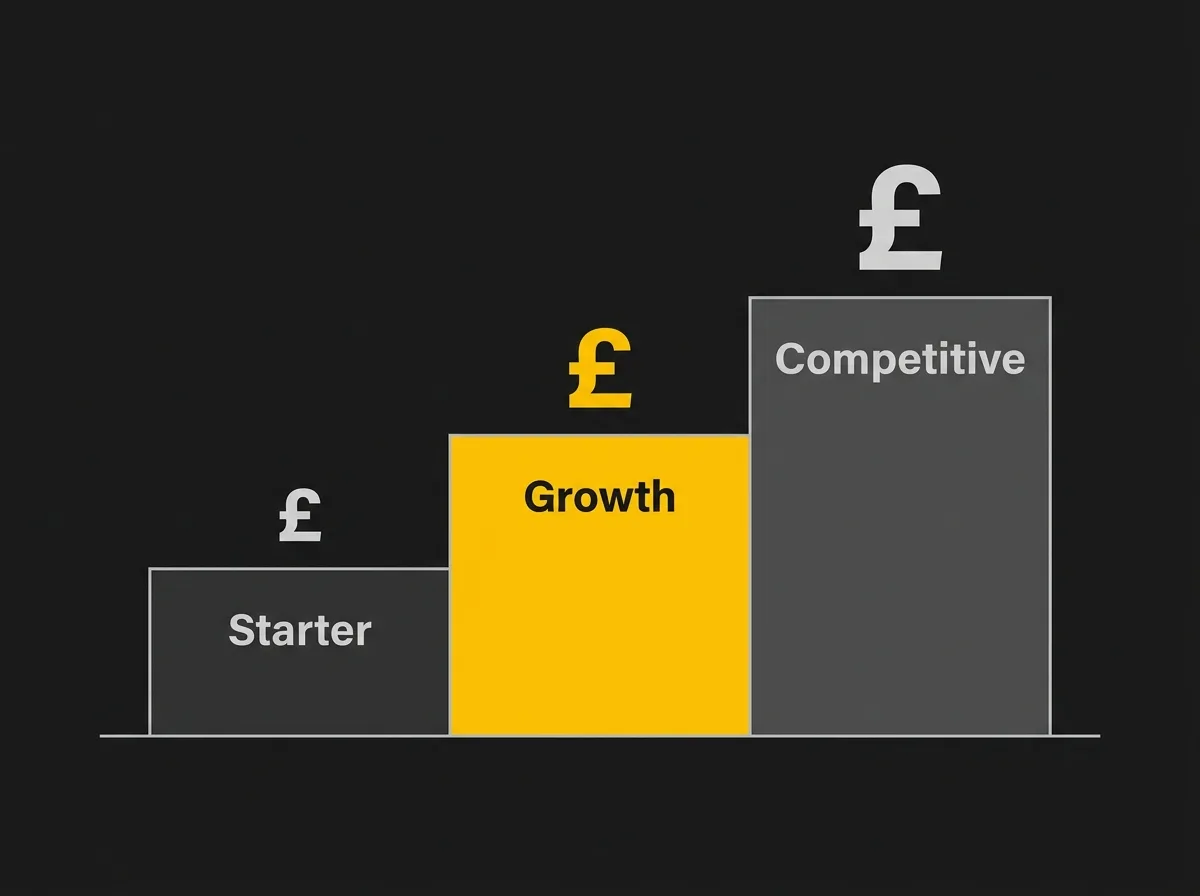
Based on what agencies across the UK typically charge, three broad tiers emerge. They are not rigid. Individual agencies price differently, and scope varies significantly. But understanding the ranges helps you read a quote rather than just react to the number.
Starter and local tier: £300-700 per month. Appropriate for genuinely local businesses operating in low-competition markets. An independent plumber in a market town where no competitor is actively investing in SEO. A local florist with no national ambitions. A single-location trades business where visibility in one postcode is the entire game. At this level, a credible package covers Google Business Profile management, some basic on-page work, and local citation consistency. It does not cover meaningful content creation, link-building activity, or competitive keyword targeting. For businesses fitting this description, how local SEO works for tradespeople is a useful reference for what this tier should actually include.
The lower end of this range, below £400 per month, deserves specific scrutiny. The resource arithmetic is challenging. After an agency covers its overheads and a small margin, there is not much left for actual work. Ask specifically: how many hours per month are allocated to my account? What is included and what costs extra? A straight answer is a good sign. Deflection is not.
Growth and SME tier: £700-1,500 per month. This is where most small businesses with real competition should be looking. A three-person accountancy firm in Leeds competing against twelve other firms with web presence. A physiotherapy practice in a large town with four competitors also running websites and publishing content. This is the tier where one of the highest-ROI acquisition channels starts to show clearly in the numbers. At this level, a credible package covers monthly content production, typically one to three pieces per month, ongoing technical maintenance, some link-building activity, and proper outcome-based reporting. This is the viable range for most serious small business SEO programmes.
Competitive tier: £1,500-3,000+ per month. For businesses competing nationally in saturated sectors, legal and financial services, private healthcare, or multi-location operations requiring separate local programmes per branch. A solicitor in central London competing against 40 established practices with active SEO programmes needs different investment to an estate agent in a smaller market where three competitors have nothing beyond a basic website and a Google listing.
The right tier is determined by competitive intensity in your specific market, not by your preferred spend. Those are sometimes the same answer. Sometimes they are not, and that is worth knowing before you brief an agency.
One note on local SEO: for genuinely local businesses with genuinely local competition, a well-structured local programme at the lower tier can deliver significant results. The mistake is buying a starter-tier package when your market demands the growth tier. Or buying the growth tier when the starter tier is everything your competition requires you to match.
What a good SEO package must include in 2026
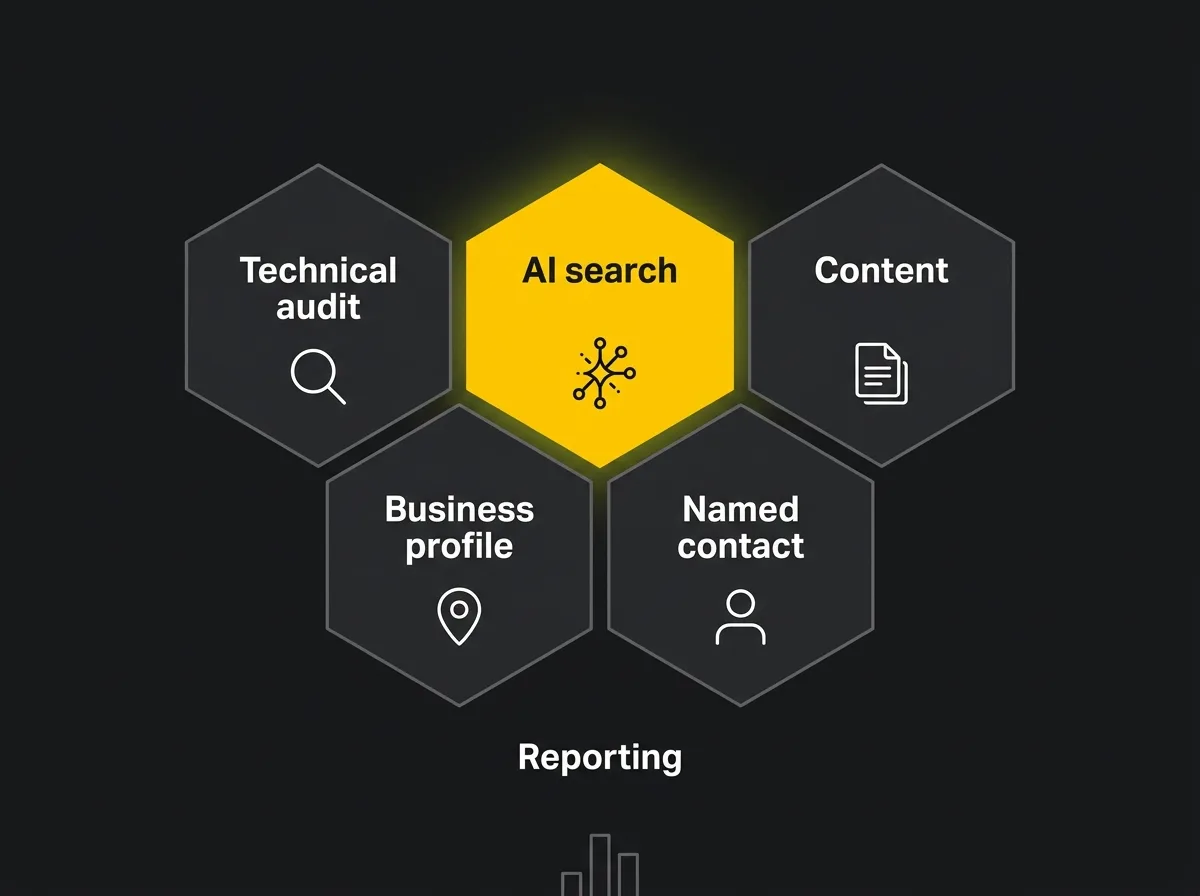
Every competitor article in this SERP lists five components. Technical, content, links, local, reporting. All correct. Here is what 2026 adds, and what most packages still don't include.
Technical health baseline. A credible engagement begins with a full technical audit in month one. No exceptions. This covers crawl health, Core Web Vitals (Google's speed and experience signals), site architecture, and indexation. If an agency skips a technical audit at the start, ask why. The technical foundation determines whether every other activity will work. Publishing content on a site Google cannot properly crawl is expensive and inefficient. The audit is not optional; it is the cost of entry that determines whether everything else has a chance.
Content that earns rankings and AI citations. Content must answer real questions at genuine depth. A 500-word post built around a keyword density has not been effective for some years now, and a credible agency knows this. Before signing, ask: how many pieces per month, who writes them, and how do you decide what to write? The answer should involve keyword research and real searcher intent, not a calendar built around topics the agency finds convenient. Thin content at volume is not the same as useful content at a considered pace.
AI search readiness. This is the 2026 addition that most packages still don't include, and no other editorial article in this SERP addresses it at all. Structured data (FAQ schema, HowTo schema, Organisation schema), an llms.txt file that tells AI crawlers what to index and what to skip, and entity clarity so that Google's knowledge graph and AI tools understand precisely who the business is and what it does. AI search traffic converts at a meaningfully higher rate than standard organic, which makes this worth caring about even for businesses not yet tracking it as a distinct channel.
For businesses that want to appear in ChatGPT, Perplexity, and Google's AI Overviews rather than just in traditional results, AI search visibility is now a distinct and measurable component of a well-run programme. Ask any agency you are considering: how do you approach AI search readiness as a standard part of your work? Listen carefully to the answer. An agency that looks blank or pivots to rankings-only language is working from an outdated approach.
Google Business Profile management (where relevant). For businesses serving a specific area, GBP is often the highest-ROI component of any package. Review response strategy, citation consistency across directories, regular GBP posts and photo updates. Some agencies sell this as a standalone cheaper programme. For genuinely local businesses, it should be the first conversation, not the last.
Outcome-based reporting. Every month you should see: organic click volume from Google Search Console (not just a ranking table), enquiries and calls attributable to organic traffic, and GBP insights if the business has a local component. Keyword positions are supporting context, not the headline metric. They show direction. Organic click volume shows what is actually happening.
A named contact. This sounds basic. It shouldn't need saying. Ask before you sign: who specifically manages my account? A job title is not an answer. A credible agency can give you a name, a track record, and a way to reach that person directly. If the answer is "our team," press harder.
Five things to watch out for before you sign

These are not vague warnings. Each one has a specific mechanical reason it is a problem.
-
Guaranteed rankings or "page one in 30 days." No agency controls Google's algorithm. A ranking guarantee means one of two things: the agency is planning to use techniques that get sites penalised (buying low-quality links, thin doorway pages, aggressive keyword stuffing), or they are going to target keywords so obscure and uncompetitive that nobody searches them. Either way, you lose. The first can take 12 months or more to recover from. The second produces reports that look fine and deliver nothing.
-
12-month contracts with no performance clause or exit mechanism. A long contract without any performance benchmark protects the agency regardless of what they deliver. A credible agency is confident enough in their work to offer rolling monthly arrangements or a short initial commitment, typically three to six months, with a clear checkpoint. If an agency insists on 12 months before they have done anything for your site, ask what they need that protection for. It is a reasonable question.
-
No named strategist on the account. Covered in the components section, but worth repeating here because it is the most consistent predictor of an underperforming engagement. Accounts managed by a rotating team drift. Strategy becomes reactive. Results fragment. If the agency cannot name your account contact before you sign, the work is being pooled across a general team or distributed offshore with minimal oversight.
-
Reports that show activity instead of outcomes. "We published 2 blog posts, checked 47 pages, and built 3 links" describes what happened. It does not say whether any of it moved anything. Before signing, ask to see a sample monthly report. Look for organic traffic trends. Look for any attribution of enquiries or calls to organic search. If the sample report is four pages of tasks completed and a keyword position table, that is your monthly update for the next year.
-
No mention of AI search in a 2026 pitch. Any agency still talking about SEO exclusively as a Google rankings exercise has not updated their approach for the current search landscape. ChatGPT and Perplexity are already sending commercial traffic. According to Search Engine Land data on AI Overview prevalence, AI Overviews appear on a significant and growing share of informational and hybrid commercial searches. Ask the agency how they approach AI search visibility as a standard component, not a bolt-on extra. If the question produces a blank look or a pivot to traditional rankings language, you are now comparing them against the agencies that do have an answer.
What the first 90 days should actually look like
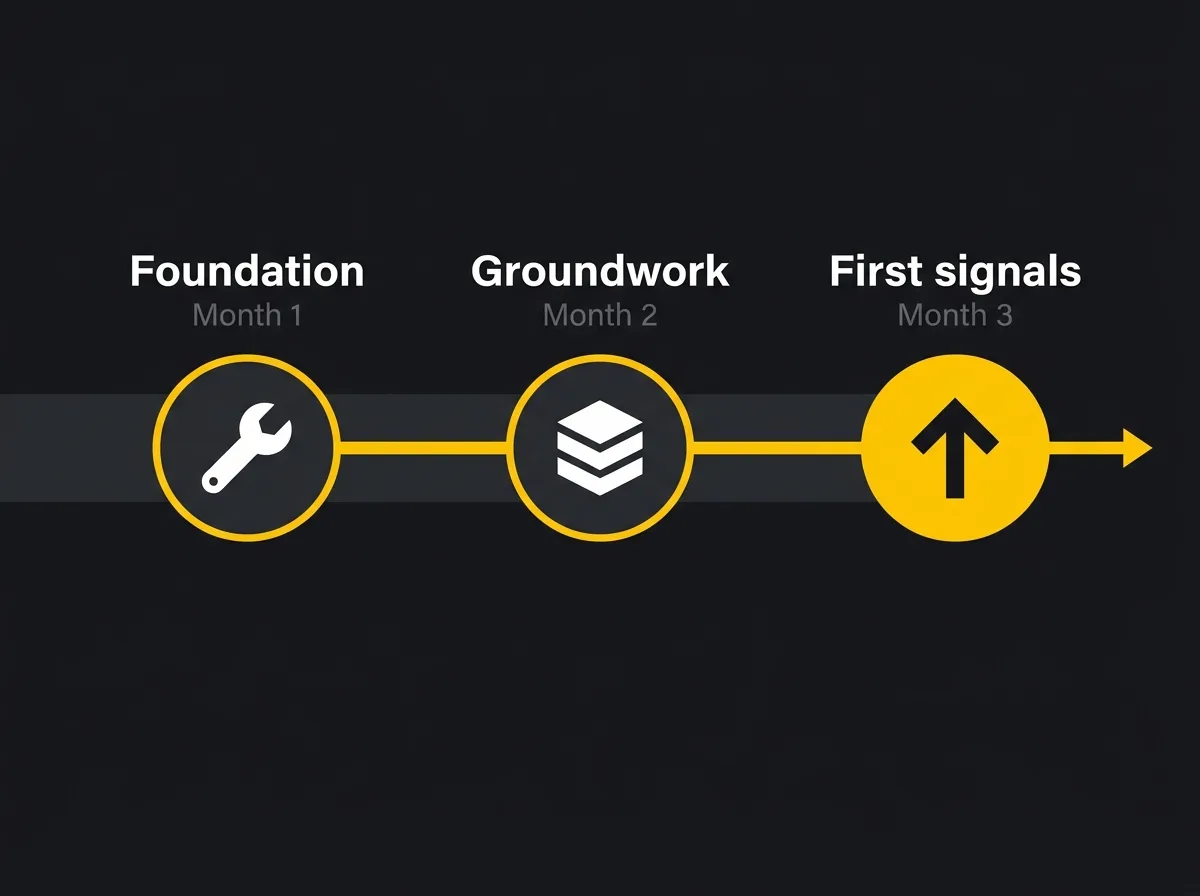
This section does not exist anywhere else in the current SERP for this topic. Here is what a credible engagement actually looks like, month by month.
Month one: foundation. Not rankings. Foundation. A thorough technical audit identifying what is broken and what is limiting the site's visibility. Keyword mapping against your specific competitive landscape, not a generic list of terms. Google Analytics 4 and Google Search Console baseline established so there is a genuine starting point to measure against. GBP audit if the business has a local component. At the end of month one, you should have a clear picture of the technical state of the site, the opportunity in your market, and a prioritised plan for the next six months. No meaningful ranking changes yet. If an agency reports significant movement in month one, that is worth questioning directly.
Month two: groundwork. First content pieces published, though they will not rank immediately. New content takes several weeks to be fully indexed, evaluated, and assigned authority relative to competing pages. Technical fixes from the month one audit implemented. GBP improvements in progress. Link outreach conversations begun. At the end of month two, you should see a clear record of what has been done, a content pipeline for the coming months, and evidence of technical work in Search Console's Coverage and Core Web Vitals reports.
Month three: first signals. Initial keyword movement appearing in Google Search Console. Branded terms often show first. Organic click volume beginning to shift on lower-competition terms. This is the first real data point, and a good agency reports it with context rather than just listing position changes. Request a 90-day checkpoint conversation explicitly. Any credible agency welcomes it.
From day one, track these: organic click volume from Google Search Console (not position averages), form completions and calls attributable to organic traffic, and GBP insights if local (calls from the profile, direction requests, photo views). Track them weekly so any regression is visible early and can be investigated before it builds into something significant.
If at the end of month three there is no visible technical improvement, no published content, and no keyword movement of any kind, ask for a clear written explanation of why and what the forward plan is. "SEO takes time" is correct. "SEO takes time and here is precisely what we have done in 90 days and here is why the results are not yet visible" is useful information. The first statement alone, without the second, is worth paying attention to.
How to compare three quotes side by side
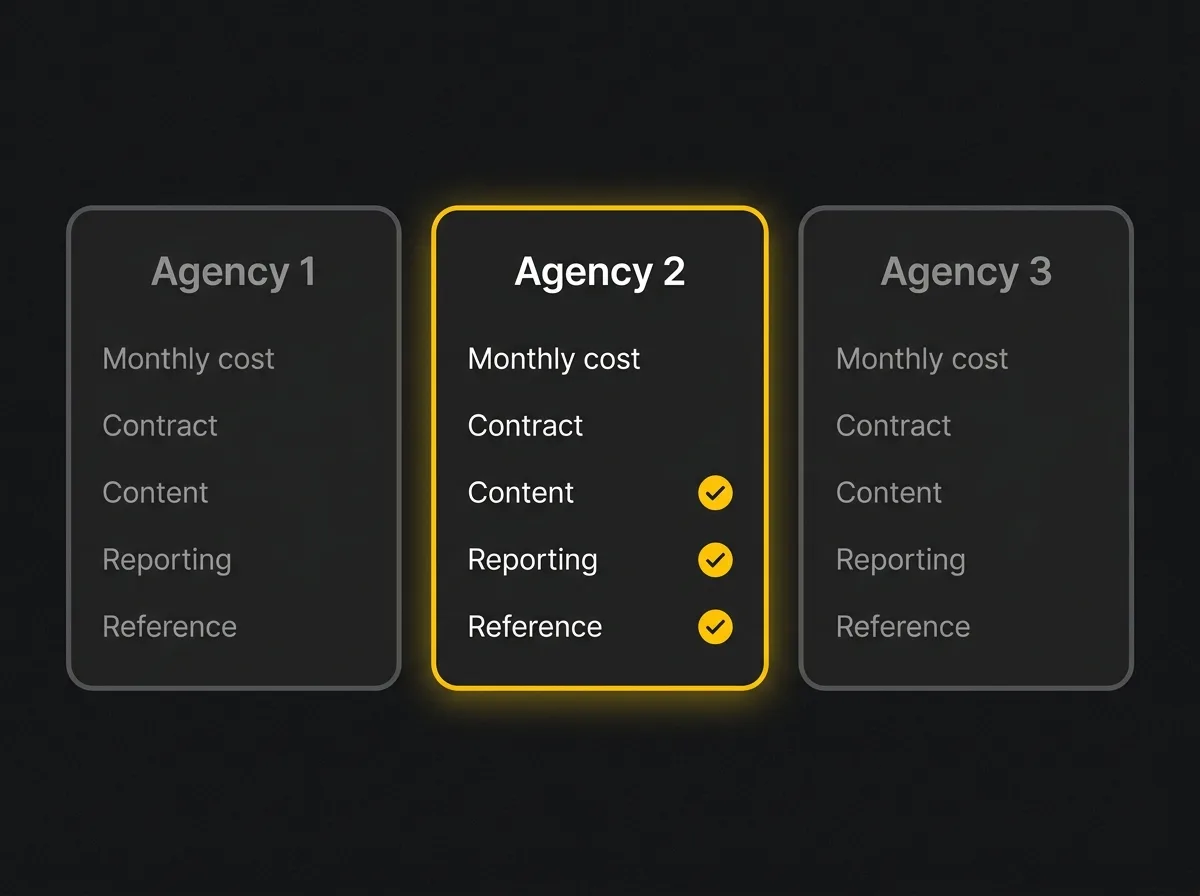
Price tells you almost nothing without scope attached. A £650/month package that includes two content pieces per month, ten hours of technical work, and proper outcome-based reporting is more valuable than a £400/month package with no content and a monthly PDF. They look different in price. They are completely different in what is actually being purchased.
For each agency you are comparing, work through these:
-
Monthly cost. The number. Then pause before drawing any conclusions from it alone.
-
Contract length and exact exit terms. Rolling monthly, or a minimum commitment period? If there is a minimum, what are the exact terms for leaving early? Get this in writing before you sign anything.
-
Content provision. How many pieces per month? Written in-house or subcontracted? Do you approve them before publication? What is the process for agreeing the topic and angle?
-
Technical audit in month one. Is it included, or does it come as an additional cost? If there is no technical audit in month one, ask what the first month actually covers instead.
-
Named account contact. A job title is not a name. A name gives you someone to hold accountable and someone to call when something needs addressing quickly.
-
Reporting format. Ask to see a sample monthly report before you sign. Specifically look for Google Search Console organic click data and any attribution of enquiries to organic traffic. A report without these tells you the agency is not measuring what matters.
-
One verifiable UK client reference. A named business, a specific outcome, a contact you can actually speak to. Not a testimonial on the website. A real person who has used their service and can describe what happened.
The single best question to ask every agency before deciding: "What specifically would you do in the first 30 days for a site like mine?" A credible agency has an immediate, specific answer covering audit, baseline, and initial priorities. An agency that responds with a generic pitch about process or a proprietary methodology is not yet thinking about your site in particular.
Free resource: Traffic Projection Report
Before committing to any agency or budget, it helps to understand what organic search could realistically deliver for your specific site and market. CT's free Traffic Projection Report maps the organic traffic opportunity in your sector, shows what keywords competitors are currently capturing, and gives you a grounded projection to set against the quotes you have received.
Frequently asked questions about SEO packages for UK small businesses
What should an SEO package for a small business include?
At minimum: a technical audit in month one, ongoing on-page improvements, regular content creation (at least one substantive piece per month for a competitive market), link-building activity, and monthly reporting that shows organic traffic and enquiry data rather than just keyword positions. In 2026, a credible package also includes AI search readiness work: FAQ and Organisation schema, llms.txt configuration, and entity clarity for AI tools. Any package missing the technical audit and the outcome-based reporting is incomplete regardless of what else it claims to cover.
How much does a small business SEO package cost in the UK?
Based on typical UK agency pricing, three tiers apply. Starter and local packages run roughly £300-700 per month and suit genuinely local businesses in low-competition markets. Growth-tier packages run £700-1,500 per month and cover content production, link-building activity, and proper reporting. Competitive-tier packages start at £1,500 and are appropriate for national competition, saturated sectors, or multi-location businesses. The right budget is determined by the competitive intensity of your specific market, not by a general preference.
How long does SEO take to show results?
Realistically, three to six months for initial movement on lower-competition terms, and six to twelve months for meaningful traffic growth on competitive terms. Month one is foundation work. Month two is implementation. Month three is where first signals appear in Google Search Console. A programme working properly will show clear movement by the end of month three, even if traffic volume is still modest. Anyone promising meaningful results in four weeks is either targeting terms too obscure to matter or creating conditions likely to cause problems later.
What are the red flags in a cheap SEO package?
Guaranteed rankings or specific position promises. No named account manager. Monthly reports showing tasks rather than outcomes. Twelve-month contracts with no performance clause or exit mechanism. No mention of AI search or structured data in a 2026 pitch. And perhaps most practically: a monthly price so low that the agency cannot cover its overheads and still do meaningful work. Below £400 per month, ask specifically what the deliverables are, in writing, before signing.
If you have three quotes in front of you and you are not sure which one is the right call, the most useful next step is understanding what organic search could realistically deliver for your specific site and market before you commit to any of them. That is what CT's free Traffic Projection Report does. It maps the organic traffic opportunity in your sector, shows what competitors are currently capturing, and gives you a grounded projection to test any agency quote against.
CT works with small businesses across sectors, with a focus on search visibility and traffic as an outcomes-led discipline rather than a monthly activity package. If you have a quote you would like a second opinion on, or want to understand what a properly structured programme looks like for your business, get in touch.