
"Three agencies. Six months. Not one of them mentioned Rightmove."
That is not an unusual situation. It is, depending on who you speak to, a fairly typical one. Estate agency principals evaluating SEO providers hear polished pitches, see long decks, and review case studies from e-commerce companies and B2B software businesses. The fundamental question of whether the agency has ever had to distinguish between a vendor (seller) lead and a buyer enquiry somehow never comes up.
This article is a buyer's guide for the estate agent doing the evaluating. Seven questions to ask any real estate SEO agency before you commit to a contract. Not as a gotcha, but as a practical diagnostic. The answers will tell you, usually within a single meeting, whether the agency across the table has actually done this for estate agents before or has adapted a general playbook for a sector they do not really know.
Here are the seven: whether they understand the vendor-versus-buyer split, whether they know the UK portal stack, whether they can evidence valuation request growth rather than just traffic, how they handle Google Business Profile across multiple branches, whether they know property-specific schema, how they think about AI search for property buyers and sellers, and what they flatly refuse to do.
We cover each in turn. First, a short piece of context that makes the rest of the list make sense.
Why real estate SEO is structurally different from "doing SEO" for any other business
Most of the search terms that look relevant to an estate agency are owned by portals. "Houses for sale in Birmingham." "Flats to rent in Leeds." "Two-bedroom properties near good schools in Edinburgh." Rightmove, Zoopla, and OnTheMarket hold those results. They have decades of domain authority, enormous backlink profiles, and pages built specifically to rank for transactional property queries. Competing against them on those terms is a poor use of budget. Always has been.
According to Rightmove's own investor reports, the portal receives tens of millions of visits every month across the UK. That traffic was not going to individual estate agencies before, and a cleverer keyword strategy is not going to change the underlying dynamics now.
Where estate agents actually win in search is a different set of queries entirely. Vendor-intent searches, the ones typed by someone thinking about selling, are where local agencies can genuinely compete.
"How much is my house worth in Harborne?" "Should I use an estate agent or sell privately?" "What is the housing market doing in [town] right now?" These belong to no portal. A local agent with a strong content programme, a well-managed Google Business Profile, and the right schema markup can own them.
The same applies to area guides written for people relocating, seller FAQ content, and long-tail informational pages that answer the specific questions vendors have six or twelve months before they pick up the phone to request a valuation.
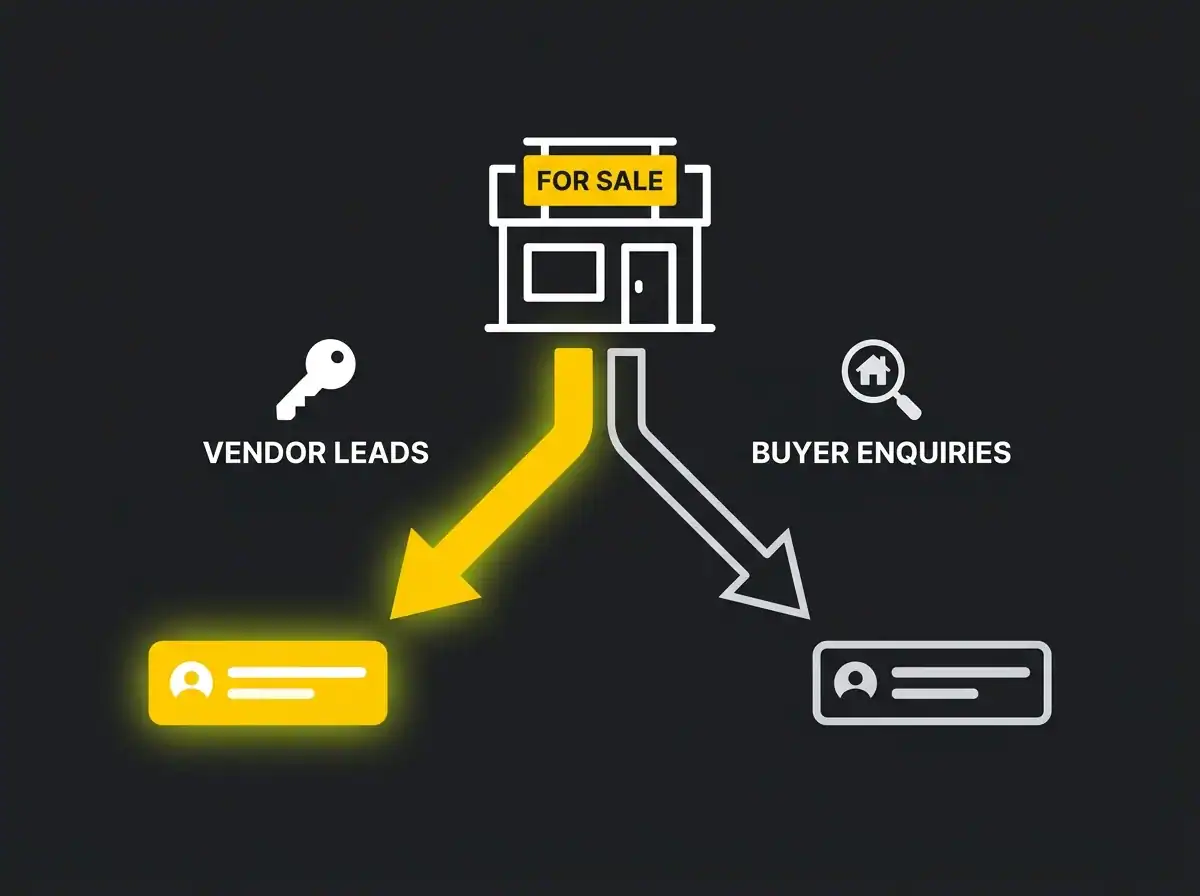
There is also a fundamental revenue split in estate agency that a generic SEO agency will rarely ask about. Vendor leads, where a potential seller requests a valuation or market appraisal, and buyer enquiries, where someone asks about a viewing, are not worth the same amount to your business. They do not come from the same searches. Getting that split wrong from the start means months of work pointed at the lower-value outcome.
One more piece of honesty before the checklist. Search is one lane, not the whole road. Estate agents win instructions through a mix: reputation and referrals in the area, your database and past-vendor relationships, the portals you pay to be listed on, canvassing and local visibility, and social media for showing off new listings and sold boards. None of that goes away.
What SEO, local search and AI visibility do is win the direct vendor valuations that come to you rather than through a portal, at no cost per lead, and reduce how dependent you are on Rightmove and Zoopla over time. That is the lane a real estate SEO agency should be improving. It does not replace the rest, and any agency implying it does is overselling. The seven questions below are how you tell whether they understand that.
Seven things to check before you sign anything
Each of these is a question you can ask directly in a meeting. None of them is a trick. A specialist will give you a clear, considered answer. A generalist will hedge, generalise, or change the subject.
1. Ask how they split vendor capture from buyer enquiries
This is the most revealing question on the list.
Most estate agency revenue starts with a vendor instruction. A seller chooses your agency, you market the property, you earn commission. Buyer enquiries matter, but they depend on having instructions to sell in the first place. An SEO strategy that treats vendor leads and buyer leads as interchangeable is optimising for the easier metric rather than the more valuable one.
Ask: how does your content strategy divide between vendor-intent queries and buyer-intent queries? What does that split look like, and why?
The answer you want: a clear explanation of which content types drive vendor intent, such as valuation guides, area market reports, seller FAQs, and "how much is my home worth" landing pages, versus buyer intent, such as property type pages and neighbourhood guides aimed at movers. Ideally with examples from estate agency clients they have worked with. An agency that reaches for the vendor-buyer distinction immediately, unprompted, understands how estate agency actually works.
An agency that presents a single unified strategy for "property searches" has probably never had this conversation with an estate agent before. That is worth knowing before you sign anything.
2. Ask which portal stack they assume you are competing with
This sounds like an inside-track question. It is not.
If Rightmove and Zoopla do not come up in the first 30 seconds of the answer, you have your answer about the agency's UK property knowledge.
A real estate SEO strategy for a UK estate agent has to account for the fact that Rightmove dominates buyer search for listed properties, that Zoopla holds meaningful share across certain buyer demographics, and that OnTheMarket has grown its position in a number of regional markets. These are not competitors in the traditional sense.
You almost certainly advertise on at least one of them. But the question is whether the agency understands which query types the portals own and which ones they cannot.
A specialist will tell you, specifically, where you cannot compete with the portals on transactional buyer searches, and where you absolutely can compete on hyperlocal valuation content, agent trust signals, and local knowledge pages. That line between owning and not owning is the entire foundation of a smart estate agent SEO strategy.
An agency that promises to "outrank Rightmove" without qualification is either uninformed or setting an expectation they know they cannot deliver. Neither is a good starting point.
3. Ask for examples of valuation request growth, not traffic growth
Traffic is vanity for estate agents. Impressions are even worse.
The conversion event that pays the bills is the valuation request. Someone contacts the branch, fills in a form asking for an appraisal, or calls to book a valuation. Everything upstream of that, rankings, sessions, clicks, scroll depth, is context rather than the thing itself. An agency that pitches you on any of those upstream metrics without connecting them to valuation request volume is selling you a lagging indicator as the end goal.
Ask to see a case study where a previous estate agency client grew their valuation request volume through organic search. You want: the starting position, what the agency did in terms of content, technical work, and local SEO, and the resulting change in enquiry volume. Not in traffic. In enquiries.
You may not get a perfect answer in a first meeting, and that is fine. But the framing of the response tells you a great deal. An agency that immediately translates success into conversion terms is thinking about the right thing. An agency that shows you a traffic chart and calls that the result is telling you, clearly, what they believe the result is. For an estate agent, traffic is not a result.
4. Ask how they handle Google Business Profile across multiple branches

For a single-branch agency, Google Business Profile is important. For a multi-branch agency, it is critical and significantly more complex to get right.
Each branch needs its own GBP listing, properly categorised and actively managed. The primary business category for an estate agent matters more than most agencies realise. Review volume and recency signal credibility at the branch level. NAP consistency, meaning the same name, address, and phone number format across every listing and every local citation, is a ranking factor that many generic SEO agencies manage poorly or not at all.
According to Whitespark's annual Local Search Ranking Factors study, review signals and proximity are consistently among the top factors for local pack visibility. The local pack is where a buyer or vendor searching "estate agents near me" or "estate agents in [town]" will see you first. A poorly managed or missing branch listing is invisible business.
A proper local SEO approach for a multi-branch estate agency covers: separate GBP listings per branch, a managed review acquisition process, consistent citation building across local directories, and branch-specific content on the website that signals genuine local knowledge. Ask the agency how they handle all four. Vague answers about "managing your Google presence" are not the same thing.
5. Ask about schema markup specifically for property
This is a technical question, but you do not need to understand the technical detail to ask it. You just need to see whether the agency does.
Schema markup is structured data embedded in your website's code that tells search engines what a page is about and who it belongs to.
For estate agents, the relevant types include LocalBusiness (to confirm branch addresses and contact information), RealEstateAgent (a schema type that exists specifically for property businesses), Service (for the types of work you do), and FAQ (which can appear directly in search results and improve click-through rates).
Where your site surfaces individual property pages, RealEstateListing schema is also worth considering.
Most generic SEO agencies will add LocalBusiness schema and consider that done. A property specialist will know that RealEstateAgent schema exists, that FAQ schema on valuation guides and seller FAQ pages can generate enhanced search appearances, and that the schema layer is how your site actively communicates its relevance for property-specific queries to Google.
Ask directly: what schema types would you apply to our site, and why? If the answer does not include RealEstateAgent, the agency's property knowledge is shallow.
6. Ask how they think about AI search for property buyers and sellers
This is the question that catches most agencies off guard, and it is worth asking in 2026.
The reason is simple: AI search is now part of property research, and the way buyers and sellers use AI tools is changing faster than many in the industry have noticed.
People are using ChatGPT, Claude, and Perplexity to research areas, compare neighbourhoods, understand the selling process, and increasingly to look for recommended local agents. A prospective vendor asking an AI assistant "which estate agents are well-regarded in [town]?" will get an answer.
Whether your agency appears in that answer depends on how your reputation, reviews, and local expertise signals are represented across the web.
An SEO agency with no view on AI search is planning for the digital landscape of two years ago.
Ask: how does your strategy account for AI search visibility? The answer does not need to be exhaustive. But any agency worth hiring should have a considered position, even if that position is "here is how our content and review strategy feeds into AI citability, and here is what we are still working out." An agency that dismisses the question has told you something important about their awareness of where search is heading.
7. Ask what they would not do for you
This is the question that catches the agencies that promise everything.
A good agency has a list of things it refuses to do. Mass link buying from property directories. Blog content produced at volume with no genuine local knowledge. Doorway pages built around town names with copy that could have been written about anywhere in the country. Keyword stuffing in title tags and meta descriptions.
These tactics exist and agencies sell them. Some produce short-term results. Most do not last, and some will get your site penalised.
Ask the question plainly: "What are the things you would not do for an estate agency client, and why?" Then let the silence sit. See what comes back.
An agency with a clear, specific answer, with reasons attached, is demonstrating that it understands the risks of the field as well as the playbook. An agency that says "we do whatever it takes to get results" has told you something useful about how they define results. It is not a reassuring answer.
Red flags that should end the conversation
Some signals do not need further investigation. They are simply reasons to move on.
A pitch built around American real estate terminology. If the deck mentions Zillow, MLS, or "realtor" without any UK equivalent framing, the strategy was not designed for your market. US and UK property search are structurally different markets, with different portals, different buyer behaviour patterns, and different search dynamics. A template built for American real estate does not transfer cleanly.
First-page ranking promises within three months. Organic search for estate agents, done properly, takes six to nine months to show meaningful results for a domain with limited authority, and three to six months on an established site addressing genuine issues. Anyone promising page-one rankings in 90 days is planning to use tactics that will not hold, or is setting an expectation they will redefine creatively at review time.
No knowledge of UK property portals. The Rightmove test from check two, in more direct form. If the portals do not come up naturally in a conversation about estate agent SEO, the agency is using a generic property template rather than UK-specific knowledge.
Monthly reports focused on impressions and keyword count. If the reporting format would look identical for a dental practice or a logistics firm, the agency is not measuring what matters for your business. Valuation request volume, local pack position for branch searches, and organic contact form trend are the metrics that matter. Impressions are context, not the result.
What a fair monthly engagement looks like
Retainer ranges vary by agency size, scope, and the complexity of the local SEO work involved.
A single-branch estate agency should expect to invest between 1,500 and 2,500 a month for a meaningful programme covering technical SEO, vendor-intent content, and Google Business Profile management. A multi-branch agency with several locations, where the local SEO work is significantly more complex and the content requirement is higher, would typically fall in the 3,000 to 5,000 a month range.
What you should get for that: a technical foundation in the first 60 days covering site speed, structured data, and content architecture (including web design that supports SEO where the site itself is part of the problem), ongoing vendor-intent content, managed GBP listings per branch, a link earning programme, and monthly reporting anchored to valuation request volume and local pack visibility.
On timeline: a new estate agency domain with limited authority should expect six to nine months before organic search contributes meaningfully to enquiry volume. An established site with some existing authority, properly addressed, will typically show movement in three to four months. Any agency that refuses to name a realistic timeline is either avoiding a difficult conversation or hoping you forget the framing by the time the first review arrives. Both are problems worth noting.
How to test an agency without committing to a long contract
The first conversation is information gathering. It does not need to end in a commitment.
The most useful pre-contract step is a paid discovery project. Ask the agency to produce a traffic and opportunity projection for your domain: which search terms are realistic targets, what the current technical state of your site looks like, and what a reasonable 12-month trajectory is if you work together.
A good agency delivers this for a fixed fee of a few hundred pounds. A great agency makes it feel like the work has already started.
If you want to go further before committing to a full retainer, ask for a defined 90-day pilot scope instead. Set specific deliverables: a technical audit and implementation, a defined number of content pieces focused on vendor-intent queries, and GBP management across your branches. Agree a specific success benchmark for the 90 days.
Valuation request growth or measurable local pack improvement for your key branch searches are reasonable targets. Write them down before the project starts.
Also ask for written assumptions. What does the agency expect to move, by how much, and on what timeline? The assumptions matter as much as the forecast. An agency that cannot articulate its assumptions is working from instinct rather than a plan.
A simpler way to start the conversation
Most estate agency principals do not need to choose an SEO agency on the first call. They need a number: what does good look like for their domain, their towns, and their current position in search?
Free resource: Traffic Projection Report
A starting-point analysis of your site's current search position and what the organic opportunity looks like if you invest in it properly. You will get a view of which terms are realistic targets, what traffic growth could look like over 12 months, and what that traffic is worth commercially. It is a buyer's tool, not a pitch document. Use it to have a better internal conversation before any external one.
If you are ready to talk through what a proper programme would look like for your specific agency, Creative Tweed's SEO services cover everything from technical foundations to local search to AI search visibility. We work with service businesses where lead quality matters as much as lead volume, and we set success metrics that mean something to the business rather than just to a reporting dashboard.