
The most important number on an SEO proposal is usually the one that isn't there.
Three quotes land on your desk. All three list keyword research, on-page SEO, content and "link building". One is £300 a month, one is £750, one is £1,200. The line items are identical. The prices are not.
None of them tells you how much of your money will be spent on links.
That missing line says more about whether SEO will work for your business than everything else on the page. This article breaks down what each budget really buys, where the money goes, and the part most SEO pricing guides quietly leave out.
One thing to say up front. We run an SEO agency, and we buy links for our clients. We have done for years. Factor both in as you read.
Where the money in an SEO retainer actually goes
Every SEO budget splits into two pots, whether the proposal shows it or not.
The first pot is labour: skilled people doing the work that makes a website worth ranking. In roughly the order it happens, that work looks like this.
Technical fixes. Making sure the site is sound. Fast, crawlable, indexed properly, nothing broken. Google can't rank what it can't read.
A keyword-led content strategy. Working out what your buyers actually type into Google, and which page on your site should answer which search.
On-page work on the money pages. Your service and product pages, the ones that actually bring in revenue, get the right structure, headings and copy for the searches they target. Anything broken or thin gets fixed.
Content that builds topical authority. Supporting articles that answer the questions around your services, so Google sees you as a credible source on the whole subject, not one page that happens to mention it.
Labour is priced in hours. At a typical UK agency blended rate of £80 to £150 an hour, every £500 buys somewhere between three and six hours of skilled time.
The second pot is authority. It works completely differently.
The biggest lever, and the one most guides skip
Here is the bit most SEO blogs would rather not say out loud.
In any competitive market, authority decides who ranks. Authority mostly means links: other credible websites linking to yours. If the five businesses above you each have hundreds of relevant sites pointing at them and you have twenty, you can publish all the blogs in the world. You still won't pass them.
And links cost money.
We have been placing links for clients for five or six years. Thousands of them. We have never once got a decent one for free. Publishers dress it up as an "editorial fee" or an "admin fee", and officially you are paying for their time to publish the piece rather than for the link itself. But the fee is always there.
The honest version is simple. Good links always cost money. Either you pay the publisher's fee, or you pay for the time it takes to earn coverage through digital PR. There is no free version.
So it makes sense to treat link spend like media spend, not like labour. How much you need depends on two things: how competitive your market is, and how quickly you want to move.
Our guide to outsourcing link building covers the market rates in detail. The short version: quality editorial placements on relevant UK sites typically cost £200 to £500 each, and anything under £100 a link is worth walking away from.
Worth knowing: Google's spam policies class buying links that pass ranking credit as link spam. That is precisely why the "editorial fee" language exists, and it is why what you pay for matters so much. A placement in a relevant publication with real readers and real editorial standards is a very different thing from 50 links on sites that will publish anything for a tenner. The risk lives in the volume packages.
One more thing. Biggest lever does not mean first lever.
Links pointed at a slow site, or at a service page that doesn't properly answer the search, are money down the drain. Authority multiplies good foundations. It doesn't replace them. That is why the labour pot comes first, and why an agency that wants to start buying links in week one before fixing anything is getting the order wrong.
Why the same budget works for one business and fails another

If links are the biggest lever, the obvious question is how many you need. The answer comes down to a handful of things.
Competitive landscape. A florist in Lichfield targeting "flowers Lichfield" is in a completely different position to a family solicitor in Manchester targeting "family solicitor Manchester". The solicitor is up against well-funded firms that have been publishing content and building links for years. Closing that gap takes serious, sustained link spend. The florist might be competing with two local shops and a national directory, and may need very few links at all.
How fast you want to move. Same destination, different speed. More links per month gets you there sooner. Fewer gets you there eventually, provided you keep going.
Website condition. A fast, technically clean site can move straight into growth work. A slow, structurally confused one spends its first few months on repairs before any of the growth work pays off.
Content and geographic scope. Targeting one town needs far less content than targeting a region or the whole of the UK. More ground to cover means more pages, more supporting articles, and more links to back them.
This is why two quotes for "SEO" can both be honest and still be £1,000 a month apart.
£300 to £500 a month: keeping the lights on
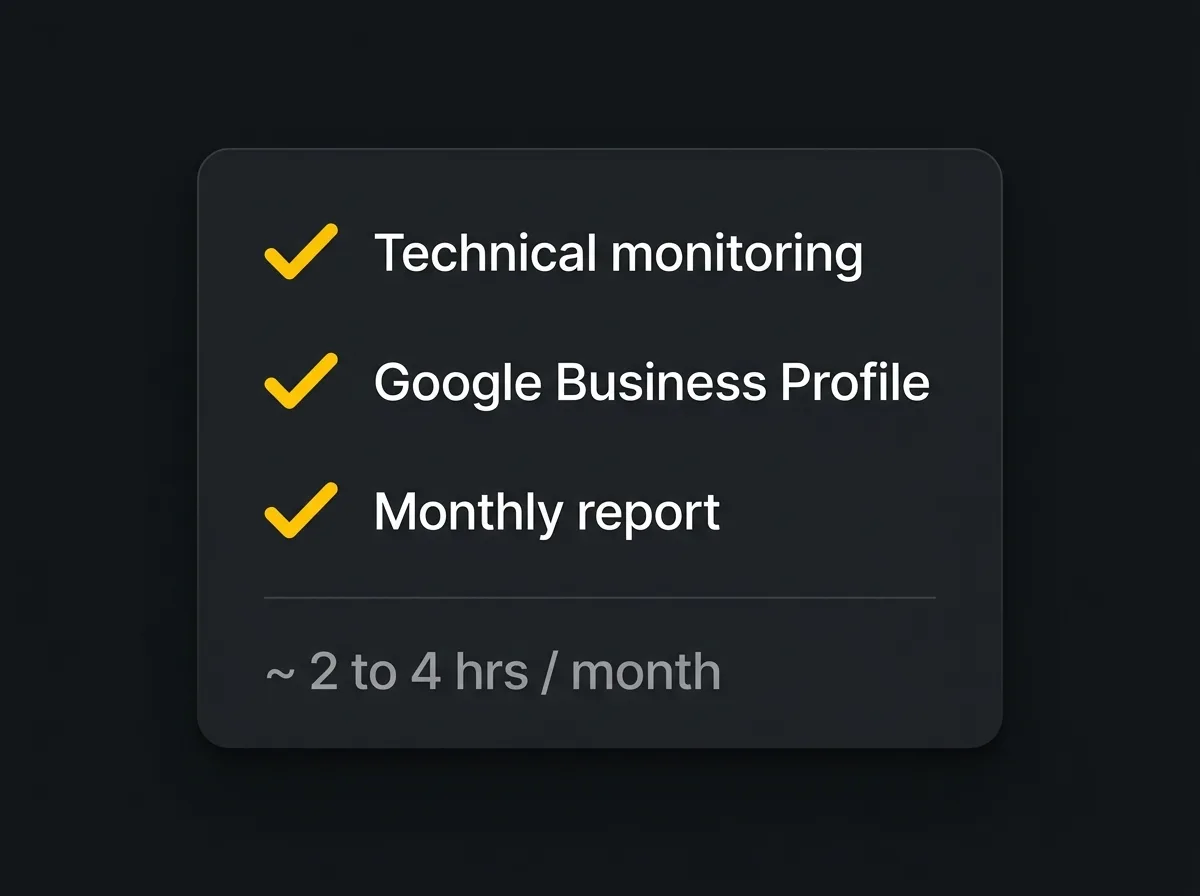
At this level you are buying roughly two to four hours of skilled time a month.
Not much.
What fits into that: technical monitoring for problems as they appear, basic on-page updates when something is clearly off, Google Business Profile maintenance, and a monthly report that explains what changed and why.
What doesn't fit: a content programme, and any link budget at all. Every pound here goes on labour.
That doesn't make it useless. The Google map pack, the three local results with the map above the normal listings, is driven largely by how close you are to the searcher, how relevant and complete your Google Business Profile is, and your reviews. A local business in a low-competition area with a solid website can do genuinely well here with good local SEO and very few links.
What it can't do is win a competitive market. An agency at this price promising page one for a contested term is making a promise the maths can't support.
£500 to £1,000 a month: foundations and content, not authority
This buys roughly five to ten hours a month. Enough for a structured programme, just.
A realistic plan at this tier covers the foundation work in months one to three, then one or two properly researched content pieces a month alongside steady on-page improvements to your money pages. Link building, if it appears at all, is one decent placement in a month where content gets cut back to pay for it.
So be honest about which searches you are going after. At this budget the winnable targets are local terms, specific long-tail searches and the practical questions your buyers ask. Not the head terms your best-funded competitors have spent years on.
Timelines matter too. Understanding how search engines crawl, index, and rank content makes it clear why there is no shortcut: new pages need to be discovered, evaluated against what already ranks, and gradually repositioned. Expect meaningful movement around months six to nine, not week six.
Consistency beats intensity. A business that spends £600 a month for twelve months will usually do better than one that spends £1,200 a month for six and then stops.
£1,000 to £2,500 a month: where a link budget first appears
This is the first tier where both pots can be properly funded at once.
A typical split might be £800 to £1,200 on labour, covering steady content and ongoing technical and on-page work, with the rest as a link budget. At £200 to £500 a placement, that is somewhere between one and five quality links a month, pointed at the pages that matter most.
Is that enough? It depends entirely on the gap. It can close a modest authority gap on carefully chosen money pages, particularly in regional markets. Against national competitors with hundreds of referring sites, it is closer to testing the water.
This is also where your agency should have a clear view on AI search. AI search is already changing how customers find service businesses, and the same content and authority work that lifts you in Google also shapes whether ChatGPT and Google's AI Overviews mention you. It shouldn't be a separate bolt-on.
£3,000 and up: what winning a competitive market costs
Here is the number most pricing guides avoid.
In properly competitive markets, serious UK link building campaigns typically run at £2,000 to £5,000 a month in link spend alone. Labour comes on top of that. A Manchester family solicitor, a national e-commerce brand or a private clinic in central London is usually playing at this level, because their competitors already are.
At this tier SEO stops being a cost and becomes an asset. Content that ranks keeps bringing in traffic long after it was written. Authority accumulates. It compounds.
It is justified when search is a primary way you win customers, when the gap between you and the businesses above you is genuinely large, and when your website already converts the traffic it gets. That last condition matters more than most people expect.
That number will put a lot of small businesses off. Fair enough.
It is also why the next section exists.
Small budget? Pick fights you can win
If you can't outspend your competitors on authority, don't fight them where authority decides the result.
That sounds obvious. Most small-budget SEO ignores it completely, aiming a £600 retainer at the same search terms as competitors spending ten times as much and wondering why nothing moves.
The better approach is to choose a smaller battlefield.
The local map pack. As above, it rewards proximity, profile quality and reviews far more than link volume. For many local service businesses it is the single most valuable place to be, and it is within reach on a modest budget.
Long-tail and specific searches. "Electric boiler installation Lichfield" has a fraction of the searches of "boiler installation", and a fraction of the competition. The people typing it are often closer to buying, too.
Questions your buyers actually ask. Good content answering real questions can rank on low-competition searches without a link budget, and it builds the topical authority that helps your money pages later.
Realistic targets for your money pages. Aim each service page at a search you can actually win this year, not the trophy term you'd love to own.
Then scale the link spend as revenue comes in. Win the small fights, use the enquiries they bring to fund the bigger ones.
The best small-budget SEO strategy is a smaller battlefield.
If you want to see which of your target searches are realistically winnable, and where the gap to your competitors is too wide for now, a Traffic Projection Report maps exactly that for your business. Free, and it gives you something concrete to test any agency's plan against.
Red flags at every price point

These apply whether you are paying £300 or £3,000 a month.
"Link building included" at a fee that can't pay for it. If a £400 retainer promises ongoing link building, ask how many links, on which sites, and what they cost. Either very few links are being built, or they are the cheap kind. Neither is what the proposal implies.
Guaranteed rankings. No legitimate provider can guarantee positions in Google, and Google's own guidance on hiring an SEO says as much. Anyone promising position one for a competitive term is either misrepresenting what they control or planning methods that will cause you problems later.
Links sold by volume. Fifty links for £500 is not a bargain. It is a description of what was cut to reach that price.
No Search Console access from day one. Your search data belongs to you. Reluctance to give you your own login is telling you something.
Reports with no line to enquiries. Rankings and traffic charts with no connection to leads aren't telling you whether the money is working. After six months you should be able to see the commercial effect, or get a straight answer about why not.
Content you don't own. If you leave, everything created for your site should leave with you.
What good looks like before you sign

Red flags tell you what to avoid. These tell you what to move towards.
The link budget is its own line. A good proposal separates labour from link spend, says roughly how many placements that buys, and explains which pages they will point at and why. If links are mentioned but never costed, ask.
A rationale, not a menu. Why these keywords? Why this content first? Why is technical work the priority in month one? A proposal that reads like a list of services probably is one.
Your own logins from week one. Google Search Console and GA4, in your name. A transparency signal, not a technical nicety.
Honest early milestones. A good agency will tell you that months one to three are foundations, and won't promise traffic growth before the work has had time to land.
Real numbers from real clients. Ask for traffic and enquiry data from comparable businesses. If the answer is a page of testimonials, notice that.
A willingness to say "not yet". The most reliable sign of a trustworthy agency is one that will tell you when SEO isn't the right move. Every agency agreeing with everything you say is a warning in itself.
For the wider picture of how search visibility and traffic fit together across traditional search, AI search and local, the hub covers all three.
When SEO might not be the right investment yet
Most pricing guides skip this section. We think it is one of the most useful.
The website doesn't convert. If 200 visitors a month produce one enquiry, doubling traffic produces two. Fixing the conversion problem first is often a better use of the same budget.
You need revenue in three months. SEO is not that instrument. Paid search gives a much faster feedback loop and is a legitimate channel to run alongside it.
The market is too competitive for the budget. If the searches that matter are dominated by businesses with years of authority, and there is no smaller battlefield worth winning, a modest retainer won't close the gap. Better to put the money into channels that pay back sooner, build the case, and come back to SEO with a budget that can actually compete.
This article isn't here to sell you SEO. It is here to help you decide whether it is the right investment for you right now, and at what level.
Getting a quote that actually tells you something
A proposal that answers four questions is one you can properly evaluate.
1. What will you do, and why?
Not a list of activities. A rationale for this business at this stage. "We always start with an audit" is not an answer.
2. How much of my budget goes on links, and where will they point?
The single most revealing question on this list. A good agency answers with a number, a rough placement count and the pages being supported. A vague answer usually means the link budget is small or non-existent.
3. How will you measure success beyond rankings?
What happens to enquiries? What does a genuinely good six months look like in commercial terms?
4. What will I have at day 90 that I don't have now?
Specifically. What gets fixed, what gets published, what gets built.
If the proposal you receive could have been written for any small business in any sector without changing a word, it probably was.

Before you agree to any retainer, it is worth getting a concrete picture of the gap: where you sit in search today, where your competitors sit, and how much authority separates you.
Free resource: Traffic Projection Report
A personalised look at the search landscape for your business: current visibility, the gap between you and your main competitors, and a realistic projection of what a properly run programme could return over 12 months. It takes around 48 hours and costs you nothing to request before signing anything.
Frequently asked questions about small business SEO costs in the UK
How much does SEO cost for a small business in the UK?
Typical UK small business SEO retainers run from £300 to £1,500 a month, but that figure usually covers labour only. In competitive markets, a meaningful link budget sits on top: quality placements typically cost £200 to £500 each, and serious campaigns spend £2,000 to £5,000 a month on links alone. Low-competition local businesses can do well at the lower end; competitive regional and national markets need considerably more.
What does £300 a month SEO actually include?
Roughly two to four hours of skilled time: technical monitoring, basic on-page updates, Google Business Profile upkeep and a monthly report. It does not include a content programme or any link budget. It suits local businesses in low-competition areas with a solid existing website, or businesses making a first step before scaling up.
Do you have to pay for backlinks?
For links that genuinely help, yes, in one form or another. Publishers charge an "editorial" or "admin" fee for placements, and digital PR costs the time it takes to earn coverage. Google's spam policies class buying links that pass ranking credit as link spam, so what you pay for matters: relevant sites with real readers and editorial standards, never volume packages.
How long does SEO take to work for a small business?
At £500 to £1,000 a month, expect foundation work in months one to three, early movement in months four to six, and meaningful traffic changes around months six to nine. Bigger budgets with a proper link spend can shorten that. Lower budgets stretch it, and in competitive markets without any authority work, the movement may never come.
Is it worth paying more for SEO as a small business?
Only if the extra money funds what your market actually requires. In a low-competition local market, more spend may add little. In a competitive one, the extra usually needs to go on authority, because content and on-page work alone won't close a large link gap. The right budget is the one that matches the size of the gap, or a strategy that picks searches small enough to win.
Pricing tells you the scope of what is possible. The link budget tells you whether you can actually compete.
Most small businesses spend all their time comparing monthly fees and none asking where the money goes. That is the wrong way round.
Before you sign anything, request a Traffic Projection Report. It shows you exactly how big the gap is, which fights are winnable now, and gives you a concrete starting point for any conversation with an SEO agency, including this one.