
Your Google Business Profile is verified. You have around forty reviews. You are on Checkatrade. And yet when someone two streets away searches for a plumber right now, the same three names appear above you every single time.
You have done the basics. The basics are not enough.
There are three specific things separating the plumbers who appear in the top three from the ones who sit just below it. Most local SEO guides cover the setup. This one covers the gaps: how the map pack actually decides its winners, what makes a service-area page rank on its own rather than simply existing, and why most link building advice for plumbers is pointing you at the wrong target entirely. If you would rather hand this to someone, our local SEO service covers all three.
How Google decides which plumber wins the map pack
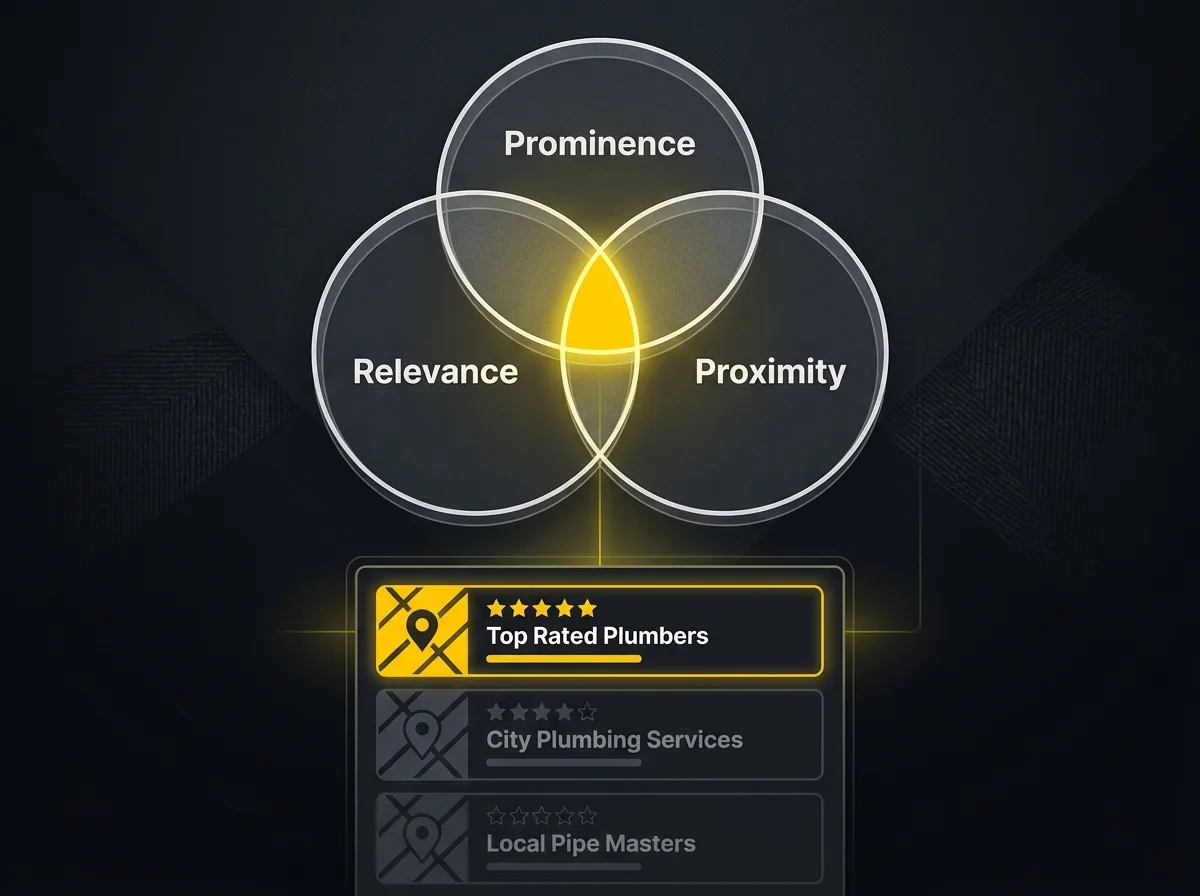
Local SEO for plumbers is the set of signals that tell Google Maps which plumbing businesses to show when someone searches in a given area. According to Whitespark's annual Local Search Ranking Factors survey, Google uses three factors to determine who appears in the top three: relevance, proximity, and prominence. Everything that follows in this guide is aimed at improving one or more of them.
Relevance is whether your listing matches what the searcher wants. The services you list, the category you have selected, and the language used across your Google Business Profile all affect this. A profile that just says "plumber" ranks less relevantly than one listing specific services: boiler repair, emergency callout, gas safety certificate, bathroom fitting, blocked drains. Google can match those specific services to queries it could never connect to a generic profile.
Proximity is the location of the person searching, not the location of your registered address. This surprises a lot of plumbers. A business registered in Solihull does not automatically dominate searches from someone standing in Sutton Coldfield, even though the two are barely three miles apart. The map pack changes depending on where the searcher is standing. That is why you might appear confidently for someone in your own town but barely register for someone a few miles over, and why covering a wider area requires deliberate effort rather than a broad service-radius setting.
Prominence is how well-known and trusted Google believes your business to be. Reviews, links pointing to your site, directory listings, and general online presence all feed this signal. A plumber consistently appearing in the top three of a competitive city market, London, Birmingham, Manchester, typically has 80 to 100 or more reviews, backlinks from real local organisations, and a website that covers their services properly. In smaller market towns, 30 to 40 reviews can be enough to compete.
Prominence builds slowly. It is also the factor that most clearly separates strong, stable map pack positions from ones that keep slipping. The rest of this guide addresses all three, starting with the signals that are most directly within your control.
Getting your Google Business Profile to the point where it can compete
Setting up your Google profile is table stakes. Having it actively compete is something else entirely.
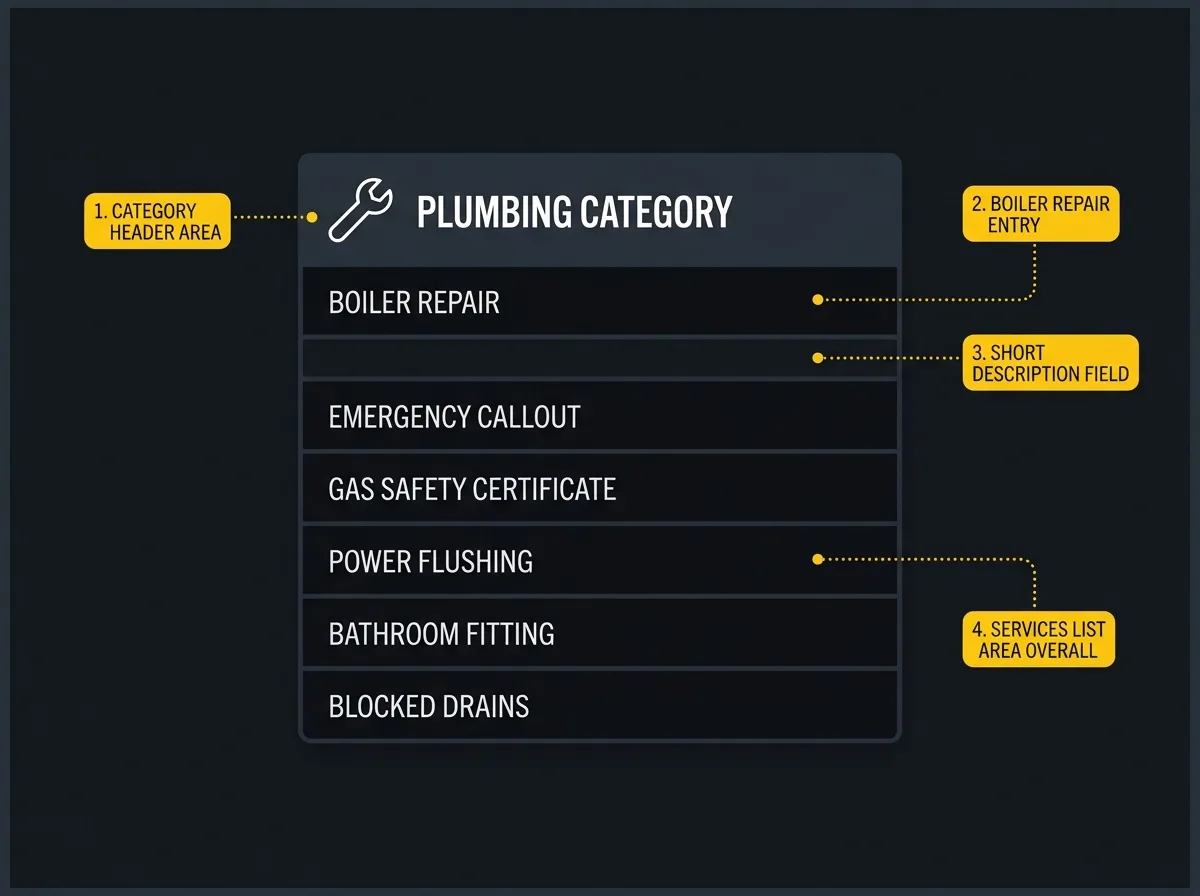
Service menus. This is one of the most underused features on a plumbing profile. Listing each specific service you offer, boiler repair, emergency callout, gas safety certificate, bathroom fitting, power flushing, unblocking drains, tells Google precisely what you do and widens the range of queries your profile can be relevant to. A generic "plumbing" category gives Google very little to work with. If a customer searches "gas safety certificate Coventry" and your profile only says "plumber", you are already at a disadvantage against the profile that lists it explicitly.
Service areas. If you work across multiple towns, the way you configure your service areas matters. A broad radius sounds efficient, but it dilutes relevance signals for any specific location within it. For a plumber covering a city and its surrounding towns, setting individual towns and postcodes consistently outperforms drawing a circle on the map. Google can be more precise about where you should rank when you tell it precisely where you work.
Photo velocity. Google rewards profiles that receive fresh photos on a regular basis. Before-and-after job photos, van and team shots, work in progress on a bathroom fit-out. You do not need a professional photographer. A few phone photos from jobs each week is sufficient. Aim for at least one new upload per week. It is one of the cheapest positive signals available, and most competitors are ignoring it completely.
Q&A. Most plumbers leave the Questions and Answers section completely blank. Seed it yourself. Post questions that real customers ask, "Do you cover emergency callouts in [town]?" "Are you Gas Safe registered?" "Do you work on combination boilers?" and answer them. These keywords are indexed separately and can appear in search snippets. They also handle objections before the customer picks up the phone to ask.
Google Posts. A brief monthly update keeps the profile looking active to both Google and potential customers scanning the results. A note about seasonal boiler checks, a post about a new service area, a recent job type you have been handling. The signal here is activity, not content depth.
Service-area pages that actually rank, and how to avoid the thin-content trap

The map pack is driven by Google Business Profile signals. Organic blue-link results for "[plumbing service] in [town]" searches are driven by your website content. You need both, and they require completely different approaches.
A service-area page is a dedicated page on your website targeting a specific town or borough. The purpose is to rank organically for searches like "plumber in Bromsgrove" or "emergency plumber Solihull", independently of the map pack. These pages can capture significant traffic on their own, particularly for areas where you have strong operational presence.
The thin-content trap is where most plumbing websites come unstuck. The approach looks sensible at first: create a page for each town, swap the location name into the template, repeat across thirty areas. Google identifies these as low-value near-duplicate content, because that is exactly what they are. At best, they fail to rank. At worst, a site loaded with dozens of thin location pages sees its overall crawl quality affected, which gradually pulls down the rankings of the pages that were previously working.
What makes a location page genuinely distinct is local context that is specific and true. Older housing stock in Victorian-era terraces means more lead pipework replacement work. Hard water across much of southern England and the Midlands means limescale-related callouts are a realistic service emphasis in those areas. Specific roads, recognised local neighbourhoods, and the postcode districts you cover intensively are all signals that this page exists because a real business knows this area, not because a template was duplicated and a town name was swapped.
A well-built location page needs: an H1 combining the service and location name, an introductory paragraph with genuine local context, a services list with any area-specific emphasis, an embedded map, a selection of reviews from customers in or near that area where available, and a clear call-to-action with a local or trackable phone number.
How many to build? One per town you meaningfully serve, not one per postcode. For most UK plumbing businesses that means somewhere between five and fifteen pages. Quality over volume, every time. The same principles apply whether you cover one city or multiple sites. We cover the architecture in more detail in this guide to local SEO across multiple locations, where the structural logic transfers directly regardless of sector.
Ten well-written pages will always outperform fifty thin ones. Always.
Local link building for plumbers: beyond the directory listings
Most "link building for plumbers" content is actually a citation guide. It lists Checkatrade, Rated People, Yell, Thomson Local, and TrustATrader, calls it done, and moves on. Citations are important. But they are not backlinks, and they do meaningfully different jobs.
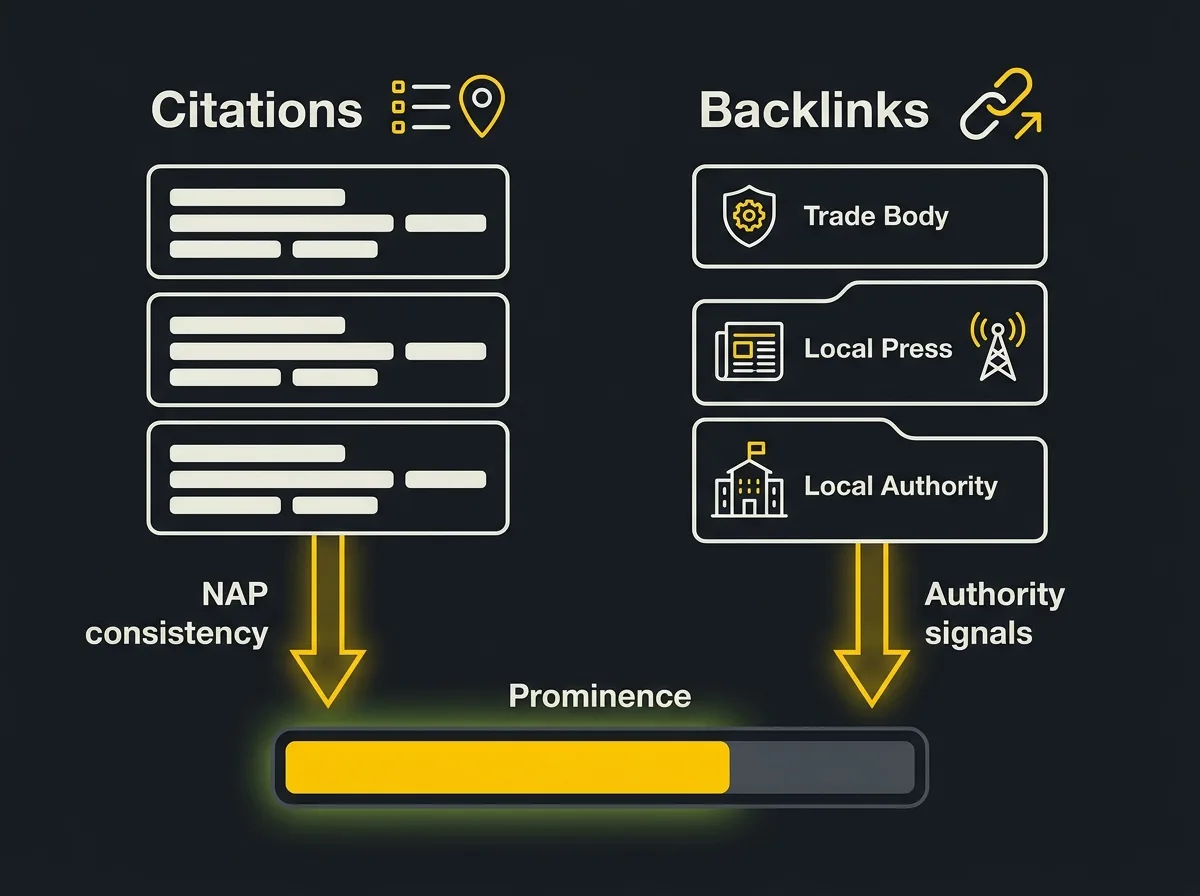
A citation gives Google consistent name, address, and phone data across the web. It confirms your business is real and located where it says. That contributes to prominence, primarily as a verification signal. A backlink from a relevant, trusted external site tells Google your business is recognised by credible organisations in your local area. That contributes to prominence as an authority signal. Both matter. Most plumbing businesses have their citations in reasonable shape within a few months of basic setup. Very few have meaningful backlinks from local organisations, which is precisely where the competitive difference lies.
Gas Safe Register. If you are Gas Safe registered, which you must be for any gas work in the UK, your Gas Safe Register profile page can link directly to your website. Most plumbers have this field empty or pointing nowhere. Update it. This is a high-trust, industry-mandatory link that is already tied to work you are required to carry out. There is no additional cost and it takes five minutes.
APHC membership. The Association of Plumbing and Heating Contractors runs a member directory that links to member sites. Membership has a cost, but it provides an industry-relevant, editorially placed link with genuine trade authority.
Local chamber of commerce. Most UK towns and cities have an active chamber with a member directory. Membership is typically modest in annual cost and produces a link with strong geographic relevance. For a plumber whose work is inherently local, the geographic signal from a chamber directory link is genuinely useful, and it is the kind of link a competitor who bought a £300 link package will never have.
Plumbing and heating suppliers. National merchants like Wolseley and City Plumbing, and independent trade counters, occasionally maintain partner or approved-contractor pages. Worth enquiring directly with your regular supplier contacts. These are contextually relevant links that almost no competitors think to pursue.
Local authority approved-contractor lists. Some councils maintain lists of approved tradespeople for home improvement grant schemes, social housing repair programmes, or similar. These are government-domain links with genuine geographic relevance. They require effort to get onto, but the authority they carry is significant.
Local press. A note about an emergency job during a cold snap, a community sponsorship, a local award shortlisting. UK regional newspapers and hyperlocal news sites carry reasonable domain authority and very high geographic relevance. A single genuine local press mention can outweigh dozens of directory listings as a prominence signal.
What to avoid: paid link packages promising hundreds of placements, link networks, press releases with no genuine news value. These do not build prominence and carry the risk of a manual penalty that is far harder to recover from than slow, earned link building.
The timeline expectation matters here. Building a handful of genuinely well-placed links over 6 to 12 months is a realistic target, not a quick win. It is the medium-term investment that shifts competitive map pack positions in ways that citation building alone cannot. For a wider view of how this fits the picture, the guide to SEO for tradesmen covers the broader context across trade sectors.
Knowing when local SEO is actually working
A single desktop ranking from your office is not a diagnostic metric. It is too variable and too dependent on your own search history to tell you anything useful. These are the numbers that matter.
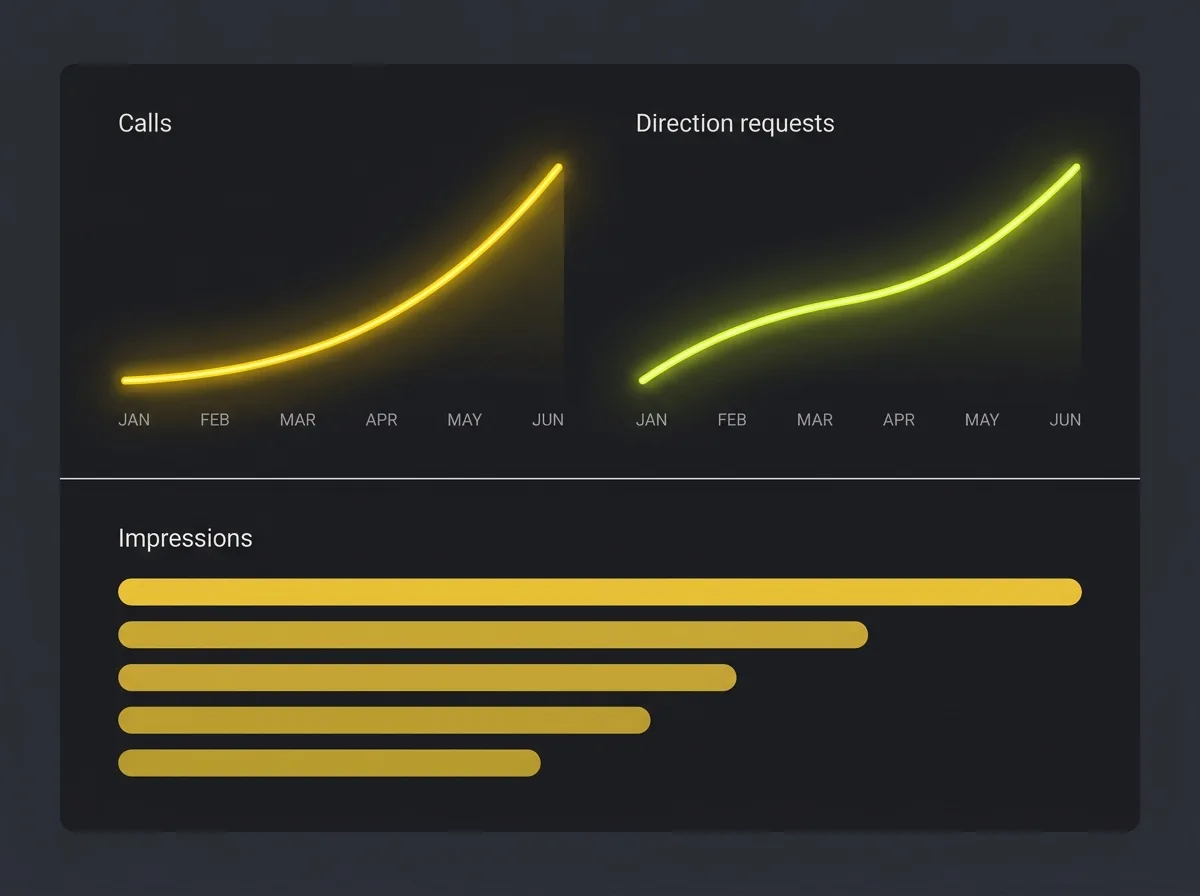
GBP Insights. Calls, direction requests, and website clicks generated directly from your Google Business Profile listing. Track these month on month. They are the direct commercial outputs of map pack visibility. Rising numbers mean the profile is gaining ground. Flat numbers despite ongoing work usually point to a relevance or prominence gap rather than a setup issue.
Google Search Console. Which queries are generating impressions and clicks? Look specifically for "[service] in [town]" patterns. These reveal whether your location pages are being found organically. Low impressions for a town you serve regularly usually means either the page needs more local depth or it lacks enough prominence to be considered competitive.
Local rank tracking. Tools like BrightLocal show your rankings across a postcode grid, not from a single fixed point. This is how you diagnose whether you are winning searches close to your registered address but losing searches three miles away, and therefore where to direct service-area page improvements or GBP service-area configuration work.
Call tracking. A trackable number on the website, separate from the GBP number, attributed via a tool like CallRail, tells you which organic pages are generating actual enquiries rather than just visits. It is the difference between knowing a page is being found and knowing it is doing something commercially useful.
Timeline. Meaningful movement in GBP call volume and Search Console impressions for local queries is typically visible within three to six months of consistent, properly directed work. The map pack position itself can shift faster in smaller markets and slower in major cities. A well-executed 12-month programme in most UK regional plumbing markets produces clear, measurable change.
Frequently asked questions about local SEO for plumbers
How many service-area pages should a plumbing website have?
One per town you meaningfully serve. For most UK plumbing businesses that sits somewhere between five and fifteen pages. Do not create a page for every postcode or every peripheral area you occasionally reach. Google rewards content depth and local specificity, not sheer volume of pages. Ten well-written pages covering your core operating areas will consistently outperform fifty thin ones, and they are significantly easier to keep current as your business evolves.
Can a plumber rank in the map pack without a physical address listed?
Yes. Google allows service-area businesses to hide their registered address and still appear in the map pack. The trade-off is a marginal reduction in proximity signals, because Google has less precise location data to calculate from. Most plumbers operating as sole traders from a home address should use the service-area business setup, hide the address, and configure service areas by town and postcode instead. The map pack position will still respond to all the normal GBP quality signals, reviews, and website prominence work.
What is the difference between a citation and a backlink for local SEO?
A citation is a listing of your business name, address, and phone number on a directory or data aggregator site. It confirms your business exists and is located where it claims to be, contributing to prominence as a verification signal. A backlink is an editorial link from another website pointing to yours, contributing to prominence as an authority signal. Both matter. Most plumbing businesses get their citations sorted early. Very few invest in building backlinks from real local organisations, which is exactly why doing so creates a competitive separation that directory listings alone never will.
How long does local SEO take to show results for a plumbing business?
Three to six months for visible movement in GBP call volume and Search Console impressions is a reasonable expectation in most UK markets, provided the foundations are properly in place first. Speed depends on how competitive the specific local market is. Link building compounds over time; the first handful of links do less than the first dozen combined. A properly run 12-month programme produces meaningful and measurable change in where you appear and how consistently customers find you through search.
Where to go from here
Local SEO for a plumbing business has more moving parts than most guides suggest. But the underlying logic stays consistent: relevance, proximity, and prominence are the three levers. Everything covered in this guide pulls on one or more of them.
Most plumbers stall after the initial setup phase because they address relevance through GBP configuration, do the basic citation work, and then stop. Prominence is left underdeveloped. No backlinks from local organisations, location pages that exist but do not earn rankings of their own, and a map pack position that plateaus because the gap between you and the top three is now an authority gap rather than a setup gap.
If you want to understand what search demand actually looks like in your specific service area, which towns, which query types, and what share of that demand is realistic to capture, a Traffic Projection Report gives you that picture before you commit to a programme of work.
Free Traffic Projection Report
We look at your market, your current position, and the realistic opportunity, then send you the report within a few working days. No cost and no commitment.
If you would rather hand the whole thing to a specialist, our local SEO service is the direct route in, or our SEO agency page covers the broader scope if you are thinking beyond local.