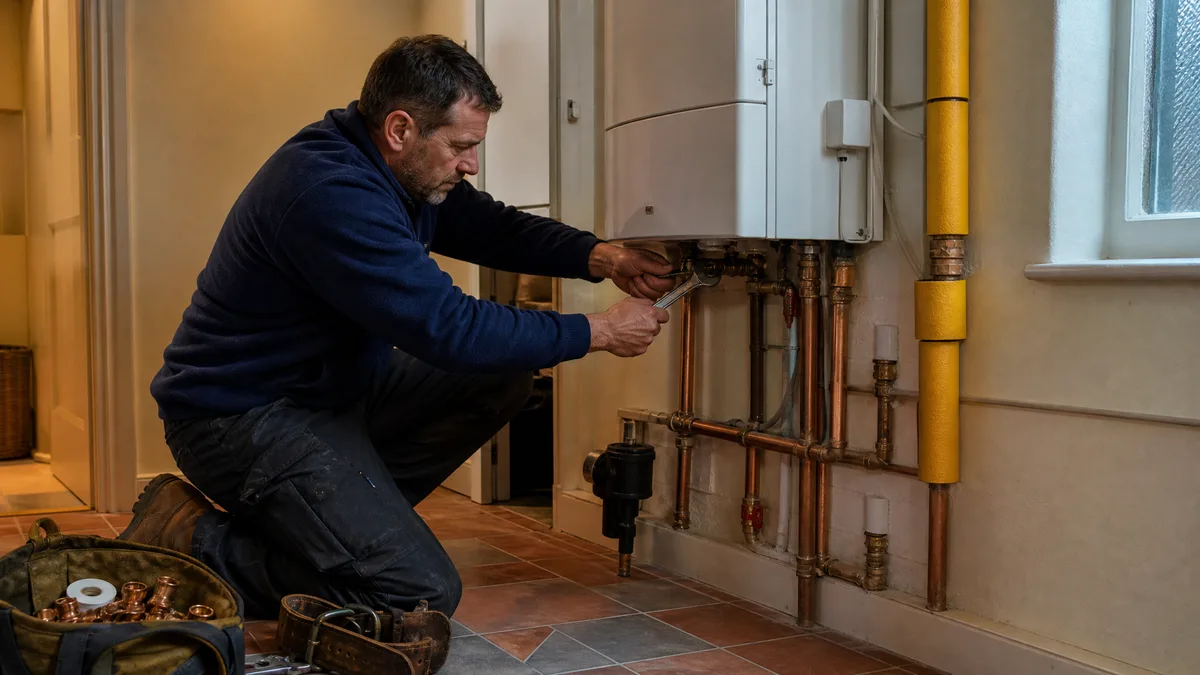
Tuesday morning, January. A homeowner in Coventry opens her phone. The boiler died overnight. She types "emergency plumber Coventry" into Google and three names appear in a box at the top of the results. She calls the first one.
The second never gets a look. Neither does the third.
A plumber sitting at position four is completely invisible to her. By the time she could have scrolled down, the call is already being made to someone else. He might be better reviewed. He might be cheaper. He has been in the trade for twelve years and does excellent work.
None of that matters this morning.
This is what SEO for plumbers is actually about. Not rankings in the abstract, not web traffic as a vanity number. The phone ringing when someone needs you in the next hour.
TL;DR: SEO for plumbers means making your business visible in Google search and Google Maps when local customers search for the plumbing services you offer. There are two distinct types of customer, and they find you in different ways. The map pack wins emergency calls. Your website and reviews win planned jobs. Most guides treat them as the same problem. They are not.
The two types of plumbing customer (and why they search differently)
Most plumbing SEO guides treat every customer as identical. They are not, and confusing the two is where a lot of effort gets wasted.
Emergency customers have a burst pipe, a boiler failure, no hot water on a February morning, or a drain backing up at the weekend. The decision cycle is measured in seconds. They search, they see a box with three listings, they call the first name showing an available number. Price barely registers. Whether your website looks professional is completely irrelevant.
Being in positions one, two, or three in that box is everything. Position four might as well be page three.
Planned customers are a different matter entirely. They are arranging a new bathroom, replacing an ageing boiler before winter, booking a landlord gas safety certificate, or installing central heating in a property they have just bought. They have time to research. They will visit three or four websites, read reviews in detail, look at project photographs, and check credentials before making contact.
Price matters. So does professionalism, qualifications, and how you present yourself.
The reason this distinction matters for SEO is direct. The tactics that put you in front of emergency customers are not the same as the ones that win planned work. The map pack and your Google Business Profile do most of the work for emergency calls. Your website, project photos, and trust signals do most of the work for planned jobs.
Both matter. They require different attention.
For a broader read on how this two-intent dynamic plays out across trades, SEO for tradesmen covers the wider picture. The pattern looks very different for builders, where the sales cycle is long and almost all work is planned.
If you want to see that contrast directly, SEO for local builders goes into the detail.
The map pack is where emergency plumbing jobs live
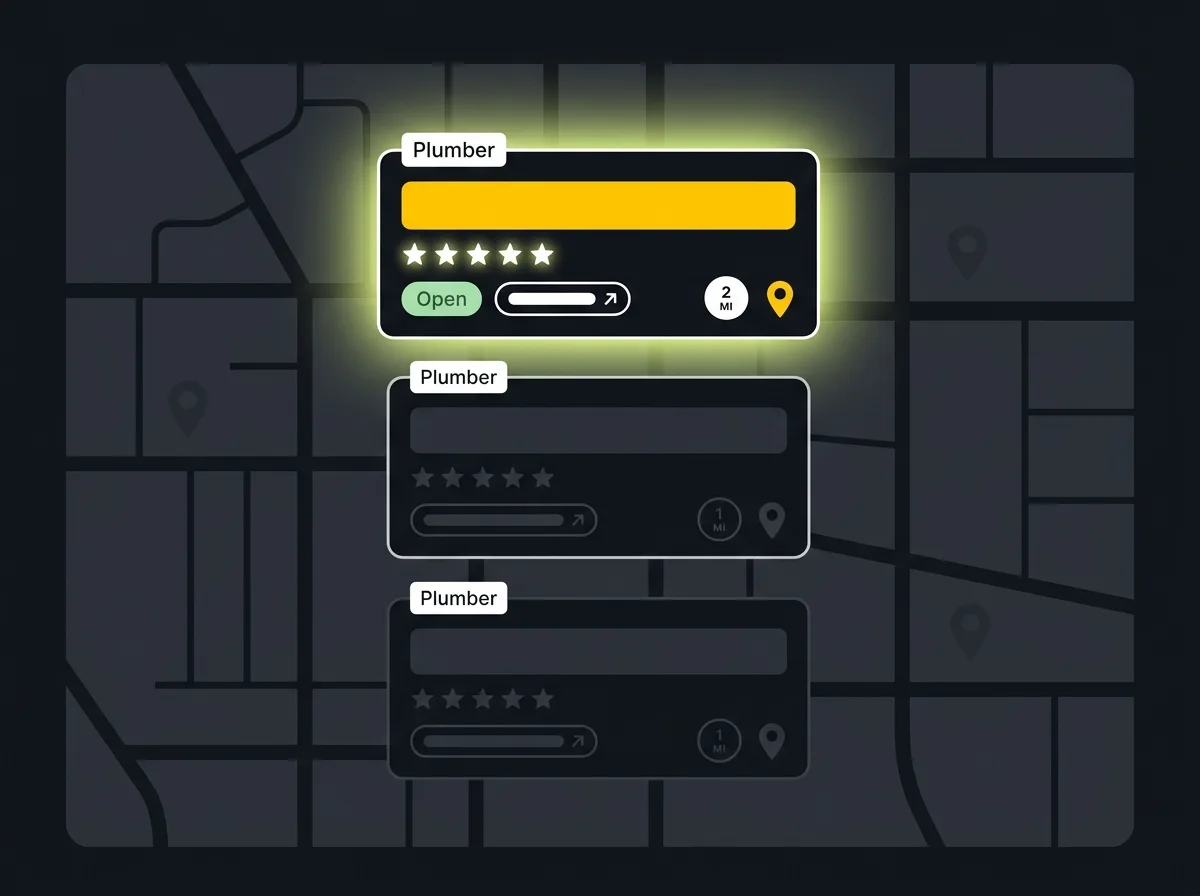
When someone searches "emergency plumber [city]" on a phone, the first thing they see is not a list of websites. It is a box with a map and three business listings, each showing a name, a star rating, a review count, and how far away the business is. This is the local 3-pack. It appears above all the organic website results.
For urgent searches, it is where the decision gets made.
Google decides which three businesses appear using three main signals. Proximity: how close the business is to where the searcher is located. Relevance: how well the Google Business Profile matches the search query. And prominence: how well-established and trusted the business appears, based on factors including reviews, links, and ongoing activity.
These three signals have been confirmed consistently by practitioners over many years.
Service area setup. The most common GBP mistake for plumbers is listing only the registered business address. If you are based in Wolverhampton but you cover Walsall, Dudley, Cannock, and Stafford, all of those towns need to be in your service area settings. Without them, Google has no instruction to show your listing for searches in those postcodes.
Open your GBP, find the service area section, and add every town where you genuinely want to appear.
Categories. Your primary category should be "Plumber". Secondary categories add query coverage without diluting the primary signal: "Drainage service", "Heating contractor", "Gas installation service", and "Hot water system supplier" are all worth adding if they reflect work you actually do.
Opening hours. If you take emergency call-outs outside standard hours, your GBP must say so. "Open 24 hours" or clearly stated weekend and evening hours are a conversion signal to the customer reading your listing, and they are information Google uses to determine whether to show you for late-night emergency queries.
Simple fix. Big impact.
Photos. Real ones. Before-and-after job shots, your van with signage, the team. Not stock images. Google's own guidance confirms that photos increase engagement with listings, and a profile updated with new photos this month sends a different activity signal than one last touched two years ago.
Q&A. The Q&A section of your GBP lets you pre-populate answers to the questions customers actually ask. Use it. "Do you cover [nearby town]?" "Are you Gas Safe registered?" "Do you charge a call-out fee at weekends?" These answer the questions before the customer has to ask, and they add keyword-relevant content to your listing at the same time.
Getting and keeping a strong map pack position is the core of local SEO for service businesses. It is the single highest-impact thing a plumber can do to generate more emergency calls.
Emergency keyword targeting: the search terms that mean someone needs help now

Not all plumbing searches carry the same urgency. "Emergency plumber Coventry" is a different intent from "best plumber Coventry". The first wants a number to call within the next two minutes. The second is still browsing.
The terms that signal genuine urgency are: "emergency plumber [city]", "burst pipe [city]", "no hot water [city]", "boiler breakdown [city]", "blocked drain [city]", and "24 hour plumber [city]". Someone typing one of these is not comparison shopping.
These terms need dedicated landing pages.
A homepage that mentions emergency cover in passing is not enough. A page specifically titled "Emergency Plumbing in Coventry" or "24-Hour Plumber in Birmingham" that loads in under two seconds, shows a phone number above the fold, and makes it possible to call without scrolling will consistently outperform a well-ranked homepage for these queries.
What makes an emergency page convert is not complicated. The phone number must be immediately visible, ideally as a large clickable element at the top of the page. A brief description of what is covered: burst pipes, boiler failures, blocked drains, weekend call-outs. An honest indication of response times if you can stand behind them. Your Gas Safe registration number for any gas-related work. A handful of recent reviews from that location.
Emergency customers do not read long pages. They scan for the number and the credentials.
Near-me searches. "Emergency plumber near me" is one of the most searched terms in this cluster. It ranks on proximity and GBP completeness, not on having the phrase "near me" written anywhere on your website. There is nothing to add to a page for this search. The GBP does the work.
Any guide that tells you to write "near me" in your page copy is wrong, and has been for years.
Boiler terms and seasonality. For Gas Safe registered plumbers who cover boiler work, search volume for "boiler repair [city]" and "boiler breakdown [city]" spikes significantly from October through January, when UK heating systems fail after sitting idle through summer. This is the busiest period for emergency calls and the period when new customers form long-term relationships with a plumber.
Having well-built emergency pages ranking before September gives them time to establish before demand arrives.
Google Search Console, which is free and takes about twenty minutes to set up, will show you which queries are generating impressions for your site. It is worth checking simply to understand which search terms are bringing people to your pages and where you are appearing in results but not getting the click.
What planned-purchase customers need from your website
The homeowner planning a new bathroom will visit your website. The one with a burst pipe called you before they got that far.
For planned work, your website is doing real commercial work. The customer is comparing you with two or three others. They will form a view of your professionalism from the site before they ever speak to you.
The things that convert them are different from what wins the emergency call.
Service pages. Every major service you offer needs its own dedicated page. Bathroom installation. Boiler replacement. Central heating installation. Landlord gas safety certificates. Power flushing. Not two-paragraph placeholders. Pages with real information about what the job involves, typical timelines, and what the customer needs to prepare. A homeowner researching a bathroom renovation wants to understand the process.
Give them something useful and you stay in the shortlist. Give them a thin page and they move on.
Before-and-after photos. Essential for planned work and almost entirely absent from plumbing websites. A gallery of bathroom renovation photographs does more conversion work for a planned customer than any amount of text. The emergency customer never scrolls to the gallery. The planned customer goes looking for it.
Most plumbing businesses have completed dozens of jobs that would photograph well. Almost none of them document it.
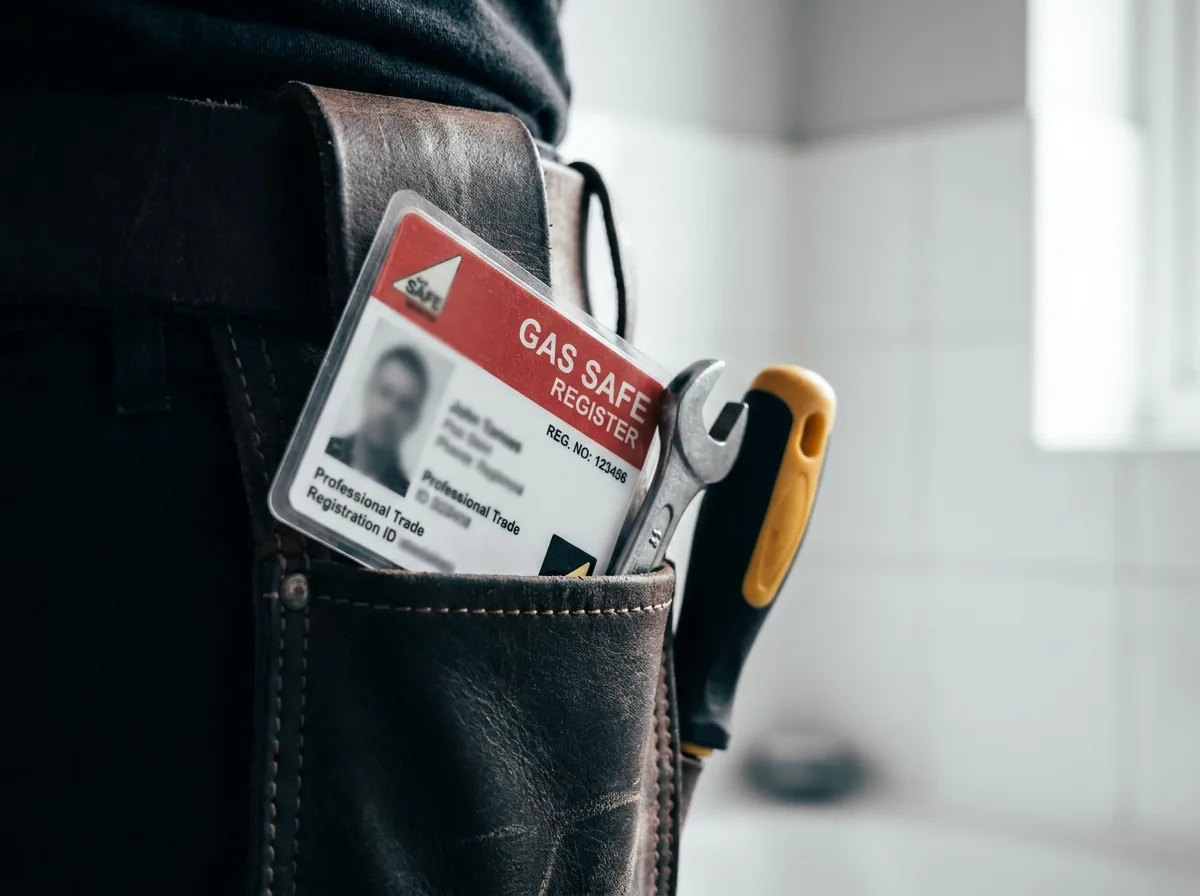
Trust credentials. For gas work, your Gas Safe Register registration number should be visible on the website with a link to the register check page so customers can verify it directly. This takes minutes to add and it converts the planned-purchase customer who researches before calling.
If you hold CIPHE membership, that belongs on the site too. Public liability insurance details can matter for certain customers, particularly landlords and commercial enquiries.
Two contact paths. Your website needs to make two things obvious simultaneously. An immediate phone number for emergency calls. A quote request form for planned work. Both need to be prominent on every page. A website that makes a customer hunt for the phone number loses the emergency caller. A website with no quote form makes it harder for the planned customer to initiate contact on their own terms.
This is where a well-built website earns its keep.
A plumber with a strong GBP but a weak website will win some emergency calls but lose a proportion of planned work to competitors whose online presence looks more considered.
Reviews: the map pack ranking signal most plumbers underuse
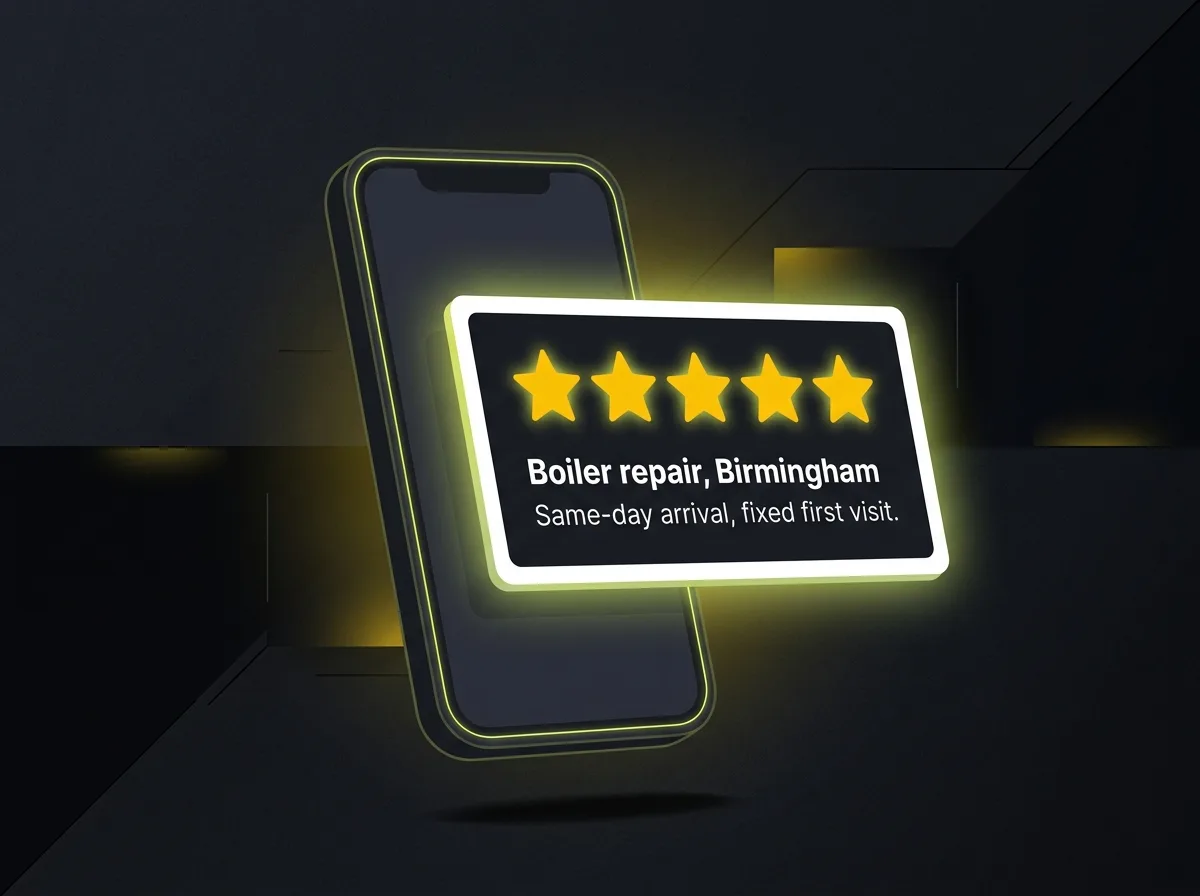
Reviews do two things at once: they influence where you appear in the map pack, and they influence whether someone calls you when they see you there. Think of them as both a ranking signal and a conversion tool.
According to BrightLocal's Local Consumer Review Survey, the large majority of local consumers read reviews before contacting a local service business. For plumbers, this matters most to the planned-purchase customer who has time to research. But reviews also influence the emergency caller who scans your map pack listing and decides in two seconds whether to trust what they see.
Most plumbers know they should collect more reviews. Few have a system for it.
Review velocity. This surprises most plumbers. Ten Google reviews collected this month carries more map pack weight than fifty reviews accumulated over four years, even when the older profile has a higher overall star rating. Google treats recent reviews as a signal of active and relevant business.
A profile with no new reviews in eighteen months looks dormant, regardless of its history.
How to ask. At the moment the job finishes, in person. "I'd really appreciate it if you left me a Google review. It helps me get more local work." That personal request, made directly, substantially outperforms any follow-up text or email template sent two days later.
Do not use incentives. Google's terms prohibit them, and the risk of losing your listing is not worth it.
What a useful review looks like. From an SEO perspective, a review that mentions the job type, the location, and a specific detail is worth more than a five-star rating with no text. "Fixed an emergency boiler breakdown in Stafford, arrived within two hours" is more useful than "Great service, would recommend." You cannot write the review for the customer, but when you ask in person you can mention what is helpful to include.
That specificity is what adds ranking value.
Respond to every review. Including the negative ones. Responding tells Google that the profile is active and managed. It also shows the planned-purchase customer who reads reviews carefully that you are professional and accountable. A business owner who responds thoughtfully to a critical review consistently impresses potential customers more than one who ignores it.
Platform priorities. Google reviews directly influence map pack ranking and they are the priority. Checkatrade and TrustATrader reviews matter to the planned customer who researches across platforms, particularly those who use those platforms habitually. Both matter, but if you are pressed for time, Google is where to focus first.
Location pages: when they help and how to build them properly
A homepage optimised for your nearest city will not rank for searches from a town fifteen miles away. If you genuinely cover a wider area, location pages are how you extend your visibility into those postcodes.
Worth doing. Hard to do well.
What a genuine location page needs is specific content about your service in that area. Some reference to local knowledge where honest: postcodes you cover, examples of jobs completed there if you have photographs, local landmarks near properties you have worked on. A real phone number if possible.
At least 400 words of content that could not simply be copy-pasted onto a page for a different town with only the location name swapped.
That last point is what causes problems. The thin location page pattern is widespread in trades: identical text across twelve town pages with only the place name changed. Google identifies this quickly. These pages do not rank, and they can actively harm the overall quality signal of the site.
The rule of thumb: if you cannot write 400 genuinely useful words about your service in a specific area, the page is not ready to publish.
Start with the five or six locations where you do the most work and where you want map pack visibility for non-emergency terms. Build those well first, rather than creating thin placeholders across the entire region.
How AI search is starting to change how homeowners find plumbers
ChatGPT, Perplexity, and Google's own AI features are increasingly being used for queries like "find me a reliable plumber in [city]" or "who should I call for a boiler repair in [area]". This happens most for planned work, where there is time to research.
The homeowner with a burst pipe at midnight is still going straight to Google Maps.
What AI tools do with a local service query is surface businesses mentioned positively in content they have indexed. Reviews on platforms they can read. Named entities in well-organised, structured content. A plumber with a complete GBP, strong reviews on Google and Checkatrade, and a Gas Safe number clearly visible on their website is more likely to appear in an AI-generated local recommendation than one who is invisible outside their homepage.
One set of actions. Two places it pays off.
The practical implication is straightforward. The GBP completeness and review strategy described in this article serves both audiences. It is not two separate strategies. The same underlying work creates visibility in Google Maps and in AI-generated recommendations.
For plumbers who want to lean into this, ensure listings are current and accurate on Checkatrade and TrustATrader as well as Google. These platforms are indexable by AI tools. They are also where a portion of planned customers still search habitually, so the investment earns its keep across channels.
What to measure (and what to ignore)
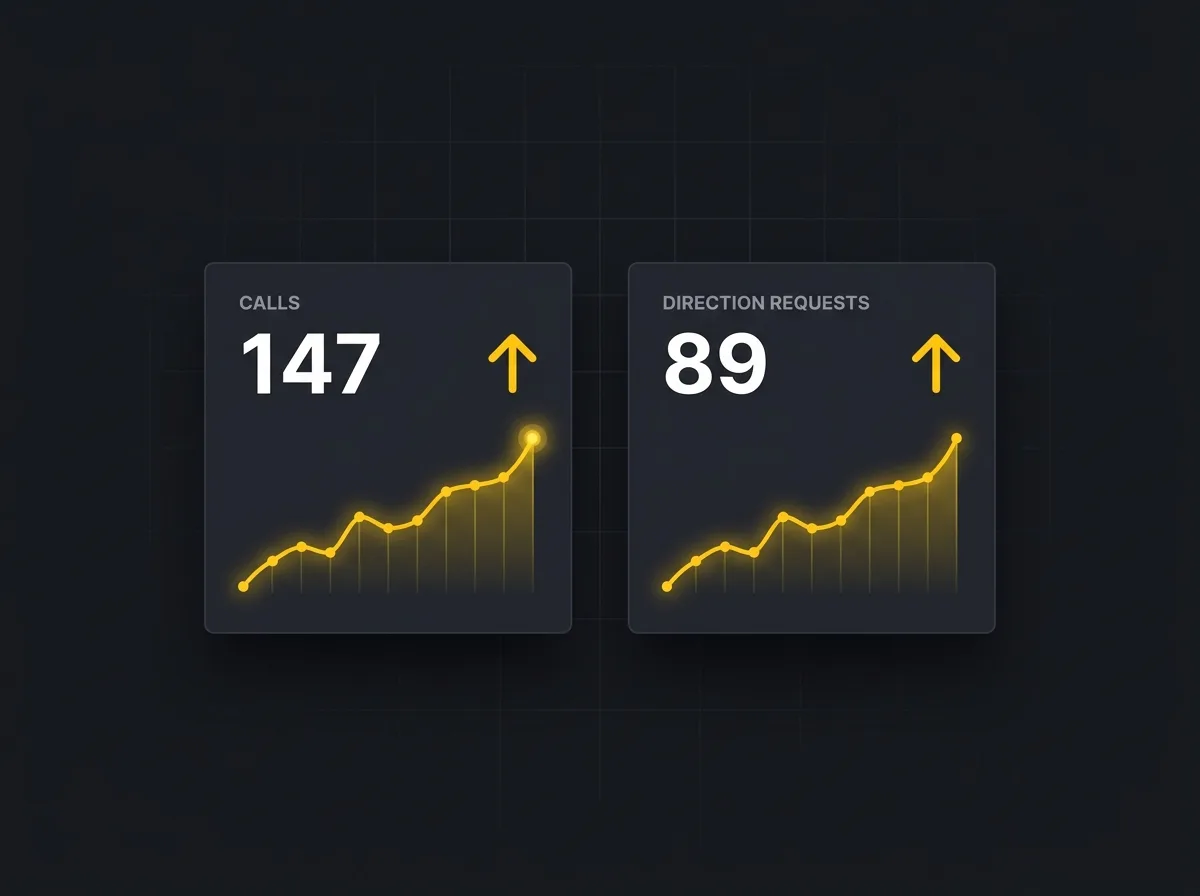
Keyword ranking position is the most commonly reported SEO metric and one of the least useful for a plumber. Being third for "plumber Birmingham" tells you nothing about whether the phone is ringing.
Track calls and direction requests from your GBP directly.
Google Business Profile Insights shows how many calls were made via the listing, how many direction requests were triggered, and how many clicks went to your website. This is closer to business reality than any ranking report. It is the metric that tells you the map pack is working.
Google Search Console shows which queries are generating impressions and clicks for your website. Free to set up, and it tells you which terms you are gaining traction on, as well as where you are appearing in results but not getting the click. That gap between impressions and clicks usually signals a page title or description that is not convincing enough.
That is a much simpler fix than an SEO problem.
Call tracking, where you use a slightly different phone number on your website versus your GBP, tells you which channel is generating calls. Simple and cheap to set up, and valuable for deciding where to invest further.
What progress looks like in practice. At three months, expect your GBP to be appearing for a broader range of queries and direction requests to start climbing. At six months, map pack position should be stabilising for your primary terms. At twelve months, measurable call volume increase and potentially a reduction in Checkatrade spend as owned search picks up more of the volume.
Progress is slow. The compounding is real.
Checkatrade and TrustATrader are not going away, and they serve a real purpose for reaching customers who use those platforms. The argument for SEO is not "stop using aggregators." It is that aggregator leads cost you per lead indefinitely.
Search visibility compounds.
Every new review, every well-built location page, every month of GBP activity builds on the last. The cost per enquiry from Google twelve months from now is significantly lower than it is from a platform taking a fee on every job.
Frequently asked questions about SEO for plumbers
Does SEO actually work for small plumbing businesses?
Yes, particularly for local SEO and map pack visibility. Sole traders and small multi-van operations are often better placed to benefit than larger businesses, because the geographic focus is clear and the review strategy is entirely manageable. A two-van operation covering a handful of postcodes can outrank a large regional company in the map pack by having a more complete GBP, more recent reviews, and better-built service pages.
The investment is in consistency, not scale.
How long does SEO take for a plumber?
The map pack element typically shows movement within two to three months if the GBP is properly set up and reviews are being collected consistently. Website and organic ranking improvements take longer, generally six to twelve months before you see meaningful changes in traffic and enquiry volume from non-map-pack searches.
Emergency call volume is usually the first thing to improve, because it depends most heavily on the map pack position.
How much does plumber SEO cost?
It depends significantly on whether you are managing it yourself or working with a specialist. A plumber handling their own GBP, review strategy, and basic website updates can make real progress for little beyond time. Working with a SEO agency for a local service business typically runs from around £500 to £1,500 per month depending on the scope and the number of locations covered.
The more useful calculation is cost per enquiry over twelve months, compared to what you are currently spending on lead aggregators.
Is Google Business Profile the same as SEO?
No, though the two are closely related. Google Business Profile is the listing that appears in Google Maps and the local 3-pack. It is the most important single element for emergency call visibility. SEO covers the broader set of work that affects how your website and your GBP appear across all Google searches, including organic rankings below the map pack.
For most plumbers, the GBP is the right starting point because it delivers the fastest visible impact on emergency enquiries. Website SEO builds more slowly but extends your visibility to a wider range of queries and planned-purchase customers.
Can I handle plumber SEO myself?
Most of it, yes. Setting up and completing your GBP, collecting reviews consistently, building emergency landing pages, and adding your Gas Safe number to your website are all doable without specialist help. Where it becomes more complex is location page strategy, understanding which keywords to prioritise, and tracking what is actually generating calls versus what is just activity.
Many plumbers start by handling the basics themselves and bring in help once they have a clearer picture of what is working.
The owned asset that keeps compounding
Most of what this article covers is implementable without an agency. The GBP work, the review strategy, the emergency landing pages, the trust credentials: a motivated business owner can make real progress on all of it.
Time is usually the constraint.
Running a van or managing a small team leaves limited capacity for website work and reputation building. The tactics work. The question is whether you have the hours to do them properly, or whether your time is better spent on the tools.
Before deciding either way, it is worth understanding what local search traffic actually looks like for your area and your services. How many people are searching for plumbers in your postcodes each month? What would a realistic share of that traffic generate in enquiries and revenue?
Traffic Projection Report: CT's Traffic Projection Report gives you a realistic picture of what is achievable for a plumbing business in a specific location, before you commit to anything. No obligations.
The aggregator fee compounds in one direction: you pay it every time you get a lead, indefinitely. Search visibility compounds in the other. Every review you collect, every location page you build, every month of GBP activity adds to something you own outright.
A year from now, the cost per enquiry from Google is significantly lower than the cost from a platform that charges per job, and it does not switch off when you stop paying.
That is the difference worth understanding.