
A physio clinic in the West Midlands had done everything the standard guides recommend. Claimed the Google Business Profile. Added the right keywords to the page titles. Built up a decent bank of reviews over two years. Eight months after they started taking SEO seriously, the clinic in the next suburb was ranking above them for every condition they treated.
The owner rang to ask what the other clinic was doing differently.
The answer had nothing to do with a bigger budget or a secret tactic. The other clinic had built content that met patients earlier in their search journey, at the moment when those patients were still trying to understand what was wrong with them, long before they had decided they needed a physiotherapist and were ready to search for one. That is the gap most SEO guides miss. They start in the middle of the patient journey. Understanding where it actually starts changes everything about the strategy.
This article covers how UK patients move from symptom to appointment, where organic search sits in that picture, what the AI search layer adds in 2026, and what actually moves patient numbers rather than just rankings. It builds on what actually works in healthcare SEO across private practice more broadly, but focuses on the decisions a physiotherapy clinic owner or manager needs to make.
How UK patients actually find a physiotherapy clinic
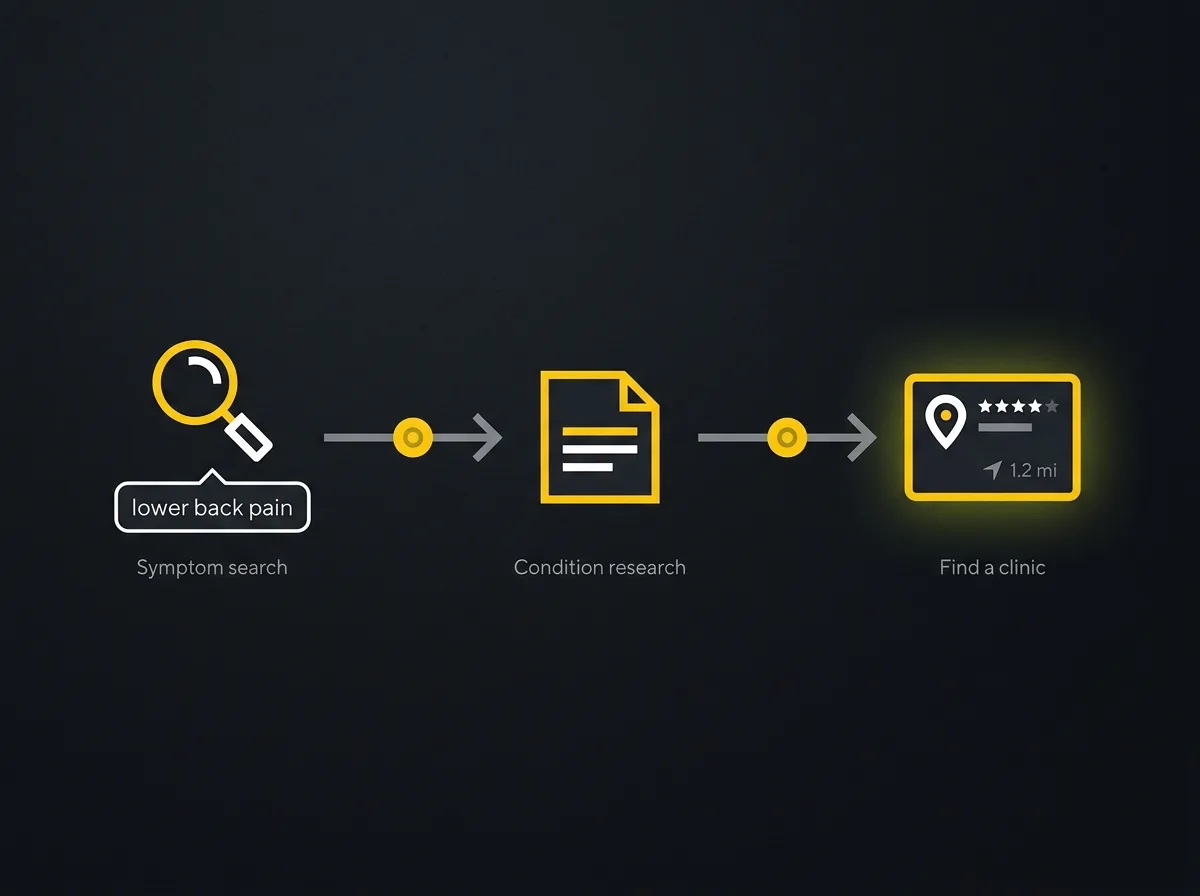
Most patients do not begin by searching "physiotherapy near me." They begin somewhere much earlier, when they are still trying to understand what is happening in their body. They search "lower back pain that won't go away" or "clicking knee when climbing stairs" or "why does my shoulder hurt when I lift my arm." They are not yet thinking about appointments. They are thinking about their pain.
The search journey for most private physio patients follows three stages.
Stage one: symptom search. The patient has a problem and does not yet know what it is. They search the symptom. They land on content from the NHS, general health information sites, and increasingly, clinics with condition-specific pages on their website. At this point they have no idea they will be booking private physiotherapy in two weeks.
Stage two: condition identification. They have learned they likely have plantar fasciitis, a rotator cuff problem, or IT band syndrome. Now they search the condition directly: "physiotherapy for rotator cuff tear" or "how is plantar fasciitis treated" or "ACL rehab physio." This is where clinic websites with specific condition pages start appearing alongside the NHS and NICE guidance.
Stage three: provider search. They have decided they need professional help. Now they search "physiotherapy Birmingham" or "physio clinic near me." This is the moment the standard SEO checklist is designed for. It is also the most competitive point in the entire journey.
The clinics winning in search are visible at stages one and two, not just at stage three. A clinic whose website answers the symptom and condition questions is capturing patients before most competitors have ever entered the picture. The clinic down the road showing up for "rotator cuff physio [city]" while your site only appears for "physiotherapy [city]" is not ranking better because of backlinks. They built content that maps to how patients actually think.
NHS waiting times are part of this picture. NHS England referral-to-treatment data shows that musculoskeletal conditions regularly involve waits of many months on the NHS pathway. Patients in pain who learn they can access private treatment within a few days do not hesitate. They go back to Google, search their condition, find a clinic whose content they have already been reading, and book.
Where search fits in the physiotherapy patient acquisition picture
Before going further on SEO, it is worth being honest about the full picture of how private physio clinics actually get patients. Search is a significant channel. It is not the only one, and pretending otherwise tends to produce unrealistic expectations.
GP and specialist referrals remain substantial, particularly for post-surgical rehabilitation and complex musculoskeletal presentations. A recommendation from an orthopaedic consultant carries a level of trust that no amount of Google ranking can replicate. These patients come because a clinician they trust sent them.
Insurance panels work differently again. If your clinic is registered with BUPA, AXA Health, Vitality Health, or Cigna, a proportion of patients will come through those panels rather than through a search. They are not searching for you. But they may still Google you before they attend, which makes your online presence a trust signal even for patients who already have the referral.
Word of mouth is the most common source of new patients for established clinics. Someone who had a good outcome recommends you to a colleague. This is also the hardest to scale. Word of mouth has a ceiling determined by your existing patient base, and it tends to reflect your current mix of conditions and demographics rather than the mix you might want to grow.
Paid search delivers fast results. It also stops delivering the moment the budget stops.
Organic search is the compound channel. A clinic that ranks well in the Google map pack for "physiotherapy [city]" continues to receive enquiries without ongoing ad spend. A clinic with strong condition-specific content continues to meet patients at stages one and two of their journey for years after that content was published. This is what distinguishes search from the other channels.
The goal is not to replace referrals or word of mouth. The goal is to reduce dependency on any single source. A clinic drawing patients from referrals, insurance panels, word of mouth, and search is in a more stable position than one almost entirely dependent on one insurance contract and word of mouth from a shrinking patient cohort.
The starting point for most clinics is local SEO for physiotherapy clinics, because the overwhelming majority of physio bookings are local in nature. A patient in Sheffield is not booking a clinic in Cardiff.
What actually determines whether SEO works for a physio clinic
For a UK physiotherapy clinic, local SEO is the most direct path to new patient enquiries. It starts with Google Business Profile, not the website.
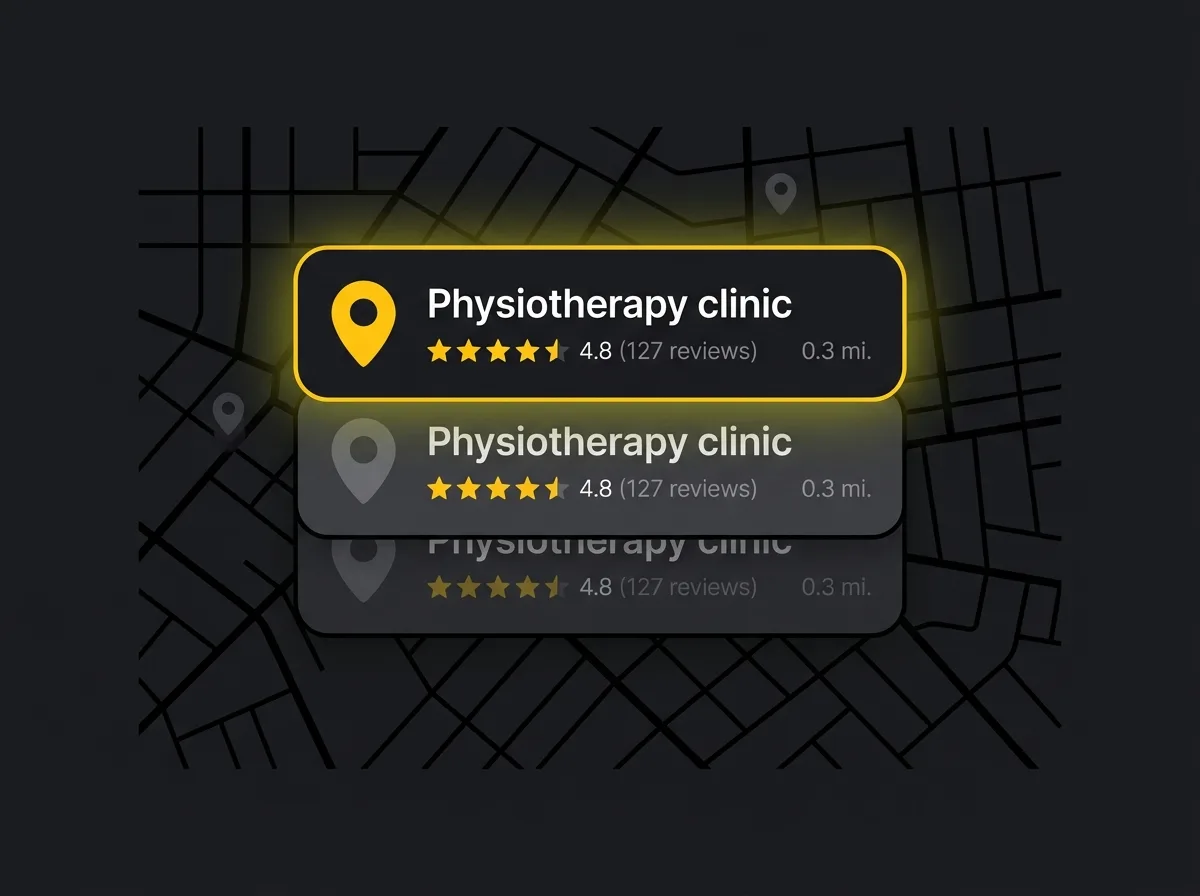
The components of physio SEO are not individually complicated. The challenge is understanding which ones produce the most return, in what order, and avoiding the common mistake of spending time on activities that sound reasonable but contribute little.
Google Business Profile. This is the first battleground for local search and the highest-return activity for most clinics that have not yet invested in it seriously. A properly completed profile means every service listed, not just "physiotherapy" but sports massage, acupuncture, post-operative rehabilitation, Pilates, and whatever else you genuinely offer. It means regular posts, photos updated in the last few months, the Q&A section populated with questions your patients actually ask, and service areas set correctly for how far you actually draw patients from. The primary category should be "Physiotherapist." Relevant secondary categories, sports injury clinic, acupuncture clinic, can be added where accurate.
Reviews. These sit alongside GBP because they are inseparable from it. Review quantity, recency, and the clinic's response rate all influence map pack ranking. They also influence conversion in a way that is separate from ranking. Two clinics appearing side by side in the map pack are often chosen between based on who has more reviews and which clinic responded to them thoughtfully. A systematic process for asking for reviews after discharge, something as simple as a personalised message two days after the final session, is one of the highest-return activities in the entire SEO toolkit. Not because it is difficult, but because almost no clinic does it consistently.
Condition-specific content pages. Generic service pages are weak. "We treat all musculoskeletal conditions" tells the search engine almost nothing and does even less for a patient trying to understand whether you treat their specific problem. Pages built around specific presentations do the real work: "physiotherapy for rotator cuff tear," "treatment for plantar fasciitis," "physio for ACL rehabilitation." These pages capture patients at stage two of their search journey. They compound over time. A clinic that has built thirty condition-specific pages has thirty points of potential patient entry into the site, not one. The prioritisation question matters: build condition pages for the presentations you actually treat most, in the locations you serve. A sports injury clinic in Leeds should not be building pages for post-natal physiotherapy in London.
Technical basics. Over seventy per cent of local health searches happen on mobile. If your site is slow or hard to navigate on a phone, you are losing patients before they have seen a single service you offer. Core Web Vitals in Google Search Console will tell you whether this is a problem. HealthcareOrganization schema markup makes your opening hours, services, and address machine-readable by both search engines and AI tools. SSL is a baseline expectation, not a differentiator.
What not to spend time on. Over-indexing on branded keywords is common. If someone is searching for your clinic by name, they already know you exist. Publishing generic wellness content that has no connection to your actual services consumes resource without contributing to patient acquisition. Chasing traffic from outside your catchment area produces rankings that produce no bookings.
AI search and physiotherapy in 2026: the patient discovery shift most clinics are missing
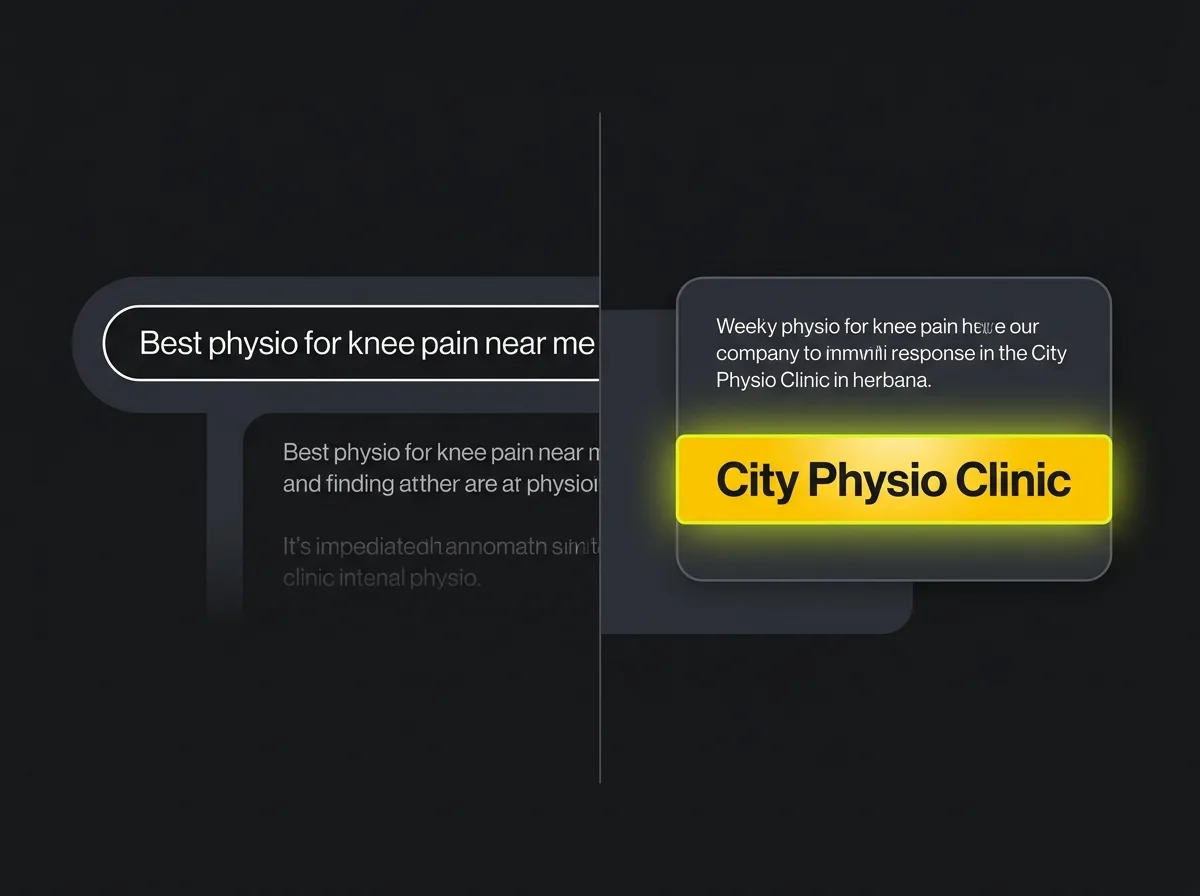
The search journey described above is evolving. Patients are using AI tools at the early stages in ways that change which clinics they encounter long before they reach a results page.
When a patient asks ChatGPT "what is causing the clicking in my shoulder when I rotate it," they receive an answer drawing on published medical and clinical content. If that answer leads them to conclude they need a physiotherapist, and they follow up with "who is a good private physio for shoulder pain in Bristol," ChatGPT will attempt to name clinics that appear in its training data and accessible sources. A clinic with authoritative specialist content, named practitioners, detailed service descriptions, and hundreds of positive Google reviews is far more likely to surface than one with a thin website and twenty reviews.
Google AI Overviews are reshaping organic search for symptom-based queries specifically. A patient searching "physiotherapy for lower back pain" may now see an AI-generated summary at the top of results before any organic link. That summary pulls from structured, evidence-based content. Clinics whose condition pages are written in clear, accurate clinical language, rather than marketing language, are more likely to be cited.
Perplexity is completing the picture. In AI search contexts, the citation is the goal, not the click. A clinic that appears across multiple AI tools when UK patients search their condition is receiving patient referrals without those patients ever visiting a results page.
AI search traffic converts at significantly higher rates than standard organic traffic. A patient arriving via an AI recommendation has already had the recommendation filtered. They are not comparison shopping. They are verifying.
What helps a physio clinic appear in AI recommendations: named specialisms mentioned explicitly on the website, location and service area information that is structured and machine-readable, clear evidence-based descriptions of treatment approaches, positive and numerous Google reviews, and HealthcareOrganization schema that identifies precisely who you are and where you practise.
Free resource: AI Visibility Audit
Find out what ChatGPT, Claude, and Perplexity say when someone asks for a physiotherapy clinic in your area. The audit shows where you appear, where you are missing, and what the priority changes are. If you want to know where your clinic currently stands in AI search visibility before committing to a programme, this is the place to start.
The compliance dimension that generic SEO agencies miss

Physiotherapy is regulated healthcare. HCPC registrants operate under HCPC standards of conduct that include their advertising and public communications. The ASA's CAP code covers health claims in marketing content, and CSP guidance on advertising and marketing provides additional context specific to the physiotherapy profession.
This matters for SEO in direct and practical ways.
What you cannot say. Guaranteed outcomes are not permissible. "We will resolve your back pain in four sessions" creates compliance risk regardless of how confident you are in your results. Testimonials that imply clinical results, before-and-after framing for medical conditions, and unqualified superlatives like "the best physiotherapy clinic in Manchester" all fall foul of ASA guidance. An agency without healthcare experience sometimes drifts in this direction without recognising the problem.
What you can say, and rank well for. Evidence-based descriptions of the conditions you treat. Accurate descriptions of treatment approaches and clinical pathways. Clear information about your practitioners' qualifications and registration. Honest descriptions of what physiotherapy can and cannot address, and under what circumstances. This is, in practice, exactly what Google's quality systems look for in health content, which falls into the YMYL (Your Money or Your Life) category where accuracy is scrutinised closely.
The compliance constraint is also, paradoxically, a competitive advantage for clinics that understand it. The content that earns long-term trust from Google's systems and from AI tools is content that a patient, a GP, and the HCPC would all consider fair and accurate. The clinics ranking well in healthcare search in the long run are not the ones making the biggest claims. They are the ones writing content that belongs there.
Working with an SEO agency that has genuine experience in healthcare means you are not the first client for whom they have had to navigate this. It is worth asking directly.
What good looks like in the first 90 days of physio SEO
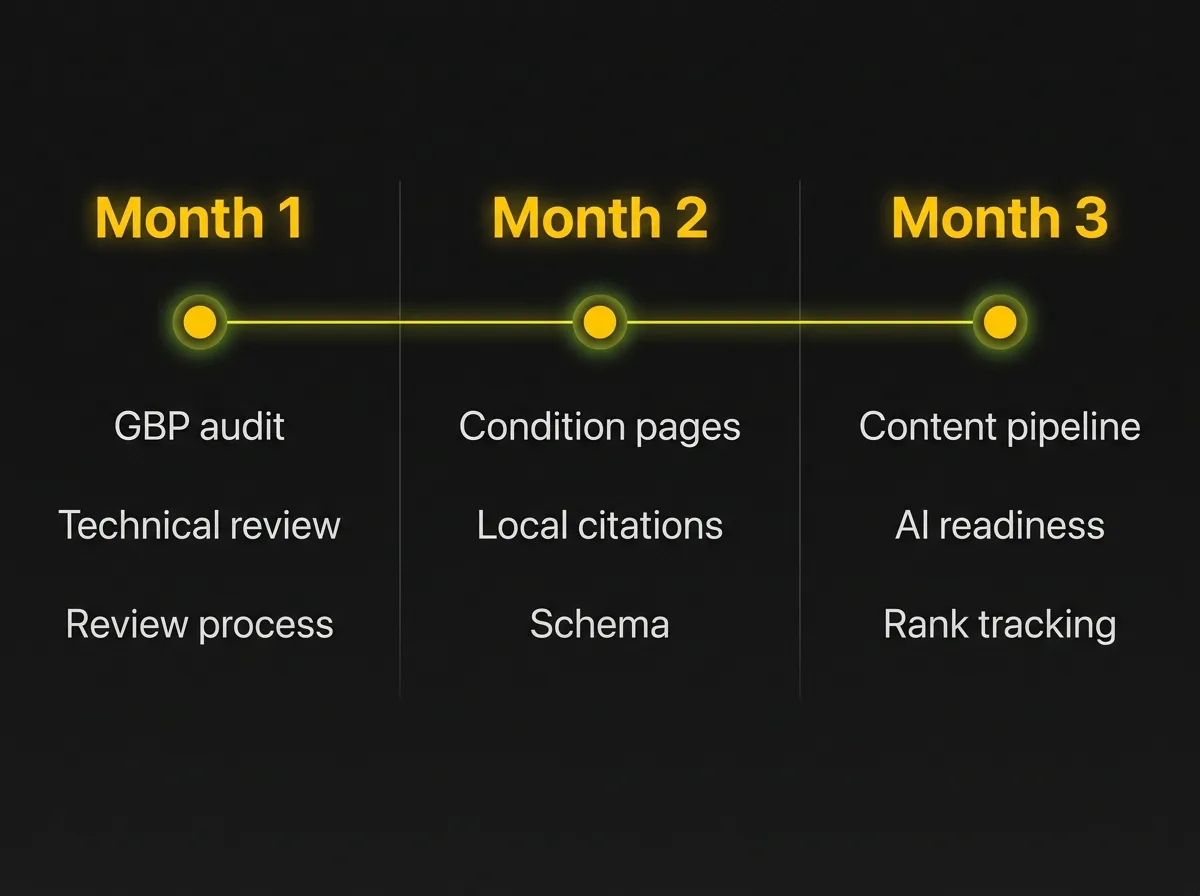
The question most clinic owners want answered is not "does SEO work." It is "what will actually happen, in what order, and when will I see something move." Here is a realistic account of the first 90 days.
Month 1. Google Business Profile audit and completion, which for a neglected profile means meaningful changes to categories, services listed, photos, and the Q&A section. A technical website audit covering mobile performance, page speed, Core Web Vitals, and HealthcareOrganization schema. An existing content audit identifying which pages already have ranking potential and which are too thin to rank for anything useful. And the review-generation process implemented, so that a post-discharge follow-up message becomes a consistent part of how the clinic operates rather than something that happens occasionally when someone remembers.
Month 2. Condition-specific page builds, prioritised by two factors: search demand for that condition and the clinic's actual caseload. If you treat a lot of knee pain and very little hand therapy, the page build reflects that. Local citation and directory clean-up, which means verifying that your clinic's name, address, and phone number are consistent across every healthcare directory and local listing where you appear. Structured local schema implementation on the website.
Month 3. A content pipeline for condition-specific posts rather than generic physiotherapy content. An AI search readiness check, looking at whether the site is being cited in AI Overviews for relevant queries. Initial rank tracking and GBP impression benchmarks, establishing the baseline that will tell you whether what you are doing is working.
What will not have moved in 90 days: top-three positions in the map pack for competitive local terms like "physiotherapy Birmingham." That typically takes six to twelve months in a competitive market. What should have moved: GBP impressions and profile views, click-through from the map pack for less competitive queries, indexation of new condition pages, and early long-tail rankings for condition-specific terms where competition is lower.
The difference between clinics that get a real return from SEO and those that feel like they are spinning their wheels is usually not budget. It is understanding where patients start searching and building backwards from that point. Most of the clinics that have called to ask why SEO is not working have been doing the right activities in the wrong order, or building content for the wrong stage of the patient journey.
Frequently asked questions about SEO for physiotherapy clinics
How long does SEO take to work for a physiotherapy clinic?
For most clinics, early signals appear within three to four months: GBP impressions increase, new condition pages start to index, and long-tail queries begin to produce results. Competitive local positions, ranking in the top three of the map pack for high-volume terms like "physiotherapy [city]," typically take six to twelve months of consistent work. Established clinics with existing domain authority and a well-structured website will see results towards the faster end of that range. New clinics with no SEO history should allow twelve months before expecting competitive map pack positions.
How much does SEO cost for a physio clinic?
A properly run local SEO programme for a private physiotherapy clinic typically runs from around £500 to £2,000 per month, depending on the size of the clinic, the competitiveness of the local market, and how much content work is required. A single-location clinic in a smaller town with a well-maintained website needs less than a multi-site group competing in central London with thin condition pages. Some agencies offer one-off audits or technical fixes as a starting point. These can be useful, but they are not a substitute for ongoing work if sustained local search visibility is the goal.
Is local SEO different from regular SEO for a physiotherapy clinic?
Local SEO is the starting point for a physio clinic rather than a separate discipline with different rules. The skills involved are the same. The focus is on the geographic dimension: appearing in map pack results, completing and maintaining the Google Business Profile, building local citations, and targeting keywords that include location. For a physio clinic serving patients within a defined catchment area, the local layer is where almost all the return sits. General organic rankings for broad non-local terms matter too, but they rarely drive the volume that local search does for a practice-based healthcare business.
Do Google reviews affect where my clinic appears in search results?
Yes, in two distinct ways. Review quantity and recency are ranking signals for the Google map pack. A clinic with 200 recent reviews is likely to rank above a comparable clinic with 20, all else being equal. Reviews also affect conversion in a way that is separate from ranking. When two clinics appear side by side in the map pack, patients consistently choose the one with more reviews and the clinic that has responded to them. A systematic approach to requesting reviews after completed episodes of care is one of the most straightforward and highest-return improvements a clinic can make to its search performance.
The version of physio SEO that actually works
Most guides for physiotherapy clinic SEO describe the component parts accurately. Google Business Profile, keyword research, condition-specific content, backlinks. The problem is they describe them as a checklist rather than a strategy, and they start with the checklist rather than with the patient.
The clinics getting a meaningful return from search in 2026 understand where their patients start searching, not just where they end up. They have content that meets patients at the symptom stage. They have a systematic review process. They are structured in ways that both Google and AI tools can read clearly. And they have built condition pages for what they actually treat, not a generic overview of everything physiotherapy can theoretically address.
That is not especially complicated. But it is specific, and it is different from what most generic agencies deliver when they say they do "healthcare SEO."
Find out where your clinic stands in AI search
The AI Visibility Audit shows what ChatGPT, Claude, and Perplexity say when someone in your area asks for a physiotherapy clinic recommendation. If your clinic is not appearing, the audit identifies exactly what is holding it back and what the priority changes are.