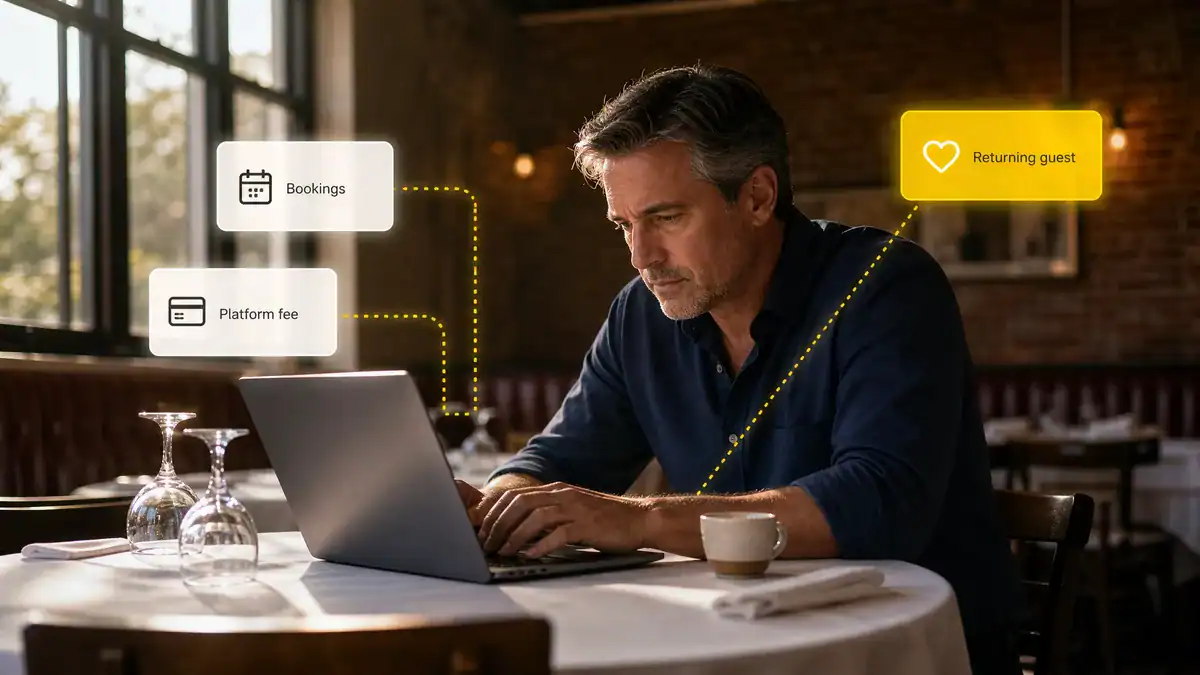
Most restaurant marketing advice is written by people who sell booking platforms.
That is worth saying plainly. Search "restaurant marketing" right now and the first page is almost entirely Square, OpenTable, TheFork, Salesforce, and Zenchef. They publish helpful-looking guides. Some of them contain genuinely good advice. But every single one has a product to sell at the end, and that product depends on you staying on their platform and paying their commission indefinitely.
This guide has no booking platform to sell. It is written for independent UK restaurant owners who want to build something that does not depend on a third party changing their terms overnight.
The framing matters. Restaurant marketing in 2026 is really two things: getting more new diners through the door, and getting the ones who came last month back again next month. Every tactic in this guide points at one of those two outcomes. If a channel cannot demonstrably move either metric, it belongs lower on your list than most people put it.
Why most restaurant marketing advice misses the point
The "12 ideas" format that dominates the search results reads like strategy. It isn't.
A list of twelve things without priority, budget context, or any acknowledgement of what to do first is content shaped to look helpful, not content designed to fill tables. When you have read a few of these guides, they all start to say the same things in the same order. GBP. Instagram. Email. Reviews. Loyalty.
Paid ads. None of them tell you what to do first with a Tuesday that is half empty and a margin that is tighter than it was two years ago.
The vendor problem is structural. OpenTable's advice on booking strategy will tend toward using OpenTable more. TheFork's guide to marketing will include TheFork prominently. This is not cynical, it is just how businesses work. But it means you are reading the advice through a filter, and that filter has a financial interest in the outcome.
UKHospitality represents thousands of independent operators across the UK, and the challenge they consistently identify is not a lack of marketing ideas. It is a lack of clarity on which ideas actually move covers. That is what this guide is for.
The honest version of restaurant marketing for an independent UK operator is one sentence: every pound you spend on marketing should trace to either a first-time cover or a returning cover. Social media engagement, press coverage, follower counts: they can all serve one of those goals, but they are not goals in themselves.
The local visibility layer
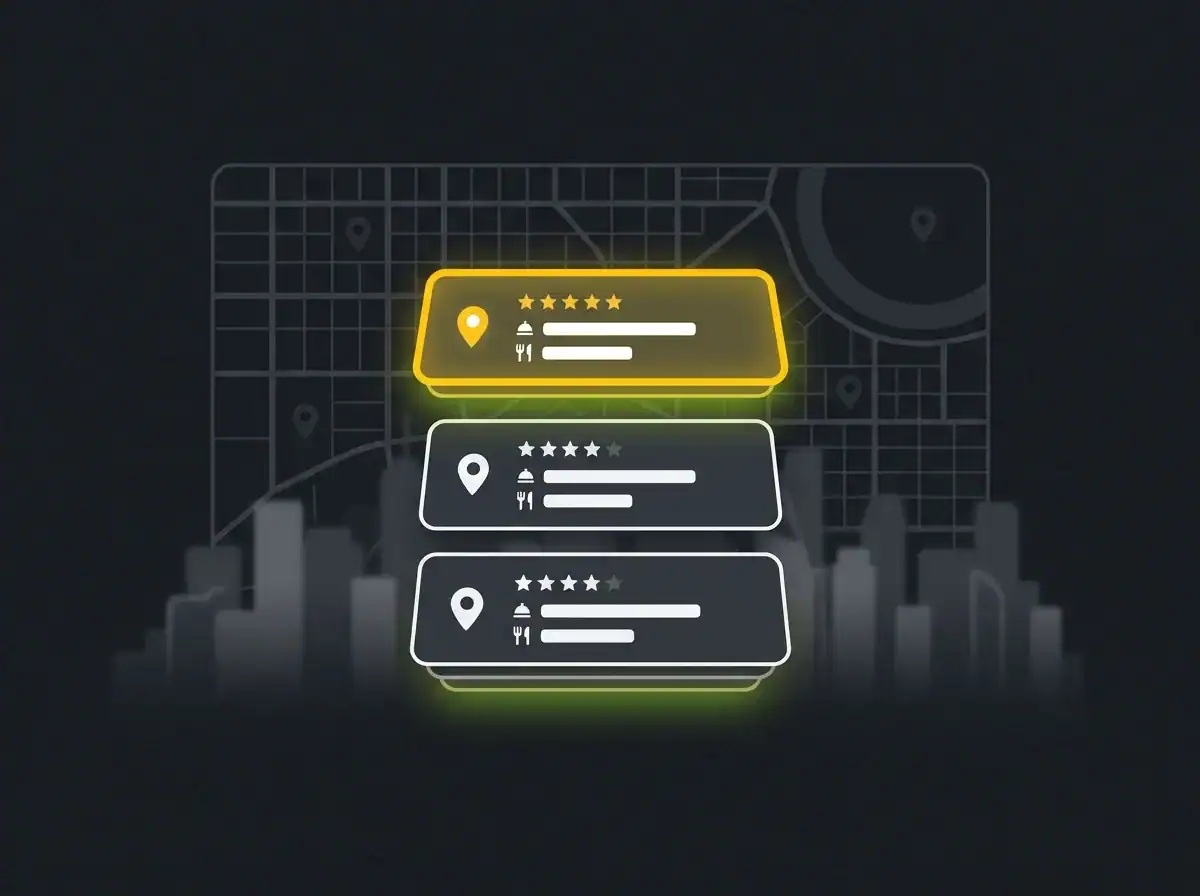
For most independent restaurants, local search is the single highest leverage marketing channel available. Not paid social. Not email. Not PR.
Local search.
Think with Google research consistently shows that "restaurants near me" queries carry very high booking intent. People searching this way are often deciding where to eat within the hour. Showing up in that moment is worth considerably more than a paid Instagram post reaching people who may live miles away and have no immediate intention to book.
Google Business Profile is the starting point, and most independent restaurants have set it up and then left it alone. That is a mistake.
The operators getting the most from GBP treat it as a live channel: keeping hours and holiday closures accurate, adding a booking link so Google can surface it directly in the map pack, uploading fresh photos monthly (dishes, the room, behind the scenes), and enabling the menu link so potential diners can see what they are booking before committing.
Review velocity matters more than most operators realise. A restaurant with 200 Google reviews and a 4.2 average will frequently outrank one with 40 reviews and a 4.5, because volume signals legitimacy and recent activity.
The gap between two reviews a month and ten reviews a month, compounded over a year, is the difference between a listing that looks established and one that looks quiet. Ask at the table. Put a QR card near the bill. Train front-of-house to mention it once, clearly, without being awkward about it.
For local SEO for hospitality, the basics extend beyond GBP. Location-led content on the website (a page targeting "Italian restaurant in Clifton" or "Sunday lunch in Chorlton") supports the map pack ranking and captures longer-tail queries from people who are planning rather than searching on impulse.
If you have more than one site, each location needs its own GBP, its own landing page, and its own review profile. One shared profile across locations is a common mistake and it costs visibility.
Your website is the direct booking engine

Open your restaurant's website on a mobile right now. What you usually find: a PDF menu that takes ten seconds to load, a booking form buried two taps away, a hero image that struggles to appear, sometimes no booking option at all because the restaurant relies entirely on a platform widget.
This costs covers. Every week.
The website's job is to convert someone already interested into someone who has booked. They found you on GBP, liked your photos, tapped through. The site now has about ten seconds to confirm that decision and get them to commit.
Slow load speeds, no visible booking button above the fold, a menu behind a download prompt, a generic page that tells them nothing about the experience: each of these is a reason to go back and click the next result.
Good restaurant website design for an independent does not have to be expensive. It needs to be fast, work on a phone, show the menu immediately, and make the booking path obvious before the reader scrolls. The booking widget matters here too.
If your site embeds an OpenTable or TheFork widget, every booking made through it carries a commission. A direct booking system (many exist at sensible cost for independents) means you own that customer relationship from the first click, with no per-cover fee.
Direct bookings versus the booking platforms
Booking platforms are not the enemy. That is worth being clear about.
For a new restaurant in a new area with no existing audience, OpenTable, TheFork, Resy, and SevenRooms genuinely drive discovery. They put you in front of diners who do not yet know you exist. The commission for that acquisition is fair. They have a marketplace and you are borrowing the audience.
The problem arrives when you are paying that commission on your own regulars.
Someone who has eaten with you four times is not discovering you through a platform. They know your name. They would book directly if your website made it easy. Every time they rebook through a platform instead, you are paying for a booking you already earned.
Booking platform terms and per-cover rates vary and change, so it is worth checking what you are currently paying against each platform's published terms rather than relying on figures from a few years back.
A useful diagnostic: look at your platform bookings for the last three months. What percentage came from guests who had also booked through the same platform before? That share is your direct booking opportunity. Covers you are currently sharing revenue on for no discovery benefit whatsoever.
The practical answer is not to leave the platforms abruptly. Keep them for discovery. Build a parallel path where returning guests are captured to an email list and actively encouraged to book directly next time. The shift takes time, but it compounds. Moving 30% of your repeat bookings from platform to direct over two years is a meaningful structural improvement to your margins.
Social proof, reviews, and the role of Instagram
Instagram is worth having. It is not worth obsessing over.
For most independent restaurants, Instagram drives discovery in very specific circumstances: a particularly photogenic dish that gets shared, a food writer post, a short video that breaks through an algorithm for a week. These moments do bring in new covers. They are not reliable or controllable at small scale, and the return on sustained daily content production for a 60-cover bistro is almost always lower than owners expect.
Reviews are a different matter entirely. A strong recent Google review is a conversion asset in a way an Instagram post simply is not. It sits in the map pack, it appears in Google's AI Overview, it influences the person already looking at your GBP and deciding whether to book. Keep TripAdvisor if your audience still uses it actively, but Google is the priority now and the gap between the two has widened considerably.
User-generated content that actually works tends to be dish-led and specific: a regular's photo of the tasting menu, a short video of the pasta being made tableside, a customer story about a birthday booking that went well. None of this requires a social media manager or a content calendar. It requires noticing when a customer takes a photo and mentioning that you would love them to tag you.
What to ignore entirely: follower counts, vanity engagement metrics, and any tool that promises to grow your reach without connecting that growth to a booking flow.
Email, SMS, and the loyalty layer almost nobody runs well
Most independent restaurants have no email list.
That is the most underused lever in hospitality, and it is not close. Email costs almost nothing per send, it reaches people who have already eaten with you and enjoyed it, and it can drive bookings directly. That profile is better than almost any other channel available at independent scale.
Capture happens in the booking flow: include an email opt-in when guests book online (most booking systems support this with a single checkbox). Add a QR card at the table linking to a simple sign-up page. A list of 400 engaged past guests who open your emails is worth considerably more than 4,000 Instagram followers who have never visited.
Two to three sends a month is enough. A seasonal menu launch, an upcoming event, a "spots available this Friday" note sent on Wednesday afternoon. Mailchimp, Klaviyo, and Mailerlite all work well at independent restaurant scale for modest monthly costs. Keep sends short, give a reason to book, include the booking link.
SMS works well for last-minute table availability and the day-before reminder that protects against no-shows. No-shows cost real covers. A reminder the day before a booking reduces them noticeably, and several booking systems handle this automatically without you having to lift a finger.
Free resource: Traffic Projection Report
If you want to understand what improving your local visibility and direct booking rate could be worth in actual covers and revenue, the Traffic Projection Report models the numbers for your restaurant. Free to access, no sales call attached.
When paid advertising actually pays back
Paid social earns its spend against specific objectives. Not general awareness.
Meta advertising (Facebook and Instagram ads) works best when you have something to announce: a new menu, a seasonal event, a Valentine's Day sitting, a Sunday brunch launch. Good creative combined with a direct booking link, targeted to a tight radius around the restaurant, can fill covers that would otherwise go empty.
As an always-on awareness spend with no specific offer and no booking link attached, it is mostly noise for an independent without a large budget.
Google Ads for "restaurants near me" type queries can work if your GBP is already performing well in the map pack. Fix the organic position first. The paid ad supplements a strong local presence; it cannot substitute for one.
The minimum sensible spend for paid to be meaningful at independent scale is roughly £300 to £500 a month. Below that, the test period is too short and the audience too thin to read anything useful from the results.
The most useful question to ask before committing: are your tables currently full on Friday and Saturday but empty mid-week? Paid aimed specifically at mid-week covers can make sense in that context.
If covers are soft every night of the week, paid is a short-term fix applied to an underlying problem that needs a different solution.
AI search and the recommend-me query
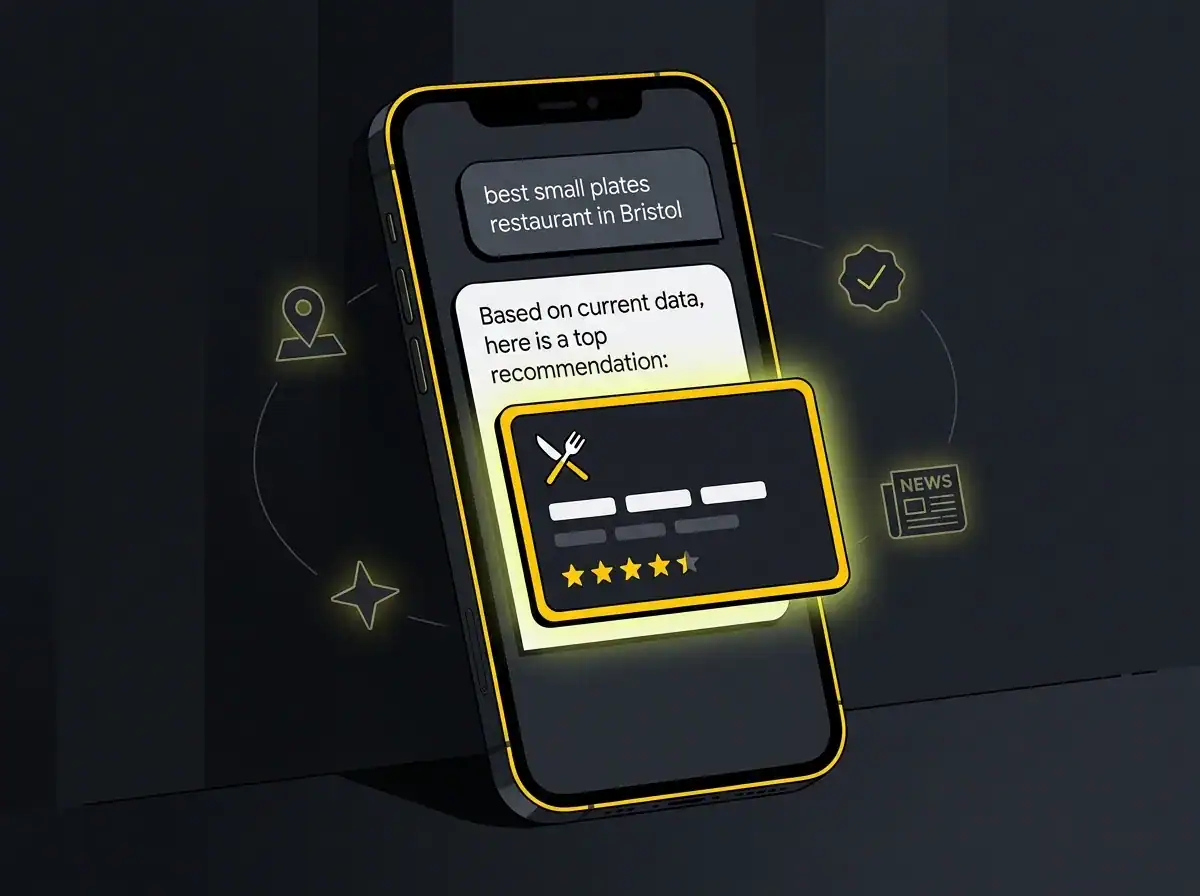
Here is something most restaurant marketing guides do not mention yet. A growing number of diners now ask ChatGPT or Perplexity things like "best small plates restaurant in Bristol on a budget" or "good Italian in Hackney for a date night." They are not typing into Google. They are asking an AI.
AI search is changing how diners pick restaurants, and being mentioned in those answers works differently from traditional SEO. It comes from being cited across the open web: Google reviews, TripAdvisor, Time Out, Hardens, local press, food blogs. The AI models learn from what the entire web says about you collectively.
A restaurant with 200 Google reviews, a well-maintained GBP, a Time Out listing, and a mention in the local newspaper is considerably more likely to appear in an AI recommendation than a restaurant with a polished Instagram account and no external citations.
Practical steps: get onto the major UK dining lists where relevant (Time Out, Hardens, OpenTable editorial). Actively seek press coverage, even local coverage from a community paper or a regional food blog.
Make sure your website has structured data (restaurant schema markup is a technical step that takes a developer roughly an hour but signals to AI crawlers exactly what kind of business you are). These steps serve traditional local search and AI search visibility simultaneously.
The AI search opportunity is particularly useful to understand because the diners who find restaurants this way tend to arrive already decided. They are not comparison shopping. They are verifying a recommendation. That is a higher-intent visitor than almost any paid channel produces.
How to measure what is actually working
The numbers that matter for a monthly restaurant marketing review are genuinely simple.
Total covers per week. Percentage of bookings made directly versus through a platform. Repeat visit rate (define it as the share of covers from guests who have booked before: imperfect but good enough for a monthly check). Email list size and whether it grew last month. GBP impressions and direction taps, both available free inside GBP Insights.
Fifteen minutes, once a month.
That is all it takes to read these numbers, spot a direction, and make one decision based on what you see. Instagram followers should not appear in this review. Likes should not appear. Press mentions should not appear unless they caused a measurable booking spike you can trace.
The only question worth answering each month is: did this channel drive a cover? If you cannot trace a channel to a cover with reasonable confidence, it sits lower in priority than one you can.
Where to start if you can only do three things this quarter
If you cannot commit to a full marketing overhaul right now, these three will give you the most return on the lowest investment of time and money.
-
Google Business Profile and review velocity. Complete the profile this week (booking link, menu link, recent photos), and build a simple system for asking every happy guest for a review. This before anything else.
-
Website conversion audit. Open your website on a phone. Can you see the menu in under five seconds? Is there a visible booking button above the fold? If not, fixing those two things is the highest-priority website task you have. Everything else waits.
-
Email capture and one monthly send. Add an opt-in to your booking flow and put a QR card on the table this week. You do not need a large list to start seeing returns. One email a month with a genuine reason to book is enough to begin.
These three are the foundation. Everything else: paid advertising, AI visibility, loyalty programmes, social content, all performs better once they are in place. Without them, the more expensive channels underdeliver. Worth doing.
Get marketing support
Independent restaurant marketing works best when the levers are connected: local visibility, a website that converts browsers into bookings, and search presence that holds up as diners change how they find places to eat.
Creative Tweed works with independent UK operators on local SEO, restaurant web design, and the bigger picture of search visibility and traffic that brings all three together. If you want to understand what direct bookings and better local visibility could realistically be worth to your restaurant in actual covers and revenue, the Traffic Projection Report is the right starting point.
Free resource: Traffic Projection Report
See what better local visibility and more direct bookings could be worth to your restaurant. No obligation, no sales call.
Frequently asked questions
How much does restaurant marketing cost for an independent UK restaurant?
It depends entirely on what you focus on. Google Business Profile management and email marketing can cost under £100 a month if you handle them yourself. A properly built website for an independent typically runs between £2,000 and £5,000.
Add paid social advertising and budget at least £300 to £500 a month to run tests with enough scale to be meaningful. A structured approach from an SEO agency for local search tends to run from around £500 to £1,500 a month depending on competition and scope.
What is the difference between restaurant marketing and restaurant SEO?
Restaurant SEO is a specific part of restaurant marketing: your Google Business Profile, your local search rankings, and your website appearing when someone searches for your cuisine or neighbourhood. Restaurant marketing is the wider picture, covering social proof and reviews, email, paid advertising, and direct booking strategy.
SEO is where most independent operators should start, because the intent is highest at that point in the funnel and the returns compound over time in a way paid does not.
How do I get more bookings without using OpenTable?
Set up a direct booking system on your website (options include Resy, SevenRooms, and a number of independent alternatives, all of which integrate without a per-cover fee on traffic you already own). Build an email list of past guests and send a monthly update with a direct booking link.
Make sure your Google Business Profile has a direct booking link prominently displayed. The shift takes time but the economics are straightforward for any restaurant with a reasonable base of regulars who would book direct if the path were easy.
Do paid Meta ads work for independent restaurants?
Sometimes. They work best for specific events and menu launches with a direct booking link, targeted tightly to people living within a sensible radius. They are considerably less effective as a general always-on awareness spend. If you are spending on Meta without a specific offer attached to a booking link, you are almost certainly not getting a meaningful return.
Should a restaurant invest in SEO or paid advertising first?
Local SEO first, almost always. Paid advertising stops the moment the spend stops. A well-maintained GBP and a website that ranks for local searches keeps producing bookings without ongoing media spend. Once the local search foundations are solid, paid can accelerate into specific windows (seasonal peaks, events, new menu launches) with considerably better results than it would achieve on its own.