Most independent schools think they have a volume problem. They do not.
The head asks the marketing manager to bring in more enquiries. The budget goes into Instagram posts, open day promotion, and a prospectus refresh. Enquiries arrive. Many of them go nowhere. The families are interested but not quite right, or the families who would be exactly right never found the school at all. Meanwhile, the admissions pipeline sits half-full and nobody is entirely sure why.
Sound familiar?
Marketing for independent schools, done well, is the process of attracting families who are the right fit academically, culturally, and financially, and converting their interest into enquiries, open day bookings, and applications. The goal is not the maximum number of enquiries. It is the right enquiries.
Since VAT was applied to independent school fees in January 2025, the pool of families who can comfortably afford the fees has contracted. Those families research more carefully before committing. They compare schools before attending an open day. They search. The schools attracting the right enquiries are the ones being found during that research phase, not the ones spending more on reaching people who are still browsing.
This article covers the honest full channel mix, then focuses on the two areas where most schools are underinvesting.
What changed in 2025, and why schools that relied on reputation are feeling it
Independent schools have not historically needed to market themselves in any rigorous way. Word of mouth, reputation, and a well-printed prospectus were enough for most. That changed in January 2025.
Standard-rate VAT was applied to independent school fees in England from January 2025. The effect was direct. Average term fees rose approximately 22.6% from January 2024 to January 2025, according to House of Commons Library research on the policy's impact, as schools absorbed some of the increase but could not absorb all of it.
ISC's May 2025 census recorded a drop of more than 2% in pupil numbers across member schools, roughly 11,000 children year-on-year. Some families moved to the state sector. Some never made the initial enquiry.
Demand for independent education did not disappear. The pool of families who can afford it is smaller, and those families are being more selective. They research before committing. They visit websites. They read reviews. They compare schools on criteria that go beyond the prospectus. And they often build a shortlist before setting foot on a campus.
Schools that were already visible in that research phase felt less disruption. Schools that had relied on reputation and existing parent networks found themselves working harder for a smaller number of enquiries.
Here is the shift worth internalising: the schools picking up new families right now are often picking them up from competitors who are invisible when families search. This is not about who has the best facilities or the strongest exam results. It is about who appears when a family types "independent prep school in their town" into Google, and what they find when they arrive.
That is a search engine optimisation problem. It is also a website conversion problem. And for a growing number of families, it is an AI search problem too.
The full channel mix for independent schools, honestly
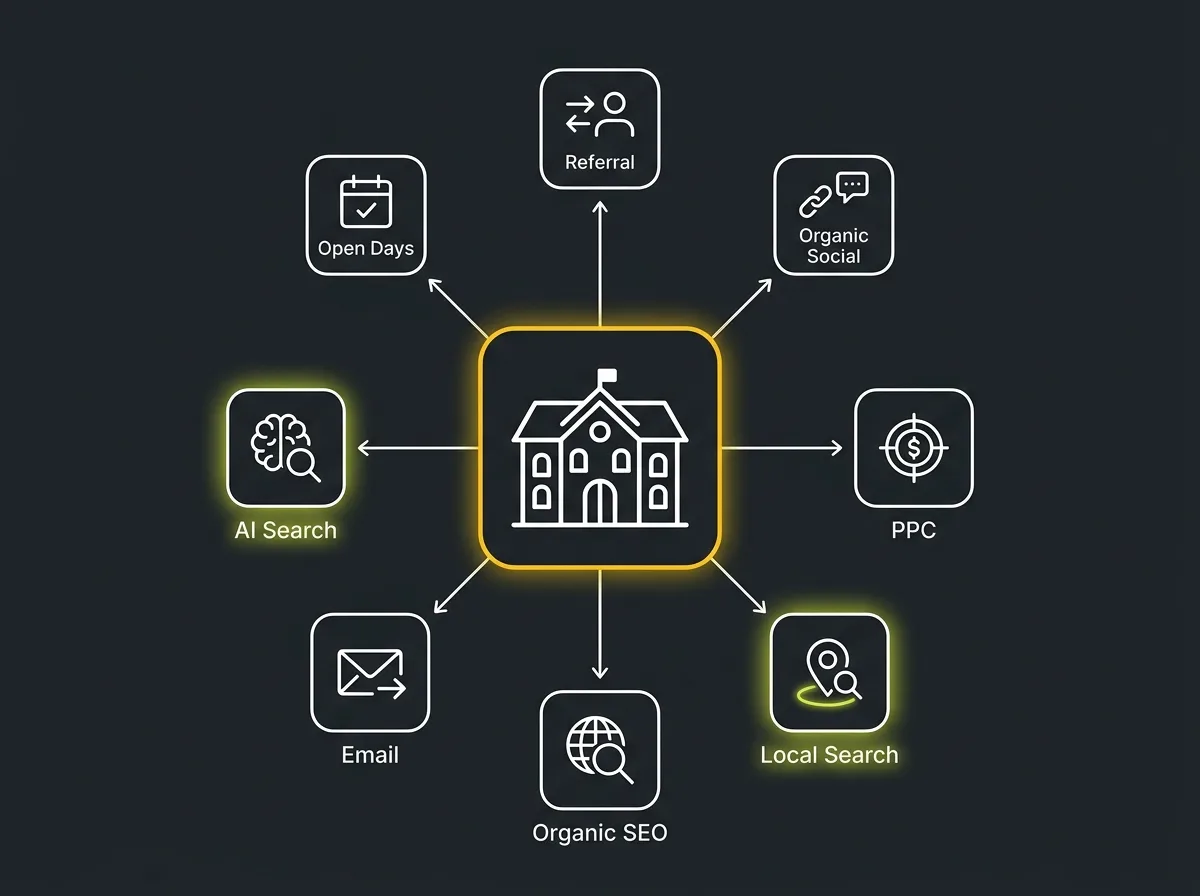
Before getting to search and AI visibility, it is worth mapping the complete picture. Every channel has a role, and dismissing any of them is a mistake.
Referral and word of mouth. Still the highest-converting channel when it works, because a trusted recommendation carries weight that no piece of marketing can manufacture. An existing parent telling a colleague "you should really look at our school" is genuinely valuable. The problem is that you cannot engineer this directly, beyond investing in the parent community and alumni relationships. It is a retention and culture job as much as a marketing one.
Organic social media. Instagram and Facebook build brand familiarity and community feeling. They reach audiences who are browsing rather than actively deciding, and they work well for open day awareness campaigns. They are not, however, where most families make final decisions. A family that discovers a school through an Instagram post is still in awareness mode. They have not yet decided they want independent education, let alone started comparing specific schools.
Paid social and Google Ads. Useful for targeted awareness and open day promotion, and for retargeting website visitors who did not enquire. Without proper measurement of what actually converts, paid social absorbs budget without a clear return. Google Ads can perform well for high-intent search terms, but competes with organic results and the local map pack for the same clicks.
Local search and the map pack. Massively under-used by most schools. Very high intent. Inherently geographical, which is exactly how school catchments work. More on this shortly.
Organic and content SEO. Longer to build than paid channels, but compounding. A well-ranked page keeps bringing in traffic months and years after it is published. Content that answers the questions parents actually ask builds both visibility and trust at the same time.
AI search. Parents are beginning to use ChatGPT, Perplexity, and Claude to shortlist schools. Also covered in detail below.
Email nurture. The most neglected channel in most schools. A family who has enquired but not yet booked an open day represents a specific opportunity. A brief, well-timed sequence of two or three emails can move that family from interest to action. Most schools send one introductory email and nothing more. Then they wonder why the enquiry went cold.
Open days and events. The primary conversion moment for most schools. But marketing is what fills the seats. A strong open day converts well; weak top-of-funnel means empty seats at the event.
The CT lane within this picture is search visibility and traffic, website conversion, and measurement. Social media and referral matter and are worth doing well. Acknowledging that honestly is what earns the right to then say: search and AI visibility are where most schools are leaving the most on the table.
The families who self-select, and how search brings them to you
Not all enquiries are equal. A family who found a school by searching "independent prep school in their town" is in a different mental state from one who spotted an Instagram post and tapped the link. Both might eventually enrol. But the search-led family has done more qualifying work to reach you.
When someone searches for an independent school in a specific area, several decisions have already been made. They want independent education. They have a child in a specific age range. They are looking in a particular geography. They are ready to compare. That is a self-selecting audience the marketing did not have to educate from scratch. They arrived with intent already formed.
Compare that to the social media audience, who is passive until a well-timed post changes something. Or the referral audience, which arrives when a conversation happens to occur. Search brings families who are already in decision mode.
Defining the right family before spending on marketing. The most practical exercise any school can do before investing in digital channels is to look at the last three years of enrolments and find the common characteristics. Which catchment postcodes? Which referral sources? Which pages did they visit before enquiring? Which open day cohort enrolled at the highest rate? That profile, built from real data, tells you where to put resource. It often shows that a small number of channels are responsible for a disproportionate share of the right enquiries.
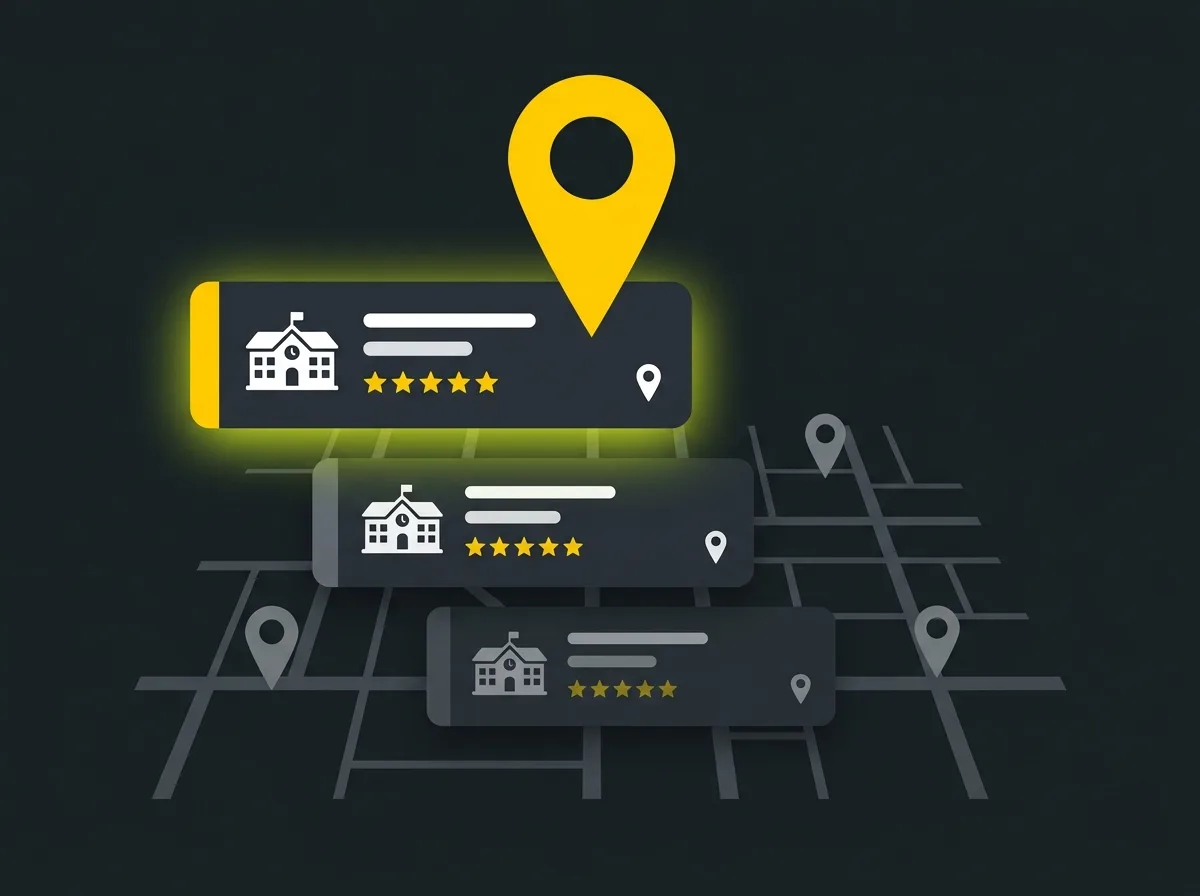
The local search opportunity. A large share of independent school searches carry local intent: "independent school near me", "best prep school in the county", "girls' independent school in town". These searches trigger Google's local map pack above the organic results. The map pack shows three schools with ratings, reviews, and a click-through to the school website. If a school is not appearing in the map pack for these searches, it is invisible to the highest-intent families in its catchment area.
Appearing in the map pack is a local SEO challenge: a properly claimed and optimised Google Business Profile, a strong and recent review profile, consistent contact details across the web, and sometimes dedicated location-specific content for the areas the school draws from.
Most independent schools are visible for branded searches, when a family already knows the school's name and types it directly. Most are invisible for the non-branded local searches where families who do not yet know the school's name are looking. That gap is where the opportunity sits.
Your website as the admissions front door, not a digital brochure

School websites are often built for the wrong audience. They are gorgeous, full of photography, and genuinely difficult to navigate if what you actually want to know is how much the fees are, when the next open day is, and what happens after you submit an enquiry form.
Most school websites are designed for families who have already decided. The first-time visitor doing due diligence has completely different questions. They want fee clarity, quickly. They want to understand the admissions process. They want to know if the school is a realistic option before investing an afternoon visiting.
A fees page that requires three clicks and is written in deliberately vague language loses families at the very top of the funnel. Fee transparency is a self-selection mechanism. Families who cannot comfortably meet the fees are better identified early than after three conversations with the registrar.
The primary conversion job of a school website is to get a family to book an open day or to make an enquiry. That needs to be the primary call to action on the home page and on key landing pages. Not buried under a news carousel, not competing with a slider celebrating last year's leavers.
What to track. What is the school's current enquiry rate from organic website traffic? If that figure is unknown, there is no starting point for improvement. According to SEO Works education marketing data, cross-channel enquiry-to-application conversion averages 5-7% for independent schools. For schools with strong digital marketing and a website structured around the admissions journey, that figure can reach 20-35%. The gap between those numbers is largely a website and follow-up problem, not a reach problem.
If the school website needs to be rebuilt around what families need to find rather than what the school wants to say, website design structured around the admissions journey is where that work starts.
The two visibility channels most schools are ignoring in 2026
Local search and AI search have the largest gap between their influence on parent behaviour and the investment schools are putting into them.
Local SEO. The Google map pack is among the most valuable pieces of real estate in independent school marketing. It appears above organic results for local intent searches, and those searches carry intent that awareness channels cannot match.
An active Google Business Profile matters: correct category, complete information, regular posts, and a strong review profile. Reviews serve a dual purpose. They are a trust signal for prospective families and a local ranking signal for Google. A school where satisfied parents consistently leave Google reviews compounds its local visibility over time. A school that never thinks about its review profile is handing map pack positions to competitors who do.
Review strategy is often treated as an afterthought. It should be a regular task for whoever manages admissions.
AI search. Parents are beginning to use ChatGPT, Perplexity, and Claude to shortlist schools, and this is the one area no other article in this space is addressing properly.
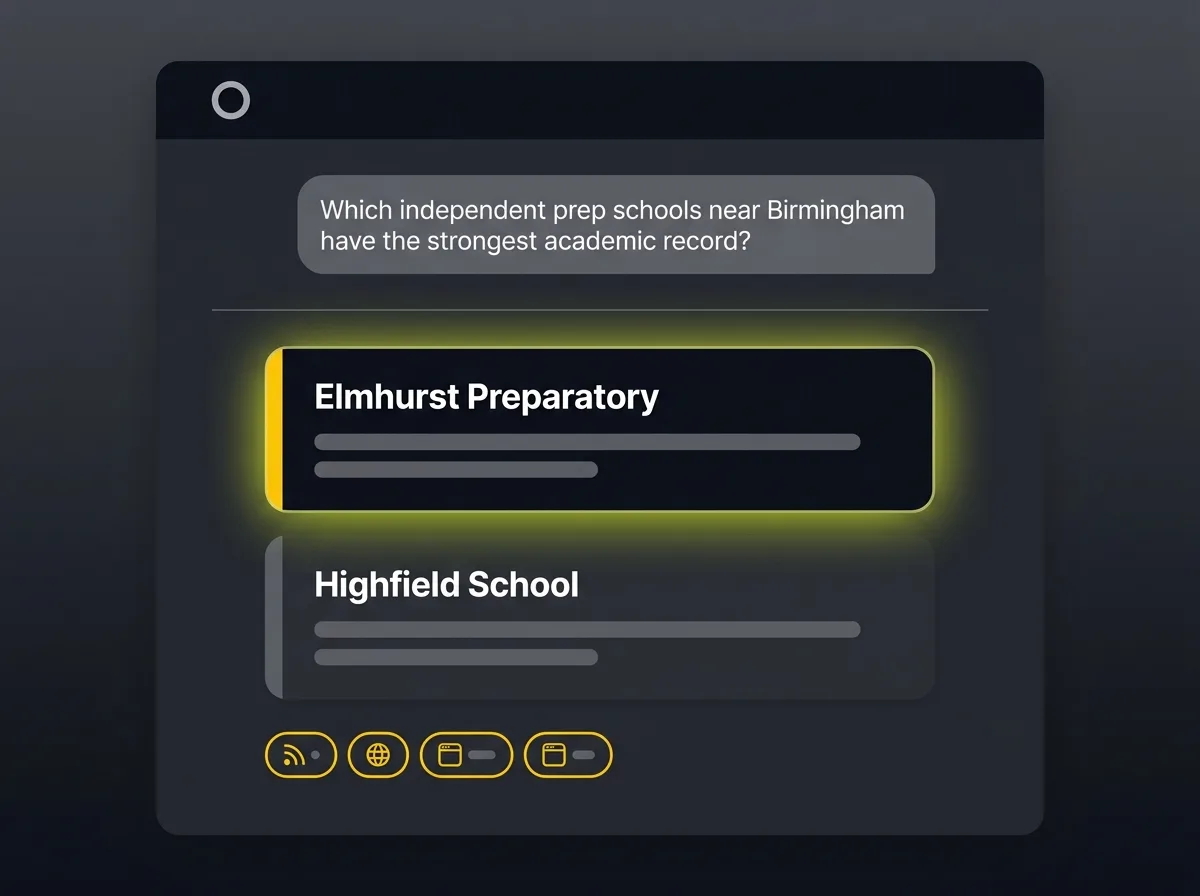
A parent researching schools in 2026 might type "what are the best independent prep schools near Birmingham?" into an AI tool, or ask which schools are known for strong provision in science or languages. The AI tool responds with named schools and a brief explanation of why. The schools that appear are broadly those with the clearest and most structured online presence: strong review profiles, well-organised website content, consistent structured data, and mentions in external directories and local publications.
AI search traffic converts at significantly higher rates than generic web traffic because the parent arriving via an AI recommendation has already been filtered by the AI's reasoning. They are not browsing. They have a specific question and the AI has given them a specific answer.
The schools that will benefit most from AI search over the next two to three years are the ones building their AI search visibility now, while most competitors are still not paying attention to it.
What a healthy enquiry funnel looks like, and how to measure yours
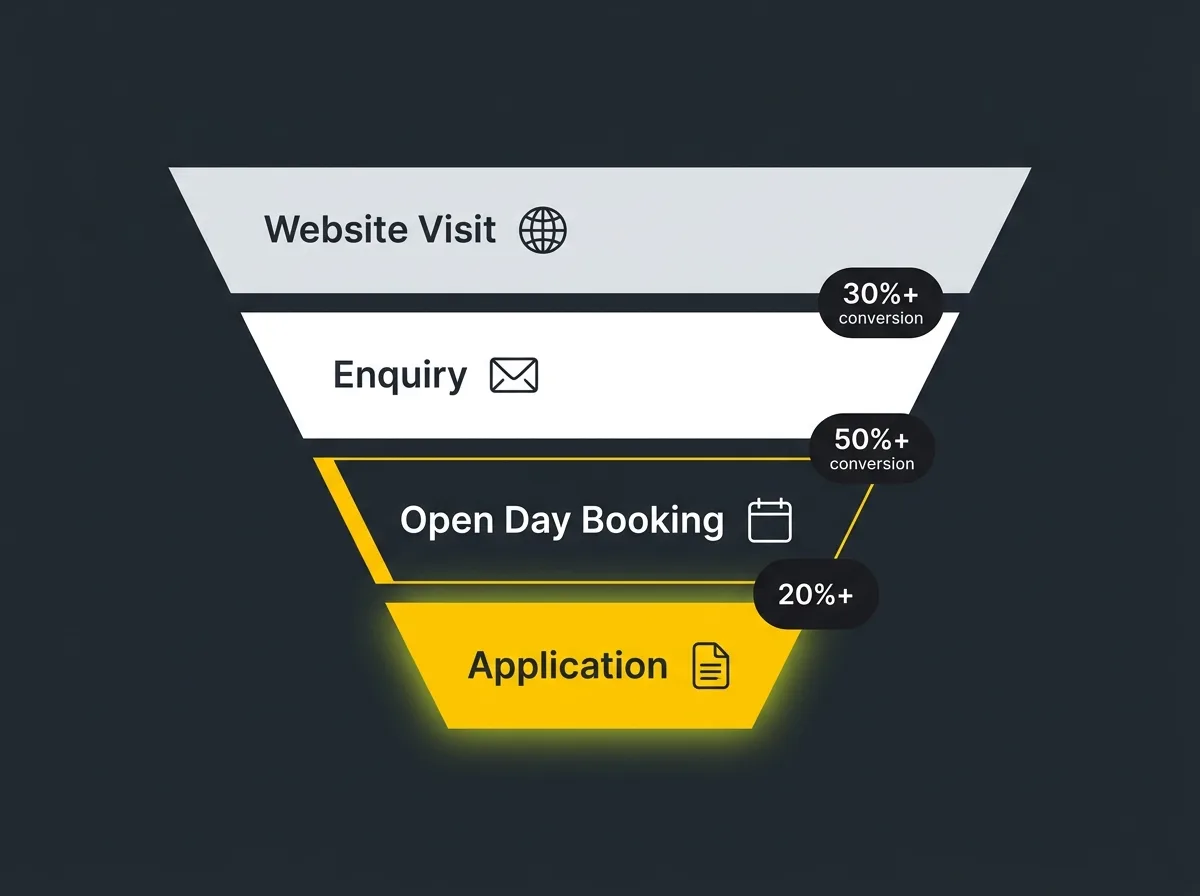
Most independent schools cannot name their conversion rate at any stage of the admissions process. Not website visitor to enquiry. Not enquiry to open day booking. Not open day attendance to application.
Most do not.
If you cannot measure where families are dropping out, you cannot improve it. That is the entire argument for putting measurement in place before spending more on acquisition.
In GA4, goal completions for enquiry form submissions and open day sign-ups give a baseline. Source and medium attribution shows which channels are driving which types of enquiry. Organic traffic tracked month-on-month against enquiry volume gives an early signal of whether search visibility investment is working.
Some simple benchmarks worth aiming for: if enquiry-to-open-day rate from organic search is below 30%, the website or the follow-up process needs attention. If organic traffic is below 2,000 visits per month for a school of 300 or more pupils, search visibility needs investment. If open-day-to-application rate is below 20%, the open day experience itself may be the issue.
The measurement step separates schools doing marketing from schools knowing whether their marketing is working. It is not complex. It requires about half a day to set up properly in GA4, and it pays back immediately in clarity.
Frequently asked questions about marketing for independent schools
What channels work best for independent school marketing?
The channels that work best are those that reach families who have already decided they want independent education and are actively comparing options. Local search, organic SEO, and AI search each bring high-intent traffic that social media and referral cannot reliably replicate at scale. Social and referral matter for awareness and community feeling but are difficult to measure and slow to compound. For schools with limited marketing budgets, starting with the Google map pack, the school website, and organic search typically delivers the clearest return on effort.
How much should an independent school spend on marketing?
Marketing spend varies by school size, fee level, and how competitive the local catchment is. ISC data from 2026 suggests that marketing budgets at mid-sized member schools commonly exceed £70,000 per year. Digital marketing, covering search visibility, website performance, and paid campaigns, tends to deliver better measurement and more predictable returns than print and prospectus production, which still absorbs a disproportionate share of budgets at many schools.
What is a good enquiry-to-application conversion rate for an independent school?
Cross-channel enquiry-to-application conversion averages 5-7% across independent schools. Schools with strong digital marketing, a website built around the admissions journey, and an active email nurture process can reach 20-35%. The gap between those numbers is usually traceable to the website experience and the speed of follow-up after the initial enquiry, rather than to the volume or quality of enquiries coming in.
How does AI search affect independent school marketing?
AI tools including ChatGPT, Perplexity, and Claude are increasingly used by parents to shortlist schools before they have visited any of them. The schools that appear in AI responses are those with the clearest and most structured online presence: strong review profiles, organised website content, mentions in external directories, and content that directly answers the questions parents ask. This is a developing channel, but one worth building toward now while most competitors are not paying attention to it.
Finding the right families starts with being found
Most independent schools are good at the relationship part of marketing. Open days run well. Pastoral care is communicated with warmth. Alumni networks exist and produce referrals. What many schools are missing is the visibility layer: being found by the right families before those families find a competitor first.
The families who are actively searching for an independent school in your catchment right now are making decisions. They are using Google. They are using AI tools. They are landing on websites and making judgements based on the first three pages they see. Whether they find your school or another school's depends on where you appear in those searches.
Free resource: Traffic Projection Report
If you are not sure whether your school is appearing in the searches that matter, the Traffic Projection Report is a practical starting point. It maps the search traffic your school could realistically attract based on your catchment area and the current keyword landscape, and shows where the biggest visibility gaps are. No cost, no obligation. Just a clear picture of what is and is not working in search right now.