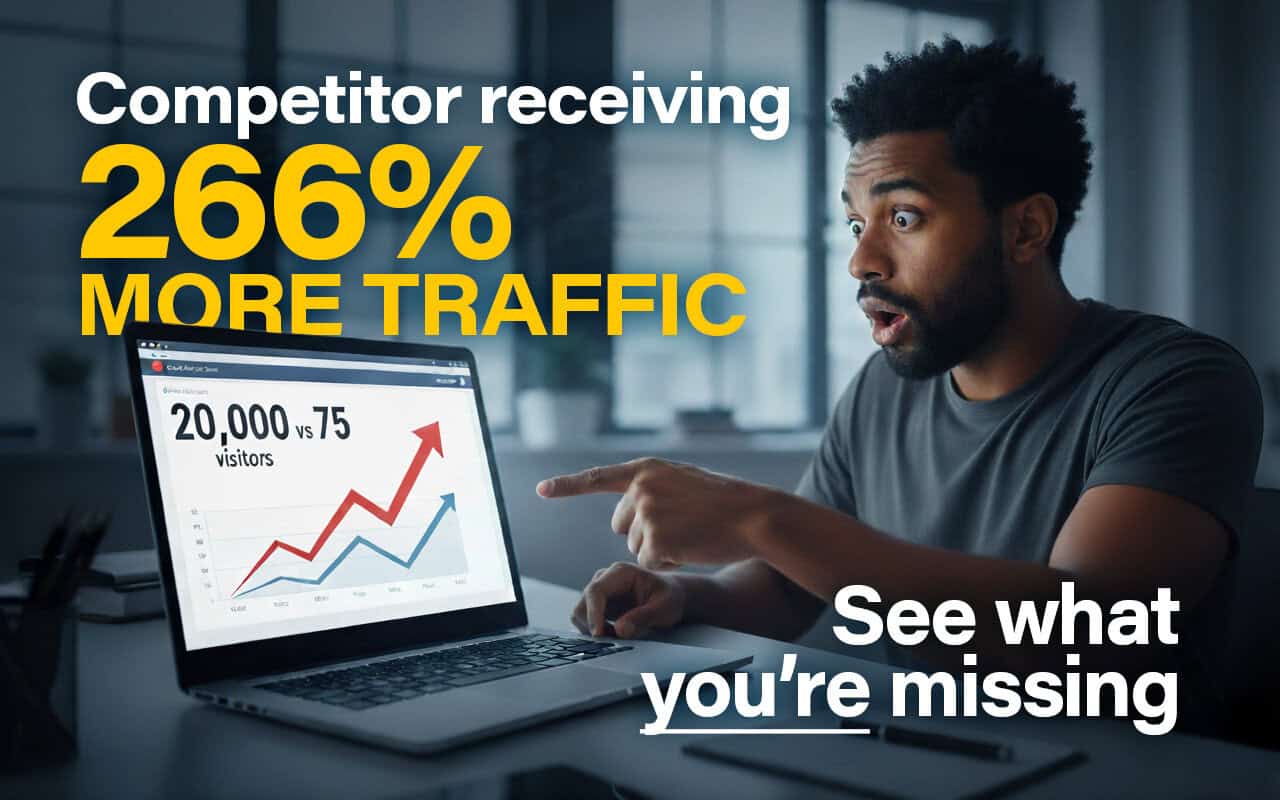
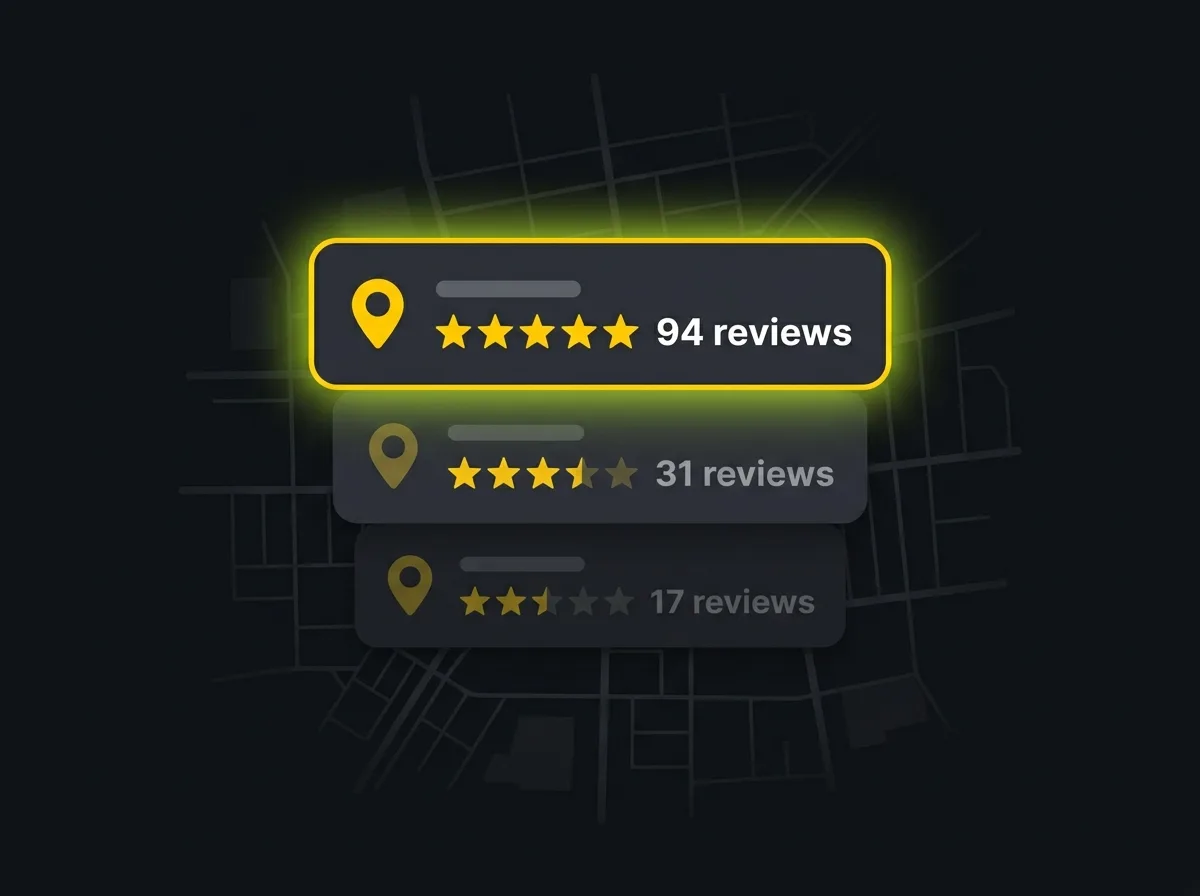
Your main competitor has ninety-four Google reviews. You have seventeen. The service you deliver is just as good, possibly better. Yet there they sit in the top three on Google Maps, while you are one scroll away from invisible.
It is not a service problem.
Most businesses with thin review counts are genuinely good at what they do. The problem is a process one. Reviews are treated as something that just happens, rather than something you make happen. And a group email to last year's clients sent when someone remembered to do it is not a process.
In 2026, reviews compound. A business with sixty reviews tends to attract more reviews each month than one with six, partly because customers perceive it as established and partly because Google rewards velocity with visibility.
Getting stuck at seventeen feels like a wall. It is actually a gap in how you are asking.
This post lays out a practical system for getting more Google reviews consistently: foundation, ask, follow-up, respond, measure. In that order. Nothing that requires a software subscription, and nothing that violates Google's policies.
The short version: verify your Google Business Profile, generate your review shortlink, create a QR code, ask every customer within 24 to 48 hours of service completion, follow up once after 72 hours, respond to every review you receive, and track your velocity against competitors monthly.
The businesses that do this consistently outpace the ones that do it occasionally. Every time.
Why Google reviews matter more than your star rating suggests
Most business owners think of Google reviews as social proof. Something that tells potential customers you are trustworthy. That is true, but it is only part of the picture.
Reviews are also a ranking signal.
Google uses reviews as an active ranking signal in its local algorithm. Not just the star rating, but the total count, the velocity (how many new reviews you are receiving each month), the recency of those reviews, and whether you respond to them.
A business with a 4.8-star average and twelve reviews does not rank the same as one with a 4.8-star average and sixty reviews. They are not competing on the same terms.
The businesses appearing in Google's local top three consistently hold significantly more reviews than those just outside that group. The gap is rarely about service quality. It is almost always about consistency of asking.
There is a newer dimension worth flagging too. When someone asks ChatGPT or a local AI assistant to recommend a nearby plumber, dentist, or accountant, those tools increasingly draw on Google Business Profile data, including review count and rating. Reviews used to feed only Google Maps. Now they feed the AI recommendation layer that sits above it.
The businesses with stronger profiles are building assets that work across more channels than they used to. For more on how that traffic pattern works and why it converts differently, there is a separate post on AI search worth reading once you have the review system in place.
Consumer behaviour confirms the pattern. According to BrightLocal's Local Consumer Review Survey, which tracks UK and US consumer attitudes annually, a significant proportion of consumers will not use a local business if it has too few reviews.
The trust threshold shifts year to year, but the direction is consistent: consumers expect a body of evidence, and a thin count raises doubt regardless of how good the underlying service is.
For local businesses, this is where local SEO starts. Reviews are not a standalone marketing task. They are one of the foundational elements of local search visibility, and the businesses that treat them seriously tend to compound their map pack position over time.
Healthcare practices face the same dynamic with extra urgency, given how much weight patients place on review count before choosing a provider. But the principle holds across every sector that depends on local search.
The real reason your review count is not growing
Here is the thing almost no one says out loud: the quality of your service is not why your review count is low. It is almost never the service.
Sound familiar?
The problem is almost always one of two things. You are either relying on customers to volunteer reviews without being prompted, or you are asking in a way that makes it too easy to put off. Both produce the same result: a handful of reviews from your most enthusiastic customers and near-silence from everyone else.
Timing is the single biggest variable. A review request sent three weeks after a job carries a fraction of the response rate of one sent within 24 to 48 hours, when the experience is still fresh and the customer is still thinking about you.
Most businesses send the request when they remember to, not when the customer is most likely to say yes.
Those are rarely the same moment.
Channel matters too. A warm verbal ask at the point of handover, when the customer is standing in front of you and has just expressed satisfaction, converts at a far higher rate than an email sent to a list of past clients on a quiet Tuesday. Both are better than nothing. They are not the same.
The fix is straightforward in principle, but it requires a shift in how you think about it. Review generation has to become a business process with defined stages, not an occasional marketing activity that happens when someone finds the time.
The rest of this post works through each stage in turn.
Getting the foundation right before you ask for anything
Before you send a single review request, four things need to be in place. Skip any of them and you are asking customers to do more work than they should have to.
Worth getting right first.
Verify your Google Business Profile. Reviews on an unverified or incomplete profile do less ranking work. More importantly, an incomplete profile creates a poor first impression for anyone who goes looking. Check that your business name, address, phone number, category, and opening hours are accurate and consistent.
This matters especially if you have moved premises, changed your phone number, or updated your services in the last couple of years.
Get your direct review link. Inside your Google Business Profile dashboard, there is an option labelled "Ask for reviews". It generates a short URL that takes customers directly to your review form, no searching required. This is the link you will use in every message you send.
Do not ask customers to find you on Google and navigate to the review button themselves. Most will not bother.
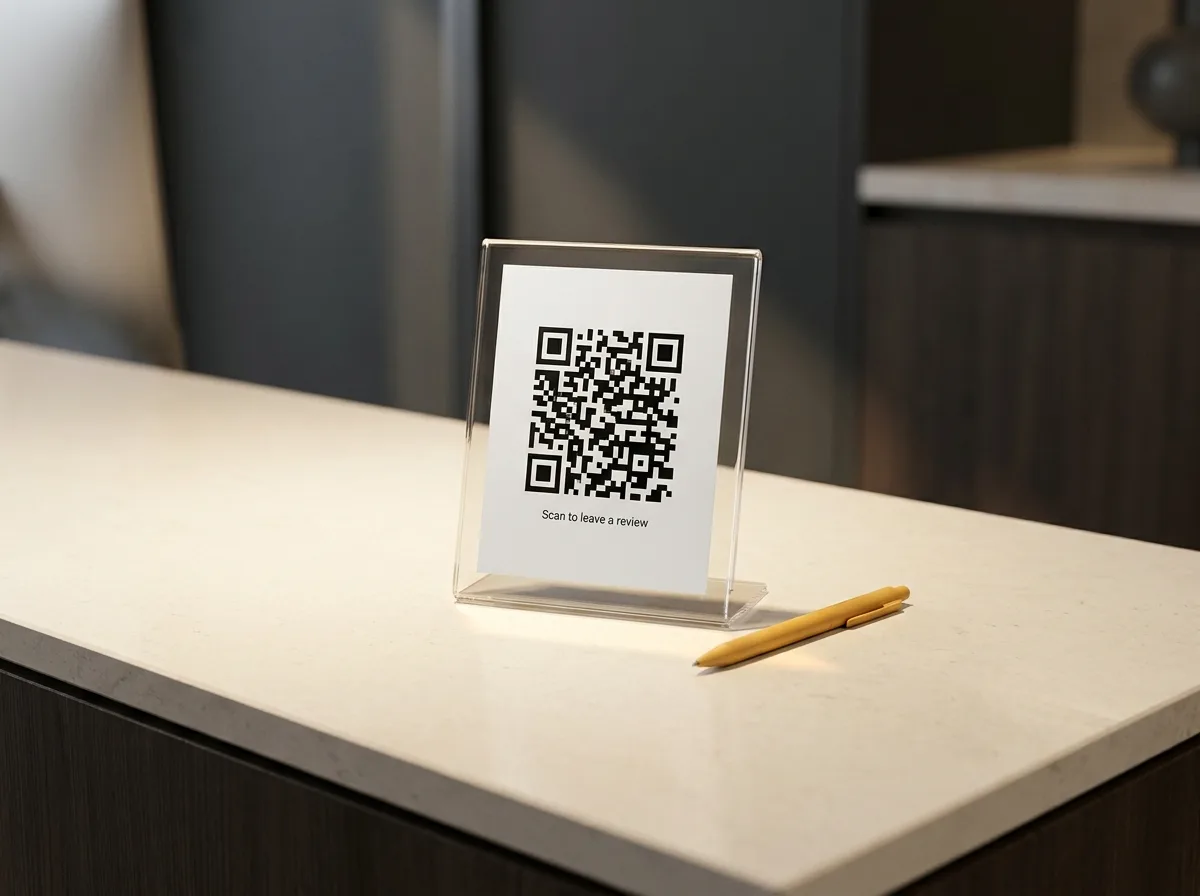
Create a QR code from that link. Free QR code generators take under two minutes. The QR code goes on receipts, invoices, service completion cards, countertop stands, and anywhere customers have physical contact with your business. A small stand at a reception desk, a card in a handover pack, a sticker on an invoice.
The goal is to make leaving a review feel like a thirty-second task, not a research project.
Brief your team. Anyone with direct customer contact needs to know what a review request looks like, when to deliver it, and how to point to the QR code or send the link. Consistency here is what makes the system work. One team member who routinely skips the ask is a leak in the process that compounds over months.
None of this is technical. It takes an afternoon to set up properly. The businesses that do not have it in place are the ones still sitting on seventeen reviews three years after opening.
The ask: timing, channel, and what to actually say
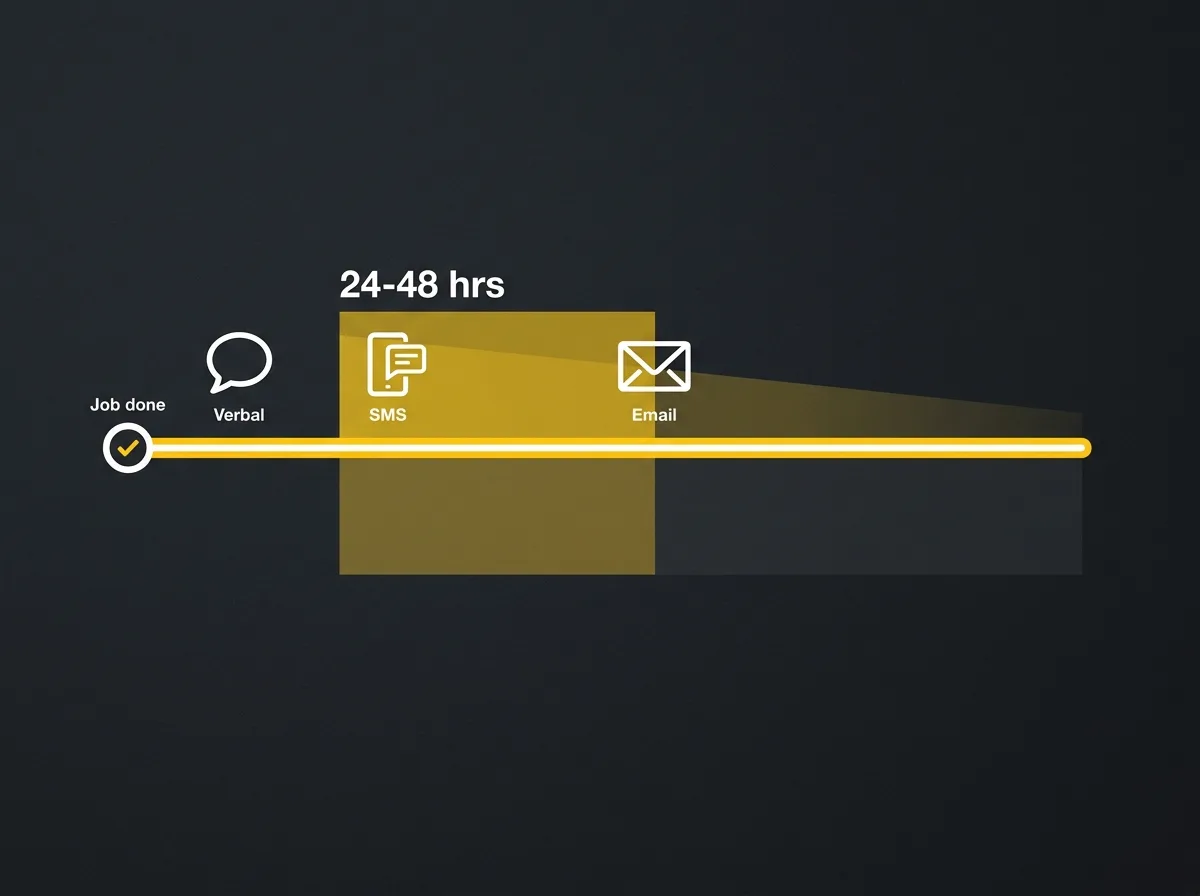
Getting the ask right comes down to three things: when you ask, how you ask, and what you actually say.
Verbal ask at the point of service completion. This is the highest-converting channel by some distance. Done at the moment of handover, when the customer has just expressed satisfaction and the experience is still front of mind, the verbal ask converts at a far higher rate than any digital channel.
Keep it natural rather than scripted. Something like: "If you found the service useful, a quick Google review would really help us out. It takes about thirty seconds." Then point to the QR code or offer to send them the link. Short, warm, not corporate.
SMS within one to two hours of completion. SMS has better open rates than email, and a message sent while the experience is still fresh performs meaningfully better than one sent the following morning. Keep it under 120 characters. Use the customer's first name, reference the specific job, and include the direct review link.
"Hi James, great to get your boiler sorted today. If you have a spare minute, a Google review would really help us out: [link]" will outperform a templated paragraph every single time.
Email for more formal relationships. B2B clients, professional services contacts, post-project work. The subject line should be short and warm, not demanding. "Quick favour if you have a minute" outperforms "Please leave us a Google review." The body is one sentence of thanks, one sentence of the ask, and the link. No paragraphs explaining why reviews matter to the business. They know.
QR codes for walk-in and in-person settings. Retail, clinics, salons, hospitality. The countertop stand or service completion card does most of the work once the verbal ask has set the expectation.
Whatever channel you use, a few small things consistently improve response rates. Use the customer's first name. Reference the specific job or service. Mention how quick it is: "It takes about thirty seconds" outperforms no time framing, reliably. Avoid anything that reads like it was written by a marketing department.
One thing to be absolutely clear on: do not offer anything in return for a review. No discount, no prize draw entry, no free service.
Google's own guidelines prohibit incentivising reviews in any form. The consequences are real: Google can remove the reviews, and in repeated cases can suspend the entire Google Business Profile. It is not worth the risk, and it is also the wrong instinct. You want honest accounts of your service, not purchased enthusiasm.
Building a consistent follow-up without pestering people
The follow-up rules are simple. One message. Once. Approximately 48 to 72 hours after the original ask, if no review has appeared.
Not a sequence. Not a reminder series. One follow-up, and then you leave it.
Most people who are going to leave a review will do so within a few days of being asked. Beyond that, the marginal gain from another nudge is low and the cost to the relationship starts to outweigh the benefit.
One follow-up is the line between persistent and annoying.
The follow-up message should be briefer than the original ask. Acknowledge that they are busy, re-send the direct link, and keep the whole thing to two sentences. "Hi James, just following up on my message from earlier in the week in case you had a spare minute. Here is that link, no pressure if not!" That is all it needs to be.
Automation is what makes this consistent at scale. If your business uses a booking platform such as Calendly, Acuity, Fresha, or Cliniko, most have native review request flows or can connect to a messaging tool via Zapier or Make. Job management tools like Jobber or Tradify work similarly.
For businesses without any of this in place, a weekly check of completed jobs and a brief manual follow-up is still far better than sending nothing.
One policy point to be explicit about: review gating is against Google's terms. Review gating means selectively asking only customers you believe were satisfied while filtering out those who seemed unhappy. Ask consistently. Every customer.
Google's algorithm flags unusual velocity patterns and heavily skewed rating distributions, and a profile with an implausibly high proportion of five-star reviews accumulated in a short window raises a flag rather than building trust.
How to respond to negative reviews without making it worse
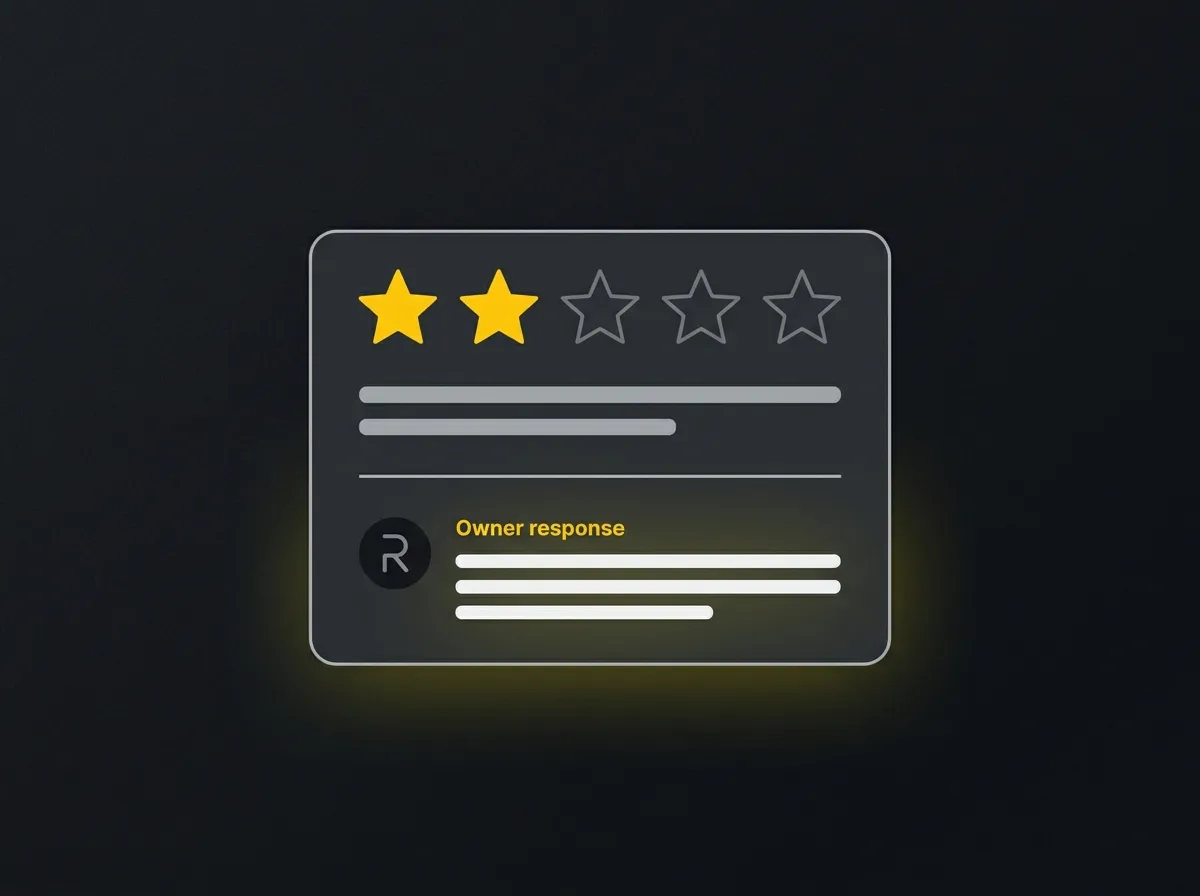
Future customers read your responses as much as the original review. A well-handled negative review can build more trust than a collection of unchallenged five-stars.
A poorly handled one can do more damage than the complaint itself.
The response formula is straightforward. Acknowledge the experience without conceding every specific claim. Apologise that it fell short of expectations. Offer a path to resolution offline, with a phone number or email address. Keep the response under 150 words. Reply within 24 hours where possible.
Something like this: "Thank you for taking the time to leave this feedback. I am genuinely sorry to hear the experience fell short of what you expected. I would very much like to understand what happened and put it right if I can. Please do reach out directly at [contact details] and I will look into it personally."
That is roughly the shape: brief, professional, not defensive, and it moves the conversation somewhere private where it can actually be resolved.
A few things not to do. Do not name the customer in your response. Do not contradict specific factual claims in public, even if those claims are inaccurate. Do not copy and paste the same template to every negative review: anyone reading through your profile will spot it immediately, and it reads as dismissive.
Do not delete your response after writing it, which creates visible gaps and reads worse than leaving it.
For reviews that appear fabricated or planted by a competitor, Google's flagging function is the right route. The bar for removal is reasonably high, but it is worth using for clear policy violations: hate speech, spam, or reviews from someone who was clearly never a customer.
Positive reviews deserve responses too. A brief individual thank-you, distinct from a template, shows that the reviewer was heard. It also signals to anyone reading the profile that there is a real person behind it.
Tracking whether your system is working
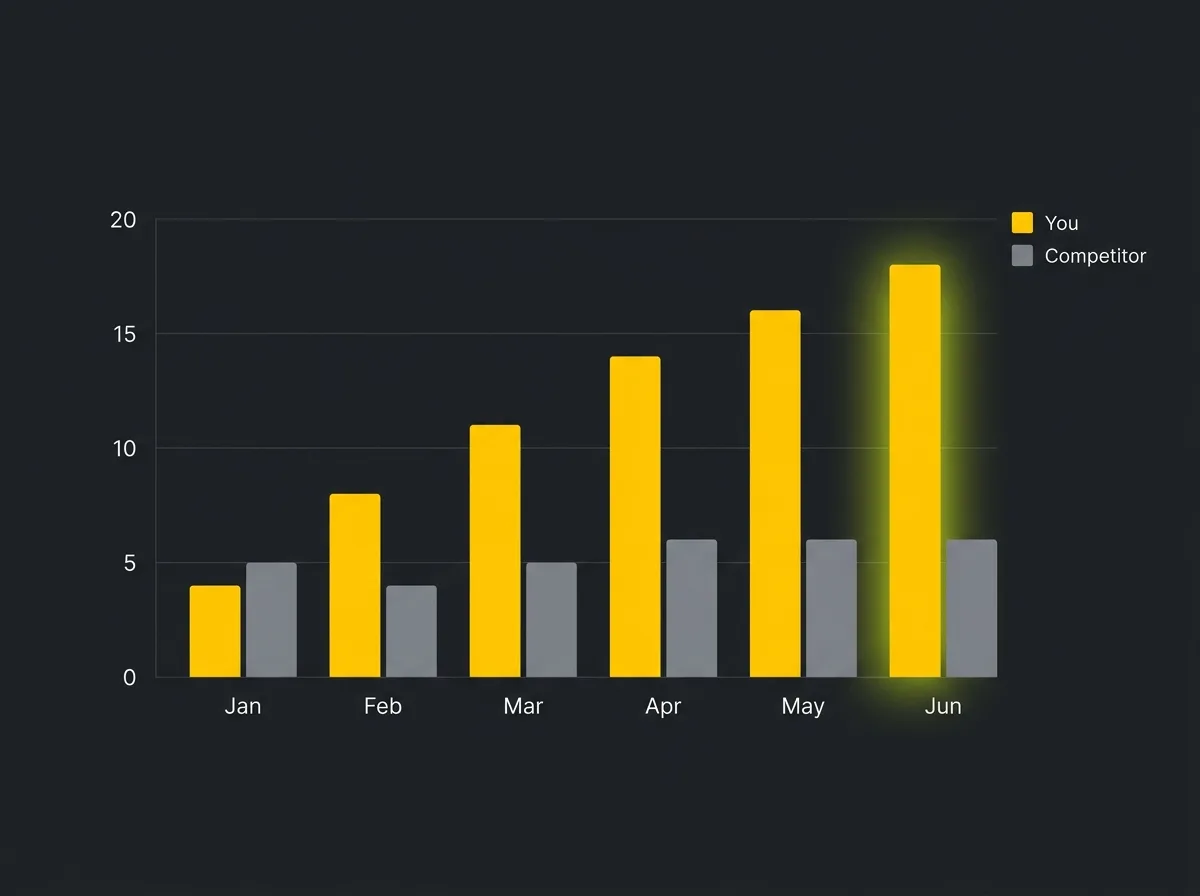
Once the system is running, the question becomes whether it is working. The answer lives in four numbers: total review count, reviews per month (your velocity), current average rating, and response rate (the percentage of reviews you have actually replied to).
Track velocity first.
This is the figure that determines whether you close the gap on competitors or remain behind indefinitely. If you are getting two reviews a month and your main competitor is also getting two, the gap stays the same no matter how long you wait. If you are getting four and they are getting two, you close it.
The arithmetic is simple, and it is the only number that actually matters for the ranking objective.
Benchmark against your two or three main local competitors. Search for them on Google, check their current review count, and estimate how many they have added in the last month or so. This gives you a velocity picture without any paid tools.
Connect the numbers to business outcomes. If your map pack position improves as your review count grows, and your profile views and direction requests are rising in the Google Business Profile performance section, the system is working.
Track these monthly: views, calls, website clicks from the profile. These are the lines that connect review activity to actual enquiries coming through your door.
The monthly check takes about fifteen minutes. On the first of every month: note your count, note your competitors' counts, check for any unanswered reviews, adjust your ask process if velocity is lower than it should be. Simple enough to be sustainable.
Frequently asked questions about Google reviews
How many Google reviews do I need?
There is no magic number, but research from BrightLocal's Local Consumer Review Survey consistently shows that a meaningful proportion of consumers will not trust a local business with too few reviews. In practice, the most useful question is how your count compares to your direct competitors in the same area and category.
If they have eighty reviews and you have fifteen, that gap affects your relative visibility in the map pack until you close it. Focus on closing the velocity gap first.
How long does it take to get more Google reviews?
Most businesses that implement a consistent ask system see meaningful improvement within four to six weeks. A realistic ongoing velocity for a local service business running the system properly is three to six new reviews per month.
From there it compounds: the more reviews you have, the more established you appear, and the more likely future customers are to leave one without being asked.
Can I ask customers to leave a Google review?
Yes, absolutely. Asking customers for honest feedback is explicitly permitted by Google. What is not permitted is offering anything in exchange for a review, coaching customers on what to say, or only asking customers you believe were happy while filtering out those who were not. Ask every customer. Provide the link. Leave the content entirely up to them.
Can I remove a negative Google review?
You cannot delete a review left by a customer, even if the content is inaccurate or unfair. What you can do is flag reviews that violate Google's policies: spam, hate speech, fake reviews, or reviews from someone who was clearly not a customer.
Google reviews these reports and removes reviews that break the rules, though the threshold for factual disputes is reasonably high. For legitimate negative feedback, a professional response is always the right move rather than a removal attempt.
The compound effect of getting it right
The businesses with the most Google reviews are not the ones with the best service. They are the ones with the best process.
It compounds.
The system is not complicated. Verify your Google Business Profile, get your review link, create a QR code, brief your team, ask every customer within 24 to 48 hours, follow up once, respond to everything, and measure velocity monthly. Done consistently, it compounds in a way that ad hoc asking never does.
A business at seventeen reviews that generates five new ones per month is at forty-seven within six months. Its competitor that started at ninety-four and is still relying on volunteers may not have kept pace.
These things flip.
Reviews are one input into your local search visibility, but they are a foundational one. If you want to understand what the full picture of your local search performance looks like, and what a structured approach could realistically generate in enquiries for your type of business, the Traffic Projection Report gives you a data-backed starting point with no obligation.
Free resource: Traffic Projection Report
See exactly what search traffic is available for your type of business and what it would take to capture it. No sales call required to access it.