Google Knowledge Panels are not just for celebrities and global brands. A well-run accountancy firm in Birmingham, a specialist physio clinic in Edinburgh, or a roofing company in Leeds can all earn one, if Google's systems are confident enough about who they are.
That last part is the key. Knowledge panels are not something you apply for. There is no form, no fee, no Google representative to charm. They are triggered automatically when Google reaches sufficient confidence about a business's identity, and your job is to give Google the signals that build that confidence.
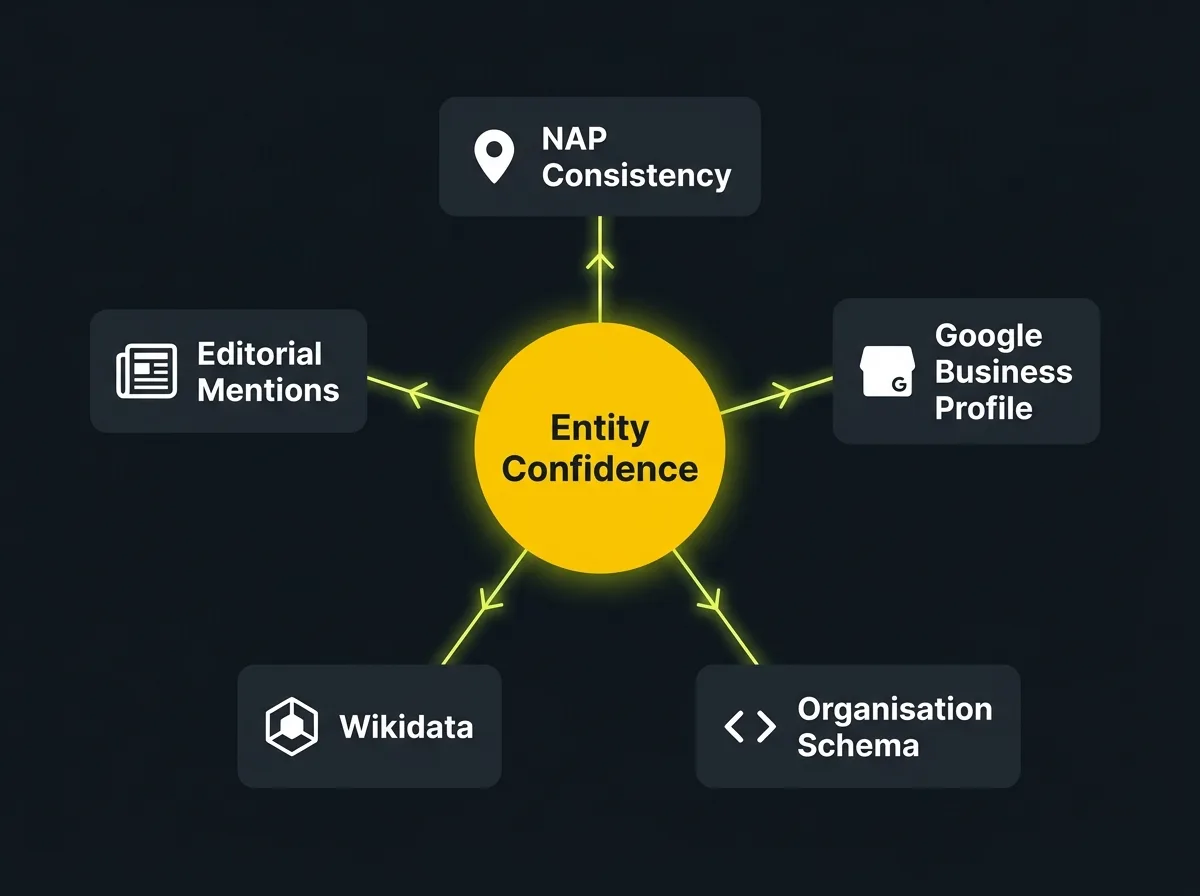
TL;DR: A Google Knowledge Panel is an automatically generated information box that appears when Google is confident enough about an entity's identity to surface a summary in search results. Five things trigger one for a UK service business: consistent NAP data across authoritative sources, a fully optimised Google Business Profile, Organisation schema with sameAs links, a Wikidata entry, and corroborating mentions from independent editorial sources. Build these signals and the panel follows. There is no shortcut.
The good news: most of these signals are within reach of any serious service business. The less good news: they take time to compound, and none of them work in isolation. What follows is the practical explanation of each trigger, starting with the one most businesses overlook entirely.
If you want the deeper context behind all of this, the companion piece on entity SEO explains how Google's Knowledge Graph works and why entity recognition is becoming one of the most important signals in search.
What a Google Knowledge Panel actually is (and how it differs from a Google Business Profile)
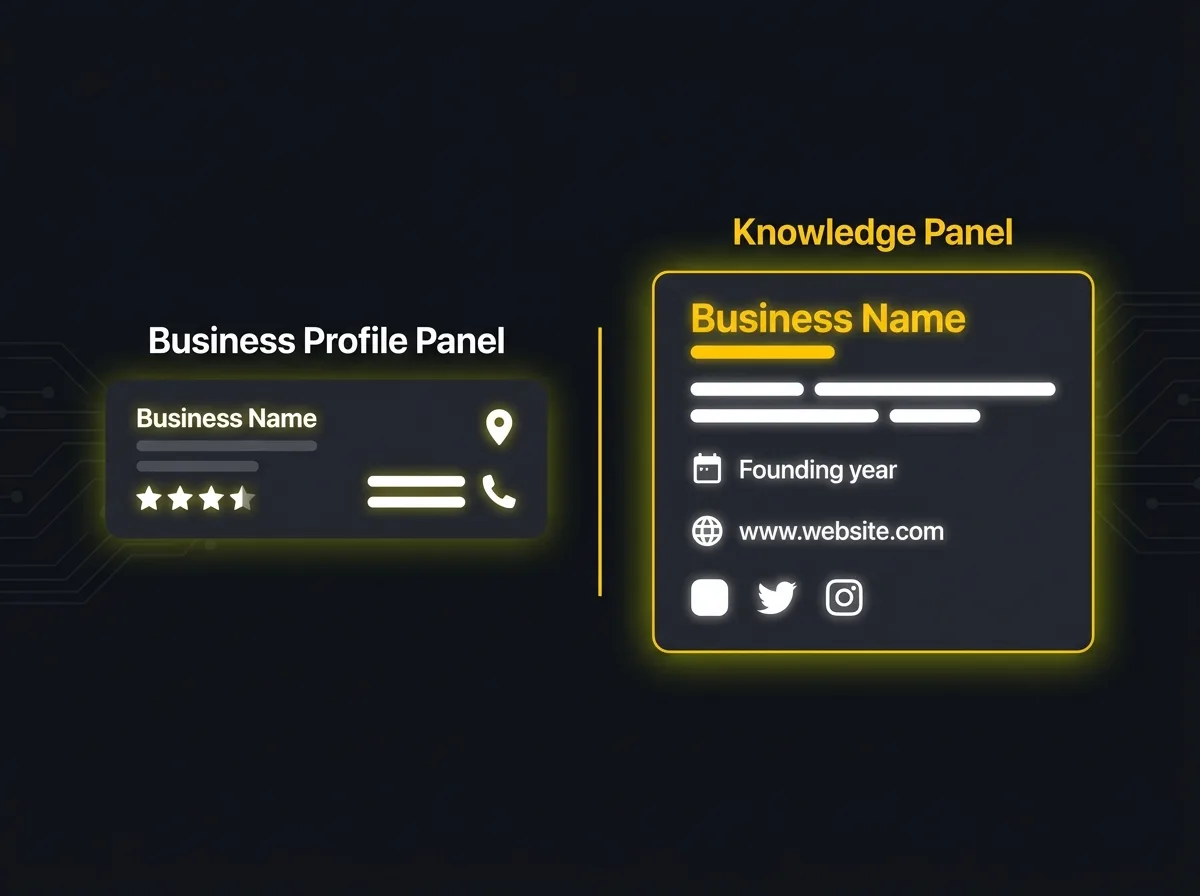
A Google Knowledge Panel is an automatically generated information box that appears on the right-hand side of desktop search results, or at the top of mobile results, when Google is confident enough about an entity's identity to surface a summary of it directly. It typically shows a name, description, founding information, social profiles, and sometimes key people. You have almost certainly seen them for recognisable brands, public figures, and organisations.
Here is the distinction most guides miss completely. There are two different panel types, and they work quite differently.
The local business panel is powered primarily by your Google Business Profile. It shows your address, phone number, opening hours, reviews, and directions. It appears when someone searches your business name or a local-intent query nearby. This type is relatively accessible: if you have a verified GBP with a physical or service-area presence, you likely already have a version of it.
The entity panel is powered by Google's Knowledge Graph. It shows a description of the business, founding information, what it does, sometimes the people behind it. This is the panel that looks genuinely authoritative, and the one most businesses are asking about when they search "how to get a Google Knowledge Panel." It is also the harder of the two to trigger, because it requires Google to have enough independent, consistent data to construct a confident entity profile.
The two types share underlying signals. A strong GBP helps both. So does consistent NAP data and schema markup. The local panel is a stepping stone, not a consolation prize. Think of it as evidence that Google has already started building an entity profile for you.
The concept that underpins both types is entity confidence. Google treats your business as a named thing in the world, and it needs enough cross-referenced, consistent data to reach a threshold before it will surface a panel. The five triggers below are the things that move you towards that threshold.
Trigger 1: consistent NAP data across authoritative UK sources
NAP stands for Name, Address, Phone number. It sounds basic. It is also the most common reason knowledge panels do not appear.
Google cross-references your business details across dozens of sources: your website, your GBP, directory listings, government registers, and professional body pages. When those sources agree, entity confidence increases. When they conflict, it stalls.
The consistency standard is tighter than most businesses expect. It is not just the same information; it is the same format. "Creative Tweed Ltd" and "Creative Tweed Limited" are, to a pattern-matching system, two different strings. "+44 121 xxx xxxx" and "0121 xxx xxxx" are two different phone numbers. Inconsistencies like these are genuinely common, and they quietly undermine the confidence score Google is trying to build.
For UK service businesses, the sources that carry the most weight include:
-
Companies House. The Companies House public register is one of the most authoritative sources Google can find for a UK business. Your registered name, address, and company number there are treated as ground truth. If your GBP uses a trading name that differs from your registered name, that gap is worth addressing.
-
Yell and FreeIndex. UK-specific directories that carry genuine authority for local businesses. Claim your listing, make sure it is accurate, and ensure it is consistent with your website.
-
Bing Places. Often overlooked. Bing's index feeds data aggregators that Google cross-references.
-
Trade and professional body directories. If your business is a member of NAPIT, NICEIC, RICS, RIBA, CQC, or a similar body, your listing there is a high-authority signal. These bodies require verified membership, and Google trusts them for exactly that reason.
The practical starting point is an audit of your existing listings before you add new ones. Find every place your business name and address appear online and standardise the format. It is unglamorous work. It matters more than most businesses expect.
A structured local SEO approach covers citation auditing as baseline work. Less exciting than schema markup, but entity signals compound on consistent foundations.
Trigger 2: a fully optimised Google Business Profile
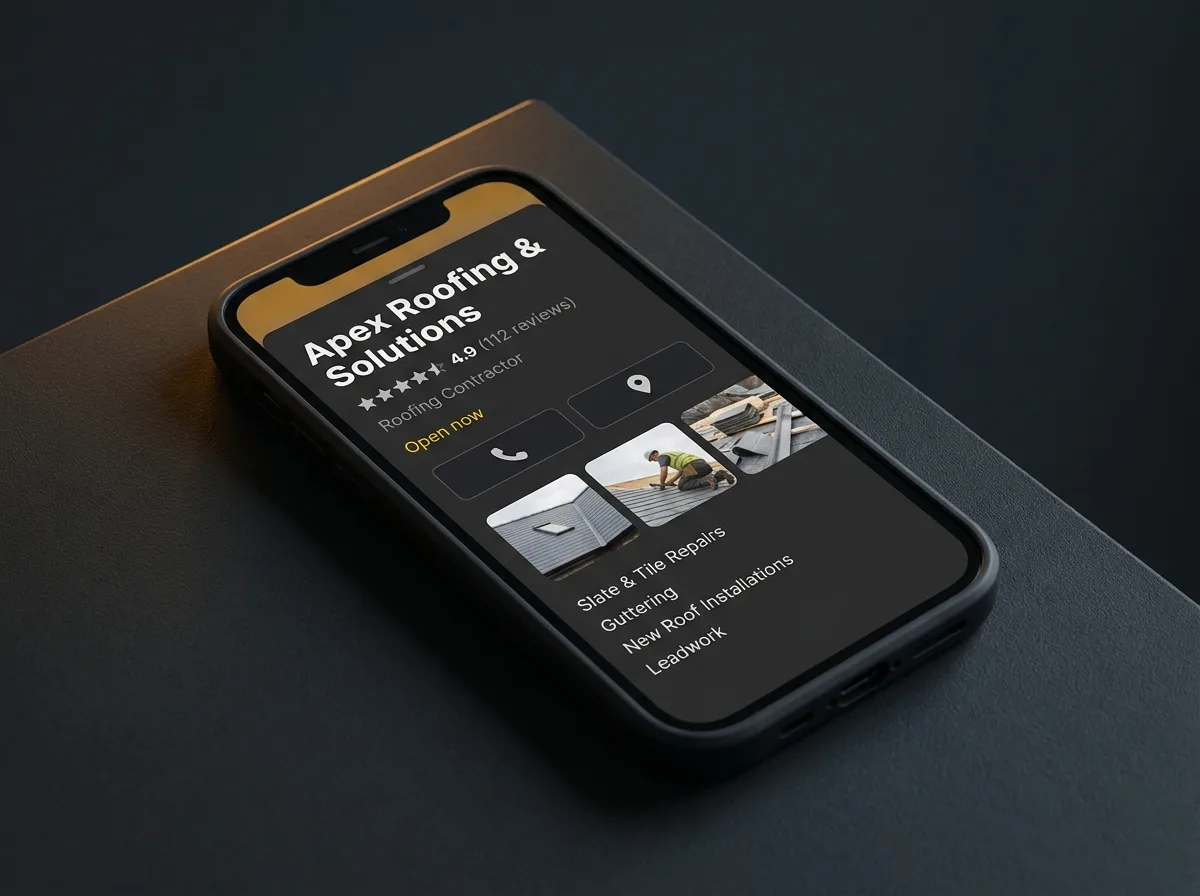
For businesses with a physical location or a defined service area, a Google Business Profile is the single most powerful entity anchor available. Google designed GBP as a structured, verified data source, and it treats a fully maintained, active profile as a high-confidence entity signal.
The word "fully" is doing real work in that sentence. A GBP with just a name, address, and phone number is a weak signal. A GBP with a complete primary category, accurate secondary categories, individual service descriptions with copy, up-to-date opening hours, regular photo uploads, weekly posts, pre-populated Q+A, and active responses to every review is a genuinely strong one.
Google uses the verified details from GBP as an anchor point when constructing an entity profile. Inconsistencies between your GBP and your website, or between your GBP and directory listings, weaken the signal rather than adding to it. Consistency across all three is what counts.
Service-area businesses, those who travel to clients rather than operating from a public-facing premises, can hide their physical address on GBP without blocking the panel. But it does mean other signals carry proportionally more weight, particularly schema and Wikidata. If you work from home and serve clients across a region, triggers 3 and 4 matter more, not less.
The maintenance point is easy to underestimate. GBP is a live channel, not a one-time setup. A profile that was completed eighteen months ago and has had no activity since is signalling something to Google's systems, and it is not confidence. Regular posts, updated service pages, and fresh photos are entity signals as much as they are marketing.
Trigger 3: Organisation schema with sameAs links

This is the trigger that most guides mention and fewest explain properly.
Organisation schema is structured data that you add to your website, typically in the <head> of your homepage, in a format called JSON-LD. It tells Google's structured data parser the core facts about your business: your legal name, your URL, your founding date, your address, your logo, and a unique identifier called @id that acts as a canonical label for your entity in the Knowledge Graph.
The part that actually moves the needle is the sameAs property. Think of it as a list of addresses where Google can go to double-check you are who you say you are. You include URLs pointing to your LinkedIn company page, your Companies House record, your Wikidata entry (once you have created one), your Yell listing, and any other authoritative profiles that refer to the same business.
Here is a simplified example:
{
  "@context": "https://schema.org",
  "@type": "Organization",
  "@id": "https://www.yourbusiness.co.uk/#organisation",
  "name": "Your Business Ltd",
  "url": "https://www.yourbusiness.co.uk",
  "foundingDate": "2015",
  "address": {
    "@type": "PostalAddress",
    "addressLocality": "Birmingham",
    "addressCountry": "GB"
  },
  "sameAs": [
    "https://www.linkedin.com/company/your-business",
    "https://find.company-information.service.gov.uk/company/12345678",
    "https://www.wikidata.org/wiki/Q12345678",
    "https://www.yell.com/biz/your-business-123456/"
  ]
}
Each URL in that sameAs array is a data point Google can visit to corroborate your identity. The more consistent those profiles are, and the more authoritative the domains they sit on, the stronger the cumulative signal. Enough consistent sameAs links push an entity above the confidence threshold where a panel becomes likely.
Why does this also matter for AI search? Because sameAs links are one of the primary mechanisms that tools like ChatGPT and Perplexity use when building entity graphs to power recommendations. A business with a coherent, well-linked entity profile is one that AI tools can confidently identify and cite. That is the connection between knowledge panels and AI search visibility: the same entity signals that earn a panel also improve how AI tools understand and recommend you.
For UK businesses, the priority sameAs inclusions are: LinkedIn, Companies House, Wikidata, Yell, Bing Places, and any relevant professional body member page. Implement the schema on your homepage and About page, and update it each time you establish a significant new authoritative profile.
Trigger 4: a Wikidata entry for your business
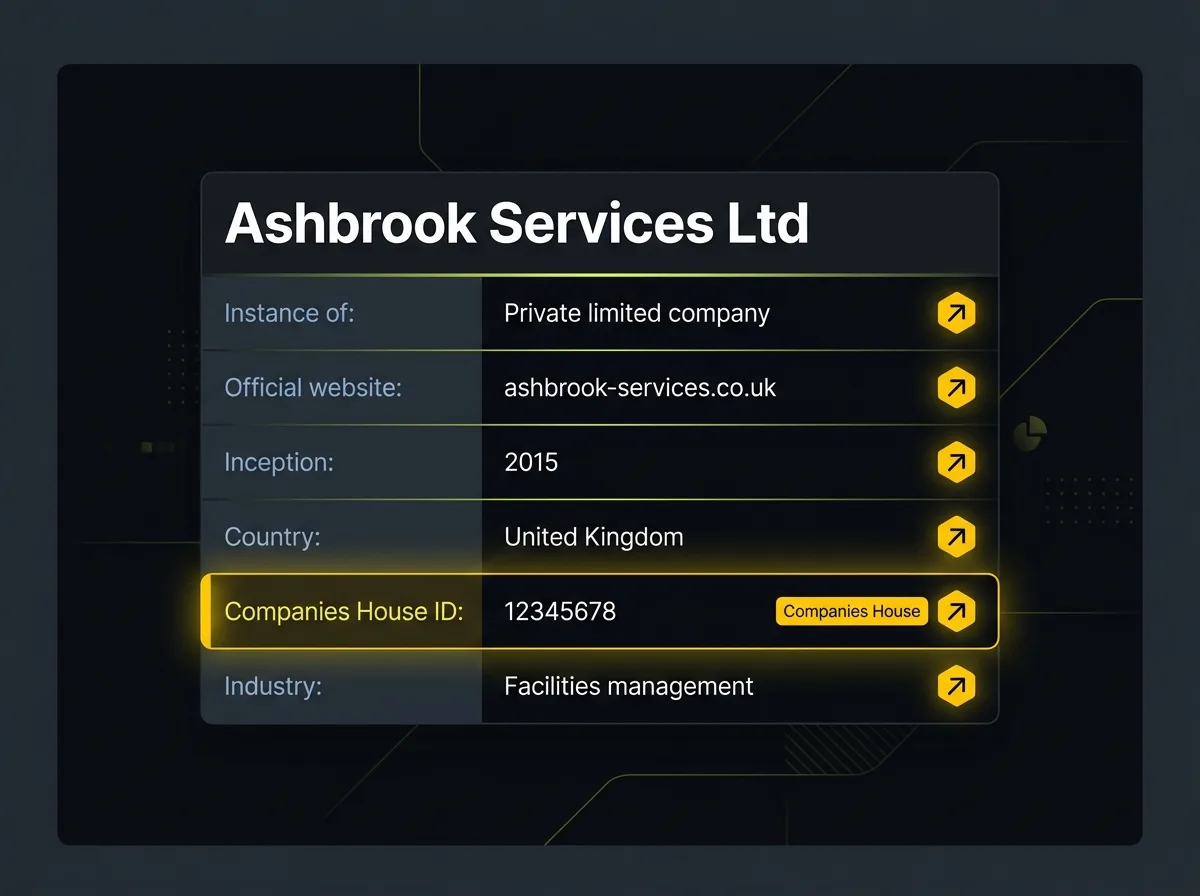
Most people have heard of Wikipedia. Fewer have heard of Wikidata, the structured knowledge base that Wikipedia is built on and that Google's Knowledge Graph actively reads and ingests.
This distinction matters enormously. Wikipedia requires notability: national press coverage, significant independent sourcing, the kind of profile most service businesses will never have. Wikidata has a much lower threshold. You need to be a verifiably real entity. That is it.
Creating a Wikidata entry for your business does not guarantee a Knowledge Panel, but it gives Google direct, machine-readable access to your structured entity data in one of the formats its Knowledge Graph is built to consume. That makes it one of the most direct signals available to a business that has not made the national press.
What to populate in your Wikidata entry:
-
Instance of. Mark your item as an "organisation" or, more specifically, "private company" or "limited company" as appropriate.
-
Official website. The canonical URL of your site.
-
Inception date. When the business was founded, with a verifiable source. Your Companies House registration date works perfectly.
-
Country. United Kingdom.
-
Industry. Use the relevant Wikidata property and point it to the appropriate industry entity.
-
Key people. Directors and founders, particularly if they have professional profiles that could reasonably link to their own Wikidata items.
-
Companies House company identifier. This is particularly valuable. It is a third-party identifier that Google can cross-reference with a source it already trusts as authoritative.
Every statement in Wikidata should have a reference source. Google weights referenced statements significantly more than bare assertions. Your Companies House record, your own website, and any published coverage are all valid references.
The practical process: create a free account at wikidata.org, create a new item for your business, and populate the statements methodically. It takes a focused afternoon. The impact on entity confidence, particularly in combination with sameAs schema, can be significant.
Trigger 5: corroborating mentions across independent editorial sources
The entity confidence model Google uses is proportional to the number of independent sources that agree on the same core facts about your business.
Here is where a common misconception causes problems. A press release that gets picked up by fifty syndication sites counts, in Google's model, as one originating claim. It does not matter how many sites carry it if every mention traces back to the same source. Genuine editorial coverage from independent sources, each of which has looked at your business separately and written about it, counts as separate data points.
Earned is better than placed. Obvious, but worth stating.
What does an editorial mention need to contain to help entity resolution? Your full registered business name, your location, and your area of work. A trade publication that uses a shortened version of your name or omits your location is a less useful signal than one that includes all three. Specificity matters.
UK sources that carry genuine weight include: local business press, relevant trade publications (a construction firm covered in a sector trade magazine, a healthcare practice mentioned in a specialist healthcare title), Companies House and CQC public records, and review platforms like Trustpilot where reviews appear under your full registered business name.
This territory connects directly to AI search. Editorial mentions are the foundation of AI citation. When ChatGPT or Perplexity draws on training data or real-time search to describe a business, it pulls from the same pool of independent editorial coverage that feeds Google's entity graph. The businesses that earn genuine coverage in credible sources are both more likely to get a Knowledge Panel and more likely to appear in AI-generated responses.
Claiming your panel once it appears
Once a panel appears for your business, you can claim it through Google's Knowledge Panel support documentation. The process involves verifying your identity as a representative of the entity, typically by connecting a Google account associated with your website.
Claiming enables you to suggest corrections, add or update social profiles, and flag factual inaccuracies for review. It does not give you editorial control. Google decides what appears in the panel based on its sources. You can suggest; Google decides.
Realistic timeline for a UK service business working across all five triggers simultaneously: three to six months is a reasonable expectation. Some panels appear faster; some take longer. Google's Knowledge Graph runs across multiple processing cycles, and there is no mechanism to accelerate indexing through any official channel.
Panel maintenance matters too. Panels can disappear if entity signals weaken: an inactive GBP, broken sameAs links, or a Wikidata entry that loses its source references can all reduce confidence below the display threshold. This is ongoing work, not a box to tick once.
An SEO agency that understands the entity layer will treat these signals as part of ongoing monitoring rather than a setup task completed at launch.
Frequently asked questions about Google Knowledge Panels
What triggers a Google Knowledge Panel?
A Knowledge Panel is triggered when Google reaches sufficient confidence about a business's identity. The signals that build this confidence include consistent NAP data across authoritative sources, a verified and active Google Business Profile, Organisation schema with sameAs links pointing to authoritative profiles, a Wikidata entry with verified statements, and independent editorial coverage. No single trigger is sufficient on its own; panels emerge from the combination of signals over time.
How long does it take to get a Google Knowledge Panel?
For a UK service business working across all five trigger areas, three to six months is a realistic expectation. Some appear sooner, some take longer. Google's Knowledge Graph processes data across multiple cycles, and the timeline depends on how quickly new signals are indexed and how much existing entity data is already in the graph. There is no way to speed this up through any official mechanism.
Do I need a Wikipedia page to get a Knowledge Panel?
No. Wikipedia has a notability threshold that most service businesses will never meet: it requires significant, independent, published coverage from multiple sources. Wikidata, the structured knowledge base that feeds Google's Knowledge Graph directly, has a much lower threshold. Verifiable existence is sufficient. A well-populated Wikidata entry is a more practical and achievable signal for the vast majority of businesses.
Can a small business get a Google Knowledge Panel?
Yes. The Knowledge Panel is a function of entity confidence, not business size or fame. A specialist with strong NAP consistency, an active GBP, Organisation schema with sameAs links, and a Wikidata entry is a more recognisable entity to Google than a large company with none of those signals in place. The panel threshold is about the quality and consistency of information, not the scale of the business.
What is the difference between a Google Knowledge Panel and a Google Business Profile?
A Google Business Profile is something you create and manage. It shows your address, phone number, hours, and reviews in local search results. A Knowledge Panel is automatically generated by Google's Knowledge Graph; you cannot create one directly. GBP data contributes to knowledge panels, but the panel itself is produced by a different system with different signals and a higher confidence threshold.
What your panel tells Google, and what it tells AI tools
Getting a Knowledge Panel is satisfying. But it is also visible proof of something more significant: that Google has built enough confidence in your business's identity to surface it directly in search results. That confidence does not stay inside Google.
The same entity signals that trigger a panel feed the data structures that ChatGPT, Perplexity, and Google's own AI Overviews draw on when deciding which businesses to name, recommend, or cite. A business with a coherent, well-linked entity profile is one that AI recommendation engines can identify with confidence. That matters beyond the panel.
Free resource: AI Visibility Audit
Find out how your business currently appears to AI tools, where the entity gaps are, and where to focus first. The audit identifies exactly which signals are missing and what addressing them would mean for your visibility across both traditional search and AI-generated results.