"Our organic traffic has been flat for 18 months. Paid keeps climbing. And every agency I've spoken to says they understand travel."
That conversation is happening in marketing departments across the UK right now. Hotel groups, tour operators, destination-led brands with real complexity and real budget. The people running search for these businesses can feel something is off but find it hard to put into words what a genuinely good travel SEO agency would actually do differently from the five on their shortlist.
The worry tends to be the same. Generalist agencies won't understand peak season demand. They won't know what hreflang looks like for a brand selling holidays across European and Australian markets. They almost certainly won't have a considered view on how ChatGPT and Claude are reshaping how people research and book trips. And yet the pitch decks all look the same.
This guide sets out what a good travel SEO agency should actually be doing in 2026, how travel search has changed, and what to ask before you commit to anything. It treats search visibility and traffic as a connected problem rather than a set of separate services. At the end there is a buyer's checklist you can take into any agency conversation.
What you are looking for, in short: an agency that speaks specifically about seasonal content planning, international SEO and hreflang, and what AI search visibility means for a travel brand. Those three things are what genuinely good travel search work looks like, whatever an agency calls itself.
What a travel SEO agency actually does

Start with how travel brands actually get bookings, because SEO is only one part of it. Most bookings come through a mix: the OTAs (Booking.com, Expedia, Tripadvisor), Google Travel and metasearch, direct traffic from organic and brand search, email and CRM to past guests, paid search and paid social, and for many brands a real contribution from social and influencers. The OTAs are the elephant in the room. They drive volume, and they take a commission on every booking. The reason organic search and AI visibility matter is that they are the lane that compounds, bringing bookings in at a lower cost over time and reducing how much of your margin the OTAs take.
So a travel SEO agency is a search agency that understands the structure of travel websites, the seasonal nature of demand, multi-market international SEO, and the discovery layer travel brands sit inside, which now spans Google Travel, the OTAs, and AI tools handling early-stage trip planning. What the work actually requires is specific, and it is worth knowing before you judge anyone’s pitch.
Seasonality. A travel business does not have a uniform content calendar. Demand for summer family holidays, winter sun, Christmas markets, and shoulder-season city trips all behaves differently. Publishing at a steady pace timed to Google’s crawl cycle misses the point: content needs to be live when customers are deciding. An August peak needs content live in May. A last-minute deals push needs organic visibility that does not appear overnight.
Internationality. UK travel brands frequently sell to multiple markets. Getting hreflang right across UK, EU, US, and Australian audiences is not a set-once task. It needs ongoing decisions about canonical structure, country targeting, and how one piece of content serves different languages and currencies without confusing search engines or readers.
Inventory complexity. A large tour operator or hotel group has thousands of pages: faceted search, destination indexes, itinerary builders, and dynamically generated package pages. A good SEO agency for travel thinks about architecture before it thinks about keywords.
The test worth applying to any agency is simple: can they explain your peak demand curve, your hreflang structure, and your inventory page architecture before they have even seen your analytics? If they can, the competence is real, whatever label sits on their service page.
How travel search has changed in 2026
A few years ago, "things to do in Santorini" was a reliable content opportunity. Write a thorough guide, earn some backlinks, rank, get traffic. Clear enough.
That opportunity still exists, but it is smaller and the competition for it has changed shape. Google's AI Overviews now answer a growing share of top-of-funnel travel queries directly. The click goes to an AI-generated summary rather than a ranked page. The same pattern is appearing across queries like "best hotels in Marrakech" or "family holidays in Croatia in October". What was once a content play is increasingly an entity play, where being known as an authoritative voice on a destination or category matters more than having the most comprehensive article.
The very top of the travel research funnel has also shifted. People plan holidays in chat interfaces now. They ask ChatGPT or Claude for itinerary suggestions, compare destinations, shortlist properties, and arrive at a rough plan before they open Google. By the time they search, they often know their destination and are verifying rather than discovering.
This matters for travel brands in two connected ways. First, ranking alone is no longer enough. If your brand is not being cited by AI tools when someone asks for recommendations in your category, you are invisible to a growing share of the market. Second, AI traffic converts at higher rates than traditional search, which means AI visibility is a revenue question, not an optional extra.
A travel SEO agency that is not discussing AI search visibility in 2026 is not paying attention. The brands appearing in ChatGPT and Claude when someone asks "best small-group tour operators in Portugal" or "boutique hotels in the Scottish Highlands" are not there by accident. They have structured content, strong entity signals, and real AI search agency thinking behind them.
Google Search Central has published guidance on how AI Overviews are being rolled out across different query types. Travel is one of the verticals seeing the fastest change. Understanding that context is table stakes for any agency you are seriously considering.
Free resource: AI Visibility Audit
Find out where your brand currently appears, or does not appear, when AI tools answer travel queries in your category. It takes minutes to request and gives you a clear baseline before any agency conversation.
Seasonal content planning, not annual content plans
Travel brands have something most industries don't: a visible, predictable demand curve.
ABTA's annual Holiday Habits research tracks UK consumer booking behaviour each year, and the patterns are remarkably consistent. Summer holidays get booked in January and February. Winter sun demand peaks in October and November. Last-minute family trips spike in late July. A content strategy built around this curve looks completely different from one built around a fixed publishing cadence.
The objective is to have the right content indexed, earning authority, and ranking before the search intent arrives. Not after. Short-haul winter sun content needs to be live by September to rank before the October booking surge. Spring city break guides should be live in January. Christmas market content needs refreshing by August. An agency that delivers your content plan in a quarterly document without referencing these windows is not doing travel SEO. They are doing content marketing for an industry they haven't quite figured out.
The reporting implication is just as important, and it is one most agencies handle badly. Publish a summer family holiday guide in March and check its session count in March: it looks like it isn't working. Check its session count in May and June, then attribute those sessions to bookings in the same window, and you see the real story. Content that converts in the right window is the metric. Not monthly session counts on a guide that hasn't reached its season yet.
Generic "four blog posts a month" plans don't account for any of this. They treat travel content like a product listing. That is the wrong model.
International SEO without the spreadsheet horror
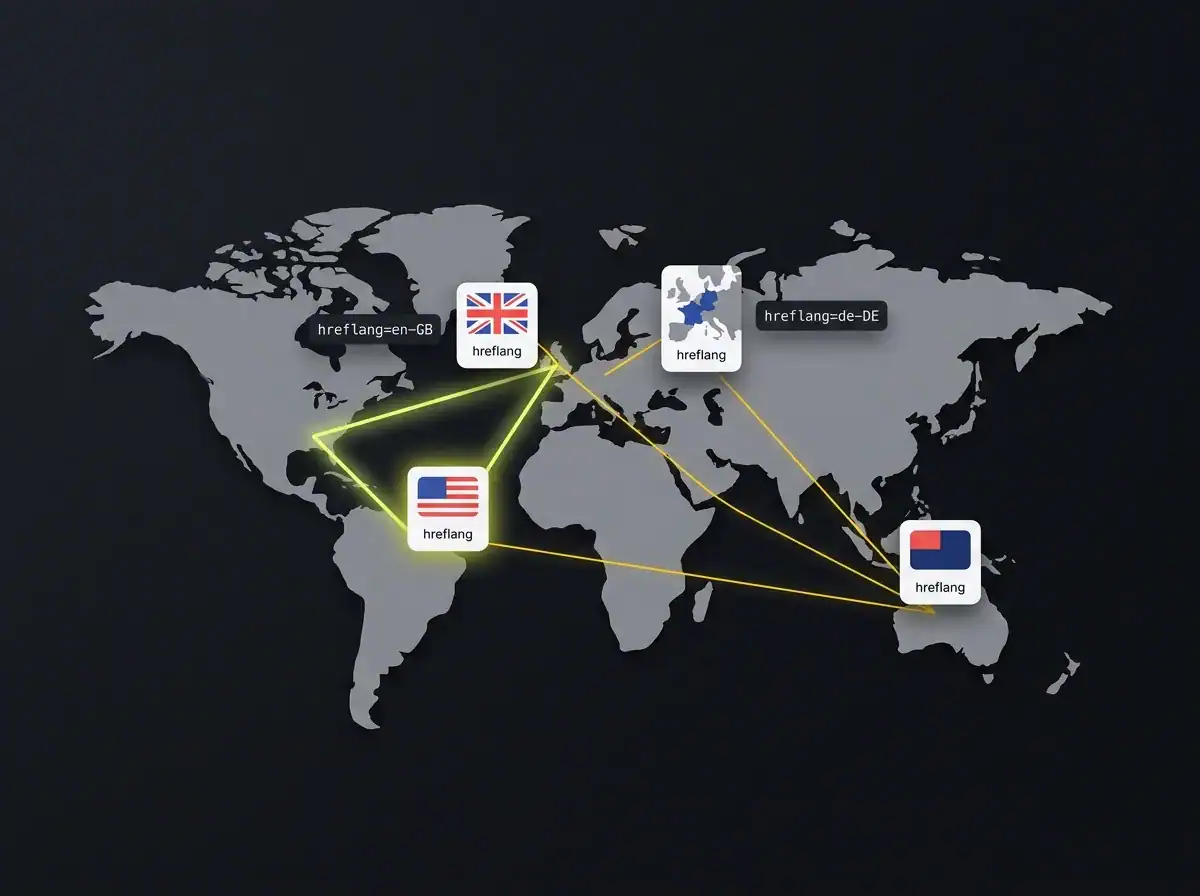
For travel brands operating across more than one market, international SEO is where things get complicated fast.
Hreflang is the mechanism Google uses to understand which version of a page is intended for which audience. A UK tour operator selling the same itinerary to British, German, and Australian visitors needs three versions of that page, correctly tagged and cross-referenced in the hreflang attributes, served on the right subdirectory or domain structure. Done correctly, each market sees the right language, currency, and trust signals. Done incorrectly, you cannibalise rankings across markets or train Google to deprioritise some of your pages entirely. Neither is a small problem.
The Brexit-era question of whether to keep .co.uk as the primary domain or move toward a .com for broader international reach is still live for many UK travel brands with European audiences. A subdirectory structure, where German visitors are served at yourbrand.co.uk/de/, consolidates link authority in one place. A ccTLD (yourbrand.de) signals stronger local relevance but requires building separate domain authority from scratch. Neither approach is universally correct. The decision depends on your scale, your operational capacity, and how much marketing resource you can put behind multiple domain properties over time.
Multi-currency display is a related trap. Showing prices in local currency without creating separate canonical URLs is a common mistake. Dynamic price display on a single URL is correct. Creating separate pages for GBP and EUR versions of the same package creates a duplication problem that takes months to untangle once it is established.
Geo-routing, where visitors are automatically redirected to a localised version of the site, is useful when implemented correctly and harmful when done with server-side redirects that confuse Googlebot. The agency you hire should be able to walk through the difference without consulting anyone.
Ask specifically about previous hreflang implementations. Not in general terms. Ask them to describe a real project, what the starting structure was, and what changed.
Technical SEO traps in travel sites
Travel sites have a category of technical problem that generalist agencies either overlook or discover too late.
Faceted search. A hotel or package search with filters for destination, check-in date, number of guests, price range, and star rating generates thousands of URL variants. Without proper parameter handling, every variant can be indexed, creating a crawl budget drain and near-duplicate content at scale. A travel SEO agency knows how to manage this with canonical tags, robots.txt directives, and parameter configuration in Google Search Console. A generalist often doesn't spot the problem until the crawl report is already a mess.
Destination indexes. A large OTA or tour operator may have hundreds of destination landing pages, each pulling content dynamically from a database. Pagination, lazy-loading, and JavaScript rendering are all potential crawl barriers. Content that can't be indexed can't rank. This is not a 2018 edge case. It still trips up travel sites regularly.
Dynamic itinerary pages. Where an itinerary is assembled from user selections rather than served as a static URL, search engines often can't reach it at all. Whether to create static equivalents, serve pre-rendered versions, or rely on Google's JavaScript rendering is a genuine technical decision with real consequences. It should not be a conversation you are having for the first time in month three of an engagement.
Core Web Vitals and image-heavy galleries. Travel sites depend on photography. Full-bleed hero images, destination galleries, property photo carousels. These are exactly the conditions that produce poor Largest Contentful Paint scores on mobile. An agency working in travel needs a concrete approach to image format, compression, and lazy loading, not a generic "improve your page speed" recommendation.
A good travel SEO agency knows these problems exist before they have audited your specific site. That prior knowledge is what you are paying for.
How a travel SEO agency proves it is working
Ranking reports are the wrong metric for travel SEO. Rankings move with algorithm updates, fluctuate seasonally, and mean nothing without context about what they are actually producing.
The measures that tell the real story are different.
Visibility by category and territory. Not a single domain-level score, but segmented visibility across your destination categories and target markets. Are you gaining share on "family holidays France" while losing ground on "luxury holidays Greece"? Those are different problems with different causes. An agency that reports only at the domain level is not giving you the granularity that travel requires.
Booking-attributed sessions. Organic traffic that can't be traced back to actual bookings or enquiries is a vanity number. A serious travel SEO agency helps you connect organic sessions to goal completions in Google Analytics 4, with an attribution approach that reflects the long consideration cycles in travel. Someone who reads a destination guide in January and books a holiday in March still counts. Most agencies don't set this up properly. Ask to see it.
AI citation tracking. Which brands are being named when ChatGPT and Claude answer category queries in your vertical? Are you in the set? This kind of monitoring is developing quickly, and agencies working at the frontier are already doing it. Ask whether they are.
For hotel groups and multi-location operators, local search visibility across individual properties matters as much as the head office domain. A chain with twelve hotels needs each property's Google Business Profile performing well, not just the brand homepage ranking.
Three months in, you should be able to see measurable movement in at least one of these areas. Not keyword rankings on broad destination terms. Real indicators tied to your business.
The buyer's checklist: questions to ask before you sign

These questions separate agencies that understand travel from agencies that say they do. Use them before you sign, not after.
-
How will you handle seasonal demand in our content plan? You want specific reference to booking windows, search volume curves by season, and content lead times. A generic content calendar answer is a signal they haven't thought it through.
-
What's your approach to hreflang and international targeting? Listen for whether they distinguish between subdirectory, subdomain, and ccTLD structures and can explain the trade-offs. If they can't, they haven't done it at scale.
-
How will you make us visible in AI tools like ChatGPT and Claude? Acceptable answers include entity building, structured content, and citation monitoring. "We don't really focus on that yet" is honest but probably disqualifying for a travel brand in 2026.
-
What does your reporting tell us about bookings? Push past "we send a monthly rankings report." Ask how they connect organic sessions to revenue and what attribution model they use for long consideration cycles.
-
Which travel brands have you worked with and what changed? Specifics only. Numbers, timelines, what the starting problem was. Vague case studies are decorative, not evidential.
-
How do you handle faceted search and inventory pages? This should trigger a reply about parameter handling and canonical strategy. A blank look here tells you something useful.
-
What technical audit will you do in the first 90 days? Look for: crawl budget analysis, Core Web Vitals baseline, hreflang audit, indexation review, parameter configuration review. "A full SEO audit" without detail is not an answer.
-
How do you measure AI citation visibility? Any thoughtful answer passes. "Our approach is still developing" is fine. Complete ignorance is not.
-
What's your stance on link building for travel sites in 2026? Good travel SEO relies on editorial links from travel publications, destination guides, and tourism bodies, not volume outreach. You want to hear they know the difference.
-
How will we know in three months whether this is working? The answer should name specific metrics tied to your business, not keyword positions on broad terms.
If an agency breezes past questions one, two, and three with generic answers, that is your answer.
Choosing Creative Tweed
Creative Tweed works at the intersection of traditional search, AI search visibility, and conversion. These are not treated as separate disciplines here. If organic traffic is flat, the answer is rarely "just do more SEO." It is usually a combination of where you are visible, how your brand is performing in AI tools, and whether the pages people land on are actually convincing them to enquire.
Travel is a sector where the stakes of getting this wrong are high. A flat organic curve while paid spend climbs is a clear signal. So is a brand that ranks reasonably well in Google but does not appear when someone asks an AI tool for recommendations in the same category.
If you want to understand where you currently stand before starting any agency conversation, the AI Visibility Audit is the right first step. It shows how your brand currently appears when AI tools answer queries in your category. Free to request, takes a few minutes, and gives you something concrete to bring to any agency discussion.
If the result shows a gap, that is a conversation worth having. Our SEO agency services cover both traditional search and AI visibility, and we approach them as the same connected problem.