
Three proposals on the desk. All three promised first-page rankings. All three used the word "bespoke" at least twice. And not one of them mentioned a single thing that was specific to running a clinic.
If you have ever shortlisted SEO companies for a healthcare practice, you know this feeling. The decks look the same. The packages look the same. The case studies are screenshots of traffic graphs going up and to the right, usually for a client in a sector that has nothing to do with yours. You are being asked to commit twelve months and a serious monthly budget, and the main thing distinguishing the options is the colour of the slides.
The label "healthcare SEO company" does almost no work here. Anyone can add a healthcare page to their site, swap "customers" for "patients", and drop in a stock photo of a waiting room. What you actually need to judge is harder to see from a pitch: whether the people doing the SEO understand how search works for a regulated clinical business, or whether they will run the same playbook they would run for a plumber.
This guide is about that judgement. Not agency selection in general. If you want the broader version, covering paid, social, PR, and brand as well as search, the guide on choosing a healthcare marketing agency covers the full channel mix. This piece stays narrow. It is about how to tell a real healthcare SEO company from a competent generalist who has never had to think about the ASA, what the work actually involves, what it costs, and how long it takes.
Why every SEO pitch sounds the same
Here is the uncomfortable part. Most of the SEO companies bidding for your work are genuinely capable. They can do keyword research, fix technical issues, build links, and write content. The mechanics of SEO do not change much between sectors. That is precisely why the pitches blur together.
The difference is not whether they can do SEO. It is whether they do it with the constraints and buyer behaviour of UK private healthcare built in from the start, or bolted on after something goes wrong.
A generalist builds a campaign from generic best practice and overlays it on your clinic. A sector-aware company builds from the clinic outwards. For most businesses that distinction is marginal. For a regulated practice where the wrong ad claim can trigger a ruling and the wrong content strategy fills your diary with price-shoppers, it is the whole game.
So the question to carry into every meeting is not "are you good at SEO". Assume they are. The question is "do you understand what makes SEO for a clinic different from SEO for a shop". The rest of this guide is how to test that.
What healthcare SEO actually involves
Before you can judge a company's competence, it helps to know what good healthcare SEO is actually made of. It is four connected workstreams, not one. When a company is strong in one and vague about the rest, that tells you where their real experience sits.
The first is technical SEO. The plumbing. Site speed, crawlability, structured data, a clean site architecture that search engines and AI tools can read. For a multi-location clinic group this gets genuinely involved, because each location needs its own properly structured, indexable presence rather than a thin page that competes with its siblings. Healthcare schema markup, marking up a practice, its practitioners, and its services in a way machines understand, is one of the more useful and most often skipped pieces of technical work.
The second is content, and this is where healthcare diverges hardest from everything else. Patients research in depth before they contact anyone. They read condition pages, consultant profiles, and treatment explanations, and they can tell within seconds whether the person who wrote it understands the subject. Content that is broadly accurate but thin gets ignored by patients and search engines alike. A healthcare SEO company that treats content as a volume exercise, churning out 800-word posts on a schedule, is solving the wrong problem.
The third is local search. For any practice serving a geographic area, this is often where the fastest returns are. Google Business Profile, the map pack, location-specific pages, and review signals. A clinic competing for "private dermatologist Leeds" needs a fundamentally different local setup than a Harley Street practice drawing national patients. Getting local SEO for clinics and practices right tends to produce measurable enquiries well before national keyword competition is worth chasing.
The fourth is AI search, and it is no longer optional. More on that below, because it is where the largest gap between companies currently sits.
A company that can talk fluently about all four, and explain how they connect for your specific practice, has done this before. One that lights up on link building and goes quiet on local and AI search is telling you something.
How compliance shows up in the actual SEO work
Most guides treat healthcare compliance as a legal footnote. In SEO it is not a footnote. It shapes what gets written, what gets published, and what gets ranked.
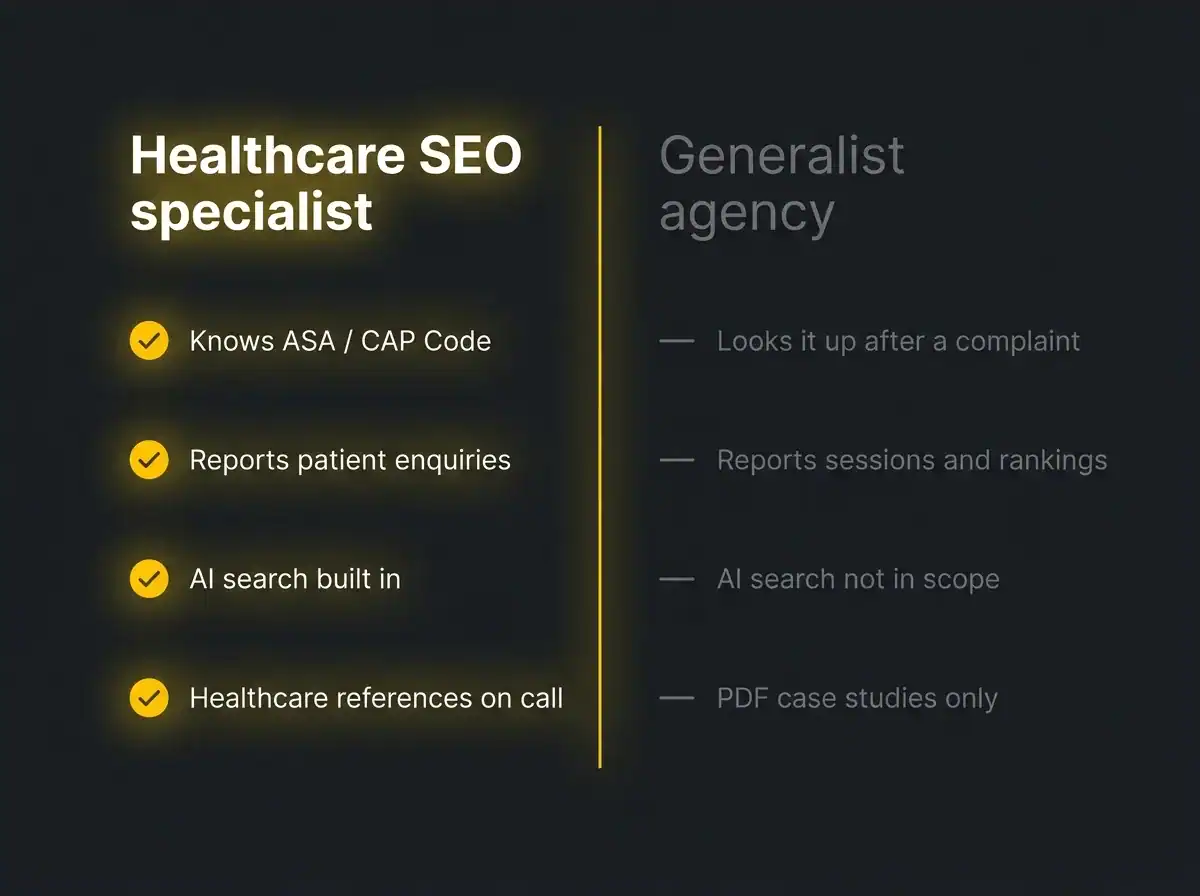
Take content. A generalist sees "recovery time from rhinoplasty" has search volume and commissions a post. A sector-aware company knows that before-and-after references and certain outcome claims are restricted under ASA's CAP Code on medicines and treatments, and structures the content so it ranks without putting the practice at risk. The page still gets written. It just gets written by someone who knows where the lines are.
Take on-page work for a regulated clinic. If the practice is registered with the Care Quality Commission, that affects how certain services can be described in the page copy, the meta descriptions, and the structured data. The SEO and the compliance are the same task, not two tasks. A company that separates them, writing copy for rankings and then asking you to "check it with your compliance people", has the relationship backwards.
This is the practical test. Ask how they would approach a content programme for a treatment that carries advertising restrictions. A real healthcare SEO company answers with specifics about what can and cannot be claimed and how they would frame the page anyway. A generalist tells you that is your responsibility to check. Both answers are informative.
The questions that separate real from repackaged
Skip the generic agency questions. References, contracts, and who-does-the-work matter, but they apply to hiring anyone. These are the SEO-specific ones that surface whether the healthcare experience is real.
How would you handle healthcare schema and structured data for our practice and practitioners? A specialist describes marking up the practice, its people, and its services. A generalist talks about schema in the abstract.
What does your local search approach look like for a single site versus several locations? The answer should change meaningfully between the two. If it does not, they have not run a multi-location clinic.
How do you decide what content to write for a practice with treatments that carry advertising restrictions? Listen for whether compliance shapes the plan or gets checked at the end.
What is your written approach to AI search visibility, and how do you measure it? Ask for the methodology in writing. This is the fastest way to separate the field in 2026.
How will you report on qualified patient enquiries rather than traffic and rankings? Healthcare SEO generates a great deal of informational traffic that never books a consultation. A company that reports sessions and average position, with no conversion layer, will show you charts that feel productive while the diary stays empty.
If a company moves quickly through these towards pricing, slow the conversation down. The answers are the contract you are actually signing.
Before you commit to any retainer, it is worth knowing what your site could realistically achieve, so the proposals have something to be measured against.
Free resource: Traffic Projection Report
A data-led view of the organic traffic and enquiry uplift your practice could realistically reach, based on your actual site and your market, with no sales conversation attached. It is the answer to the question most practice owners are really asking before they sign anything: is this worth it, and what should I expect.
AI search, and why healthcare companies cannot ignore it

Patient discovery is moving towards conversational AI faster than most clinics have noticed. Someone researching a knee consultant in Birmingham is now as likely to ask ChatGPT "what should I look for in a private orthopaedic surgeon" as to scroll through several pages of Google. Someone comparing cosmetic clinics may ask Claude to summarise the differences before visiting a single website.
This matters more in healthcare than almost anywhere else, because AI search traffic converts at five times the rate of traditional search. A patient who arrives through an AI recommendation has already done the research and the comparison. They land having largely decided. That profile matches private healthcare buyer behaviour almost exactly.
The content that gets cited in AI answers is specific, clearly structured, demonstrably expert, and grounded in UK context. A clinic publishing genuine clinical expertise with clear authorship is positioned to be cited. A clinic with a service page and a contact form is not. For Creative Tweed clients, AI search visibility is built into the SEO programme from the start, not added as an extra line item.
So ask any company you shortlist where your practice currently appears when AI tools answer questions in your specialty, and whether their methodology for improving that is in the retainer or charged separately. A blank look is an answer. For the underlying mechanics of all of this, the guide on what actually works for UK medical practices covers the SEO specifics in full.
What healthcare SEO costs in the UK in 2026
Price ambiguity is one of the main reasons shortlisting drags on for months. Here is a straight answer.
For a single-location practice with a focused site and a moderate keyword target, a credible programme typically runs between GBP 800 and GBP 1,500 per month. That covers technical upkeep, content at a sustainable cadence, and local search management. For many single-site clinics, starting with local search is the most effective entry point, because it produces measurable enquiries before broader national competition is worth pursuing.
A multi-location clinic group, or a practice with a wider specialty offering in a competitive area, typically sits between GBP 2,500 and GBP 6,000 per month. The range reflects content volume, the number of locations needing Google Business Profile management, the competitiveness of the terms, and whether AI search work is included.
The price band matters for one practical reason. At the lower end of any range, what you are buying is primarily time. GBP 800 a month is roughly six hours of work a week. Enough for a solo practitioner targeting local search in a quieter area. Not enough for a group competing for high-volume national terms. If you are quoted at the lower end for a large scope, ask exactly what is included, what is not, and what happens if results fall short. Healthcare SEO done properly is not cheap, because the specialism is real. Pricing that looks unusually low usually means a junior account, an expanding scope after signing, or a volume model that does not fit clinical work.
How long it actually takes
Three to six months before anything meaningful shows in the data. That is the honest answer for most practices, and any company promising page-one rankings in four to six weeks is offering something that does not exist or will not last.
Technical fixes, new content, and local signals take time to be crawled, indexed, and reweighted. Between six and twelve months, traffic movement starts translating into qualified patient enquiries at scale, as content published early accumulates authority and the links placed in that period compound. This is the point where the programme starts to feel operational rather than experimental.
AI search visibility can move faster. On long-tail recommendation queries, a practice can begin appearing in AI answers within a few months if the content is structured to support it. That is one more reason to get AI search into scope from day one rather than treating it as a later phase.
What the first ninety days should look like
A good healthcare SEO engagement is diagnostic-first, not launch-first. If a company hands you a content calendar in week one without having understood your starting point, they are running a template.
Month one is audit and foundations. A technical crawl, a review of how the site is currently indexed, a proper Google Business Profile assessment for each location, and a baseline of where you currently appear in both Google and AI tools. This is also where the measurement gets built, so that enquiries can be attributed properly rather than reconstructed later.
Month two is the structural work. Fixing the technical issues the audit surfaced, sorting site architecture and schema, and beginning the content that targets the highest-intent, lowest-risk queries first. Local signals get strengthened in parallel, because that is usually where the first measurable enquiries arrive.
Month three is where it starts to compound. Content published in month two begins to gain traction, local visibility improves, and the early data tells you which queries are converting to enquiries rather than just traffic. A good company uses that signal to reprioritise, rather than pressing on with the original plan regardless.
If a company cannot describe their first ninety days in roughly these terms, with a diagnostic at the front and a measurement layer built early, you are looking at a generalist with a healthcare page.
Where Creative Tweed sits
Creative Tweed is an SEO agency with direct experience in UK private healthcare. The work covers traditional search and AI search together, which means the programme addresses how your practice ranks in Google and how it appears when a patient asks ChatGPT or Claude for a recommendation.
We do not describe ourselves as exclusively a healthcare company. What we bring to healthcare clients is a team that understands CQC registration, GMC obligations, and ASA and CAP compliance for treatment claims before a programme is designed, not as a content-review afterthought. If your last SEO company sent you traffic reports with no enquiry data attached and never once mentioned the ASA, the difference a sector-aware approach makes is structural, not incremental.
The most useful first step, if you are still comparing options, is to see where your practice currently stands in AI search before your next agency conversation.
Free resource: AI Visibility Audit
A free assessment of where your practice appears, and does not appear, when patients ask ChatGPT, Claude, and Perplexity for a recommendation in your specialty. Most clinics have never checked. The results are usually a useful starting point for any briefing conversation. If you would prefer the broader view first, the search visibility and traffic page covers the full picture.
Frequently asked questions
How much does a healthcare SEO company cost in the UK?
For a single-location practice, a credible programme typically runs between GBP 800 and GBP 1,500 per month. Multi-location groups or practices targeting competitive national terms generally sit between GBP 2,500 and GBP 6,000 per month. The range reflects scope, competition, the number of locations, and whether AI search visibility is included in the retainer.
How long does healthcare SEO take to work?
Three to six months for the first sustained movement in rankings and relevant traffic. Six to twelve months for that traffic to translate into qualified patient enquiries at scale. AI search visibility on long-tail recommendation queries can improve faster if the content is structured from the outset to support it.
What is the difference between a healthcare SEO company and a healthcare marketing agency?
A healthcare marketing agency covers a wider channel mix: paid search, social, PR, patient communications, and brand. A healthcare SEO company focuses on organic search visibility and the technical, content, and authority work behind it. Some cover both. If you need the full mix, the guide on choosing a healthcare marketing agency is the better starting point. If your priority is search specifically, a focused SEO company is usually the stronger and more cost-effective choice.
How do I know if an SEO company actually understands healthcare?
Ask SEO-specific questions rather than generic ones. How they handle healthcare schema, how their local approach changes between single and multi-location practices, how compliance shapes their content plan, and what their written methodology for AI search is. A sector-aware company answers fluently. A generalist talks in abstractions or defers the compliance questions back to you.
Should a healthcare SEO company also handle AI search visibility?
Yes. By 2026, AI search is a meaningful and growing share of how patients discover providers, and it converts at a notably higher rate than traditional organic search. Any programme that ignores how your practice surfaces in ChatGPT, Claude, and Perplexity is missing part of the journey. Ask whether that work is included in the retainer or charged separately.