
Two years of blog posts. Not a single attributable consultation.
That was the situation when a private clinic marketing manager described their content programme to us. They had published consistently, covered the right topics, and followed the usual advice about keywords and word counts. Enquiries had barely moved. The content existed. Patients were not finding it. And the ones who did find it were not converting.
The problem was not the content itself. It was the approach. They were treating publishing as a presence signal rather than a search asset, ticking a box rather than building a resource patients were genuinely searching for.
That distinction is the whole game in healthcare content marketing. This guide covers what it actually means for a UK private clinic in 2026: the content types that earn genuine search authority, what UK regulation permits and prohibits, how AI search is changing the way patients discover clinics, and what a realistic publishing programme looks like when time and consultant availability are limited.
What healthcare content marketing actually is
Healthcare content marketing is the practice of publishing patient-useful content, including educational articles, condition explainers, treatment guides, and video, that builds search authority and earns patient enquiries inside a regulated category.
That definition matters because it separates content marketing from content activity. Posting on Instagram three times a week is content activity. Writing a thorough guide to self-pay cataract surgery costs in the UK, earning a search ranking for "private cataract surgery price", and receiving consistent enquiries from that page over the next 18 months is content marketing. One is presence. The other is a search asset.
The discipline is older than digital. Medical practices have always produced patient education materials. What changed is the distribution mechanism. Search engines and AI tools now determine whether that content reaches the patient who needs it, or whether it sits unseen inside a CMS.
Google holds health content to a higher standard than almost any other category. YMYL, which stands for "Your Money or Your Life", is the classification Google applies to content with meaningful implications for a reader's health, finances, or safety. Health content sits squarely inside it. That means Google evaluates healthcare publishers far more rigorously than it evaluates a recipe blog or a fashion retailer. Who wrote this? What are their credentials? Has it been reviewed? When was it last updated?
The distinction between social media activity and content marketing as a discipline becomes critical here. Social posts have a lifespan measured in hours. A well-structured article answering "what does private hip replacement recovery look like week by week" can earn organic search traffic for years.
Why generic content marketing advice fails for clinics
Most content marketing advice assumes you can publish whatever you want. Private clinics cannot.
The ASA CAP Code Section 12 covers advertising of medical and health services. It prohibits claims that are likely to mislead patients about treatment outcomes, effectiveness, or the qualifications of practitioners. A skincare clinic publishing a blog post that promises "guaranteed results" from a laser treatment is not making an error of judgement. It is breaking the code.
The MHRA draws a separate line around medical device claims. If a clinic performs a procedure using a regulated device and the content implies the device treats or cures a specific condition, that claim requires either the clinical evidence to support it or careful rewording to describe what the treatment involves rather than what it promises.
Before-and-after photography is where aesthetics clinics most often come unstuck. The ASA has published specific guidance on before-and-after content in the aesthetics sector. Showing transformative results without clearly communicating realistic expectations, the role of individual variation, and the limits of what a treatment can achieve creates real regulatory risk. Most clinic owners know this in principle, and still occasionally publish content that crosses the line.
None of this means effective content is impossible. It means the content has to be structured differently. The practical answer is writing that describes what happens during and after a treatment, what realistic recovery looks like, what factors influence outcomes, and what the patient should ask the consultant. That approach satisfies patients, satisfies regulators, and ranks better because it answers real questions rather than making claims the regulator will eventually challenge.
The CQC duty of candour for patient information reinforces this further. Transparent, honest communication about procedures and outcomes is not just good marketing practice; it is a regulatory expectation for registered providers.
The content types that build authority for UK clinics in 2026

Not all content earns authority at the same rate. Some types compound over years. Others generate short-term traffic with no lasting return. Here is what actually works for UK private clinics.
Condition explainers. Patients search for their symptoms before they search for treatments. A private rheumatology clinic that ranks for "what does joint hypermobility syndrome actually feel like" is already in front of its audience before they have decided whether to book. Writing the patient's question better than NHS pages do requires specificity: named symptoms, honest descriptions of the diagnostic process, and a clear account of what a private consultation pathway looks like.
Treatment guides. These are the pages that earn consultation bookings. A thorough guide to private knee replacement that covers the procedure itself, anaesthesia options, realistic recovery at two, six, and twelve weeks, and what to ask during the pre-operative assessment gives a prospective patient everything they need to make a decision. The clinics that rank consistently with these pages have named consultant expertise and visible medical review dates attached to every piece.
Recovery and aftercare content. This is the most consistently under-published category in private healthcare, and it converts at a surprisingly high rate. The patient searching "what to expect after a tonsillectomy in adults" is not browsing. They are preparing to book, or have already booked. Recovery and aftercare pages also earn backlinks from patient forums, health journalists, and NHS leaflets because they are genuinely useful. Hard to beat for compounding return.
Self-pay cost and finance guides. UK private healthcare has a transparency problem on costs. The self-pay market is growing steadily, and patients are actively searching for price information that most private providers have been reluctant to publish. A straightforward guide to what a private MRI costs, what determines the price, and whether self-pay versus private medical insurance makes sense for a given procedure is not giving away competitive advantage. It is capturing the search traffic of a patient who is ready to book, and who will otherwise go to a competitor who does publish it.
Consultant-authored opinion pieces. These are the E-E-A-T compounders. A piece written by a named consultant about a specific aspect of their specialty, with their credentials in the byline, a declared review date, and referenced sources, builds the kind of author authority Google uses to evaluate YMYL content. Ten of these from named consultants will outperform fifty anonymous blog posts. The investment of consultant time is real, but so is the return.
Comparison and decision content. "Private versus NHS waiting list for knee replacement." "LASIK versus SMILE eye surgery: what is the difference." "Private GP versus NHS GP appointment: what you actually get." These pieces rank because they match the internal conversation the patient is already having. They require neutral, honest framing. A comparison piece written as a sales pitch fails immediately, and patients who have done their research know the difference.
Video. Useful in specific situations, overrated as a primary channel for most clinic types. Short explainer videos on procedures, embedded on the relevant treatment page and uploaded to YouTube, add genuine value for patients with high anxiety around a specific procedure. A standalone video strategy without supporting search content is expensive for the return it typically delivers to a single-site clinic.
For a deeper view on how this content connects to organic search rankings, healthcare SEO that actually works for UK practices covers the technical and structural side in detail.
How content earns search authority in a YMYL category
Publishing health content is not the same as earning authority from it. That distinction matters because clinics that produce high volumes of content without the right signals often see little or no search movement, then conclude that content marketing does not work for them.
E-E-A-T stands for Experience, Expertise, Authoritativeness, and Trustworthiness. In YMYL categories, it is not optional. Named authors with real credentials in the byline are a basic requirement for health content that expects to rank. A blog post signed "The Clinic Team" will consistently underperform a post written by a named consultant with a link to their professional profile and GMC registration number included.
Medical review dates matter more than most clinics realise. Adding "Last reviewed by [Name], [Specialty], [Date]" to a content page is not a box-ticking exercise. It tells Google that someone responsible for patient safety has checked the information and that the content will be maintained. Clinics that add review dates to existing content routinely see ranking improvements without any other changes to the page.
The internal linking structure inside a clinic site is where most practices leave authority on the table. A treatment page and a condition explainer covering the same patient journey should link to each other. Consultant bio pages should link to the articles that consultant has authored. The recovery guide should link to the pre-operative guide. Each internal link passes authority through the cluster, and a well-linked cluster is measurably harder for a competitor to displace.
External credibility signals matter too. Coverage in health trade press, citations from patient information aggregators, mentions from NHS pages, and links from professional bodies all signal to search engines that the clinic is a trusted entity in its specialty. If you are considering specialist SEO support to build that foundation properly, the time to do it is before publishing more content, not after it has accumulated.
One thing that actively hurts authority right now: publishing AI-generated content at volume without editorial oversight. Clinics that outsourced 200 thin articles in 2024 are dealing with the ranking consequences in 2026. Thin, undifferentiated, unreviewed health content is precisely what Google's quality systems are designed to penalise.
AI search and how patients now find clinics
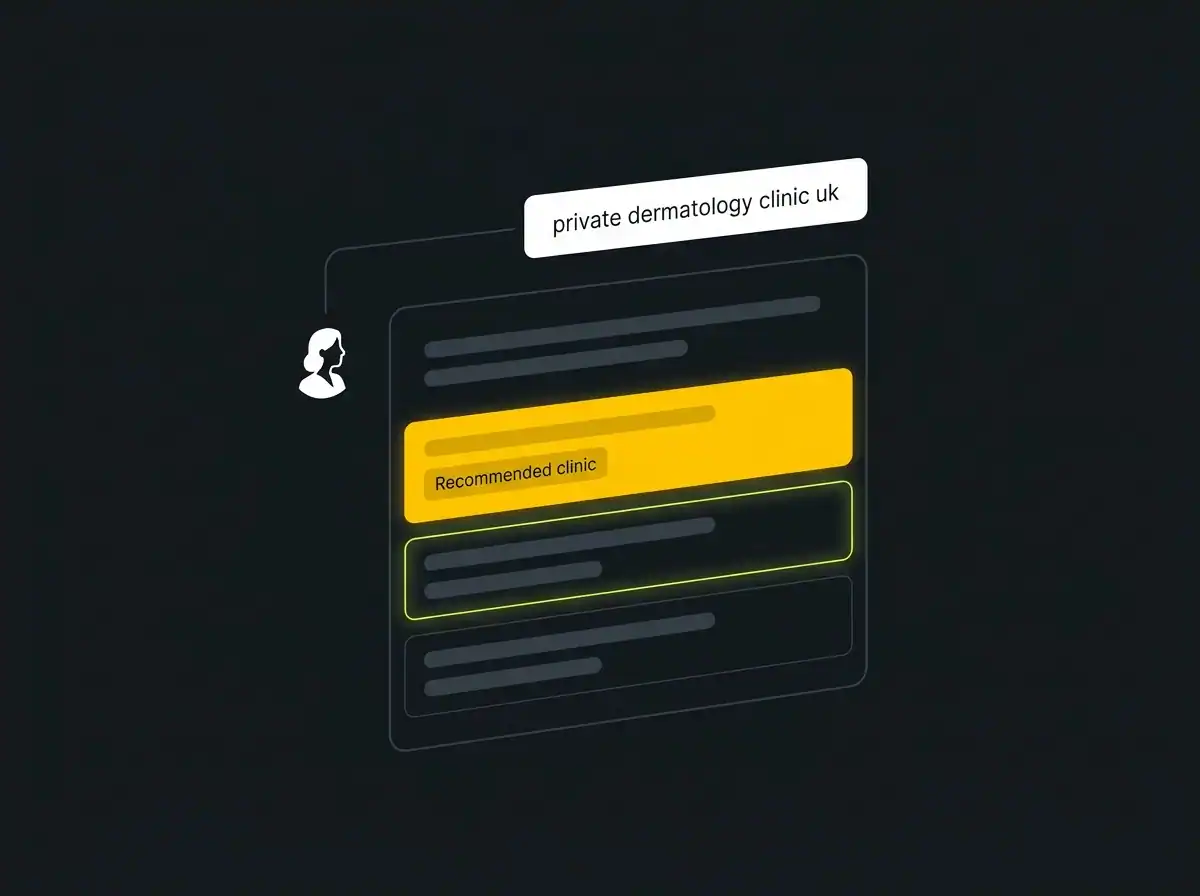
Patients are asking AI tools questions they used to type into Google. "What does a private dermatologist actually do differently from an NHS one?" "How much does private physiotherapy cost near London?" "Should I go private for my hip replacement?" These queries are being typed into ChatGPT, Claude, and Perplexity every day.
What gets cited in those answers is not what most clinics publish. AI tools weight clearly structured content with named authors, specific figures, visible dates, and named regulatory bodies. A page that says "we offer comprehensive dermatology services at competitive prices" will not appear in a ChatGPT response. A page that says "a private dermatologist appointment typically involves a 30 to 45 minute consultation, may include dermoscopy or a skin biopsy, and costs between £150 and £350 at most UK clinics depending on location and clinic type" has a genuine chance.
The principle is: write content specific enough to be quotable. An AI model needs a sentence it can lift into an answer without heavy qualification. That means named procedures, named regulators, realistic cost ranges from identifiable sources, and a visible publication date.
There is no AI Overview currently in the GB SERP for "healthcare content marketing", but expect that to change as the query matures. The right response is to structure content to survive that addition without a rewrite: tight summary paragraphs near the top, clear question-and-answer formatting where natural, and named entities throughout.
AI search traffic converts at significantly higher rates than traditional organic traffic, for a specific reason. Patients arriving via an AI recommendation are arriving in verification mode, not discovery mode. They have already been told your clinic is relevant. They are checking whether to book. That shift in intent is why AI search visibility for healthcare brands is worth taking seriously now, not treating as a 2027 consideration.
Free resource: AI Visibility Audit
Find out where your clinic currently appears in ChatGPT, Claude, and Perplexity, which competitors are being recommended in your place, and what to address first. Free, no obligation.
Local search still matters more than people admit

The majority of clinic queries are local in intent. "Private GP London." "Dermatology clinic Birmingham." "Private physiotherapy near me." A patient in Sheffield is not booking at a Harley Street practice unless the specialty demands it. Local search still determines a meaningful share of bookings for most clinic types.
The map pack, those three local listings with star ratings and phone numbers that appear above the organic results, drives disproportionate click-through for clinic searches. Appearing there requires a properly configured Google Business Profile, consistent name, address, and phone number data across the web, a steady stream of genuine patient reviews, and location-specific content on the clinic website.
Reviews deserve more attention than most clinics give them. Volume matters, but so does recency. A practice with 200 reviews accumulated over four years looks less active than one with 80 reviews that includes 15 from the past three months. Encouraging reviews as a routine part of the post-appointment process is not manipulating the system. It is making it easy for satisfied patients to do something they were already inclined to do.
A structured local SEO for clinics approach covers all of this systematically. The organic search strategy and the local search strategy are not separate disciplines; they reinforce each other, and neglecting one limits the ceiling on the other.
A realistic publishing rhythm for a clinic
Two high-quality articles per month beats eight low-quality ones. Not a platitude. That is how Google evaluates YMYL content and how the healthcare patient journey actually works.
For a single-site clinic with one marketing manager and limited consultant time, a workable rhythm looks like this: one condition or treatment explainer per month, written in collaboration with a named consultant, reviewed and published with their byline and credentials. One service-adjacent piece per month addressing a question patients commonly raise, whether that is cost and finance, comparison content, or recovery guidance. That is 24 pieces per year, all with genuine authority signals attached.
A quarterly sprint with a consultant to produce two or three opinion pieces gives the site a fresh dose of E-E-A-T authority without burning out the consultant's time. Opinion pieces on emerging treatments, commentary on NICE guidance, or analysis of trends within a specialty tend to earn backlinks and press coverage in a way that evergreen guides rarely do.
AI drafting tools can speed up the research and structural phase of content production. But publishing AI-generated text directly, without consultant review and meaningful editorial reshaping, in a clinical context is both a compliance risk and an authority risk. Use AI to draft. Use a human who understands the clinical context to approve, fact-check, and personalise.
Free resource: 12-month content planner
A ready-to-use planning template to map out the year's content before you start. Covers topic planning, publishing cadence, and review scheduling.
How to know it is working
The right metrics for a healthcare clinic are different from those for an e-commerce brand. Traffic alone tells you very little. A clinic blog generating 5,000 sessions per month from people looking for free medical advice is in a fundamentally different position from one generating 300 sessions per month from people comparing private consultation options. The second site is doing more useful work.
The metrics that matter: organic sessions to treatment and condition pages specifically, not total blog traffic. Enquiry form completions attributed to organic search in GA4. Organic-to-consultation conversion rate. And, increasingly, AI citation tracking, whether your content is being referenced when patients ask ChatGPT, Claude, or Perplexity about your specialty.
GA4 setup for clinics needs event tracking on enquiry forms, phone number clicks, and consultation booking button clicks. Without that, you are measuring visitors, not patients. The configuration is straightforward but almost never done by default on a clinic site.
Attribution in healthcare is lumpy by nature. A patient who first reads your recovery guide in January, returns to a cost guide in March, and books a consultation in May is not well-served by last-click attribution. GA4's path exploration report is the most useful tool for understanding those longer journeys. Do not judge content marketing on a 30-day window. The compounding happens over quarters.
Should you work with a healthcare content marketing agency
Some clinics can run this in-house. A practice with a dedicated marketing manager, engaged consultants willing to review and author content, and an established publishing rhythm does not necessarily need an external partner. The capability exists. It is usually the system and the consistency that need attention, not the headcount.
Most single-site private clinics are not in that position. Marketing is handled by one person who is also managing social media, the website, patient communications, and a handful of other responsibilities. Content gets published when there is time, reviewed when someone remembers, and measured annually if at all.
A specialist partner brings three things an in-house generalist rarely has: familiarity with YMYL content requirements and the UK regulatory context, a strategy built around what actually earns rankings rather than what fills a calendar, and the AI search knowledge to ensure your content is cited as well as found.
The thing to look for when evaluating a partner is not claimed healthcare experience. It is evidence of it. Rankings achieved for specific clinic types, content that surfaces in AI answers, and regulatory awareness built into the production process rather than added as a disclaimer at the end.
If you want to understand where your current content sits and what to prioritise first, work with a healthcare content marketing partner who can audit what you have and show you the gaps.
Frequently asked questions
What is the purpose of content marketing in healthcare?
Healthcare content marketing builds patient trust and search authority over time. Its purpose is to answer the questions patients ask before they book, position the practice as a credible and transparent provider, and earn the kind of search rankings and AI citations that deliver consistent enquiries without relying entirely on paid advertising. A well-executed content programme also reduces the information burden on clinical and reception staff, because patients arrive better informed.
What are the 5 Ps of healthcare marketing?
In a private clinic context, the 5 Ps are: Product (the clinical services and the patient experience around them), Price (transparent self-pay costs and finance options), Place (physical location, catchment area, and any digital or telemedicine offerings), Promotion (how the practice communicates its services, including content, search, and paid channels), and People (the consultants and clinical staff whose expertise is the product being offered).
What are the 5 Cs of content marketing?
Clarity (patients need to understand what a treatment involves without medical jargon obscuring the answer), Credibility (named authors, review dates, cited sources), Consistency (publishing reliably enough to build search authority over time), Conversation (content that addresses the questions patients are actually asking, not the questions a clinic wants to answer), and Conversion (a clear next step that moves an interested reader towards a consultation booking).
How long does it take for healthcare content marketing to work?
Realistically, three to six months before search rankings begin to move, six to twelve months before consistent enquiry attribution from organic content. YMYL categories move more slowly than general commercial categories because Google takes longer to establish trust with a new healthcare publisher. Clinics that start with a solid technical foundation, publish with genuine authority signals, and maintain a consistent rhythm typically see meaningful results within nine months.

Where to start
Most UK private clinics are invisible in AI search right now. Not because their content is bad, but because it was not written with AI citation in mind. That gap is becoming harder to close as more patients begin their search in ChatGPT, Claude, and Perplexity rather than typing directly into Google.
The AI Visibility Audit shows exactly where you currently stand: which queries your clinic appears in, which competitors are being recommended in your place, and which changes to prioritise first.
Free resource: AI Visibility Audit
It takes about two minutes to request. You will have a clear picture of your clinic's AI visibility within a few days, with specific recommendations you can act on immediately.