Six gyms within two miles. One person, phone in hand, searching at 7pm on a Tuesday.
Three results appear above a map. Stars, a photo, a distance. They tap one. The decision takes about four seconds, and the other five gyms never entered the conversation.
That is the local pack. And for a large portion of new gym enquiries, it is where the membership pipeline starts and ends. Not a referral from a friend. Not a flyer through the door. Not your homepage. A map, three listings, and a choice made before the gym has had any say in the matter.
Gym SEO is the practice of improving how a fitness business appears in Google search results, including the local map pack, class-specific searches, and seasonal membership queries. It applies to independent studios, multi-site operators, and boutique fitness brands alike. The mechanics vary slightly between them, but the underlying system is the same.
According to UK Active's annual market report, there are now 12.2 million gym members in the UK, representing 18% of the adult population, with membership visits growing year-on-year. That demand is real and sustained. But the businesses showing up in search when that demand converts are not always the best gyms. They are the ones that have invested in three specific things: the local pack, their class and programme pages, and their seasonal timing.
SEO is not the only way gyms win new members. Organic social, referrals, and community are all genuine channels. But search is the one most gym operators underinvest in relative to the compounding return it can deliver. This guide covers how all three layers work, and what it takes to compete in each.
Why the local pack is where gym membership decisions actually happen
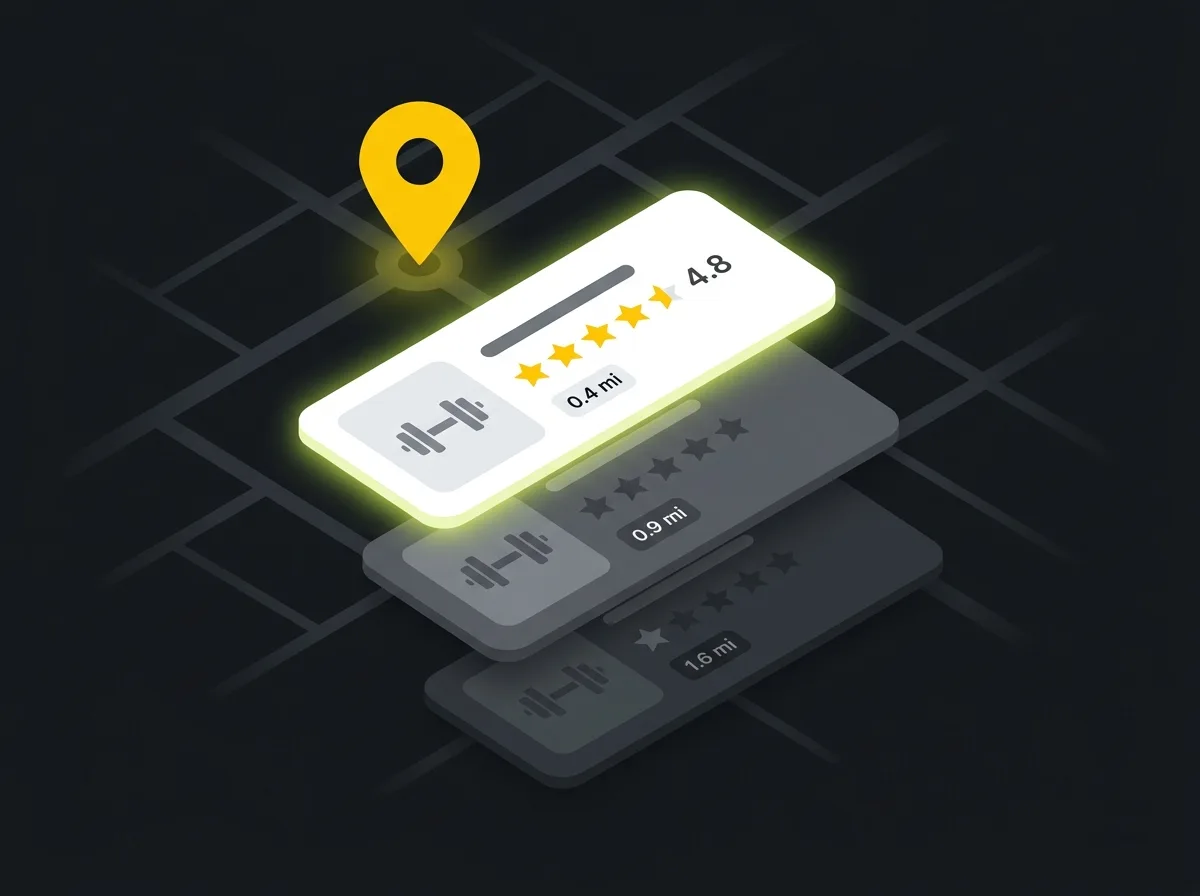
Open Google on your phone and search "gym near me." You will see a map and three results before you see a single organic listing. Each result shows a name, a star rating, a number of reviews, a thumbnail photo, a distance, and a phone number. That is the entire competitive moment.
The searcher is not in research mode. They are not comparing websites, reading about what to look for in a gym, or building a careful shortlist. They are close to a decision, and the map pack is where that decision happens. BrightLocal's local consumer research consistently shows that the majority of people who carry out a local search visit a business within 24 hours. For gym searches, intent is high and the attention window is short.
So what determines which three gyms appear? Google evaluates three factors.
Proximity is the distance between the business and the searcher. It is the one factor a gym cannot control. You are where you are.
Relevance is how well the gym's Google Business Profile and website content match what the search query is asking for. A gym that has accurately listed its categories, filled in its services, and has website content that backs up those signals will register as more relevant than one that set up a GBP five years ago and never touched it again.
Prominence is the broadest of the three. It covers review volume and quality, how frequently the GBP is updated, local citation consistency across directories and platforms, and external links pointing to the gym's site. Google treats prominence as a measure of how trusted and active the business is in its local area.
Most gym owners control proximity and nothing else. They set up GBP when the gym opened, verified the address, and assumed the work was done.
It is not done. Not even close.
The local pack is not a directory. It is an active channel. A gym in the top three typically has a GBP that is being worked on consistently: photos added regularly showing classes in action and facilities, posts published at least weekly covering timetable updates and new offers, review responses written genuinely and promptly, service listings that accurately reflect every class type on offer. This activity is a real ranking signal.
A competitor who posts weekly, collects 30 new reviews a month, and responds to every one within 24 hours will, over time, outrank a gym with better facilities but a dormant profile. An active listing beats a passive one. Every time.
One more thing worth knowing about the local pack in 2026: Google's AI Overviews for local gym queries draw from GBP data and top review snippets. Being in the top three means being part of the AI-generated summary some users see before they even look at the map results. Good local SEO work does not just help you rank in the map. It helps you appear in an AI response that sits above it.
Class schedule pages: the SEO asset most gyms don't build

Here is the problem with putting everything on the homepage: the homepage can only rank for one or two things at once.
A homepage that says "We offer yoga, spin, HIIT, pilates, boxing, and reformer pilates in Birmingham" is competing for one broad keyword. "Gym in Birmingham" at best. But someone searching for "yoga classes in Harborne" or "spin studio Digbeth" is not searching for a gym. They are searching for a specific class type in a specific location. That search does not resolve to a gym homepage. It resolves to a dedicated page for that discipline, in that area.
Most gym websites do not have those pages. The class schedule exists as a table on the homepage or a single subpage listing all classes in one block. From a search perspective, that table is invisible. It is not an asset Google can rank for a class-specific query.
This is where most gym operators leave a meaningful amount of search visibility on the table.
A dedicated page for each class type gives Google something to rank specifically for that query. A yoga page can target "yoga classes [city]", "yoga studio [area]", "beginners yoga near me." A spin page can target its equivalent queries. Each page is independently rankable, and each captures a different type of searcher. Someone searching for "boxing gym [city]" is not just looking for a gym. They are committed to a specific discipline. That specificity makes them more qualified than a generic "gym near me" enquiry.
What a well-built class page actually needs:
Title and H1 that match how people search. Not "Yoga" but "Yoga classes in [town]" or "Yoga studio [area]." This is how the page gets found.
A real description of the class. Not marketing copy. A plain explanation of what to expect: the format, the intensity level, what experience suits it, the equipment involved. Written in the language the discipline's community actually uses.
An up-to-date timetable. Structured with schedule or event schema markup where possible. One sentence on why this matters: schema markup helps Google understand your class page as representing a recurring service, which can improve how it appears in search results.
Instructor credentials. A short bio or a line about instructor experience. This matters for Google's quality signals around Experience, Expertise, Authoritativeness, and Trustworthiness, and it reassures a prospective member who cares about who is actually teaching them.
A clear next action. A join button, a free trial form, a WhatsApp link. The page needs to convert visitors, not just rank.
Some social proof. A few testimonials specific to that class, or a photo from a session. The reader is deciding whether this is the class and the studio for them. Give them something to visualise.
The near-me connection is direct. Class pages that are properly localised also capture near-me category variants. "Yoga class near me" resolves to local results. A well-built yoga page on a gym site in Shrewsbury is a local result for that query. The class page and the near-me search are not separate strategies. They are the same strategy applied at the class level.
The compounding effect is real and builds over time. A gym offering eight class types, with a well-built dedicated page for each, has eight independently rankable search entry points rather than one homepage fighting for everything.
For context on how this fits into a broader fitness marketing for gym operators approach, search is one input among several. But the class page architecture is the specific piece most gyms have not built, and it costs relatively little to get right.
How "near me" searches work, and why most gyms misunderstand them

"Near me" does not mean "nearest." That distinction matters more than it sounds.
When Google handles a "gym near me" search, it is not running a simple distance calculation. It is running a weighted ranking that considers proximity, relevance, and prominence simultaneously. And proximity is only one third of that equation.
A gym half a mile away with a dormant GBP, 15 unresponsive reviews, and no presence on any local directory can lose to a gym two miles away with an active GBP, 180 reviews with consistent responses, and listings across Apple Maps, Bing Places, Yell.com, Gympass, and ClassPass. Google is not finding the nearest gym. It is finding the nearest credible, active, well-documented one.
Most gym operators know reviews matter. Fewer understand that review velocity, how many new reviews come in each month, matters as much as the total count. And very few have ever thought about NAP consistency.
NAP stands for Name, Address, Phone number. These three pieces of information need to be identical across every directory, platform, and listing where the gym appears. Not "Fitness Studio" in one place and "The Fitness Studio Birmingham" in another. Not "0121 123 4567" on Google and "01211234567" on Yell. Small variations that accumulate over years, as a business changes phone numbers, moves premises, or gets listed in directories it never set up, create noise in the local algorithm. That noise dilutes the prominence signal Google uses to rank local results.
Auditing and correcting NAP inconsistencies is unglamorous work. It involves tracking down every directory listing that mentions the gym, which is harder than it sounds for a business that has been open for several years. But it is genuinely impactful, particularly for gyms with established local presences that have accrued inconsistent listings over time.
The majority of gym searches happen on mobile. The intent behind a mobile "near me" search is typically higher than the same search on a desktop. Someone searching on their phone may be walking past the gym or two streets away looking for somewhere to start a routine. That is a high-value moment. The gym needs to be not just findable but immediately actionable: click-to-call working, directions one tap away, a clear join path if they land on the website.
Fixing the near-me problem for a gym is largely a GBP and citations project, not a website rebuild. The website matters for relevance signals, but the local pack decision happens primarily in Google's local index, fed by GBP quality, review activity, and citation consistency across the local web.
Seasonal membership intent, and why SEO preparation needs to start months in advance
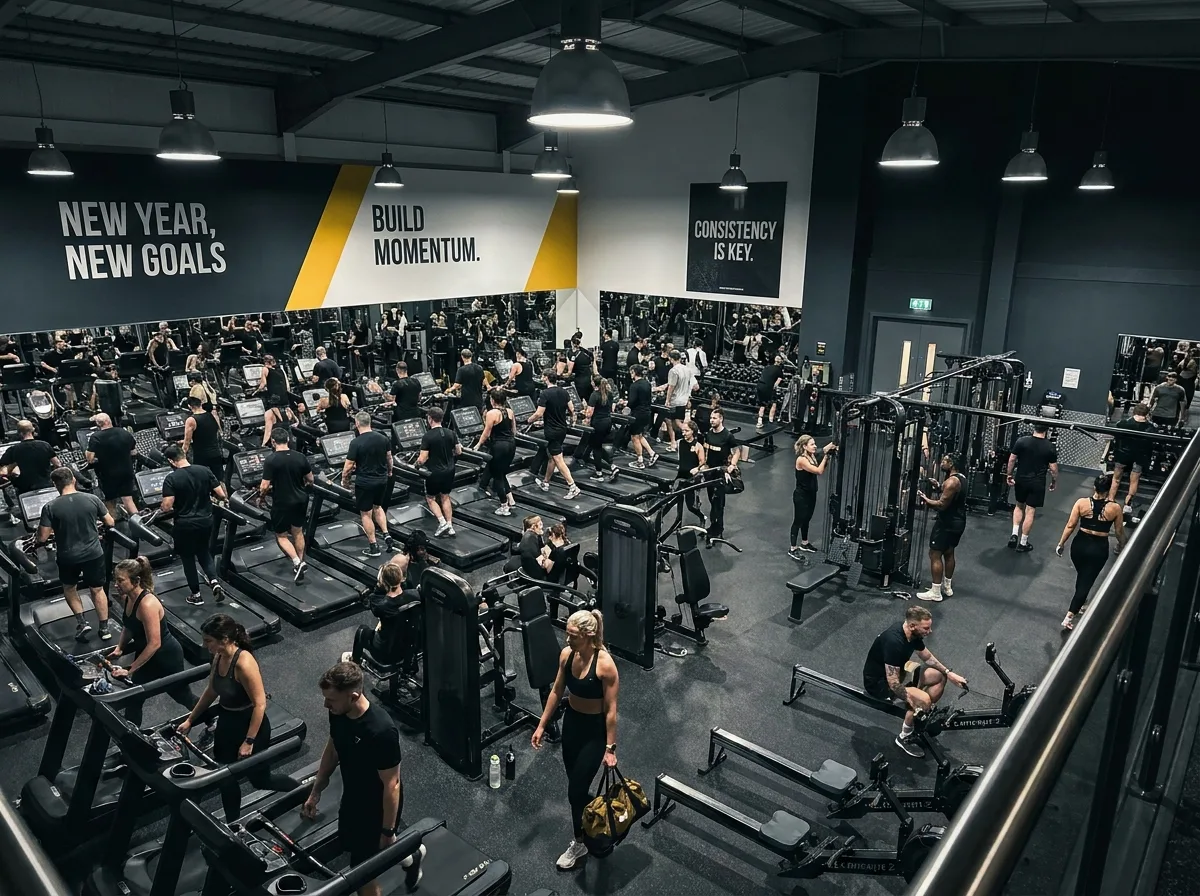
Every gym owner knows January. The induction lists stack up. The car park fills. Early morning sessions that ran with twelve people in October run with forty in the first two weeks of the year. And then February arrives, and half of them are gone.
What most gym owners do not think about is what happens on Google before January. Because the search spike for gym-related queries, "how to start going to the gym," "gym membership near me," "best gyms in [city]," does not begin in January. It begins in November and builds through December. The people joining in the first two weeks of January started searching weeks before they walked through the door.
This is the core operational difference between Google Ads and SEO for seasonal intent.
A Google Ads campaign can be switched on in December to capture January traffic. Switch it on on 28 December and you will be visible by 29 December. Ads are immediate.
SEO does not work that way. Content published on 28 December will not rank meaningfully by 1 January. A seasonal landing page built in late October, live through November and December, with time to be crawled, indexed, and to build some authority, is ready when the search volume peaks. The same page built in late December misses the window entirely.
The practical implication: the SEO calendar for a gym runs roughly three months ahead of the walk-in calendar. January preparation starts in October. September preparation starts in July.
What the January window needs, prepared in advance:
A seasonal offer or trial membership page. Not a standard join page. A page specifically framed around new-year intent, with an offer attached. Built in October, live in November, indexed and crawlable before the search volume builds.
Blog content targeting the informational queries that peak alongside membership intent. "How to start going to the gym," "best time to join a gym," "gym tips for beginners" are real queries with real search volume through November and December.
A gym that publishes content targeting these in October or November will rank in time to capture that traffic. A gym that does nothing will watch a third-party site take it.
GBP posts timed to the run-up. These can go up closer to the event, two to four weeks before. A January membership offer posted on GBP in mid-December is visible during the peak searching window.
Updated opening hours. If January means extended sessions or new-year hours, the GBP needs to reflect that before people start searching.
September follows the same logic, with a July start. End-of-summer, return-to-routine intent is the second largest UK gym search window of the year. The gym industry tends to go quiet in August. Competitors who do nothing in August miss the September spike entirely. A gym that builds a "back to fitness in September" campaign with a dedicated landing page in July is operating in a largely empty lane.
The compounding advantage is worth naming directly. A seasonal page built properly in year one can be refreshed and reused in year two. Update the offer, refresh any date references, re-promote it. A page that builds authority across two or three seasonal cycles accumulates ranking power progressively. This is the opposite of a Google Ads campaign that resets to zero each year.
AI search is starting to play a small role here too. Tools like ChatGPT and Perplexity are being asked "what gyms near me have January deals" or "good gyms to join in the new year in [city]." A gym with published, structured seasonal content has a better chance of appearing in those AI-generated responses than one whose search presence exists only in its GBP.
Honest framing: seasonal SEO preparation is early, unglamorous, and requires discipline that most gym operators cannot find in August when membership is fine and there is no visible urgency. That is precisely why it creates a real competitive advantage for the ones who do it.
What a complete gym search presence looks like in 2026
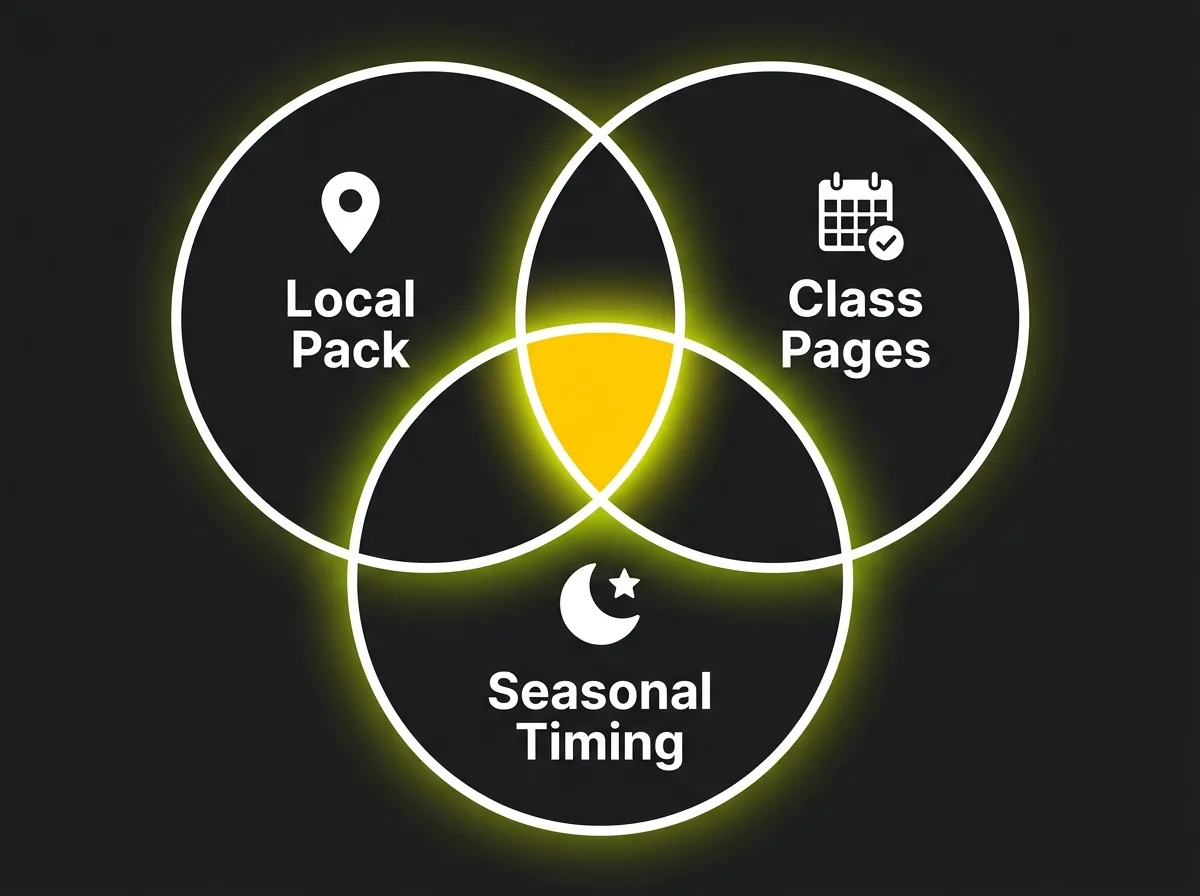
The three layers work together. That is the point.
A well-maintained GBP that signals strong relevance to Google's local algorithm also reinforces the relevance of the class pages sitting behind it. Class pages that are properly localised support the GBP's prominence signals as the gym accumulates authority for category-specific queries. Seasonal content that lands in November and December brings new organic visitors to the site, many of whom review the gym or share its pages, building the prominence signals that strengthen the local pack position.
Pull one layer and the others weaken. Build all three and they compound in your favour.
The honest SEO versus Ads comparison for a gym comes down to economics and timeline. Google Ads deliver visibility immediately and stop the moment you stop paying. The day you pause the campaign, you disappear from the results it was generating. For a fitness business with monthly membership revenue, that is a genuine vulnerability.
SEO delivers traffic that persists. A well-ranked class page keeps generating enquiries on a Tuesday morning when you have not looked at it since it went live. A strong local pack position keeps bringing in "gym near me" searches without a daily cost attached to each click.
The payoff is slower, typically six to twelve months to build meaningful visibility from scratch. But the economics over three years strongly favour organic for a business with recurring membership revenue. For gyms in competitive urban markets with multiple large chains within a mile, the realistic picture is often both: Ads to generate immediate enquiries while the organic foundation builds, then a gradual shift in budget mix as the organic starts delivering. For gyms in lower-competition markets, a well-executed organic strategy can often own the local pack and class-specific results without Ads at all.
AI search is an emerging factor, not yet the dominant one. ChatGPT and Perplexity are increasingly being asked to recommend local gyms. The signals those tools draw from, published web content, structured data, reviews, indexed class pages, overlap substantially with the traditional SEO signals already described in this guide. Doing good SEO is already improving AI search visibility as a side effect. It is not a separate project yet.
The question most gym owners cannot answer is: where do I actually stand right now? Which queries am I ranking for? Which competitors are ahead? How much potential search traffic am I missing each month? That is the starting point. Not another marketing initiative before understanding the baseline.
For a broader picture of how search visibility fits into a gym's overall growth model, that baseline is always where it begins.
See exactly where your gym stands on search
Most gym owners are flying blind on their search presence. They know they appear for their gym name. They have no idea whether they show up for "spin class [town]", "gym near me", or any of the seasonal queries that bring in new members in January and September.
The Traffic Projection Report is a free diagnostic that shows the estimated available search traffic for your gym's area and service type, where the gaps in your current visibility are, and which competitors are capturing the enquiries you are not.
No cost. No commitment. No agency pitch before you see the data.

Get your free Traffic Projection Report
If you want to discuss a structured approach to the local pack, class pages, and seasonal content as a joined-up strategy, the SEO services page covers how CT works with gyms and fitness businesses.
Frequently asked questions about gym SEO
How long does SEO take to show results for a gym?
The local pack can start responding within six to eight weeks for a gym that has a verified GBP, actively works it, and has no major technical issues on the website. A dormant GBP brought back to life with consistent posts and reviews can move meaningfully within that window.
Class pages and seasonal content take longer, typically three to six months before they rank for competitive queries, because Google needs time to index them, evaluate them against competitors, and see whether they earn engagement. The full picture of a properly executed gym SEO strategy delivering measurable new-member enquiries from organic search is usually twelve months, not twelve weeks.
Do I need SEO or Google Ads for my gym?
Most gyms benefit from both, but they serve different purposes and have different economics. Google Ads deliver visibility immediately and stop the moment you stop paying. SEO builds visibility slowly but delivers traffic that continues without a daily cost attached to each click.
For a gym with monthly membership revenue, the long-term maths of SEO are generally stronger because the traffic compounds rather than resetting. If you need enquiries this month, Ads work. If you want a pipeline that sustains itself and costs less per enquiry over a three-year horizon, SEO is the better investment. Many competitive urban gyms run both.
How do I get my gym into the Google map pack?
Start with a fully completed and verified Google Business Profile: accurate categories, service listings, opening hours, and website link. Then build review velocity by actively asking members for reviews after a positive moment, a great class, a milestone reached. Respond to every review, positive and negative. Post to GBP at least weekly: class updates, promotions, photos from sessions, timetable changes. Audit your NAP consistency across every directory where the gym is listed and correct any variations. None of this is quick, but it is the work that moves the map pack needle over three to six months.
Do separate class pages really help gyms rank on Google?
Yes, and they are consistently underused. A homepage cannot rank for "yoga classes in [town]" and "boxing gym [city]" and "spin studio near me" simultaneously. Each query needs a dedicated page to compete specifically for that term in that location. A gym with eight class types that builds eight well-built class pages has eight independently rankable assets instead of one homepage fighting for everything. Each page also targets a different, more committed type of searcher, which typically makes the incoming traffic more qualified than a generic gym enquiry.
How often should I post on my Google Business Profile?
At a minimum, once a week. More often during the run-up to high-intent seasonal windows. The content does not need to be elaborate: a new class starting, an updated timetable, a photo from a session, a short-term offer. What matters is the signal of activity. GBP posts and photo uploads are ranking signals. A profile that has not been posted to since 2022 tells Google's algorithm that the business is either inactive or disengaged, and neither helps your local pack position. The gyms consistently in the top three of the local pack are almost always the ones posting most consistently.