
Your website looks fine. Your enquiries are not. You are running a private clinic, the reputation is solid, the practitioners are excellent, and yet the phone is quieter than it should be. You are wondering whether to spend more on Google Ads, do more SEO, post more on Instagram, or whether the whole thing has shifted again with AI.
It has shifted. But probably not in the way most of the articles you have found will tell you.
This guide is for UK clinic and private practice owners who want a clear, honest picture of how healthcare marketing actually works in 2026: which channels matter, what each one does for a clinic specifically, how the compliance picture fits together, and where your next pound is most likely to produce a result. If you want to understand your search visibility and traffic before committing to a channel, this is where to start.
What healthcare marketing actually is in 2026
Healthcare marketing is the work of getting found by the right patients in the right channels, and converting that attention into enquiries, within the rules that apply to regulated medical services.
That last clause matters more than most marketing guides acknowledge. Healthcare is not like marketing a law firm or an accountancy practice. You are operating inside a regulated environment where the ASA, the CQC, the GMC, the MHRA, and the ICO all have something to say about what you can and cannot claim.
Commercial instincts that work for other service businesses will sometimes get you into trouble here. Understanding that from the start saves a lot of wasted spend.
The channel mix has also changed materially in the last 18 months. AI search, meaning ChatGPT, Claude, and Perplexity, has become a genuine patient discovery channel. Local search has become more competitive, not less.
And social media, which many clinics still treat as a primary channel, is delivering meaningfully less organic reach for healthcare content than it was three years ago.
The clinics getting the best results right now are the ones putting resource into search and AI visibility first, and treating social as a secondary layer rather than the engine.
Generic marketing advice also fails for healthcare because the patient’s consideration window is longer. Someone researching a knee surgeon is not going to convert because of a good Instagram post. They will spend days or weeks reading, comparing practitioners, checking credentials, and looking at reviews before they pick up the phone. That journey needs to be supported across multiple channels, most of them in search and content.
The five channels that bring patients into a UK clinic

There are five channels that consistently drive patient enquiries for UK private clinics and practices. Understanding what each one does, and in what order to prioritise them, is the foundation of a sensible healthcare marketing strategy.
The five are: organic search (SEO), local search and Google Business Profile, paid search and paid social, content and email, and AI search.
The order above is broadly the order most clinics should think about priority. It is not necessarily the order of spend. Paid channels produce results quickly but cost money every month. Organic and AI search take longer but compound over time.
Most clinics should eventually be active across all five, but very few should try to do all five at once from a standing start. The right question is which gap matters most for your specific situation right now.
Organic search (SEO) for healthcare
SEO is the process of making your website visible in Google and Bing when patients search for the services you offer. For a private clinic, that means treatment pages, condition pages, location-specific pages, and practitioner profiles, all built to answer the questions patients are actually typing.
The case for organic search is straightforward. A patient who finds you by searching “private knee surgeon in Birmingham” is warm, specific, and actively looking. They chose to come to you. That is a fundamentally different quality of traffic from a paid ad, and it shows in conversion rates.
What healthcare-specific SEO looks like in practice is building a content architecture that matches how patients actually search. A clinic offering orthopaedic services should have individual pages for knee replacement, hip replacement, and shoulder surgery, each targeting the phrase a patient would use when they are ready to act. Most clinic websites have a single generic “Our Services” page that covers everything in 200 words. That is why they are invisible.
Where most clinics underinvest is in the technical health of the site, internal linking between related pages, and schema markup for medical services. These are not glamorous, but they are the foundations that make everything else work. With SEO for healthcare websites, the first two months with a new client are usually 60% technical fixes and 40% content.
For the full picture of what SEO for clinics involves, including practitioner profiles, E-E-A-T signals, medical service schema, and realistic timelines, the healthcare SEO deep dive covers all of it in detail.
Local search and Google Business Profile

For most private clinics, local search is the highest-ROI channel available, and the one with the most room for quick improvement. When a patient searches “private GP near me” or “physiotherapist in Leeds”, Google shows a map pack of three local results before any website links. If your clinic is not in that pack, you are invisible to those patients entirely.
The basics most clinics still get wrong: incorrect business categories (choosing a generic “Medical Clinic” label rather than the specific specialty), incomplete service listings, no recent photos, no posts, and no consistent approach to reviews. Getting these right costs almost nothing and can move your map pack position measurably within a few months.
Reviews deserve a separate paragraph. Google reviews are both a ranking signal and a conversion signal. PHIN data on how private patients research providers consistently shows that private patients check reviews as part of their decision process.
The same is true of Doctify and Top Doctors, the two main patient review platforms for UK private healthcare, as well as Trustpilot. A simple, consistent process for asking satisfied patients for a Google review compounds into a genuine competitive advantage.
Responding to every review, good and bad, in a compliant and professional way, matters too.
For clinics serving a specific geography, a structured local SEO for clinics approach covering Google Business Profile, local citations, location landing pages, and review volume typically produces visible movement within three to four months. It is usually the fastest win available for clinics starting from scratch.
Paid search and paid social
Paid channels are the fastest route to visibility. They are also the most expensive per enquiry, and the channel where compliance issues bite first.
Google Ads for healthcare works well in two situations: launching a new service that has no organic visibility yet, or filling gaps in seasonal demand. The mechanics matter here.
Healthcare advertisers need to avoid triggering Google’s sensitive category restrictions, write ad copy that does not make claims the CAP Code prohibits, and send traffic to a single-purpose landing page rather than a general services or home page.
Sending paid traffic to your home page is the most common and most expensive mistake in healthcare PPC.
Paid social is more nuanced. Meta Ads work well for a specific subset of treatments: aesthetics, dental, weight management, cosmetic procedures, and some mental health services. They tend to perform poorly for complex surgical specialties and treatments where the patient journey is long and research-driven. LinkedIn can work for occupational health, corporate wellness, and health insurance adjacent services, where the decision maker is a procurement or HR professional rather than a patient.
One practical note: paid is the channel where compliance problems become most visible, because the ads are public and the ASA actively monitors them. Before-and-after imagery, unsubstantiated outcome claims, and patient testimonials about medical results are all high-risk territory. Understanding the rules before spending is cheaper than finding out afterwards.
Content and email
Content does a job that paid search alone cannot: it builds trust before the patient is ready to book. A condition explainer that helps someone understand whether they need an orthopaedic consultation, a practitioner profile that makes a surgeon feel knowable rather than clinical, a post-treatment care guide that arrives in an email the week after a procedure. All of these are marketing, and all of them compound in ways paid channels never will.
The underused channel for most UK clinics is email. Not cold email, but the list of people who have already been in contact: past patients, enquiries that did not book, patients who came once and did not return. A GDPR-compliant, properly consented email list is an asset most clinics have not exploited.
Even a simple three-email sequence triggered when someone enquires and does not book within five days will recover a meaningful proportion of those leads.
Social media sits in this section because for most healthcare practices that is where it belongs. Social rarely drives direct bookings. What it does is provide a supplementary trust layer: a practitioner who posts consistently on LinkedIn, or a clinic that documents outcomes within regulatory constraints, builds familiarity that helps convert patients already considering a booking. If no one in your practice has the appetite for that kind of presence, social is not worth forcing.
AI search and why clinics need to take it seriously now
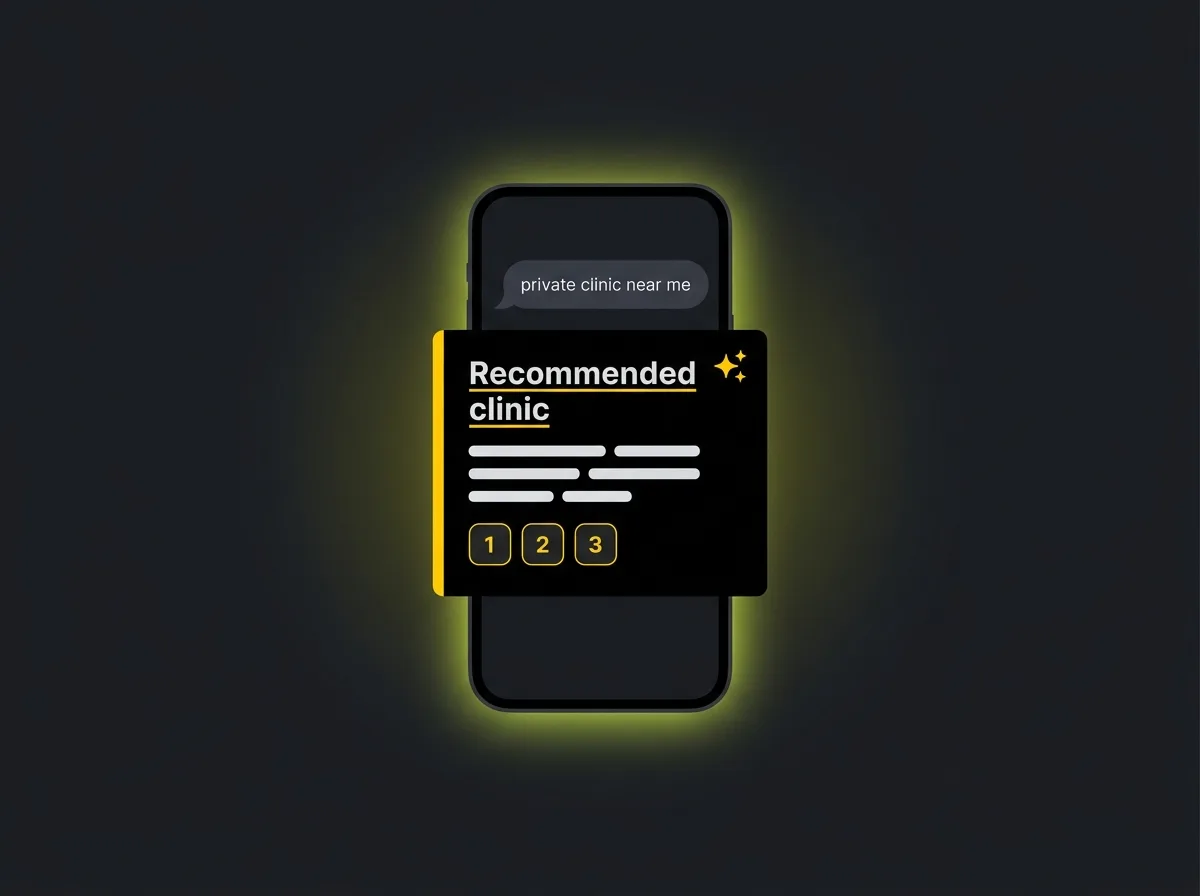
Here is the shift that most healthcare marketing guides are not yet talking about. Patients are increasingly using ChatGPT, Claude, and Perplexity as a first port of call when they need medical guidance or want to find a specialist.
They ask: “What are my options for a herniated disc in the UK?” or “Which private clinics in Manchester treat sleep disorders?” They are not going to Google first. They are going to an AI assistant, which gives them either a direct answer or a recommended list of providers.
Most UK clinics are completely absent from those answers. Not ranked poorly. Absent entirely.
AI search visibility is a different discipline from traditional SEO, though it builds on many of the same foundations. To appear in AI-generated answers, your website needs clear, definitional content that AI models can quote and cite. It needs named entities: real practitioners, real specialties, real locations. It needs schema markup. It needs to be cited by sources that AI models trust. These are things most clinic websites do not have in place.
The good news is that why AI search traffic converts at 5x the rate of typical search traffic is well-documented. Patients who arrive from an AI recommendation are already in a verification mindset. They are not comparing options; they are confirming a choice. That makes them significantly more likely to book.
The honest take: do not wait until AI search feels more established. The clinics building AI visibility now will have a compounding head start, exactly as early SEO adopters did in 2010.
The compliance picture every UK clinic should keep in mind
This section is orientation, not legal advice. But you need to know which regulators govern healthcare marketing, because the rules here are genuinely different from other sectors and the consequences of getting them wrong can be serious.
The ASA and CAP Code section 12 govern advertising claims for medicines, medical devices, health-related products, and services. Section 12 is the one that applies most directly to clinic marketing. Claims must be substantiated, patient testimonials about treatment outcomes are restricted, and before-and-after imagery is tightly controlled.
The MHRA oversees medical devices and medicines. If your clinic uses or sells anything in either category, MHRA rules on how those products can be marketed apply directly.
The GMC has GMC guidance on advertising for doctors covering comparative claims, testimonials, and how outcomes may be described. Other professional bodies, including the GDC for dental practitioners and the NMC for nursing professionals, have equivalent guidance.
The CQC regulates care quality and how services are presented to patients, including marketing materials that describe the nature of the care provided. The ICO and UK GDPR govern how patient data is handled: email lists, contact forms, retargeting pixels, and GA4 tracking. Health data is a special category under GDPR with additional requirements that go beyond standard data protection.
None of this should stop you marketing effectively. But it does mean that whoever manages your marketing, in-house or via an agency, needs to understand these rules as a working baseline.
Where to start
The most common mistake is attempting all five channels at once with a limited budget. The result is half-hearted effort spread across five channels rather than meaningful investment in two.
A sensible starting point for most clinics: audit what is currently working, fix the website conversion basics, and prioritise the channel where the gap between your current position and where you should be is largest.
In practice, this usually means getting Google Business Profile properly set up first, fixing the technical foundations of the website so traffic actually converts when it arrives, and investing in SEO to build organic visibility over the following six to twelve months.
The three numbers every clinic should be tracking: organic enquiries per month (this tells you whether SEO and content are working), cost per enquiry from paid channels (this tells you whether paid is efficient), and share of voice in AI assistants for your specialty and city (this tells you whether you are visible in the new discovery channel).
For healthcare web design specifically, the conversion basics are often the easiest wins available: a clear call to action on every treatment page, a phone number visible without scrolling, and a contact form that actually works on mobile. Simple fixes, and most clinic websites still get them wrong.
If you are not sure which gap is biggest, the honest answer is to find out before committing resource. That is what a good audit delivers.
Frequently asked questions
How much does healthcare marketing cost a UK clinic?
The range is wide. A solo practitioner managing their own content and review process might spend a few hundred pounds a month. A single-site private clinic working with a specialist agency typically starts somewhere between £1,500 and £4,000 per month, depending on how competitive the specialty and location are.
Paid media budgets sit on top of management fees. Multi-site groups should expect significantly more. The variance is driven primarily by specialty competitiveness and the clinic’s starting position.
Which channel is best for a private clinic?
It depends on your timeline and current position. Paid search gets you visible within days but costs money every month. Local search delivers visible improvement within two to four months with consistent effort. SEO takes six to twelve months to produce meaningful organic traffic, but the return compounds. Most clinics underinvest in local and organic, and over-invest in paid. AI search is early but the window to build a head start is now.
Is healthcare advertising regulated in the UK?
Yes. The ASA and the CAP Code govern advertising claims for healthcare services. The GMC governs how doctors specifically may advertise. The MHRA governs claims about medicines and medical devices. The ICO governs how patient data is used in marketing. Compliance is not optional; it is the baseline.
Do I need to show up in ChatGPT and Claude?
Yes. Patients are already using AI assistants to find clinics and get information about treatment options. The question is not whether AI search matters for healthcare; it already does. The question is whether your clinic appears in those answers, or your competitors do.
How long does healthcare marketing take to work?
Paid search: days to weeks. Local search and Google Business Profile: two to four months with consistent effort. Organic SEO: six to twelve months for meaningful traffic. AI search visibility: similar to SEO in timeline, though the compounding dynamics are still developing. Email and content: depends on the quality of your existing contact list, but a well-managed list can produce results within months.
A practical next step
The channel picture above is the orientation. The harder part is working out which gap matters most for your specific clinic, specialty, and location before committing resource to a direction.
If you want to know where your clinic currently stands in AI search specifically, whether ChatGPT, Claude, and Perplexity are recommending you, what they are saying, and what is currently missing, the fastest way to find out is an audit.

We look at how your clinic appears across AI assistants and search engines, identify the gaps in your current visibility, and give you a clear picture of where your next investment will have the most impact. Most clinics we speak to have never checked what AI tools say about them. The answer is usually surprising.
Marketing for healthcare practices in 2026 is about building quiet, compounding visibility across the channels patients actually use, including the newer ones. Start with the right channel for your current situation, do it properly, and add the next one when the foundations are solid.