Google can rank your website. That doesn't mean AI models know your brand exists.
These are two completely different things, and in 2026 that distinction matters more than most B2B businesses have registered. You can sit on page one for your main service terms, see consistent organic traffic month after month, and still be entirely absent when a potential client opens ChatGPT and asks it to recommend a firm like yours in your region. Not mentioned. Not considered. Simply not there.
That's not a content problem. It's not a backlinks problem. It's an entity problem.
Entity SEO is the practice of building signals that tell search engines and AI models not just that your website exists, but that your brand is a real, distinct, trustworthy thing in the world. It's the difference between being found when someone types a query into Google and being named when someone asks an AI to recommend you. A good SEO agency will increasingly address both sides of this. This article explains what entity SEO actually is, why B2B service businesses face a structural disadvantage, and what to do about it in a logical order, without needing a Wikipedia page or a national press campaign.
What is entity SEO?
Start with what an "entity" actually means here. In the context of search, an entity is a real-world thing that can be uniquely identified: a brand, a person, a place, a product, a concept. Your business, as an entity, has a name, a location, a set of services, and relationships with other entities: the industries you operate in, the people who lead the company, the clients you serve.
Google stores all of this in something called the Knowledge Graph. Think of it as a vast database of entities and the relationships between them. When Google recognises your business as an entity in that graph, it doesn't just know you have a website. It knows your official name, your sector, how you're described by independent sources, and how you connect to other recognised entities. That's what powers the Knowledge Panel that sometimes appears on the right side of Google results when someone searches for an organisation directly. It's also what underpins the AI-generated answers that increasingly sit above organic results.
The shift that made this relevant began with Google's Hummingbird update in 2013. That update moved Google from matching strings of text to recognising real-world things. The phrase at the time was "strings to things." Instead of asking "does this page contain these words," Google started asking "does this page help us understand this entity better." Every significant algorithm update since has extended that logic, and the arrival of AI-powered search tools has accelerated it considerably.
Entity SEO is the practice of building signals that help search engines and AI models recognise your brand as a distinct, trustworthy thing in their knowledge systems, not just a website that contains certain keywords.
It's worth distinguishing this from semantic SEO, because the terms get conflated. Semantic SEO is about the relevance and relationships between the topics in your content: writing about connected concepts so Google understands what your website covers at a thematic level. Entity SEO is about being a named, recognised thing in a knowledge system. They reinforce each other, but they're different levers. You can have well-structured semantic content and still be a blank entity to any AI model asked to recommend you.
Named entities to know: Google Knowledge Graph, Wikidata, Wikipedia, schema.org, and the Hummingbird update are all part of the same story. Understanding where each one fits makes the practical steps later in this article easier to follow.
Why B2B service businesses have an entity problem

Product brands accumulate entity signals constantly and mostly without trying. They're reviewed on multiple platforms, stocked by retailers who list them on their own pages, covered by consumer press, discussed on social media by customers who photograph them, and referenced in countless comparison posts and buying guides. Every one of those mentions is a small corroboration signal: multiple independent sources agreeing that this brand is a real, specific thing in a particular category.
A B2B service business acquires almost none of this organically. A compliance consultancy in Bristol, a payroll software firm in Leeds, a marketing agency in Glasgow: each of these businesses might do excellent work for their clients, win meaningful contracts, and operate for a decade without generating a single editorial mention beyond their own website and a LinkedIn company page. That's not a failure. It's simply the nature of professional services.
Limited domain authority compounds the problem. Google uses the same signals that build DR, backlinks and editorial mentions from credible sources, as entity corroboration data. Low authority and thin entity signals tend to move together, reinforcing each other in a slow cycle that feels hard to break from inside it.
AI models amplify the disadvantage further. ChatGPT, Claude, and Perplexity draw on training data weighted heavily toward high-authority sources: major publications, industry media, well-documented organisations. A brand that appears primarily on its own website and a handful of directories may not register as a coherent entity in that data at all. The model has encountered your domain name. It hasn't seen enough consistent, contextual, independent description to treat you as a distinct, trustworthy thing. So when someone asks which firm to use, you're not part of the answer.
This is the gap that almost every entity SEO guide ignores. Those guides are written for companies that already have baseline brand authority. They're not written for the B2B service business that ranks reasonably well on Google but barely registers in any AI model's awareness. This article is.
How AI models decide which brands to mention
AI models don't run a fresh Google search every time someone asks a recommendation question. They generate responses from patterns in their training data, weighted by how coherently and consistently a brand has been described across credible, independent sources. A brand that exists as a named, described, corroborated entity across multiple reliable sources is significantly more likely to appear in an AI response than one whose presence is thin or fragmented.
The queries where this matters most are recommendation queries: "which B2B SEO agency is worth using in the UK," "who should I consider for AI search visibility strategy," "what firm handles compliance consultancy for fintech companies." For those questions, the AI is functioning as a recommendation engine. The brands it names are not the ones with the most keyword-heavy pages. They're the ones its training data associates with credibility in that specific category.
There's an important distinction between a brand mention and an entity signal. A passing reference to your company name in someone else's blog post is a weak signal. A mention that includes your full legal name, your location, your specific service category, and ideally a link to your website is a proper entity signal. It's the difference between "we worked with a marketing agency" and "we worked with Acme Digital, a B2B content and SEO agency based in Manchester." Volume matters, but so does the quality of the surrounding context.
Ranking on Google doesn't automatically make you a recognised entity in any AI model's knowledge. Worth saying that plainly, because it surprises most people who've invested seriously in SEO over several years. You can rank consistently, generate good organic traffic, and still be invisible in AI responses for recommendation queries. The two channels use overlapping but distinct signals. It's also worth knowing that AI search traffic converts at a significantly higher rate than traditional search, which makes closing that gap commercially worthwhile rather than just theoretically interesting.
The entity signals that matter most for B2B
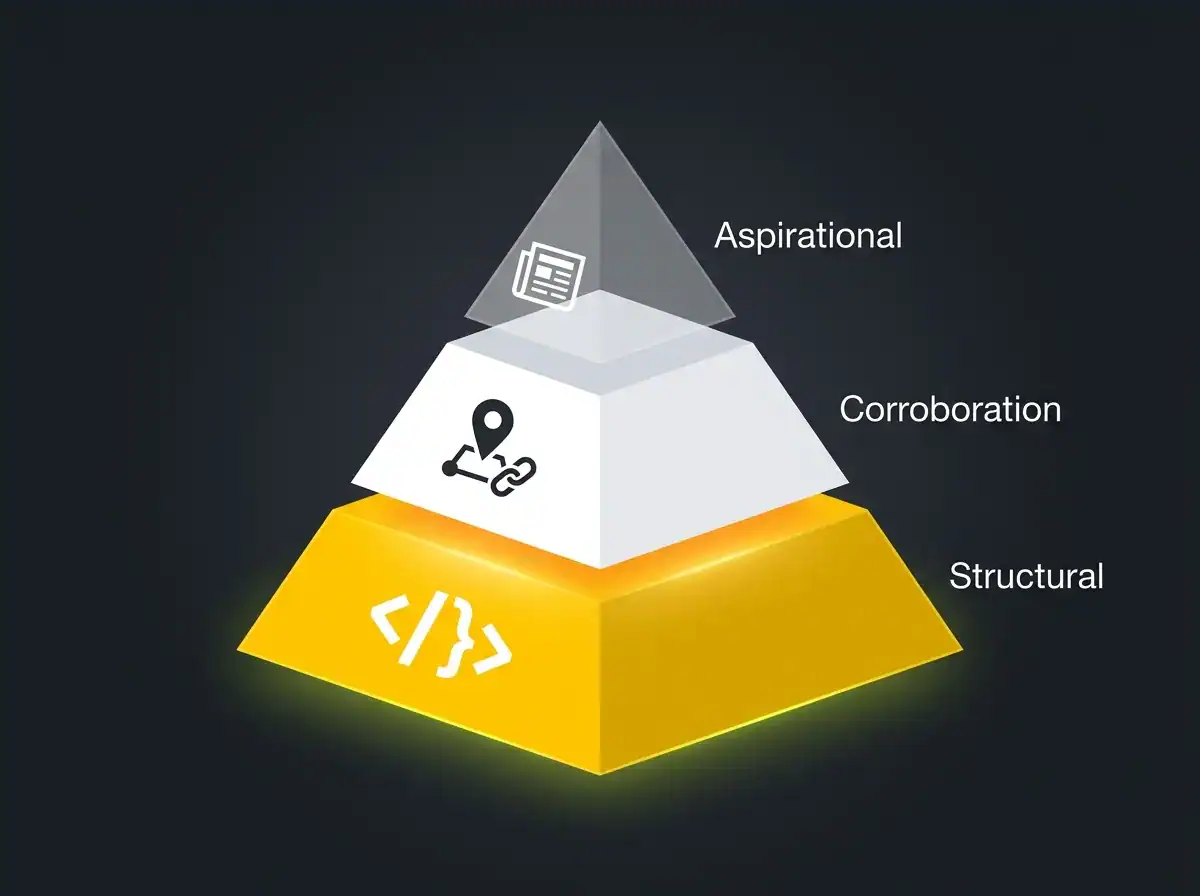
Not all entity signals are equally achievable for a B2B service business, and not all of them carry the same weight. The following breakdown organises them by impact and effort, so you can start where the return is highest rather than where most guides assume you already are.
Tier 1: high impact, achievable for most B2B businesses
Organisation schema on your website is the single most direct signal you can send about your brand's identity. Schema.org's Organisation type lets you specify your official name, your website URL, your logo, your address, your contact details, and crucially your "sameAs" links: Wikidata, LinkedIn, Companies House, and any other authoritative identifier for your business. Implemented on your homepage and About page, Organisation schema is the foundation of a B2B entity footprint. If you operate from a specific location or serve a defined area, LocalBusiness schema applies alongside it.
Google Business Profile is an entity signal even for businesses that don't depend on local search. It tells Google your official name, your category, your location, and your online presence in a structured, trusted format. A fully completed GBP with the right primary category is a direct contribution to entity clarity, and it's free.
Consistent brand language across every owned channel is more important than it looks. Your company name, description, and service category should be identical on your website, LinkedIn company page, Companies House registration, and any industry directories. Even minor variations, "Smith and Jones Consulting" in one place and "Smith & Jones" in another, register as ambiguity to a machine processing signals at scale.
Tier 2: high impact, requires more effort
A Wikidata entry is something any business can create, and it's more valuable than most B2B owners realise. Wikidata is an openly editable knowledge base that both Google and AI models use as a source of entity data. Creating an item for your organisation with your official name, website URL, founding date, country, and sector is a direct entry into the same data ecosystem that powers the Knowledge Graph. You'll need a Wikimedia account and to add a new item at wikidata.org. Once the item is live, link to it from your Organisation schema sameAs field immediately.
Editorial mentions in industry publications carry real entity weight. The key word is editorial: a reference by a journalist or editor that includes your name, your service category, and your location. Guest posts written by your own team for link-building purposes don't carry the same signal. A genuine reference in The Drum, Marketing Week, a regional business publication, or a relevant trade title tells AI systems that an independent, credible source has placed your brand in a specific professional category. That's corroboration.
Digital PR placements, including regional press coverage, build entity credibility in ways that directory links simply cannot. Multiple independent sources each consistently describing your brand in the same terms: that's the pattern AI models weight most heavily.
Tier 3: good practice, lower entity impact for most B2B businesses
Wikipedia is often the first thing mentioned in entity SEO guides. For most B2B service businesses, it's also the least realistic target. Wikipedia's notability guidelines mean a professional services firm without substantial national press coverage will struggle to get a page approved and maintained. Know the bar exists. Don't treat its absence as something blocking your progress.
Social profile consistency across LinkedIn, X, and sector-relevant platforms matters as hygiene rather than as a primary driver. Inconsistencies add noise to the machine's picture of you. Consistent profiles don't transform entity clarity on their own, but they remove unnecessary ambiguity.
Our AI SEO team builds these entity footprints as part of CT's AI search visibility work, starting with a full entity audit and structured data implementation. If the technical side feels like a lot to manage while running a business, that's what the service is for.
A practical entity SEO checklist for B2B
Turn the above into action. These steps are ordered by what to do first for a B2B service business approaching this from scratch, or doing it properly for the first time.
-
Run an entity audit. Search your brand name in Google. Does a Knowledge Panel appear on the right? Now open ChatGPT, Claude, and Perplexity in turn. Ask each one: "Tell me about [your company name]." Then ask: "Who are the leading [your service type] businesses in [your region]?" Note exactly what each model says, or doesn't say. This is your baseline, and you need it before building anything.
-
Implement Organisation schema on your homepage and About page. Include: name, url, logo, address, contactPoint, and sameAs, with links to your Wikidata item, LinkedIn company page, and Companies House entry once they exist. Google's documentation on structured data has the technical reference; most web developers and SEO agencies handle this as a standard task if you'd rather delegate it.
-
Claim and fully complete your Google Business Profile. Choose your primary category with care. It is a direct entity signal for your service type. Fill in your website, description, services, and any relevant attributes. A half-complete GBP helps less than you'd expect.
-
Create a Wikidata item for your organisation. Sign up for a Wikimedia account, then create a new item at wikidata.org. Include your official name, official website URL, country (United Kingdom), instance of (organisation), founding date, and your primary service type. Once the item is live, add its URL to your Organisation schema sameAs field.
-
Audit your NAP consistency. Your company name, address, and phone number should be character-for-character identical across your website, GBP, Wikidata, LinkedIn, and any directory or trade body listings you appear in. Small formatting differences, "Ltd" versus "Limited," a postcode present in one place and absent in another, create entity ambiguity that compounds across dozens of listings.
-
Map three to five publications where a genuine editorial mention would be appropriate. Not a guest post. A real mention: a journalist covering your sector who might reference you as a relevant firm, a regional business desk, an industry awards listing, a trade body announcement. Build a short list and a realistic outreach approach. One solid editorial reference in the right publication is worth more for entity building than fifty directory submissions.
-
Run a quarterly AI brand check. Set a recurring reminder. Every three months, ask ChatGPT, Claude, and Perplexity: "Who are the leading [your service type] firms in [your location or sector]?" Track whether your brand appears, in which models, and in what context. This is your ongoing measure of entity recognition progress.
How to know if it's working
Entity SEO builds slowly. The first two or three months often feel like nothing is happening. That's normal. Signals are accumulating even when the visible indicators haven't shifted yet.
Branded search growth in Google Search Console is the first metric to watch. If more people are searching your exact brand name, that means more of them have encountered your brand independently and are following up. It's a direct signal that your entity presence is widening beyond your existing audience and relationships.
Knowledge Panel appearance is a milestone worth tracking. When you search your brand name directly in Google, does a panel now appear on the right side? That means Google has confirmed your entity in the Knowledge Graph and is surfacing your information directly. Check what it contains, whether the services, location, and description are accurate, and update your structured data or GBP if they're not.
The quarterly AI brand check from the checklist is the ongoing measure that matters most for AI search visibility. Track the progression over time: from no mention, to occasional passing reference, to named alongside relevant competitors, to recommended in a specific context. That progression takes time. Twelve months is a realistic window for meaningful movement if the Tier 1 and Tier 2 signals are being built with consistency.
Third-party brand mentions are a useful proxy for entity corroboration progress. Set up Google Alerts or Ahrefs brand alerts for your company name. Growth in organic mentions across independent sources, even unlinked ones, tells you the signal pool is growing.
The window is still open
Every brand that becomes visible in AI search over the next two years will have built its entity footprint before the AI models were sophisticated enough to surface them consistently. The businesses investing in this now are the ones that will be recommended when a potential client opens ChatGPT and asks for a firm like theirs. The ones who wait will find themselves chasing a gap that widens with every model update and every competitor who got there first.
According to Ofcom's Online Nation research, the share of UK adults using AI tools for information and research has been growing steadily year on year. The business owners and procurement managers who are your prospective clients are increasingly beginning their supplier search with an AI conversation. Being a recognised entity in that conversation is where B2B visibility is heading.
Free resource: AI Visibility Audit
Not sure where your brand currently sits? The AI Visibility Audit checks your entity footprint across Google, ChatGPT, and Perplexity and shows you exactly what's missing and what to fix first.