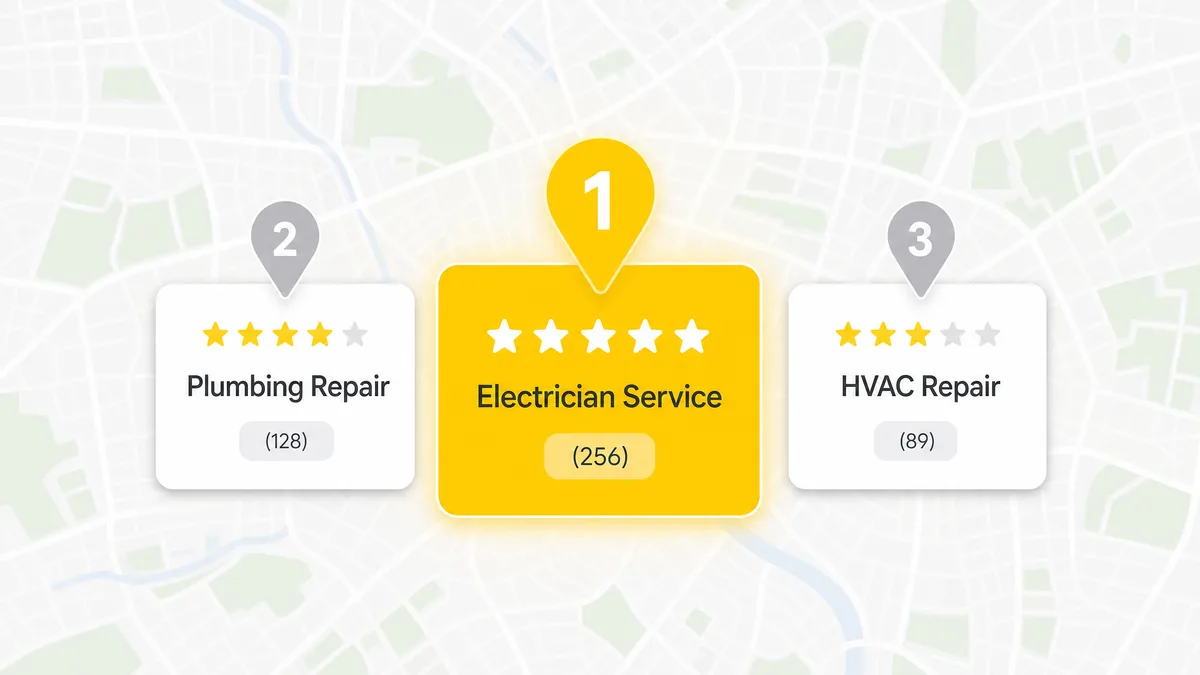
You have eighteen reviews. Your competitor down the road has twenty-six. As far as you can tell, everything else looks roughly similar: same type of business, same area, broadly the same services listed.
Yet they sit in position one of the local pack every single time someone searches for what you do, and you are hovering around fourth or fifth.
Sound familiar?
That is the frustration behind most searches for this topic. The question is not how to get on Google Maps. You are already there. The question is why someone who appears broadly equivalent keeps appearing above you.
The answer almost never comes down to the factor most businesses assume.
The short answer
Google ranks map pack results on three signals: relevance, distance and prominence. Six of the seven factors that determine your position are within your control. The one that is not, proximity, is rarely the actual bottleneck.
The highest-impact changes most businesses can make are: picking a more specific primary category, building consistent review velocity rather than chasing a single volume target, and resolving NAP inconsistencies across directories. Each of the seven factors below maps to one of those three pillars with a specific fix attached.
How Google Maps actually decides who ranks

Google's own help documentation names three signals that determine where a business appears in local results: relevance, distance and prominence. Every factor this article covers maps back to one of those three.
Relevance is how well your business profile matches what someone searched for. A dental practice appearing when someone searches "emergency dentist in Coventry" is a relevance win. The same practice appearing for "dentist in Birmingham" when they operate twenty-five miles away is a relevance miss.
Google uses dozens of signals to judge relevance, but the primary category and the content of your Google Business Profile (GBP) are the most direct levers.
Distance is proximity from the searcher to the business address. Google factors in the searcher's location, or the location implied by the search query. Someone typing "plumber in Leeds" is specifying a location even without GPS.
Prominence is how well-known and trusted Google believes the business to be. Reviews, citations, domain authority and website quality all feed into it. This is where most businesses have the biggest gap and the most room to improve.
Those three pillars map to seven specific factors. Understanding which pillar each one belongs to tells you why fixing it matters and roughly how long it takes to show results.
One more thing worth noting. Google's AI Overview now appears for queries like this one, and it draws partly from map pack data. A business that ranks well in Maps is more likely to be surfaced when someone asks an AI tool about local services. AI search is changing how local businesses get found, and the map pack is one of the places where traditional local SEO and AI visibility genuinely overlap.
Factor 1: the proximity problem, and why it's rarely the real issue
Distance from the searcher to your business address is a fixed input. A plumber in Leeds will not rank for a search made in Sheffield. That is expected behaviour, not something to fight.
The error most business owners make is assuming proximity is the explanation when, in fact, the real gap is relevance or prominence. If a competitor two streets away consistently beats you, proximity is not your problem.
For service area businesses, those who travel to the customer rather than having customers visit them, the practical fix is to set service areas in GBP accurately. A domestic electrician might set areas covering several postcodes or a named region rather than relying on a single address.
What you should not do is list a false address closer to a town centre you want to rank in. That is a direct violation of Google's guidelines and can result in your listing being suspended entirely.
The check is straightforward: confirm your address pin is correctly placed, set service areas by region or postcode if you are a mobile business, then move on. For most businesses competing within their genuine operating area, proximity is not what is holding them back.
Factor 2: your primary category is doing more work than you realise
Of all the inputs into a GBP listing, primary category delivers the most ranking return for the least effort. It is Google's clearest signal for what the business does.
The common mistake is choosing a category that is too broad. A building contractor who lists under "General contractor" is competing with every contractor in the area. The same contractor who lists under "Loft conversion company" sends a far sharper relevance signal for anyone searching specifically for loft work.
Both are accurate. One is far more specific.
How to find the most precise available category: search for your two or three strongest competitors in the Google Maps local pack, click their profiles, and check what primary category Google shows. You will often find specific categories you were not aware existed.
Secondary categories broaden your reach without diluting the primary signal. A dental practice might list "Dentist" as primary and add "Orthodontist" and "Cosmetic dentist" as secondaries. Google permits up to ten categories total. Most local businesses use fewer than three.
Worth revisiting.
The fix is one of the quickest in this article: log into GBP, review the available categories, choose the most specific accurate option as your primary, and add relevant secondaries. Takes fifteen minutes.

Factor 3: profile completeness, what Google is quietly scoring
Google gives every GBP listing a completeness score. A profile at 60% sends weaker relevance signals than one at 100%. Most businesses fill in the basics and stop.
The sections most commonly left incomplete: the 750-character business description (natural service-specific language matters here — it should read as a description for customers, not a list of keywords), the attributes section covering accessibility features, payment methods and booking availability, and the Products and Services sections with individual descriptions.
A dental practice that lists individual treatments under the Services tab gives Google multiple relevance signals at once. That is not a coincidence.
The Q&A section is almost universally ignored. You can seed it yourself: post the questions customers ask most often, then answer them. This adds genuine, keyword-rich, crawlable content to the profile and gives Google more to match against when deciding relevance.
Photos matter too. Research from Google and BrightLocal consistently shows that profiles with photos receive substantially more direction requests and website clicks than those without. The figure that circulates widely is that businesses with photos receive around 42% more direction requests — verify this against the most current data before using it in client-facing reporting, but the directional point has held up across multiple years of local SEO research.
A new photo set every month or two, showing recent work, team members or your premises, signals an active, maintained listing.
Factor 4: reviews, why velocity beats a perfect score
Volume matters. Recency and velocity often matter more.
A solicitors' firm with twenty reviews collected consistently over the past six months will frequently outrank a competitor that has eighty reviews mostly written three years ago and nothing since. Google reads consistent recent reviews as evidence that the business is currently active and that customers are genuinely engaging with it.
A long tail of old reviews looks stale by comparison.
Keywords in reviews carry relevance weight too. When a customer writes "really fast emergency boiler repair, excellent service," that phrase becomes part of the profile's relevance signal. You cannot ask customers to use specific words, but you can notice whether the language your most enthusiastic customers use naturally aligns with the searches you want to rank for.
Responding to reviews is an engagement signal. It tells Google the profile is actively managed. BrightLocal's annual Local Consumer Review Survey consistently finds that a significant proportion of UK consumers specifically look for owner responses when evaluating a local business before making a decision.
The practical fix is to build a review request process rather than running a one-off push. Ask at the point of service completion, whether in person, via SMS, or via a QR code on an invoice. Use a shortened Maps review link so it takes the customer straight to the review box. Make it part of the standard follow-up routine so reviews arrive consistently month by month rather than in bursts separated by long gaps.
Two things to avoid: review gating, which is selectively asking only customers you believe are happy, and incentivised reviews, which means offering discounts or gifts in exchange for a positive rating. Both violate Google's guidelines and risk suspension of the listing.
It compounds. Do not do it.

Factor 5: citations, the unglamorous work that holds everything up
A citation is any online mention of your business name, address and phone number. The shorthand in local SEO is NAP: name, address, phone. Citations act as corroborating signals that help Google confirm your business is real, operates at a specific location, and serves a defined area.
NAP inconsistency is far more common than most businesses realise. "St." versus "Street" in the address. A mobile number listed on one directory and a landline on another. An old address that was never updated after the business moved.
To Google's algorithm, these discrepancies look like different businesses, or a business whose information cannot be trusted.
The UK directories that carry the most weight for local SEO: Google Business Profile, Bing Places, Apple Maps, Yell, Thomson Local, Checkatrade or TrustATrader for trades businesses, and your local Chamber of Commerce or Business Improvement District directory. Industry-specific directories matter too: medical register listings for healthcare, regulatory body directories for financial services, professional association member pages.
The order of operations matters here. Auditing and fixing existing citations should come before building new ones. Creating new directory listings on top of inconsistent existing data just adds to the problem.
Tools like BrightLocal Citation Tracker or Moz Local will surface rogue listings and mismatches far faster than manual searching.
The fix: run a citation audit, resolve every discrepancy you find, submit to the core UK directories if you are not already listed, and if the business has moved premises at any point, treat updating every directory as a priority task, not a future job.
Factor 6: what your website is telling Google about you locally
The GBP listing and the website are not separate concerns. Google cross-references them. A business with a weak website and thin local signals will consistently underperform in the map pack, even if the GBP listing itself is well-maintained.
That matters more than most people expect.
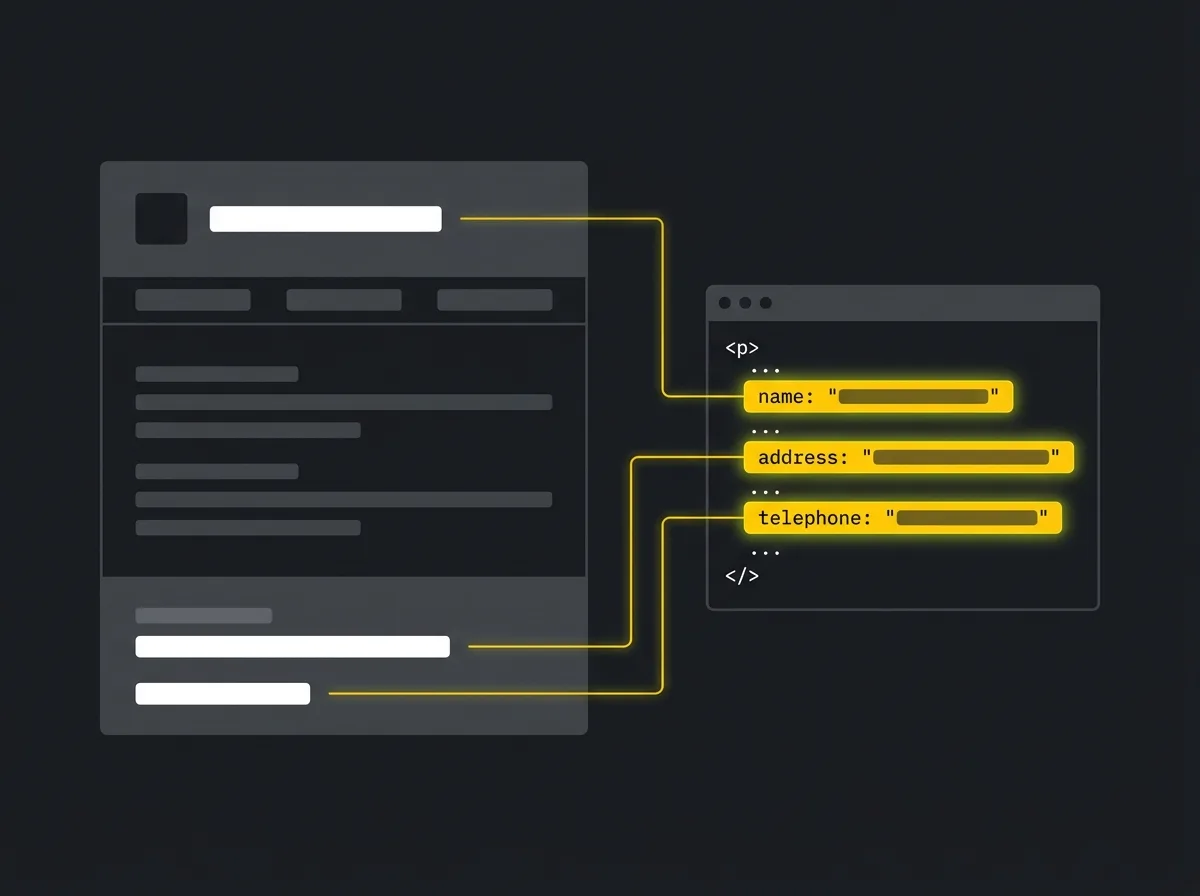
LocalBusiness schema markup is a structured data block in the website's code that explicitly tells search engines the business name, address, phone number, opening hours and service area. Think of it as a machine-readable business card embedded in the site. Most local business websites in the UK do not have it. If yours does not, this is one of the highest-value technical changes a developer can make.
NAP on-site should match the GBP listing exactly, down to the abbreviated versus full business name. The name, address and phone number should appear verbatim on the contact page and, ideally, in the site footer. Even small discrepancies create conflicting signals.
Location pages matter for businesses serving multiple areas. A separate page for "physiotherapist in Leamington Spa" and another for "physiotherapist in Stratford-upon-Avon", each with genuinely distinct content rather than duplicated text with the town name swapped, helps the website rank in those areas without needing a separate GBP listing for each one.
Domain authority and local links contribute to prominence. Inbound links from local news sites, a Business Improvement District, a sponsored local charity, an industry association — all of these build the kind of local authority that feeds into map pack prominence alongside the GBP profile. If the website has very few external links pointing to it, working with an SEO agency on a structured link-building programme will support map pack performance as much as it supports organic search.
Factor 7: activity signals, Google notices when you go quiet
A GBP profile optimised once and then left alone will gradually lose ground to competitors who keep engaging with it. Freshness signals reward active profiles.
Here's why.
Google Posts are short updates that appear in the knowledge panel: a seasonal offer, a recent project completion, a new service. Posting once or twice a month signals activity without requiring significant time. You do not need to post weekly. You do need to post more than twice a year.
The Q&A section, mentioned under profile completeness, also doubles as an activity signal. Checking quarterly that existing answers are still accurate, and responding promptly when new questions appear, shows the profile is monitored.
Photo updates tell a similar story. A profile whose most recent photos are eighteen months old looks dormant. A new set of photos every six to eight weeks — new work, a recent job, a team update — takes under thirty minutes and consistently places you ahead of the many competitors who are not bothering.
The minimum viable monthly routine: one Google Post, one new photo set, one scan of the Q&A section for anything that needs a response. The time investment is genuinely small. The differential between businesses doing this and those who are not is surprisingly large.
How to know if it's working
Making changes to your GBP and then checking your own position from your own device at your own address is not a reliable test. Google personalises results based on your search history and location. You will almost certainly see yourself ranking higher than a neutral nearby searcher would.
GBP Insights, the built-in analytics dashboard, is the first place to look. The most useful metrics are direct searches (someone typed your business name specifically) versus discovery searches (someone searched a category or service and found you). A rising proportion of discovery searches over time is the clearest signal that the relevance and prominence work is having an effect.
Direction requests and calls from the listing are the most useful leading indicators of real commercial activity.

Geolocation rank trackers such as BrightLocal, Local Falcon or Whitespark show your map pack position at multiple geographic points across your service area. The position shown when searching from one street is often meaningfully different from the same search conducted two miles away. A grid-level view is far more informative than a single-point check from the office.
Call tracking adds another layer if phone enquiries are an important channel. A unique number assigned specifically to the GBP listing lets you isolate enquiries that came through Maps, which makes it much easier to connect the ranking work to actual revenue.
Realistic timelines: in most competitive local markets, meaningful position improvement requires sixty to ninety days of consistent effort across several factors simultaneously. Fixing one thing in isolation rarely shifts position as meaningfully as making three or four changes in the same month.
The businesses we see stall are almost always the ones that made one change, waited three weeks, saw nothing dramatic, and stopped.
What to do first
If you are working through this without agency support, here is a sensible order of operations.
-
Category and profile completeness (Factors 2 and 3). These are the quickest wins and require no external actions, just time inside GBP. Primary category, secondary categories, business description, attributes, services, photos, Q&A seeded with common questions.
-
Review velocity (Factor 4). Set up a repeatable ask process this week and make it permanent. This is the single change that compounds fastest over the following months, and the gap between businesses with a process and those without becomes more pronounced over time.
-
Citation cleanup (Factor 5). Run an audit before building new listings. BrightLocal or Moz Local will surface the inconsistencies. Resolve mismatches before adding anything new.
-
Website signals (Factor 6). LocalBusiness schema, NAP on-site, location pages where relevant. These often require a developer, which is why they appear later in the sequence, but they are structurally important for sustained map pack performance.
-
Activity signals, ongoing (Factor 7). Build this into the routine from the start. One Google Post and one photo set per month takes less time than writing a single email.
If you would like to understand what improved Maps ranking could realistically mean for your specific business in terms of additional enquiry volume, the Traffic Projection Report models that out using your current search landscape and market conditions.
Free resource: Traffic Projection Report
See what search visibility could realistically deliver for your business in the next twelve months. We model your specific market and give you a projection based on current local search conditions, not a generic formula.
For businesses that want to hand this work to a specialist and see it done properly, our local SEO service covers the full picture: profile setup and ongoing management, citation building and cleanup, review strategy, website signals, and the activity programme that keeps the listing competitive.
Frequently asked questions about ranking higher on Google Maps
How long does it take to rank higher on Google Maps?
In most competitive local markets, expect sixty to ninety days before meaningful position movement is visible. The factors that respond fastest are primary category corrections, which can shift rankings within a few weeks, and review velocity, which builds steadily over three to six months of consistent collection.
Website signals and citation cleanup take longer to be reflected in rankings. The main reason businesses do not see results is abandoning the programme after three or four weeks, well before the changes have had time to compound and register.
Why is my competitor ranking above me on Google Maps?
The most common reasons are primary category choice (they have a more specific one that matches the search query more closely), review velocity (they are collecting reviews more consistently, even if your total count is similar), or profile completeness (their listing is simply better filled in across every field).
Distance plays a role if they are physically closer to the typical searcher in that area. Prominence gaps, usually reflecting stronger website authority or more consistent citations, can also account for a meaningful ranking difference. The quickest diagnostic is to open their GBP profile and compare primary category, review recency, and how complete their business description and service list are.
Do more reviews improve your Google Maps ranking?
Reviews contribute to prominence, one of Google's three ranking signals. Volume matters, but recency and consistency tend to matter more in competitive local markets.
A business collecting three or four reviews per month steadily over the past year will often outrank one that collected sixty reviews several years ago and has had almost nothing since. Keywords appearing naturally in the text of reviews also add relevance signals. Responding to reviews appears to be a positive engagement signal, though Google has not published an exact weighting for it.
What is the single most important Google Maps ranking factor?
Primary category is probably the highest-leverage individual change for most businesses because it directly drives the relevance signal and is so frequently set incorrectly. For businesses that already have the right category set, review velocity tends to be the most impactful ongoing factor.
Proximity is the one signal you cannot change, and it is rarely the actual reason a business is underranking within its genuine service area. If you can only do one thing today, log into GBP and check whether your primary category is the most specific, accurate option available for what you actually do.
That five-minute check is often where the gap sits.