
You're paying Rightmove close to £1,500 a month. Across town, a smaller agency keeps showing up in the Google map section every time someone searches for estate agents in your area. They are getting the call first.
This is the part that stings: that competitor may have fewer listings, a smaller team, a quieter shopfront. But they appear in the local pack before you do, and the vendor has already dialled them by the time they scroll far enough to find your Rightmove profile.
That gap is a local SEO problem.
Most portal-reliant agencies have never seriously addressed it. The three things that close it are a well-built Google Business Profile at branch level, area pages that say something real rather than repeating a template across twenty locations, and the citation infrastructure that quietly reinforces everything else. Working on local SEO for estate agents is not about replacing your portal spend. It is about building visibility that compounds rather than visibility that stops the moment a direct debit is cancelled.
Why estate agents need local search beyond their portal listings

Two categories of property search. Different platforms. Different objectives.
The first is listing search: "3-bed semi for sale in Worcester." Rightmove, Zoopla, and OnTheMarket own this category entirely. Buyers run these searches, and the portals have spent two decades building an unassailable position in them. Competing with Rightmove on your own website for listing queries is not a realistic goal.
The second is agency search: "best estate agents in Worcester," "estate agents near me," "who should I use to sell in [area]," "estate agent reviews [town]." These searches happen on Google. Portals do not rank for them. Nothing in your Rightmove profile puts you in front of a vendor deciding who to call for a valuation.
Vendors selecting which agent to instruct search on Google. Propertymark research on home-mover behaviour consistently shows that the overwhelming majority of vendors research agencies online before making contact. Your portal presence is irrelevant to that research stage.
The searches Google owns are precisely the ones where the instructions pipeline originates. A structured local SEO programme fills that gap. Portal spend does not.
How the Google local pack works for estate agents
The local pack is the map-based block of three businesses that appears above every organic result when someone types "estate agents in [town]" into Google. On a mobile device, it occupies most of the visible screen before a single organic blue link appears. For agency-selection searches, this is where the commercial race is won or lost.
Google ranks local pack results on three factors: relevance, proximity, and prominence.
Proximity cannot be changed. You serve the areas where your branches physically sit.
Relevance is controlled through your Google Business Profile. Primary category should be "Real Estate Agent," not a generic business type. Service areas should list every town and postcode the branch actively covers. The description should reflect the actual work the office does, whether that is residential sales, lettings, property management, or a combination.
Prominence is the signal Google uses for how trusted and established a branch is. Review volume, review recency, citation consistency, and website authority all feed into it. An office with 200 recent Google reviews and consistent NAP data across every relevant directory is considerably more prominent than one with 40 reviews and mismatched address formats scattered across the web.
Estate agents have a structural advantage in building review volume. Every completed sale or letting is a natural review-request moment. A post-completion email and text to the client within 48 hours, with a direct link to the Google profile, builds review counts faster than most industries can manage. BrightLocal's Local Consumer Review Survey consistently shows that review volume and recency are among the most decisive factors in whether a local business receives the first call from a prospective customer.
One GBP profile per physical branch. Not one brand-level profile. Four offices means four separately optimised profiles, each with local photos, local reviews, and the correct branch-level contact details. A single shared profile will not surface in local pack results across multiple towns.
Area pages: why most estate agents build them wrong
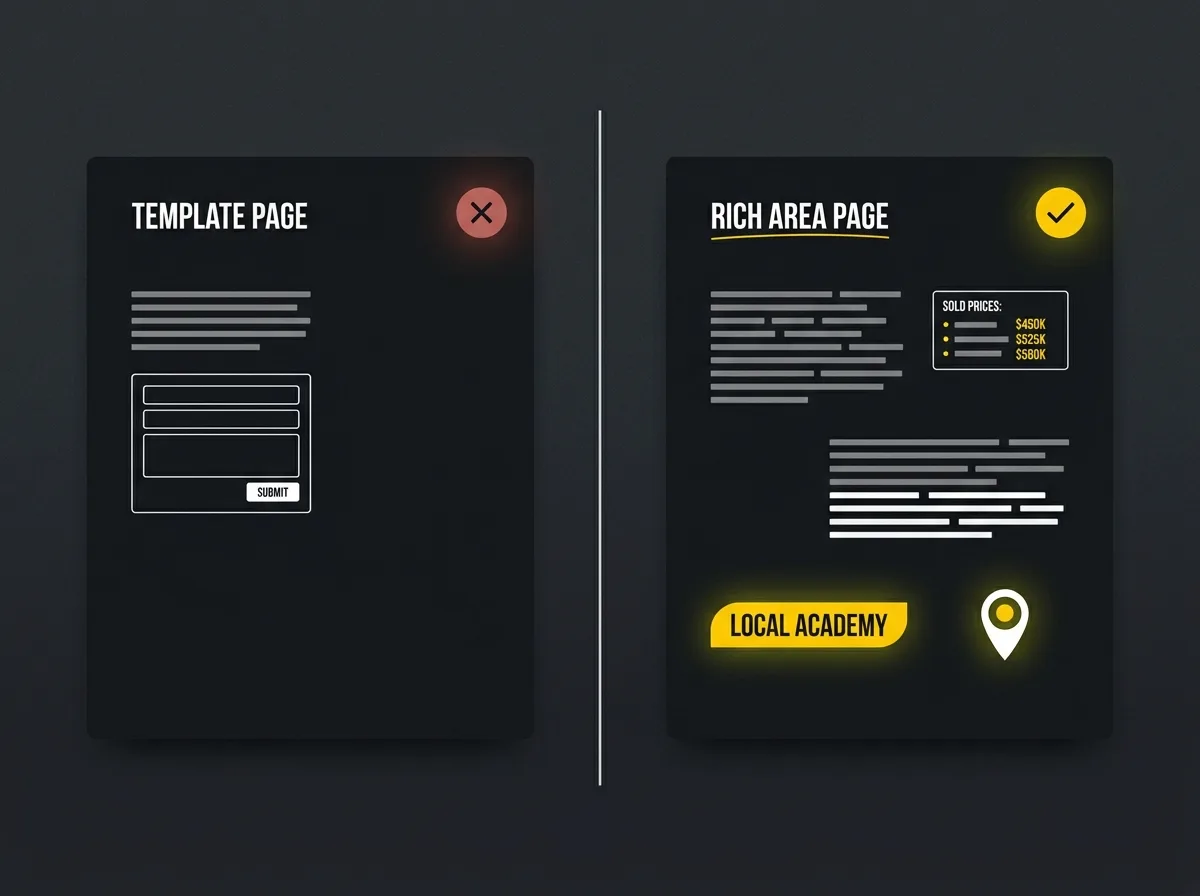
Most estate agency websites have area pages. Most of them rank for nothing.
The pattern is familiar: a page titled "Estate Agents in [Town]," a paragraph about how long the agency has been serving the area, a list of current properties pulled dynamically, a contact form at the bottom. Change the town name and the page is functionally identical to twenty others on the same site.
Google is not fooled.
Near-duplicate content at scale is a reliable signal that a site does not merit strong rankings. At best these pages are filtered from the index. At worst they dilute the authority of every other page on the domain.
What a useful area page looks like is different in kind, not just in length.
It contains original market commentary: current sold prices by property type, whether demand is running ahead of available stock, what the recent instruction pipeline has looked like in that area. It has area character: who the neighbourhood attracts, why people move there, what long-term residents cite as the reason they stay, what the transport connections mean for commuters. It names schools and gives current Ofsted ratings. It shows price ranges by street or postcode. It names the branch specialist who covers that territory and knows the market.
The test is simple: remove the agency name. Can a vendor reading the page tell you genuinely know the area?
If not, it is not a useful area page.
Freshness matters as much as the initial build. Market commentary goes stale. A page updated quarterly with fresh sold-price data and stock-level notes becomes a living record of local expertise. A page written in 2021 and untouched since then reads as a placeholder, because it is.
There is an AI search visibility dimension worth naming. When a homeowner asks ChatGPT or Perplexity which estate agent best understands a particular area, the answer draws from content that demonstrates genuine local authority. Thin, template area pages contribute nothing to that answer. Detailed, original, regularly refreshed pages give AI tools something concrete to cite. This is not a separate AI tactic. It is the same content standard applied with more care.
The economics of owned visibility versus portal subscription
A Rightmove subscription for a UK estate agent branch runs somewhere between £800 and £2,000 per month depending on the tier and the size of the operation. That is a significant annual commitment, and one that most agencies renew without much deliberation.
What it buys is legitimate: visibility in Rightmove's listing results when buyers search for properties. For buyer acquisition, portals work. They should stay.
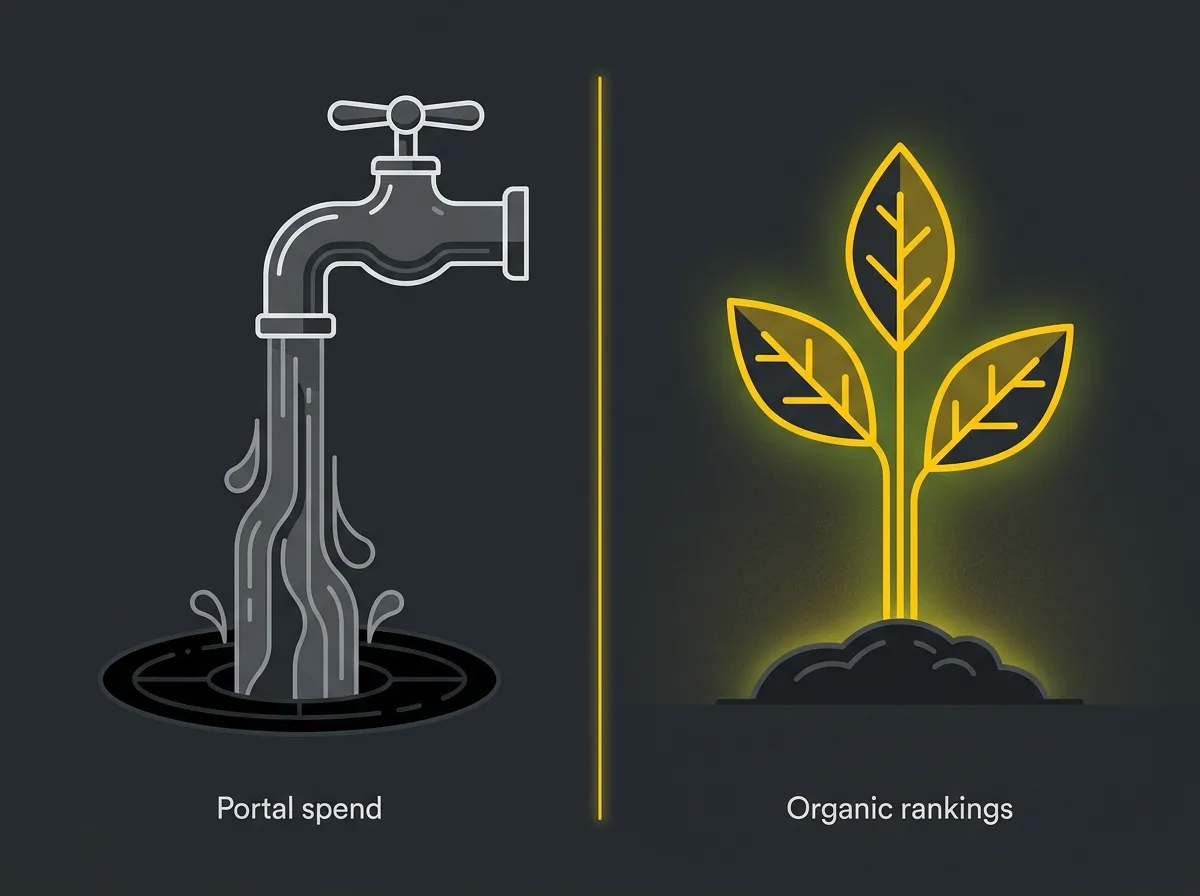
What they do not buy is any presence in Google. Portal subscriptions build Rightmove's domain authority, not yours. They do not appear in the local pack. They do not surface you when vendors and landlords run agency-selection searches. Cancel the direct debit and the visibility stops. There is no residual value.
An organic search strategy works differently. Rankings earned through area page content, a well-maintained GBP, and consistent citation infrastructure do not expire when the month ends. A page that ranks in March continues ranking in September. Reviews accumulated over three years keep driving prominence in year four.
It compounds.
The argument here is not "cancel Rightmove." Portals and local SEO serve fundamentally different categories of search. Portals catch buyers in the listing phase. Local SEO catches vendors and landlords in the agent-selection phase, which is where the instructions pipeline originates. Both channels have a job to do. Running only one of them means being invisible in half the pipeline.
Building the infrastructure: citations, links, and schema
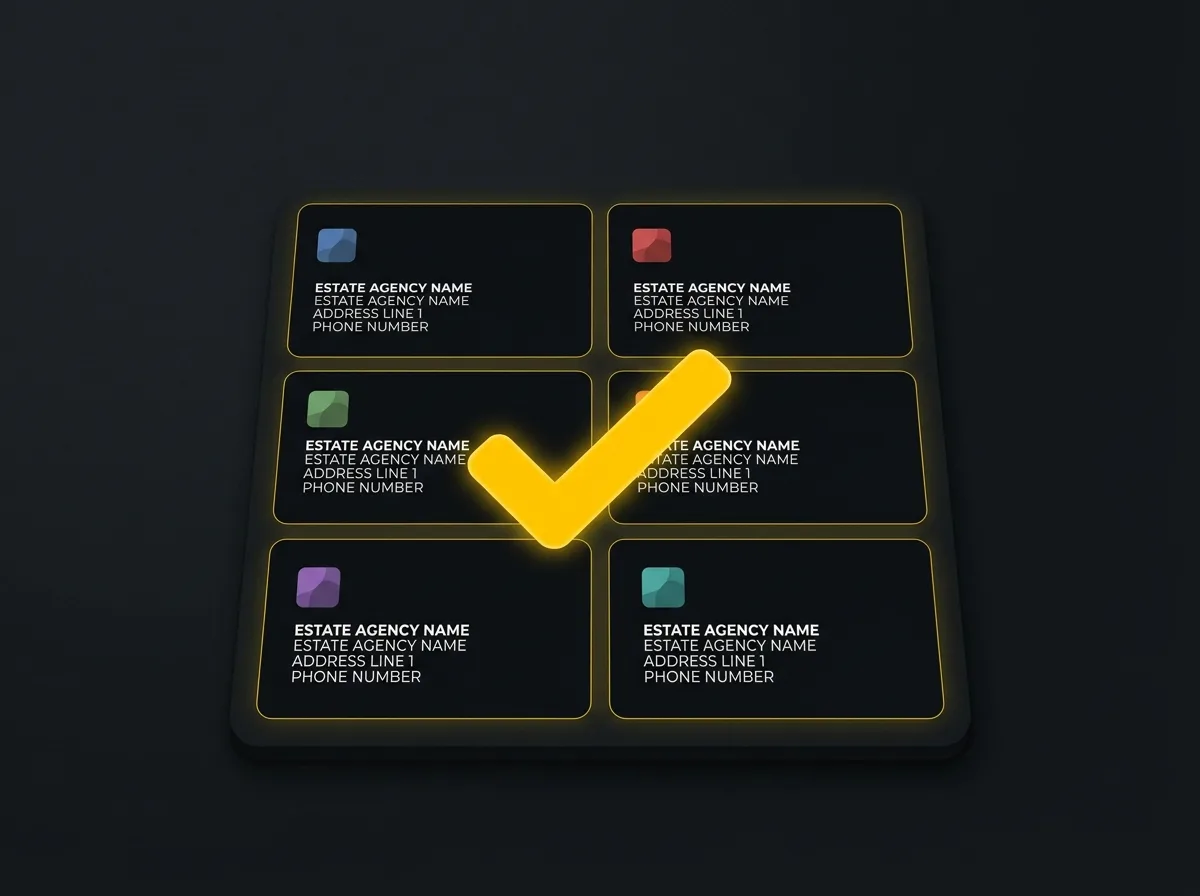
Behind the GBP and the area pages is an infrastructure layer most agencies set up once, set up badly, and then leave alone for years. Done well, it reinforces every other signal. Done poorly, it quietly fragments them.
NAP consistency. Agency name, address, and phone number must match exactly across every listing: your website, GBP, Rightmove, Zoopla, OnTheMarket, Yelp, Yell, Thomson Local, and any local authority or Chamber of Commerce directory where the branch appears. "Anytown Sales Ltd," "Anytown Sales," and "Anytown Sales Limited" read, to Google, as three separate businesses. Inconsistencies split your prominence signal and reduce it.
Priority citations for UK estate agents. Google Business Profile is the anchor. Rightmove and Zoopla both generate business profile pages as a side effect of your listing presence with them, which function as citations. OnTheMarket does the same. Beyond portals: Yelp, Yell, Thomson Local, and local authority directories complete the picture.
Local link building. Estate agents are naturally well positioned to earn local links. Property market movements are a regular feature in local press, and a branch manager quoted in a story about sold prices in the area earns a link from a credible local domain. Conveyancer and independent mortgage adviser content partnerships are another consistent route. If outsourcing link building is something you are considering, make sure the approach focuses on local relevance rather than generic content campaigns with no connection to the areas you serve.
Schema. LocalBusiness and RealEstateAgent schema on branch pages. FAQ schema on area pages and guide content. A one-time technical task with lasting benefit.
What to track and how long to expect results
Track local pack positions for target keywords by branch area. Manual incognito searches or a dedicated rank tracking tool gives you a baseline and shows movement over time. GBP Insights shows how many people found the profile by searching, requested directions, called directly, or clicked through to the website.
In Google Analytics 4, filter organic traffic by page path to isolate area page performance. Someone visiting your "estate agents in [town]" page already knows what type of business they need. That is low-funnel intent, and it shows up in contact rates.
Ask callers and form submitters how they found you. Still the most honest attribution data available.
Realistic timelines: GBP and citation improvements typically show visible movement in local pack rankings within six to twelve weeks of consistent effort. Area page authority takes longer. Expect three to six months before new content gains meaningful traction in organic search, then compounding from there. Agencies that built and maintained area page content consistently 18 months ago are seeing it contribute a material share of their vendor valuation requests now.
Frequently asked questions about local SEO for estate agents
How do estate agents appear in the Google local pack?
The local pack is determined by relevance, proximity, and prominence. Estate agents can influence relevance through their Google Business Profile by setting the correct primary category (Real Estate Agent), listing accurate service areas, and writing a description that reflects the branch's actual work. Proximity is fixed by the physical office location. Prominence is built through review volume and recency, citation consistency across directories, and website authority. A branch with a well-maintained profile, consistent NAP data everywhere it is listed, and a steady flow of recent reviews will rank in the pack for searches within its service areas.
What should an estate agent area page include?
A useful area page contains original market commentary covering current sold prices, stock levels, and demand trends; area character explaining who the area attracts and why; schools with current Ofsted ratings; transport links relevant to commuters; typical price ranges by property type; and a named branch contact. The test is whether a vendor reading the page could tell you genuinely know the area, with the agency name removed. Template pages that swap only the location name across 20 versions will not rank and actively undermine overall domain authority.
How long does local SEO take for an estate agent?
GBP and citation improvements typically show visible movement in local pack rankings within six to twelve weeks. Area page authority takes longer: expect three to six months for new content to gain meaningful traction in organic search, with results compounding from there as pages accumulate update frequency and link signals. Agencies that have built and maintained area page content consistently for 12 months or more commonly see organic search contributing a measurable share of their vendor valuation requests.
Is local SEO better than Rightmove for estate agents?
They are not competing tools. Rightmove is the right channel when buyers search for listed properties. Local SEO is the right channel when vendors and landlords decide which agent to instruct: searches like "estate agents near me," "best estate agent in [area]," and "estate agent reviews [town]." Portals cannot rank for these queries. Agencies that treat the two as complementary channels with different jobs tend to have the most complete vendor enquiry pipeline.
Do estate agents need a separate Google Business Profile for each branch?
Yes. A single brand-level profile will not surface in local pack searches across multiple towns and service areas. Each physical office needs its own GBP with the branch address, local phone number, and branch-specific photos and reviews. It requires more maintenance than a single shared profile, but it is the only structure that delivers local pack visibility in every area you actively serve.
The agencies already showing up above you did something deliberate
They built area pages with real content, not templates. They asked every vendor and tenant who completed to leave a Google review. They made sure their name, address, and phone number appeared identically everywhere online.
None of that is a trade secret. None of it requires an unusual budget.
The agencies that started 18 months ago are compounding those efforts now. Starting today means seeing the same effect 18 months from now.
If you want to understand where your current local search visibility stands and what a structured programme could realistically deliver, the Traffic Projection Report gives you a clear picture: where you rank now, what the available traffic looks like, and what it would take to capture more of it. Specific to your branch areas, with no obligation attached.
Free resource: Traffic Projection Report
See where your estate agency's local search visibility currently stands and what a structured programme could deliver. Takes a few minutes to request; shows you the gap and the opportunity in plain figures.