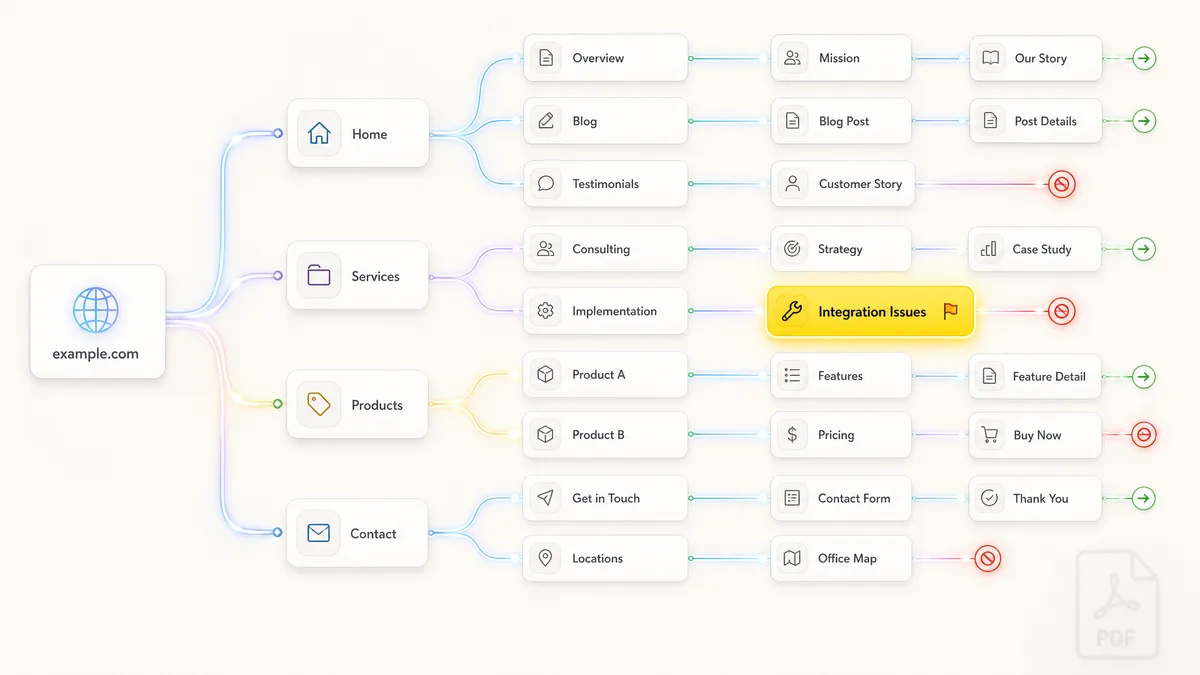
The report arrives in your inbox on a Thursday afternoon. Sixty-three issues. Four pages of colour-coded spreadsheet. A polite email from the agency asking if you have any questions.
You do not know where to start. Nobody told you which three of those sixty-three issues are actually stopping your site from ranking.
Sound familiar?
That is the experience most business owners have after commissioning a technical SEO audit. Not because the findings are wrong. Because nobody translated them into something you can act on.
This post covers what a technical audit actually examines, what a quality one looks like, what it realistically costs in 2026, and what should happen after the report lands. Think of it as the briefing you read before commissioning one.
What a technical SEO audit actually is
A technical SEO audit is a structured assessment of the infrastructure layer of your website: the settings, architecture, and performance signals that determine whether search engines can find, access, and understand your content. It does not look at what you are saying on the page (that is a content audit) or who is linking to you from other sites (that is a backlink audit). It looks at whether the technical foundations are solid enough for your content and links to do their job.
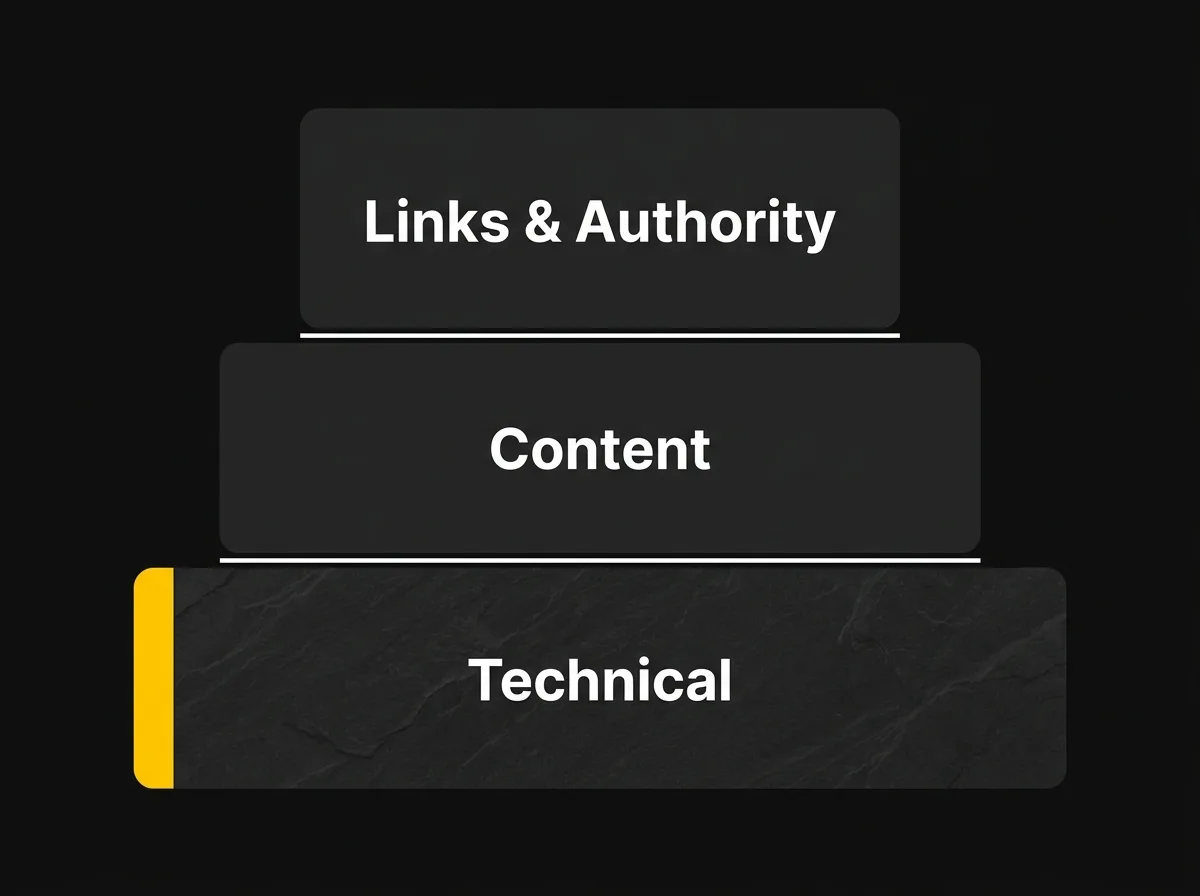
Think of SEO in three layers. The technical layer is the foundation. Content sits on top of it. Links and authority sit above that. Most SEO advice, the keyword strategies, the content plans, the outreach campaigns, operates somewhere in the top two layers. The foundation gets less attention, and problems accumulate there quietly.
Pages that cannot be crawled cannot rank. Full stop. The audit's job is to find those problems before they silently cost you traffic for months.
For a closer look at how site structure affects both crawlability and rankings, getting your website structure right covers the architecture side in depth.
The main areas a technical audit covers
This is the section that usually becomes a 47-item spreadsheet. Here is what those items are actually checking for, in plain English.
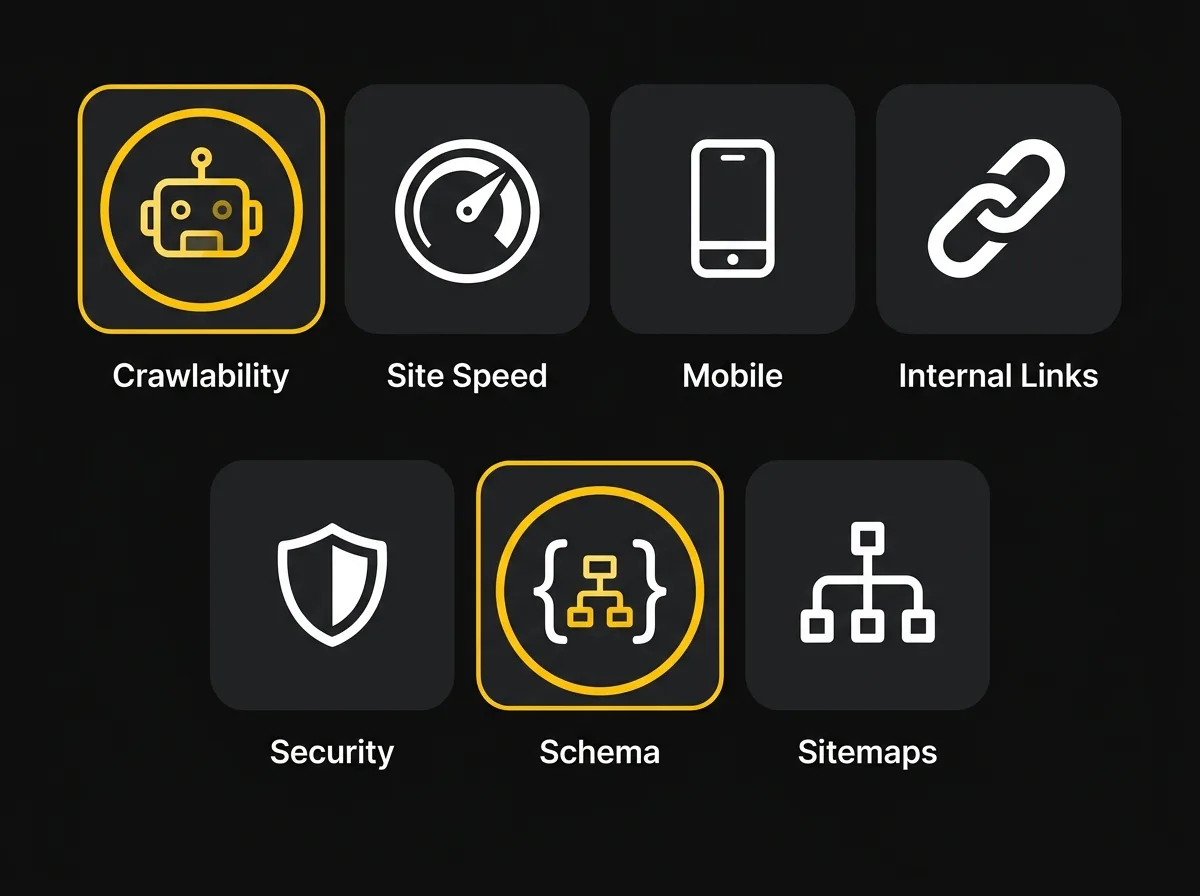
Crawlability and indexation. Crawlability is whether search engines can reach and read your pages. Indexation is whether Google has then included those pages in its search results. Problems here are the most serious category. According to Google's own documentation on how it crawls the web, Googlebot follows links and reads page code to understand what a site contains. A file called robots.txt governs which areas it can access. The most common mistake on SME sites: inadvertently telling Google not to crawl the very pages you most want it to rank. Service and product category pages are the most frequent casualties.
Site speed and Core Web Vitals. Google has three official measures of page experience, known collectively as Core Web Vitals: how quickly the main content loads (Largest Contentful Paint), how quickly the page responds to a user's first tap or click (Interaction to Next Paint), and how much the layout shifts while the page is loading (Cumulative Layout Shift). A slow site does not just frustrate visitors. It affects how Google scores your pages against competitors in the same search results. Critically, Google measures the mobile version first, so a page that loads in two seconds on a desktop but takes seven on a phone is being judged on the seven-second version.
Site architecture and internal linking. This covers the logical hierarchy of your site and whether the links between pages are directing authority where it needs to go. A common finding on sites that have grown organically over several years: pages that are important for SEO have very few internal links pointing to them, so search engines have little reason to treat them as significant within the site.
Mobile usability. Google uses what it calls a mobile-first index, meaning the mobile version of your site is the primary version it crawls and indexes, not the desktop version. A site that works well on a large screen but breaks, overlaps, or loads slowly on a phone is penalised at the indexation level, not just the user experience level.
Redirects, canonical tags, and duplicate content. A canonical tag is a signal in your page code that tells Google which URL is the definitive version when the same content is accessible under more than one web address. When canonical tags are missing, misconfigured, or pointing at a staging URL rather than the live site, Google either ignores them or makes its own decision, which is sometimes the wrong one. Redirect chains, where one URL redirects to another that redirects to another, dilute the authority flowing through the chain and slow the page down.
Structured data and schema markup. Schema markup is code added to a page that helps both Google and AI platforms understand what the page is about in precise, machine-readable terms. A page with properly implemented schema can appear in Google's rich result formats, including FAQ panels and People Also Ask sections. There is a direct connection to AI search here: AI platforms including ChatGPT and Google's own AI features use structured page signals when deciding which sites to read and recommend. A technically clean site with well-implemented schema is not just easier for Google's crawler; it is easier for AI tools to understand and cite.
XML sitemaps and robots.txt. The XML sitemap is the list you hand to search engines of every page you want them to visit. The robots.txt file sets the access rules. Mismatches between the two are more common than you might expect: a page listed in the sitemap as important but blocked in the robots.txt file is sending two contradictory signals to every crawler that arrives.
What the findings usually look like in practice
Most business sites have technical issues. Very few have anything catastrophic.
The typical site with 50 to 200 pages has a mixture of smaller problems rather than one spectacular blocker. Common findings include: service pages set to noindex in error (meaning Google cannot include them in results); slow mobile load times on key conversion pages; internal links pointing to pages that have since been redirected, creating chains that waste link equity; schema markup that is missing or contains validation errors; pages present in the XML sitemap but blocked in the robots.txt.
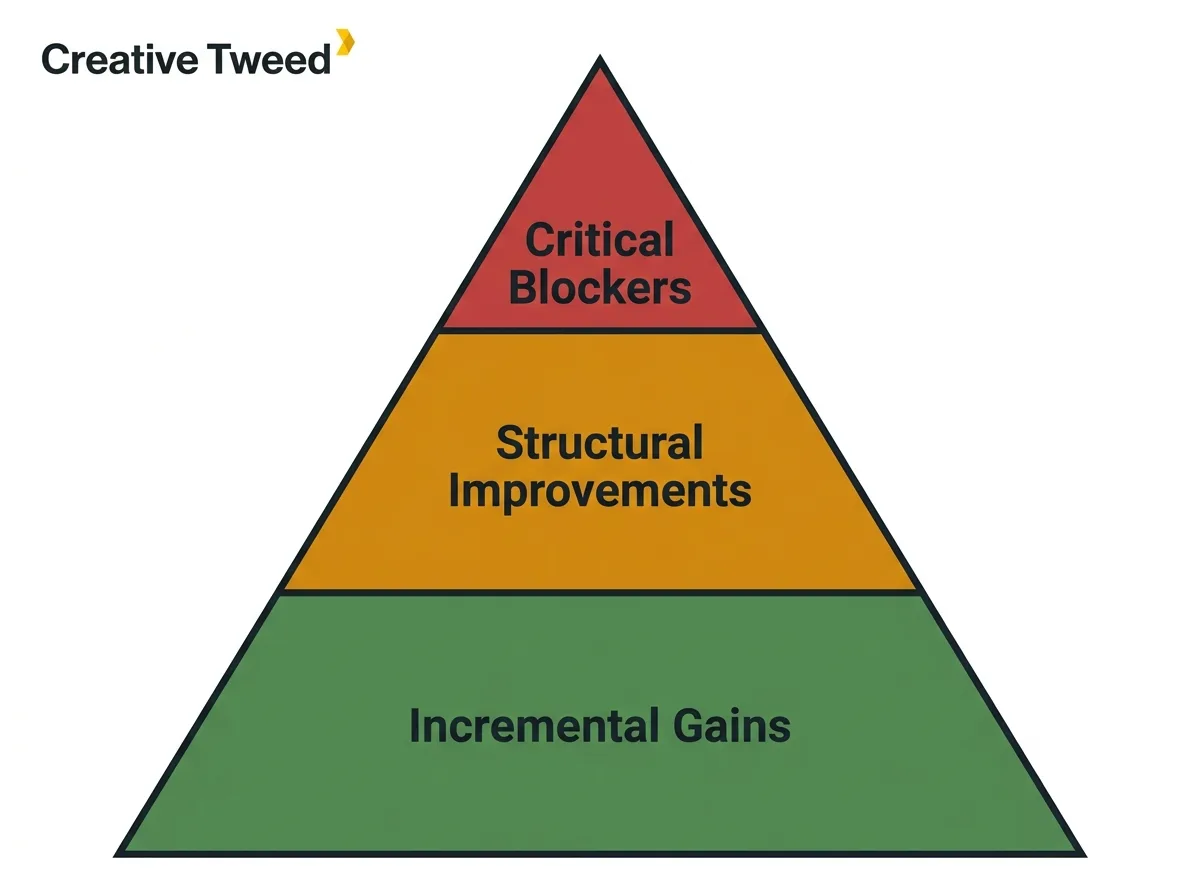
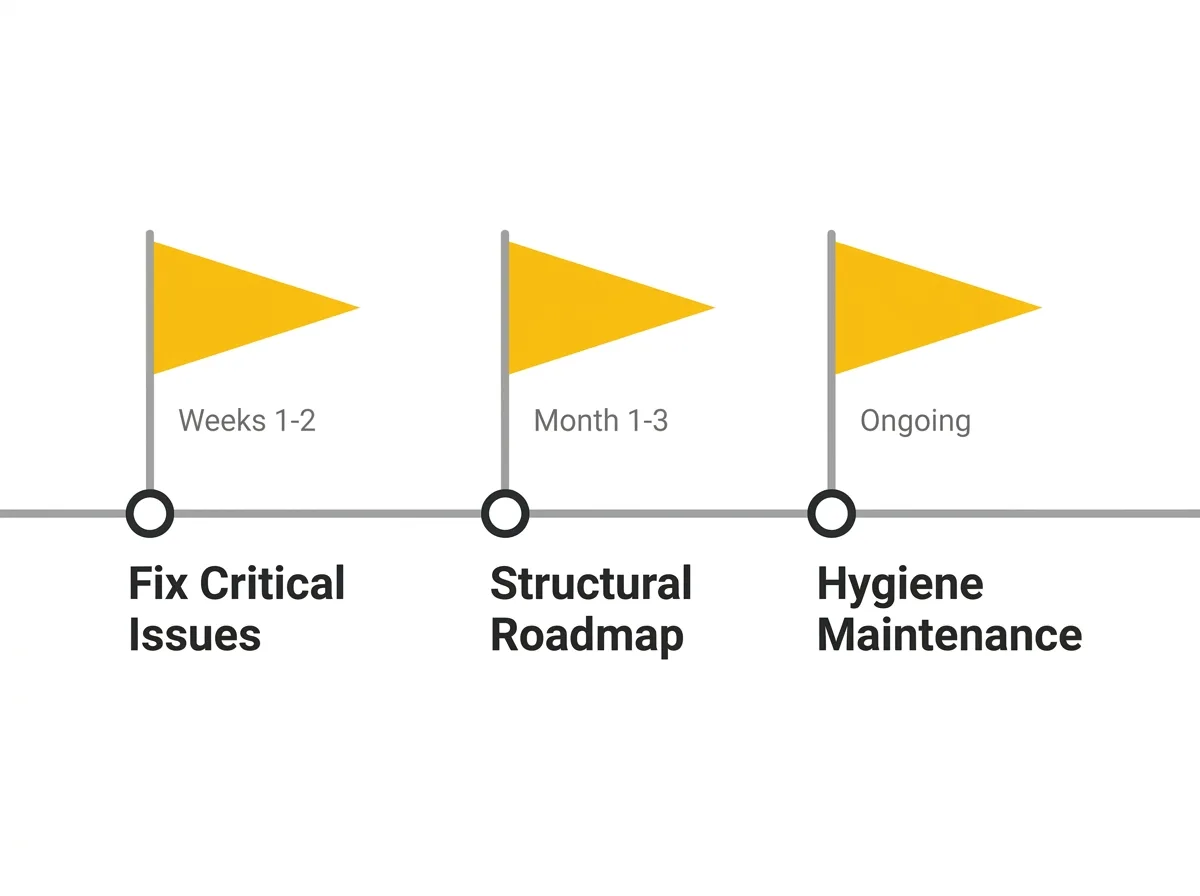
The prioritisation principle matters more than the length of the list. Three tiers. Not sixty equal items.
Critical blockers are issues that actively prevent pages from being indexed or ranked. These need addressing in the first couple of weeks. One scenario we see on sites that have recently gone through a rebuild: the developer left the noindex setting active from the staging environment once the site went live, meaning the entire site had been quietly telling Google to ignore it for months without anyone noticing. That is a blocker.
Structural improvements are issues that are costing the site somewhere in the region of 10 to 20 percent of its potential traffic. They do not need emergency treatment, but they belong in a planned one to three month remediation roadmap.
Incremental gains are ongoing hygiene: image compression, resolving minor redirect chains, schema enhancements, improving internal link anchor text. These accumulate meaningfully over time. They do not belong in the urgent pile.
A report that presents all three tiers as equally urgent is not helping you prioritise. It is just transferring the problem from the agency's desk to yours.
What should happen after the audit — and why most do not deliver it
An audit is a diagnosis, not a treatment.
You would not accept a medical scan that listed sixty readings without a clinician explaining which three actually need attention. The same principle applies here. A 60-issue spreadsheet emailed over with no conversation, no prioritisation, and no guidance on who is supposed to do what is not a deliverable. It is raw data with a bow on it.
What a quality audit report actually contains is quite specific. There should be a non-technical executive summary that a business owner can read in five minutes and come away with a clear sense of the site's health. Issues should be grouped by impact tier, not alphabetically or in the order a crawl tool happened to flag them. Each issue should have clear implementation guidance identifying who needs to act: the developer, the SEO team, or the content manager. And there should be some indication of the effort involved relative to the expected benefit, so you can make sensible decisions about sequencing.
What a low-quality audit looks like is also quite specific. It is usually a site crawler export emailed over with no narrative, no prioritisation, and no walkthrough meeting to go through the findings together. Any agency that delivers a spreadsheet and then goes quiet has given you data without insight.
There is also the implementation question, which is the one most people forget to ask before they commission. Who is going to fix the issues? An audit from an agency that does not offer implementation support leaves you holding a list with no one to action it. Ask upfront whether the relationship ends at report delivery or continues through the remediation.
Some technical issues are one-time fixes: rewriting a robots.txt error, correcting canonical tags, fixing a redirect chain. Others, like Core Web Vitals scores, crawl health, and indexation, need ongoing monitoring as the site grows and changes. A quality audit acknowledges this distinction rather than treating the engagement as complete the moment the PDF is sent.
If this is your first serious look at your site's SEO foundations, building an SEO strategy is worth reading alongside this post. The audit tells you where you are. The strategy is what you build from there.
How much does a technical SEO audit cost in the UK?
The range is wide and the variation is real, not arbitrary. Here is what the different price points actually get you.
Sub-£500. This territory is almost always an automated tool crawl with minimal human interpretation. The software scans your site, flags issues against a standard checklist, and produces a report. There is nothing wrong with knowing that is what you are buying. If you want a quick sense of whether anything serious exists on a small site, an automated report can tell you that. What it cannot do is tell you what to prioritise, how serious each finding is in the context of your business, or who should do what and in what order.
£800 to £2,500. This is where genuine expert-led audits for most SME sites sit. At this level, you are paying for a person to review the findings in the context of your specific site, prioritise them sensibly, and deliver a report you can act on, alongside a walkthrough meeting to go through it together. For a site of 50 to 500 pages with standard technical complexity, this is the right range to budget for.
£3,000 and above. Enterprise sites, international sites with hreflang complexity (multi-language or multi-region URL structures), sites about to go through a major migration, or audits that include competitive benchmarking and traffic modelling sit at this level. The complexity is real and the price reflects it.
Four questions worth asking before you agree to any audit. Is the deliverable a raw data export or a prioritised recommendations report? Who is doing the analysis, a person or a tool? Does the fee include a walkthrough meeting? Is implementation support available or included after delivery?
Worth knowing: a £300 audit that generates 200 items nobody implements costs more in the long run than a £1,500 audit with a clear action plan and someone to carry it out. The cheap audit that gathers dust is the expensive one.
Getting real value from an audit
Before you commission anything, a small amount of preparation makes a significant difference to what you get back.
Pull your Google Search Console data if it is set up. A good auditor will read it alongside the crawl. If you have an upcoming redesign, URL changes, or content expansion planned, flag it upfront so the audit prioritises around your actual plans rather than an assumed steady state.
Once you have the findings, resist the instinct to act on everything at once. Fix critical blockers in the first two weeks. Build structural improvements into a one to three month plan. Treat incremental gains as standing monthly maintenance.
The audit is not the product. The organic traffic and enquiries are the product. The audit is the diagnostic that points you toward the right fixes.
If you want a directional view of what your traffic could look like with a proper SEO programme in place before you commit to any investment, the Traffic Projection Report is the right starting point. It gives you the commercial case before you spend anything on the diagnostic.
Frequently asked questions about technical SEO audits
What does a technical SEO audit cover?
A technical SEO audit examines the infrastructure layer of your website: whether search engines can find and access your pages (crawlability), whether those pages are included in search results (indexation), how quickly and stably they load (Core Web Vitals), how the site is structured and internally linked, whether schema markup is correctly implemented, and whether your XML sitemap and robots.txt are configured consistently. It does not cover the content on your pages or the links pointing to you from other sites.
How long does a technical SEO audit take?
For a typical SME site of 50 to 200 pages, an expert-led audit takes five to ten business days from access to delivery, including crawl time, manual analysis, and report preparation. A walkthrough meeting usually follows. Automated tool-only reports can turn around in 24 to 48 hours, though the depth and usefulness of what you receive is very different.
How much does a technical SEO audit cost in the UK?
Prices range from under £500 for automated tool exports to £800 to £2,500 for expert-led audits of most SME sites, and £3,000 or more for enterprise sites or complex migrations. The meaningful difference is whether you receive human analysis with prioritised recommendations and a walkthrough meeting, or a raw data report emailed without context.
What should happen after a technical SEO audit?
The report should include a plain-English executive summary, issues grouped by impact tier (critical, structural, incremental), implementation guidance identifying which items need a developer versus an SEO versus a content manager, and a sense of effort against expected benefit. After delivery, critical blockers should be addressed within two weeks. Structural improvements belong in a one to three month roadmap. Incremental hygiene items are ongoing maintenance.
Do I need a technical SEO audit if my site is already ranking?
Probably yes, though not necessarily urgently. Technical issues accumulate as sites grow, new pages are added, and CMS plugins are updated. A site ranking today can develop problems that quietly cap its potential without being obvious from traffic data until months later. If your site has not had a proper technical review in the last two years, or you are planning a redesign or migration, commissioning one before work starts is almost always worth the cost.
The part most audits miss
Most technical SEO audits end in a PDF in a downloads folder not because the findings are wrong, but because nobody connected those findings to a clear plan of action, and nobody asked who was going to do the work.
The value is in the implementation. An auditor who diagnoses and then disappears has given you half a service.
If you want to understand what an SEO programme could mean for your business before committing to an audit, why an SEO strategy matters covers the commercial case. And if you are ready to work with a team whose SEO services are built around implementation rather than just diagnosis, that is where we start.
A free directional view of your site's organic traffic potential. Before you commission an audit, see what the numbers could look like with the right foundations in place.